Category Archives: Philosophy

Reading and Talking

Reading a book as if it had “no introduction, no notes, no aids or guides, no nothing but the naked text” (as William Deresiewicz puts it): such a reading seemed to need a defense. Here is my elaborate one, which seemed in the end to fall into nine sections as summarized below.

Let me note first that searching on “ahistorical reading” led me to a textbook chapter called “What Is Ahistorical Reading?” (in Intro to Poetry, by Alan Lindsay and Candace Bergstrom). The chapter seems to say well what every high-school graduate ought to know, though unfortunately they may not in fact. If you don’t want to slog through what I wrote, read that.

1. Some Novels and Novelists.
These may be read in school or for pleasure – mine, or that of writer and blogger Hai Di Nguyen. There can be epics such as War and Peace, Moby-Dick, and Zen and the Art of Motorcycle Maintenance. George Steiner finds the last two comparable. There can be an unreliable narrator.
2. Reading Comprehension.
This may be challenged by some poetry, such as Wordsworth’s, and annotations may not help.
3. Reading Without Preconceptions.
St John’s College accustomed me to this.
4. Reading Groups.
There are many that (thanks to the Catherine Project) I have been able to join and enjoy, all pursued in the St-John’s way as I understand it.
5. Story.
Mythos or logos. We inevitably tell it in our own words (unless perhaps somebody else has fed us the words).
6. Giving What Is Wanted.
“Ask me no questions, and I’ll tell you no fibs.” (To Goldsmith’s comedy She Stoops to Conquer, the saying is traced by Grammarist, which however has “lies” for “fibs”; Wikipedia currently repeats this apparent misquotation, citing Grammarist.) People are trained now to give most of their attention to their mobiles; in school we may be trained to supply what teachers want to hear.
7. Historicism.
I continue not to understand the objection of Leo Strauss to the “historicism” of R. G. Collingwood, but I agree with such ahistorical reading as is practiced at St John’s and was defended in my day (as I recall) by Strauss’s student and my teacher, David Bolotin.
8. The Classics.
There is something to be said for being assigned to read what one might not otherwise. My example is John Donne.
9. Re-Enactment.
Collingwood came to understand history as the re-enactment of thought, but this can be misunderstood, either when reading a poet such as John Donne, or when thinking of a certain major general who happened to read poetry while getting ready for battle.

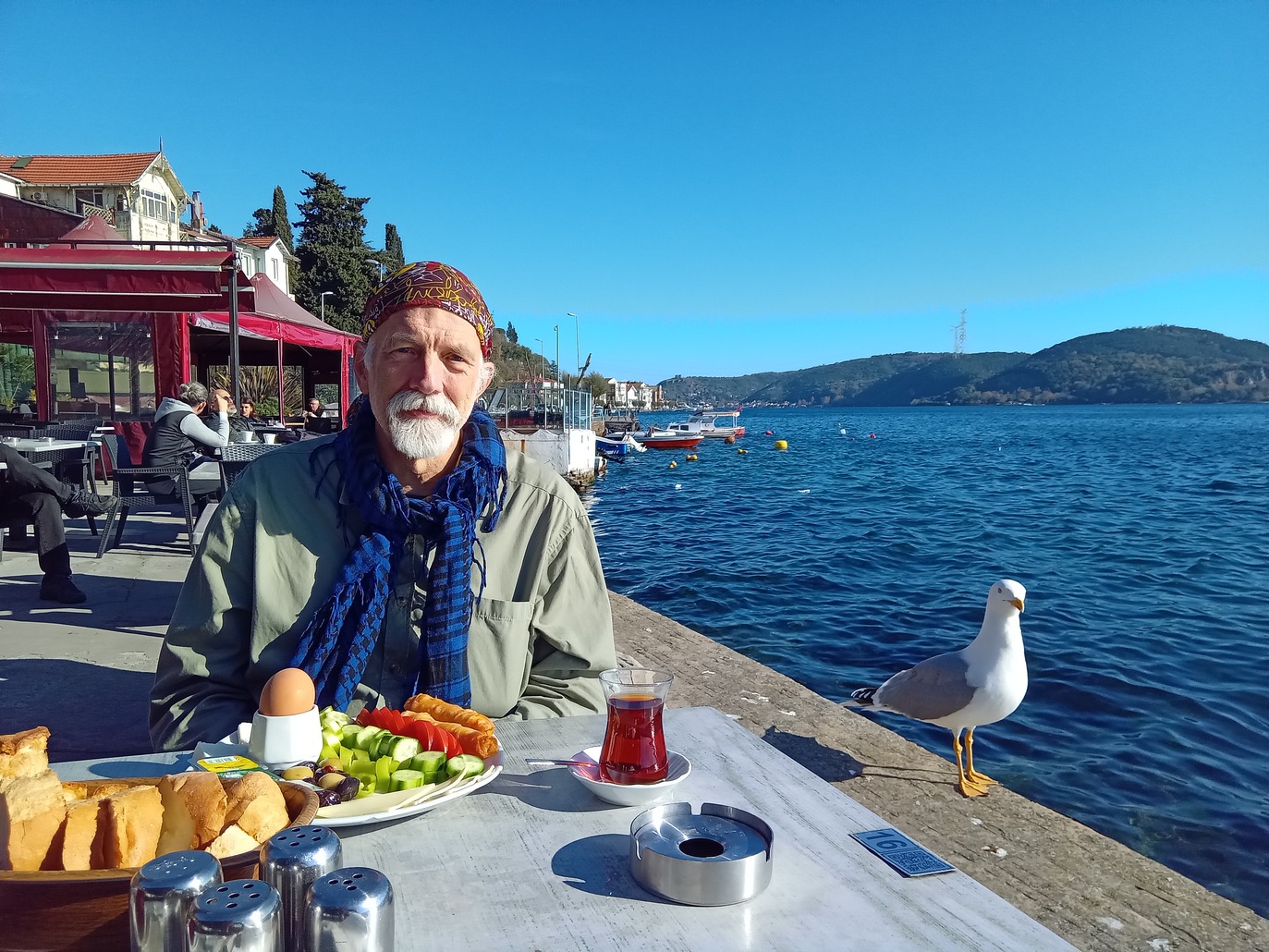
Seaside on a sunny day. Seagull, and human with tea and breakfast plate in front of him

Beyazpark Liseliler Kafe
Sarıyer, Istanbul
November 25, 2025

Continue reading

Motion and Rest

This is mostly about Goethe’s Faust, but it was not going to be. Faust says he never wants to sit still. It doesn’t seem like a great idea.

Parthenon

Athens, Monday, July 10, 2017

If, as Wikipedia now mentions, and John Warner discusses in the fittingly titled “That’s Not What Lolita Is About” (November 16, 2025) – if Elisa New recommended that Jeffrey Epstein read Lolita (which I have read) and My Antonia (which I haven’t), why not Faust?

Continue reading

The System

After sitting behind his father on a motorcycle for a day, and riding through a thunderstorm, Chris Pirsig wants to tell and hear ghost stories. He asks whether his father believes in ghosts.

Clear blue sky above; below, a sand beach, with a strip of sea visible; on the left, a brick road parallel to the shore passes in the distance through trees

Altınova, September 10, 2025

Continue reading

Gödel and AI

To prove that no recursive theory of addition and multiplication of the counting numbers can be complete, Gödel relies on the distinction between the subjective and the objective. I suggested this in “Subjective and Objective,” while noting also that, for a computer, all is subjective.

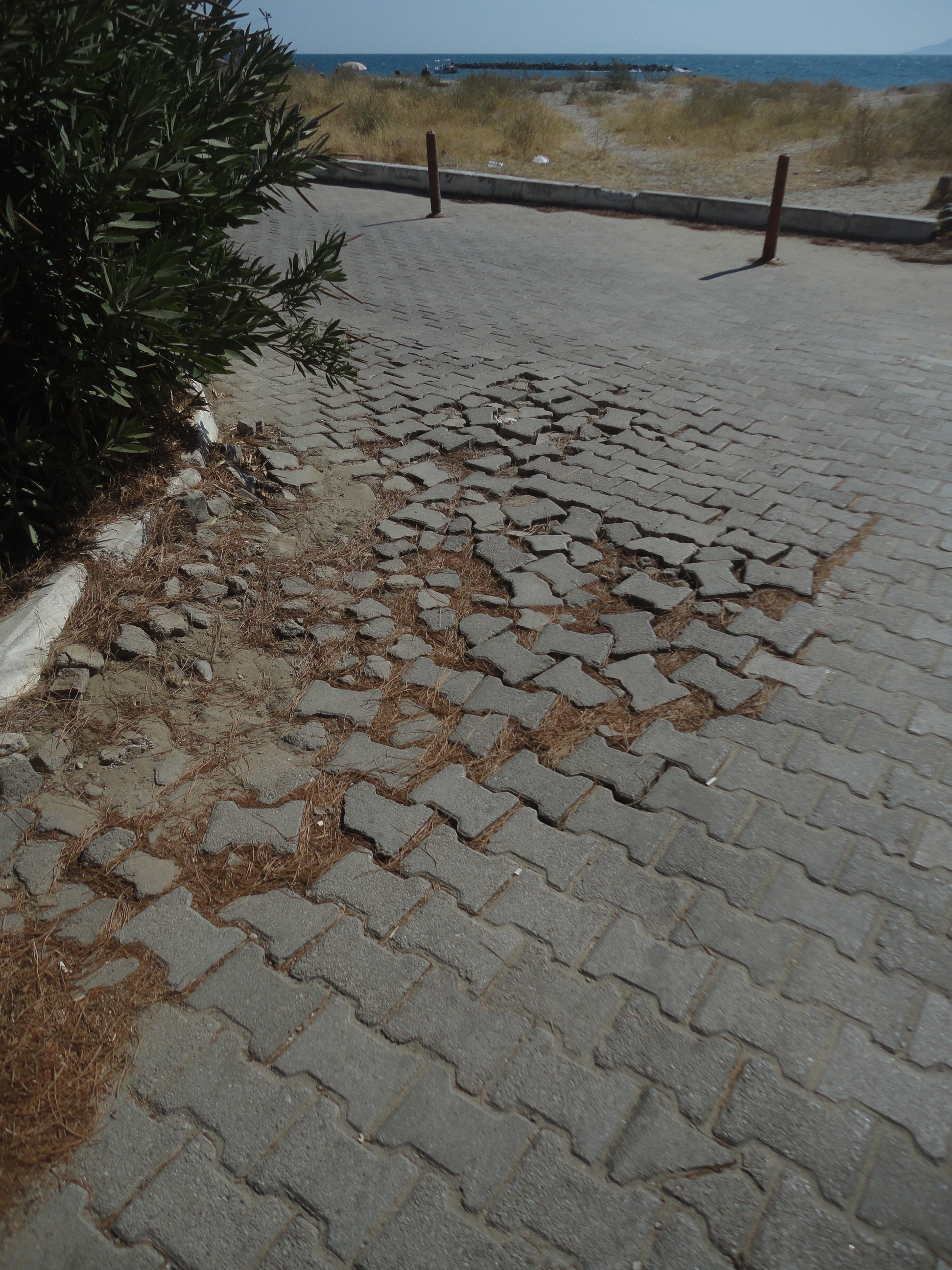
At the inner corner of a street, interlocking bricks break out of their pattern

Incomplete pavement
Altınova, Ayvalik, Balıkesir
September 9, 2025

Continue reading

Artificial Language

TL;DR: AI writing is like human writing. Of course it is, since its model is human writing. But then what AI produces is like bad human writing.

My sources include Plato, Wendell Berry, George Orwell, E. B. White, William Deresiewicz, Hadley Freeman, Andrew Kay, Kenneth G. Crawford, Hollis Robbins, Yuval Noah Harari, William Egginton, Megan Fritts, and Vi Hart.


About preparing certain seeds for human consumption in an infusion:

For sensory attributes, I’m admittedly Platonic and believe that since coffee is a fruit, it should taste something like a fruit. (And it’s not just any fruit – it’s a cherry!) My roasting philosophy comes from the same conviction. Generally, I’m after bright, juicy, fruity, syrupy goodness.

Thus Caleb Bilgen, founder of Ánimo Coffee Roasters in Asheville, North Carolina.

          ⯅          

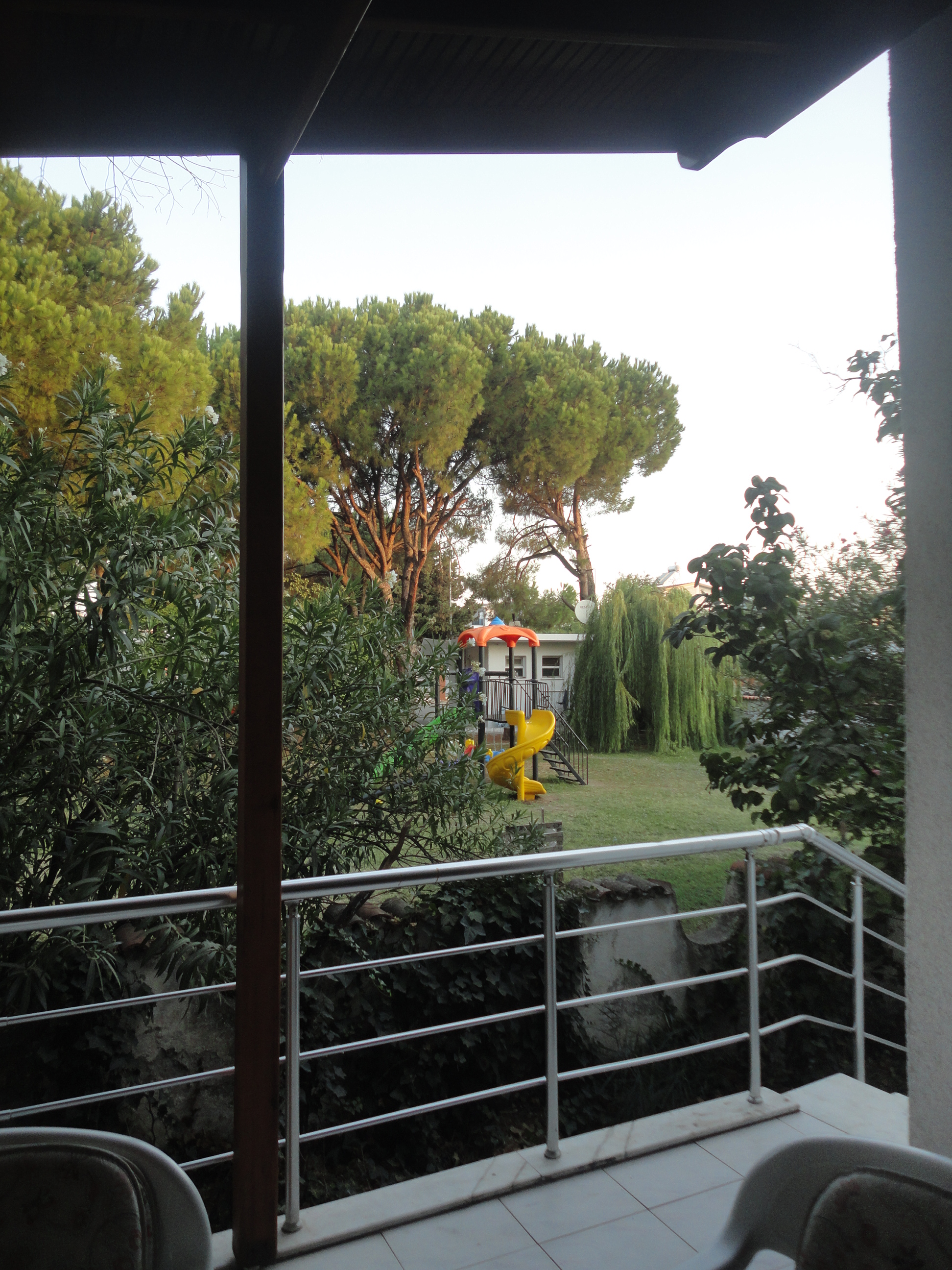
From a terrace beneath an awning, a low wall obscured by ivy, oleander, and quince; on the other side, a lawn with a jungle gym; beyond this, a weeping willow and a small white house beneath umbrella pines

What I see as the sun rises
Altınova, Ayvalik, Balıkesir
September 5, 2025

          ⯆          

Continue reading

Prairie Life

I’m going to make some comparisons here, even some likenings, mainly between

  • Robert Pirsig, Zen and the Art of Motorcycle Maintenance (1974), especially chapter 2, and
  • Wendell Berry, “Conservation is Good Work” (Sex, Economy, Freedom & Community, 1993; reprinted in Essays 1993–2017, Library of America, 2019).

Pirsig recounts a motorcycle trip west from Minnesota across the prairie. The riders pass through Yellowstone National Park, but Pirsig does not like it. At least his former self did not like it. This is in chapter 12 of ZAMM:

The guided-tour attitude of the rangers angered him. The Bronx Zoo attitudes of the tourists disgusted him even more … It seemed an enormous museum with exhibits carefully manicured to give the illusion of reality, but nicely chained off so that children would not injure them.

For Berry, such parks set the wrong standard for what should be conserved:

Right at the heart of American conservation, from the beginning, has been the preservation of spectacular places. The typical American park is in a place that is “breathtakingly” beautiful or wonderful and of little apparent economic value. Mountains, canyons, deserts, spectacular landforms, geysers, waterfalls – these are the stuff of parks. There is, significantly, no prairie national park.

I do see that Tallgrass Prairie National Preserve was created in Kansas in 1996.

A number of roses in three groups on canes sharing a root, against ground covered with pine needles; the shadow of a tree trunk divides the scene diagonally

Roses in the garden
Altınova, Ayvalik, Balıkesir
September 2, 2025

Continue reading

Omniscience

I have been working on a post that could have been the result of the following prompt:

Write on Gödel’s Incompleteness Theorem and AI, using such thinkers as

  • Yuval Noah Harari (b. 1976),
  • William Deresiewicz (b. 1964),
  • Annie Dillard (b. 1945),
  • Roger Penrose (b. 1931),
  • Robert Pirsig (1928–2017),
  • George Orwell (1903–50),
  • E.B. White (1899–1985),
  • Michael Attaleiates (c. 1022–80), and
  • Plato (fl. 4th cent. b.c.e.).

Not until I had finished a first draft did I actually know that all of those people would feature. My real prompt had been more like,

In the style of David Pierce, write on Gödel’s Incompleteness Theorem and AI, as discussed by Roger Penrose in his “Précis of The Emperor’s New Mind.

So instructed, could an LLM have come up with the connections that I did? Well, sure. Anything that has happened, could have happened, even in some other way. The real question is whether I would want AI to write my next post.

The present post consists of things I wanted to say at the beginning of that other post, after I had a first draft.

          ⯅          

Note added September 27, 2025. The next post after this one was

  • Prairie Life,” comparing Robert Pirsig and Wendell Berry, because I was reading them both.

After that came the two posts that the draft mentioned above turned into:

After those came

  • The System,” on what was bothering Pirsig; this led me to the resurgence of fascism today.

I was trying to work all of this out in the place in the photo below.

          ⯆          

Two tall bushes, lit up by the sun, rise in front of a low wall, next to a pine trunk; crowns of pines behind

Laurels in the garden
Altınova, Ayvalik, Balıkesir
September 2, 2025

Continue reading

Courage

Below is my essay on courage, first drafted in April of last year (2024). A reason to think of it now is a recent pair of essays, coming from the United States:

The latter takes up all of the virtues that Socrates does.

Plato didn’t get everything right, but he remains one of the most widely studied philosophers in western history for a reason. In Book IV of The Republic, he discusses the four cardinal virtues. Hope didn’t make the list.

Here they are:

  • Wisdom (or prudence)
  • Self-control (or temperance)
  • Fairness (or justice)
  • Fortitude (or courage)

These four virtues feed a healthy society. We’re supposed to teach them to our young and practice them every day. Hope stems from an insufficient knowledge about the world, but fortitude grows out of wisdom.

We’re long on hope, but short on fortitude.

It would be good if we had more fortitude. As Wildfire writes more recently, in “Fighting Fascism at The End of The World: What nobody wants to say” (August 20, 2025),

It’s gotten popular to tell people to physically throw themselves in front of ICE agents to stop arrests. Allow me to pose a rude question: If someone won’t even wear a piece of cloth on their face for a few hours a day, are they going to get thrown in jail to protect someone they don’t even know?

For Aristotle at least, there is a distinction between the two qualities that could be meant by fortitude and courage respectively. The distinction is a theme of my own essay below.

Aristotle, Nichomachean Ethics, Crisp translation; behind it calm water, with wooded bluffs dotted with houses beyond

Aristotle, Nicomachean Ethics
Tuesday, July 11, 2023
I usually read Rackham’s translation in the Loeb edition
sometimes along the Bosphorus, as here

Continue reading

On Kant’s Groundwork

Below are some notes (by me) on Immanuel Kant’s 1785 treatise, Grundlegung zur Metaphysik der Sitten. This is the work that introduces the categorical imperative. My notes are in sections corresponding to Kant’s, but with my own titles (after the preface):

  1. That there appears to be a moral law.
  2. What the moral law must be.
  3. Whether there can be a moral law.

The English title of the treatise is Groundwork for the Metaphysics of Morals. Apparently the first word can also be Grounding or Foundation or even Fundamental Principles, and the ensuing preposition can be of. Also, in imitation of the German, Metaphysics can be made singular in form.


Book, bottle, &c. on picnic table; through the trees beyond, water with a passage to open sea

One place I have been reading Kant is Çamlık Parkı, Erguvantepe, Kireçburnu, Sarıyer, İstanbul, here on Wednesday, July 2, 2025. Çamlık = pine grove; erguvan = Judas tree: tepe = peak; kireç burnu = lime point (source for the construction of Rumeli Hisarı, a fortress used in the Ottoman siege of Constantinople, which led to the conquest of the city in 1453); sarı yer = yellow place, perhaps so named for the soil in some part of today’s borough.

The view is of the Bosphorus as it opens to the Black Sea. Jason would have passed through the opening with the Argonauts, and Xenophon with the Ten Thousand. Now the third Bosphorus Bridge crosses it


Continue reading

Astronomy Anomaly

Aristotle was the subject of the last three posts on this blog:

Perception Deception
The Philosopher asserts in De Anima that the eyes cannot be in error about color; Josef Albers contradicts this.
Imitation Limitation
In the Poetics, Aristotle seems to use mimêsis as a differentia of poiêsis among the technai. Arts not poetry are nonetheless imitative, but perhaps artists are to be distinguished for imitating themselves.
Purity Obscurity
Does catharsis clean the emotions, or wash them away?

Two more posts might have taken up the latter half of the Poetics, but they never materialized.

I turn now to the work held under the arm of Aristotle’s teacher, at the center of Raphael’s School of Athens.


Small book atop a pile of rubble on a beach, sea beyond

Altınova, Balıkesir, Monday, June 16, 2025

Continue reading