Category Archives: Collingwood

Concerning the philosopher R. G. Collingwood (1889–1943). Many if not most of my posts concern Collingwood somehow, so this category may not be of much use. See Articles on Collingwood for some articles by other persons

Thinking & Feeling

This essay is written as a distraction from current events, though I make some reference to them. I am prompted by questions of analogy provoked by

  1. the similes of Homer and
  2. a recent theater review in Harper’s that mentions the parables of Jesus.

With sea in the background, on the sand of a beach sits Chapman’s Homer: The Iliad, the cover featuring a 16th-century Flemish tapestry (framed by a circle), Scene from Roman History, showing a number of men, the one in the middle armored; a horse is in the foreground

Continue reading

One & Many

0

This essay – these notes for an essay, this draft of an essay – is inspired by Robert Pirsig’s first book. I have made sectional divisions where they seemed to occur naturally.

Photo of paperback and hardback editions of Zen and the Art of Motorcycle Maintenance

Continue reading

35th Istanbul Film Festival, 2016, part 3

Part 1 | Part 2

Between the composing of parts 1 and 2 of this account came the death of Prince, whose work had inspired Rain the Color of Blue with a Little Red in It. Between the composing of parts 2 and 3 came the release of the four Turkish peace activists, whose imprisonment had given poignancy to The Demons and The Music of Strangers. There is a certain absurdity associated with each event.

Photo of book, Shakyamuni Buddha

Nikkyô Niwano, Shakyamuni Buddha: A Narrative Biography
(Tokyo: Kôsei Publishing Co., 1980; fifth printing, 1989)

On the cover, a modern copy by Ryûsen Miyahara,
owned by Risshô Kôsei-kai, of
“The Nirvana of the Buddha,”
painted in 1086 and owned by temple Kongôbu-ji,
Wakayama Prefecture, Japan

Continue reading

35th Istanbul Film Festival, 2016

After a preamble on freedom, this is an account of nine movies in three parts.

This part:

  • Thirst

  • Rain the Color of Blue With a Little Red in It

  • Fire at Sea

Part 2:

  • The Demons

  • The Music of Strangers: Yo-Yo Ma and the Silk Road Ensemble

  • Florida

Part 3:

  • Interruption

  • Under the Sun

  • News from Planet Mars

Photo of books referred to in this article

In the summer of 1994, I was a graduate student at the University of Maryland, and I had lived in the state since 1989. My roommate in a suburban apartment complex was finishing her own degree and moving away. I decided to move across the border into the city of Washington, where I had already become involved in some bicycle activism. I found a congenial vegetarian group house. I would bicycle the nine miles to the College Park campus. But moving to the city raised a moral question: should I really give up my political right to a meaningful vote?

Continue reading

Nicole at the Golden Horn

The setting was gorgeous. We were atop a hotel (and former convent) opposite the compound of the Italian Consulate—the Italian Embassy, in Ottoman times, before Mustafa Kemal founded the Turkish Republic and moved the capital to Ankara. We looked out over old trees. The street just below us was closed to cars; off to the right it became a stairway and a narrow passage up to İstiklâl Caddesi. Beyond the trees of the Consulate were the Golden Horn and Seraglio Point, with the Bosphorus and the Sea of Marmara beyond. As night fell, electric lights illuminated the Seraglio itself—Topkapı Palace—along with the Hagia Sophia.
Continue reading

Thoreau by the Aegean

In a session of the 1986–7 senior laboratory at St John’s College in Santa Fe, for reasons that I do not recall, our tutor asked us students whether we had any heroes: for it was said that young people of the day no longer had heroes. None of the students at the table named a hero. I myself refrained from telling how I had once named a hero, when asked to do so in a high-school French class. This hero was the Buddha.

In recent times, I have listed my favorite writers as Somerset Maugham, Robert Pirsig, and R.G. Collingwood. I might add Charlotte Brontë and Mary Midgley to the list. I cannot add the Buddha, because he is not a writer. If my list were of writers and thinkers, I still could not add the Buddha: I cannot know him or any other thinker well enough, except through his own writing. But now I would add Henry David Thoreau. Continue reading

Liberation

This article is based on quotations from three writers, of three different nationalities, who share a spirit with which I am in sympathy:

Fukuoka
“The ultimate goal of farming is not the growing of crops, but the cultivation and perfection of human beings.”
Pirsig
“The real cycle you’re working on is the cycle called ‘yourself.’ ”
Collingwood
“I thought that the democratic system was not only a form of government but a school of political experience coextensive with the nation.”

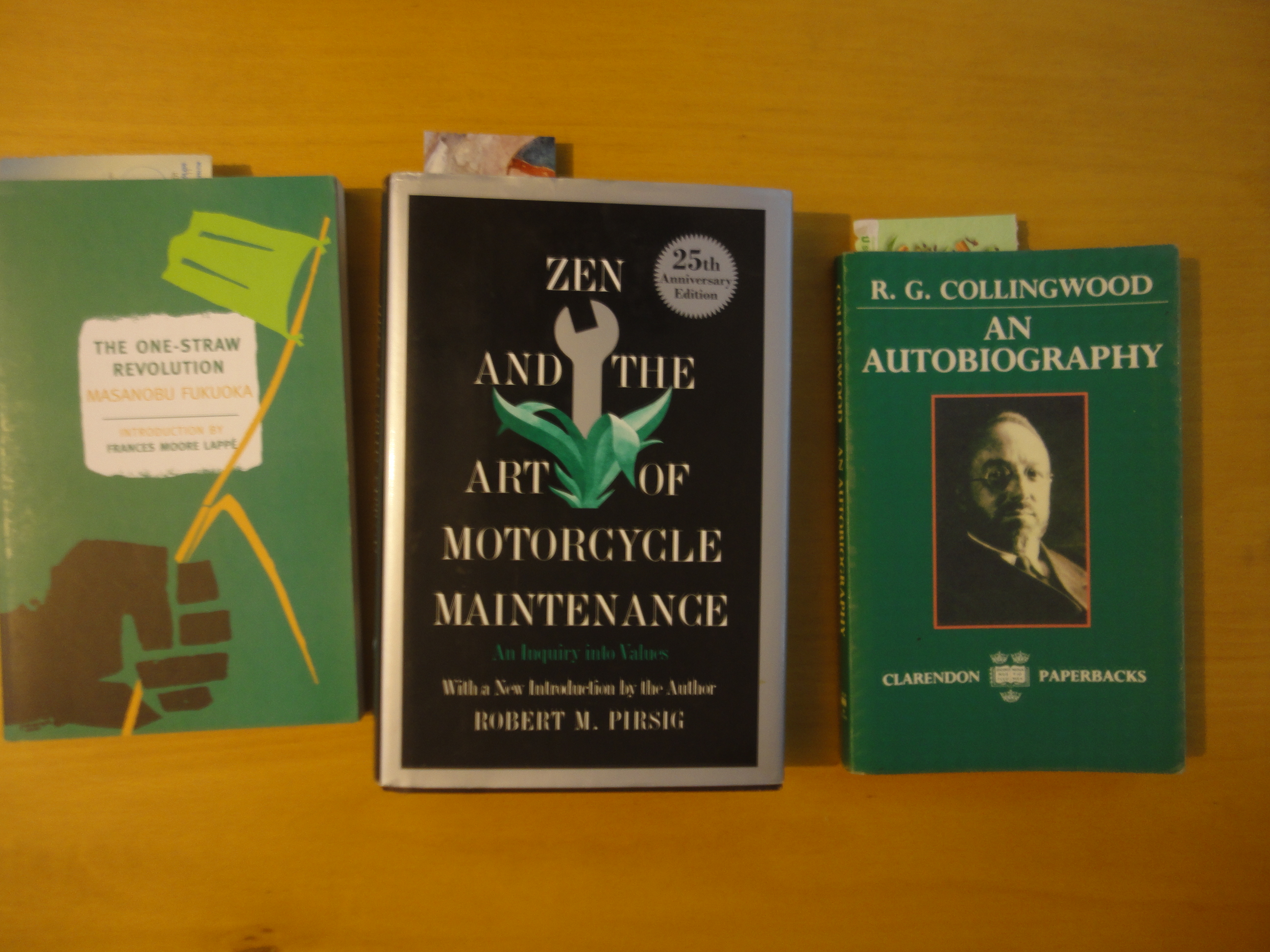
The books quoted here: The One-Straw Revolution, Zen and the Art of Motorcycle Maintenance, and An Autobiography. They all have on their covers a similar forest green, along with black

Continue reading

The Writer and the Persona

One may like a writer’s books without liking the writer. I have not had opportunity to test this maxim directly; but the experience of reading The First Mate’s Log may come close to what is needed. I like the book, as I like all of Collingwood’s books. But the Log is what it says, an account of Mediterranean Sea voyage taken by the author with a bunch of young men (Oxford students) half his age. The Log perhaps reveals more of Collingwood’s personality than his philosophy books do. Or maybe Collingwood just adopts a somewhat different persona for the Log.

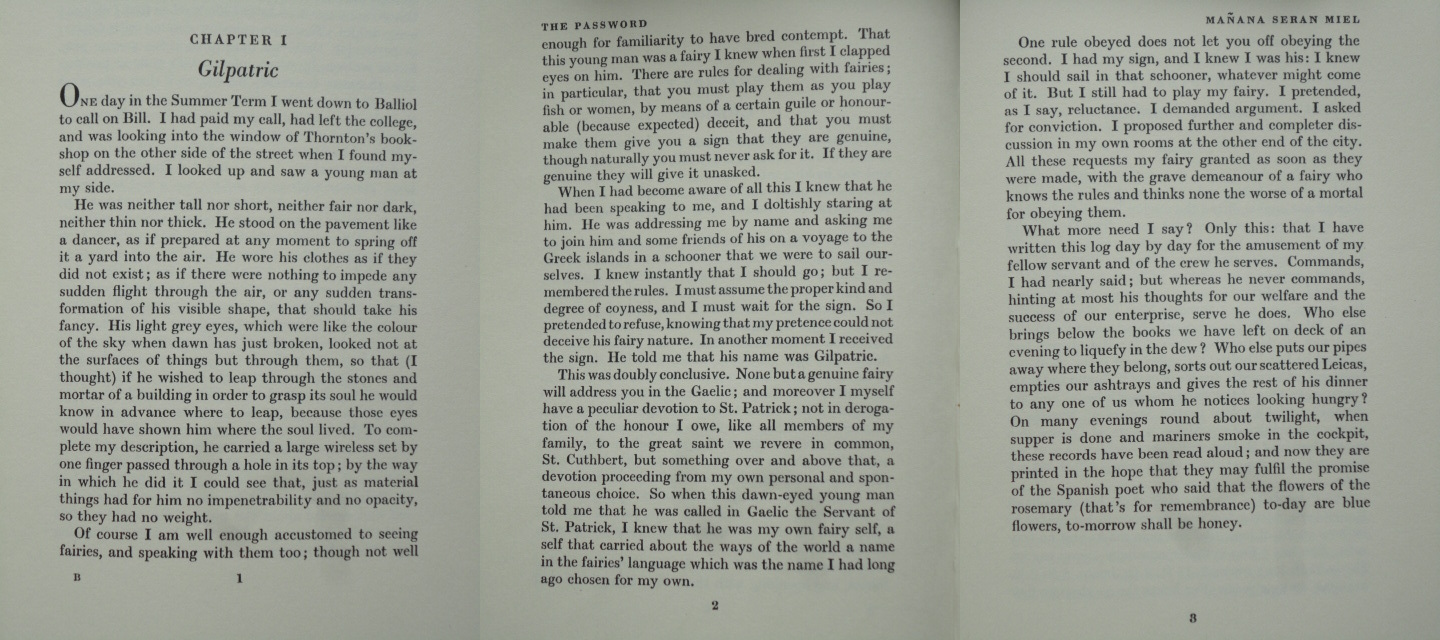
Three pages of text, side by side

Continue reading

Equality Is Not Identity

I want to record here an account by Collingwood of Aristotle’s theory of knowledge. The passages quoted below are relevant, both to something I have learned from reading Euclid with students, and to the considerations of consciousness that led to my recent article “Body and Mind.”

Continue reading

The Peace of Liberal Education

The wall of Dolmabahçe Sarayı, January 11, 2015

The wall of Dolmabahçe Sarayı, January 11, 2015

The occasion of this article is my discovery of a published Turkish translation of Collingwood’s Speculum Mentis or The Map of Knowledge (Oxford, 1924). Published as Speculum Mentis ya da Bilginin Haritası (Ankara: Doğu Batı, 2014), the translation is by Kubilay Aysevenler and Zerrin Eren. Near the end of the book, Collingwood writes the following paragraph about education, or what I would call more precisely liberal education. The main purpose of this article then is to offer the paragraph to any reader who happens to stop by.

Continue reading