Category Archives: Philosophy

Purity Obscurity

The covers of the books named just below, showing a stern bearded face (Aristotle), a wrench like a flower on a stem among leaves (Pirsig), a dirt road lined with brick buildings (Eliot)
Books taken up in this post:

Aristotle’s Poetics,
George Eliot’s Middlemarch,
Robert Pirsig’s Zen and the Art of Motorcycle Maintenance

Continue reading

Imitation Limitation

I alluded to this post in my last one, “Perception Deception.” There I questioned the gnomic assertion of its title.

The questioning then consisted of little more than quoting De Anima, where Aristotle points out that a sense cannot be deceived by its proper object. In particular, sight detects color infallibly.


Can of Coca-Cola held in a hand
I do not recall the source of this particular image, which I saved on March 29, 2024. The concept, at least, is apparently due to Akiyoshi Kitaoka.


If you see red in the image above, you are not mistaken, even if none of the pixels is of a kind called red.

Continue reading

Perception Deception


John Donne, Holy Sonnet XIX
(on the last line, “make” should be “ſhake”)

This post involves:

  • “the” philosopher –
    • Aristotle;
  • two mathematicians –
    • Euclid,
    • David Hilbert;
  • three persons associated with Black Mountain College –
    • Josef Albers,
    • Dorothea Rockburne,
    • Max Dehn;
  • one person (in addition to myself and Dehn) associated with St John’s College –
    • David Bolotin.

Continue reading

Machinations

Sources for this post include the following.

  • On recent events in the US:

    1. Seth Masket, “Friday Night Musk-acre” (February 1, 2025).
    2. Olga Lautman: “Why has Musk gained access to our data?” (February 2, 2025).
    3. Timothy Snyder, “The Logic of Destruction: And how to resist it” (February 2, 2025).
    4. Heather Cox Richardson, “February 2, 2025.”
    5. Malcolm Nance, “In The Trump ‘White’ House: No Spies Matter” (February 7, 2025).
    6. “An Uproar as Trump and Musk Wreak Havoc” (New York Times, letters, February 7, 2025).
    7. Elad Nehorai, “Elon Musk Isn’t a White Nationalist. He’s a White Globalist” (February 7, 2025).
  • On technological fantasies and what they may do to students:

    1. Michael Townsen Hicks, James Humphries, and Joe Slater, “ChatGPT is bullshit” (2024).
    2. John Warner, “AI Boosters Think You’re Dumb” (February 2, 2025).
    3. Seth Bruggeman, “A Crisis of Trust in the Classroom” (January 14, 2025) – students either cheat with technology, or do little of anything.
    4. Robert Pirsig, Zen and the Art of Motorcycle Maintenance (1974) – perhaps students motivated only by grades should drop out.
    5. Steve Rose (interviewer), “Five ways AI could improve the world: ‘We can cure all diseases, stabilise our climate, halt poverty’” (Thu 6 Jul 2023) – Ray Kurzweil thinks “Our mobile phone … makes us more intelligent,” and since we already have nukes, AI is “not really making life more dangerous”; anyway, “More intelligence will lead to better everything.”
    6. Rachel Uda, “In Such a Connected World, Why Are We Lonelier Than Ever?” (February 6, 2023).
    7. Hanna Rosin interviewing Jonathan Haidt, “The Smartphone Kids Are Not All Right” (March 21, 2024).
  • On a particular fantasy of effortless learning:

    1. Wikipedia, “Decoded neurofeedback.”
    2. Adam Hadhazy, “Science Fiction or Fact: Instant, ‘Matrix’-like Learning” (June 21, 2012).
    3. Takeo Watanabe and others, “Perceptual Learning Incepted by Decoded fMRI Neurofeedback Without Stimulus Presentation” (9 December 2011).
    4. Kevin Le Gendre, “Steel pan virtuoso Leon Foster Thomas: ‘Some people don’t think it’s a serious instrument’ ” (February 24, 2023).
  • Works leading me, somehow, to all of that:

    1. Northrop Frye, The Double Vision (1991).
    2. Peter Jukes, “In a rare interview, Philip Pullman tells us his own origin story, and why the great questions are still religious ones” (13 January 2014).

Towering over tourists are stone figures that have “the body of a bull, wings of an eagle, and the crowned head of a bearded men”
At Persepolis, outside Shiraz, Iran, Tuesday, September 4, 2012, this is the Gate of Xerxes – the Xerxes whose failed invasion of Greece is recounted by Herodotus


Continue reading

Removal

This is about metaphor.


Handwritten sign in shop window: ΜΕΤΑΦΕΡΘΗΚΑΜΕ …
Shop window in Athens, Monday, July 10, 2017:
ΜΕΤΑΦΕΡΘΗΚΑΜΕ
ΔΙΠΛΑ ΣΤΟ 46Α

ΤΑΚΗΣ
Μεταφερθήκαμε is the first-person plural passive aorist of μεταφέρω. I guess the meaning of the sign is, “We moved next door to 46A – Takis.” I took the photo, just so I could use it at a time like this. I didn’t try to talk with Takis.

Continue reading

Subjective and Objective

The use of a distinction between the subjective and the objective has sometimes made me suspicious. The suggestion is made here that Gödel’s Incompleteness Theorem relies on the distinction. I shall look at this more in “Gödel and AI.” Meanwhile, the major sources for the present post are the following.

  1. William James, Psychology: Briefer Course (1892), on “the stream of thought, of consciousness, or of subjective life” – also on
    • nerves as telephone lines;
    • emotions as resulting from “a physical effect on the nerves.”
  2. C. F. von Weizsäcker, The Relevance of Science (1964), on how “Cosmogony … is, objectively speaking, the way in which the world came into being, or it is, subjectively speaking, the teaching about this way.”
  3. Robert Pirsig, Zen and the Art of Motorcycle Maintenance (1974), on whether quality is objective or subjective (the answer is no) – also on the distinction between the classical and the romantic.
  4. R. G. Collingwood, Speculum Mentis (1924), on
    • his usage whereby
      • what pertains to a consciousness is called subjective;
      • what the consciousness is of is called objective;
    • atoning for the Fall, that is, the separation of subject from object

    – also (in response to James) on how emotions don’t need a physical source.

  5. James Mumford, “Therapy Beyond Good and Evil: A nonjudgmental psychology is failing patients who need to hear hard truths” (perhaps the hard truths of the title are objective truths, and what the patients need to hear is that their own subjective evaluations of themselves may be wrong).
  6. William Egginton, “Why Kant Wouldn’t Fear ChatGPT-4” (for a computer, there is nothing beyond what it “knows” – all is subjective).
  7. Kurt Gödel, “On formally undecidable propositions of Principia mathematica and related systems I” (the Incompleteness Theorem relies on a distinction between a [subjective] statement and its [objective] meaning).
  8. Shannon Vallor, “The Thoughts The Civilized Keep” (they require labor, with a history).

Minor sources include the following.

  1. James Joyce, Ulysses, as presenting streams of consciousness.
  2. Sigrid Undset, Kristin Lavransdatter, as being more readable.
  3. Aristotle, Nicomachean Ethics and Physics, on how there is not deliberation about the cosmos, or the irrationality of √2, or how to build a ship.
  4. Jared Henderson, “How to read Aristotle’s Nicomachean Ethics.”
  5. C. S. Lewis, The Magician’s Nephew, where an iron bar grows into a lamp-post the way Aristotle imagines a log’s growing into a ship.
  6. a letter to Analog magazine on how religion is false science.
  7. Robert Pirsig, Lila, on the distinction between the static and the dynamic.
  8. Elle Hunt, “Octopus farming turns my stomach – but are some species really more worthy than others?”
  9. the Hebrew Bible (Psalms and Ezekiel) on eating words.
  10. Alexander Bevilacqua, “Saints for Supper” (a review of Jérémie Koering, Iconophages: A History of Ingesting Images).
  11. Jack A. Goldstone and Peter Turchin, “Welcome To The ‘Turbulent Twenties’.”
  12. David Allen Green, “‘Twelfth Night Till Candlemas’ – the story of a forty-year book-quest and of its remarkable ending.”

Having started last spring, my wife and I recently completed a project to read Ulysses together. I was glad to be able to put the book back on the shelf. It sits there, next to another of comparable length, Kristin Lavransdatter; this is because I order my books according to the birth of the writer (or subject), and James Joyce was born February 2, 1882; Sigrid Undset, May 5.

I read her book on my own, for and with pleasure, and it entered into my thoughts on the Nicomachean Ethics of Aristotle, expressed for example in “Impermanence” (on Book IX, chapters i–iii; the common theme was how children might forget their mothers, but not conversely; Maya Angelou recalled how many black women had nursed white children in America).
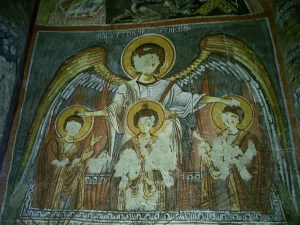

Three haloed figures in front of a fourth with spread arms and wings; faces are mostly scratched out
Karanlık Kilise (Dark Church), Göreme Open Air Museum
Cappadocia, January 11, 2009


Continue reading

Religious Science

Below is Chapter 1, “Science and the Modern World,” of The Relevance of Science by C. F. von Weizsäcker.

The last post of this blog was of my annotated version of Chapter 3, “Creation in the Old Testament.”

As the author reports in his Preface, The whole book consists of the first of two series of Gifford Lectures at Glasgow, 1959–61.

Stage seen from audience
I had the opportunity myself to lecture in Tabriz, on August 28, 2012. This was in Iran, so the wall behind me held a portrait of the late Ayatollah Khomeini, along with some kind of icon of science. We were at a national mathematics conference, but I included some of my artwork in the slides of my talk (called “Model-theory of differential fields”)

Continue reading

Biblical Creation

Below is “Creation in the Old Testament,” which is Chapter 3 of The Relevance of Science by C. F. von Weizsäcker. I have highlighted key passages. I have added a note concerning Pascal, because I spent time reading him and blogging about him, and von Weizsäcker mentions him.

I am studying von Weizsäcker’s chapter, to see what the author makes of the Creator’s assessment of His own work. That assessment is the title of another post of this blog: “It Was Good.”

Hundreds of identical unfinished fairy-tale châteaux in a broad valley
Somebody set out to build Burj Al Babas here in Turkey, for buyers in the Persian Gulf, but abandoned the project

Continue reading

Free Groups and Topology

My title alludes to some notes for the layperson that I rediscovered recently. I have reviewed and edited them, and they are below, in the following sections (linked to by the titles after the three main bullets; other links are to Wikipedia).

  • Quasicrystals,” based on an email of mine sent to a group of alumni of St John’s College on October 8, 2011. This was my contribution to a thread in which somebody said that
    • Dan Schechtman (whom she called Danny) was a worthy recipient of that year’s Nobel Prize in Chemistry for the discovery of quasicrystals, but
    • John Cahn deserved credit, even the prize itself, as the real discoverer.

    My wife and I had recently moved to Istanbul, and the Istanbul Model Theory Seminar had just got going. The Nobel Prize and quasicrystals had been mentioned there too.

  • Free Groups,” based on an email of October 10, 2011. I tried to describe free groups to somebody who expressed interest, but who also called himself the world’s worst mathematician.
  • Topology” – a draft of an attempt to describe that subject. In graduate school, I got excited about the definition of a topological space when I first encountered it. Here I try to motivate the definition by abstracting from the properties of the Cartesian plane as a metric space. I give the example of the Zariski topology on the same plane. I start to talk about the topology derived from the Gromov–Hausdorff metric on the space of groups with n generators, but then I stop.

A green landscape
Vegetable plot in Yeniköy (where Cavafy lived a while), Istanbul, Saturday, September 28, 2024

Continue reading

Motivated Reasoning in the Cyropaedia of Xenophon

The son of the king of Persia wants to press the advantage, after the combined forces of Media, Persia, Armenia, and Chaldaea have

  • killed the Assyrian king, along with most of his best men, and
  • driven the rest of the Assyrian army from their fortifications.

The king of Media is of another mind: he would rather quit while he is ahead. He has an argument for standing pat, by the account of Xenophon in the Cyropaedia (IV.i.11–18).

One may consider the argument of Cyaxares as an example of “motivated reasoning.” I think it is a specious argument: attractive, but ultimately unsound. Perhaps I say that, only because the king’s nephew Cyrus rejects the argument, but is nonetheless successful in what he goes on to do. With his Persian troops and as many Medians as wish to join them, along with the Hyrcanians, who have defected from Assyria, Cyrus pursues and defeats again the Assyrian army. He kills the kings of Cappadocia and Arabia, and he puts to flight both the king of Phrygia and Croesus, king of Lydia (IV.ii.28–31). Of course, this is not the end of the story; history never ends.

I have been reading and discussing the eight books of the Cyropaedia with a Catherine Project group, at the rate of half a book a week, since July 8 of this year (2024). Thus we shall have completed the sixth book (called “On the Eve of the Great Battle” in the Loeb edition) on September 23. It has astonished me that some of my fellow readers think well of the argument for taking it easy, even as they acknowledge that the man who makes it may be a fool. The argument does not seem to me like one that a king such as Cyaxares can afford to make.

Possibly Xenophon has an esoteric message, as Plato is thought to have. However, although these two writers had a common teacher in Socrates, he never went far from Athens. Xenophon helped lead a stranded army of ten thousand Greek mercenaries, from Babylon north to the Black Sea, after the failure of the coup for which they had been hired by Cyrus the Younger. Xenophon admires a practical man who can actually get things done. This being what Cyrus the Elder is, he is the hero of the Cyropaedia. I shall review my textual reasons for saying this. First I shall look at “motivated reasoning” today, along with the idea that we could have “evolved” to use it. (In short, the rest of this post has the three parts just linked to.)

Pine bough above; bushes below; blue sky, sparkling water, and sand in between

Photo taken September 17, 2024, of Lesbos over the sea, from a beach in Lydia. Of this country, Chrysantas says to Cyrus, after the latter has pursued the Assyrians over the objections of his uncle Cyaxares (Cyropaedia VI.ii.21),

since it now appears that Syria is not to be the only prize – though there is much to be got in Syria, flocks and herds and corn and palm-trees yielding fruit – but Lydia as well, Lydia the land of wine and oil and fig-trees, Lydia, to whose shores the sea brings more good things than eyes can feast on, I say that once we realise this we can mope no longer, our spirits will rise apace, and we shall hasten to lay our hands on the Lydian wealth without delay.

This is in response to the suggestion of Cyrus that his army are intimidated by the alliance that Assyria has formed with Lydia.

Continue reading