Category Archives: Aristotle

Motion and Rest

This is mostly about Goethe’s Faust, but it was not going to be. Faust says he never wants to sit still. It doesn’t seem like a great idea.

Parthenon

Athens, Monday, July 10, 2017

If, as Wikipedia now mentions, and John Warner discusses in the fittingly titled “That’s Not What Lolita Is About” (November 16, 2025) – if Elisa New recommended that Jeffrey Epstein read Lolita (which I have read) and My Antonia (which I haven’t), why not Faust?

Continue reading

Courage

Below is my essay on courage, first drafted in April of last year (2024). A reason to think of it now is a recent pair of essays, coming from the United States:

The latter takes up all of the virtues that Socrates does.

Plato didn’t get everything right, but he remains one of the most widely studied philosophers in western history for a reason. In Book IV of The Republic, he discusses the four cardinal virtues. Hope didn’t make the list.

Here they are:

  • Wisdom (or prudence)
  • Self-control (or temperance)
  • Fairness (or justice)
  • Fortitude (or courage)

These four virtues feed a healthy society. We’re supposed to teach them to our young and practice them every day. Hope stems from an insufficient knowledge about the world, but fortitude grows out of wisdom.

We’re long on hope, but short on fortitude.

It would be good if we had more fortitude. As Wildfire writes more recently, in “Fighting Fascism at The End of The World: What nobody wants to say” (August 20, 2025),

It’s gotten popular to tell people to physically throw themselves in front of ICE agents to stop arrests. Allow me to pose a rude question: If someone won’t even wear a piece of cloth on their face for a few hours a day, are they going to get thrown in jail to protect someone they don’t even know?

For Aristotle at least, there is a distinction between the two qualities that could be meant by fortitude and courage respectively. The distinction is a theme of my own essay below.

Aristotle, Nichomachean Ethics, Crisp translation; behind it calm water, with wooded bluffs dotted with houses beyond

Aristotle, Nicomachean Ethics
Tuesday, July 11, 2023
I usually read Rackham’s translation in the Loeb edition
sometimes along the Bosphorus, as here

Continue reading

Purity Obscurity

The covers of the books named just below, showing a stern bearded face (Aristotle), a wrench like a flower on a stem among leaves (Pirsig), a dirt road lined with brick buildings (Eliot)
Books taken up in this post:

Aristotle’s Poetics,
George Eliot’s Middlemarch,
Robert Pirsig’s Zen and the Art of Motorcycle Maintenance

Continue reading

Imitation Limitation

I alluded to this post in my last one, “Perception Deception.” There I questioned the gnomic assertion of its title.

The questioning then consisted of little more than quoting De Anima, where Aristotle points out that a sense cannot be deceived by its proper object. In particular, sight detects color infallibly.


Can of Coca-Cola held in a hand
I do not recall the source of this particular image, which I saved on March 29, 2024. The concept, at least, is apparently due to Akiyoshi Kitaoka.


If you see red in the image above, you are not mistaken, even if none of the pixels is of a kind called red.

Continue reading

Perception Deception


John Donne, Holy Sonnet XIX
(on the last line, “make” should be “ſhake”)

This post involves:

  • “the” philosopher –
    • Aristotle;
  • two mathematicians –
    • Euclid,
    • David Hilbert;
  • three persons associated with Black Mountain College –
    • Josef Albers,
    • Dorothea Rockburne,
    • Max Dehn;
  • one person (in addition to myself and Dehn) associated with St John’s College –
    • David Bolotin.

Continue reading

Subjective and Objective

The use of a distinction between the subjective and the objective has sometimes made me suspicious. The suggestion is made here that Gödel’s Incompleteness Theorem relies on the distinction. I shall look at this more in “Gödel and AI.” Meanwhile, the major sources for the present post are the following.

  1. William James, Psychology: Briefer Course (1892), on “the stream of thought, of consciousness, or of subjective life” – also on
    • nerves as telephone lines;
    • emotions as resulting from “a physical effect on the nerves.”
  2. C. F. von Weizsäcker, The Relevance of Science (1964), on how “Cosmogony … is, objectively speaking, the way in which the world came into being, or it is, subjectively speaking, the teaching about this way.”
  3. Robert Pirsig, Zen and the Art of Motorcycle Maintenance (1974), on whether quality is objective or subjective (the answer is no) – also on the distinction between the classical and the romantic.
  4. R. G. Collingwood, Speculum Mentis (1924), on
    • his usage whereby
      • what pertains to a consciousness is called subjective;
      • what the consciousness is of is called objective;
    • atoning for the Fall, that is, the separation of subject from object

    – also (in response to James) on how emotions don’t need a physical source.

  5. James Mumford, “Therapy Beyond Good and Evil: A nonjudgmental psychology is failing patients who need to hear hard truths” (perhaps the hard truths of the title are objective truths, and what the patients need to hear is that their own subjective evaluations of themselves may be wrong).
  6. William Egginton, “Why Kant Wouldn’t Fear ChatGPT-4” (for a computer, there is nothing beyond what it “knows” – all is subjective).
  7. Kurt Gödel, “On formally undecidable propositions of Principia mathematica and related systems I” (the Incompleteness Theorem relies on a distinction between a [subjective] statement and its [objective] meaning).
  8. Shannon Vallor, “The Thoughts The Civilized Keep” (they require labor, with a history).

Minor sources include the following.

  1. James Joyce, Ulysses, as presenting streams of consciousness.
  2. Sigrid Undset, Kristin Lavransdatter, as being more readable.
  3. Aristotle, Nicomachean Ethics and Physics, on how there is not deliberation about the cosmos, or the irrationality of √2, or how to build a ship.
  4. Jared Henderson, “How to read Aristotle’s Nicomachean Ethics.”
  5. C. S. Lewis, The Magician’s Nephew, where an iron bar grows into a lamp-post the way Aristotle imagines a log’s growing into a ship.
  6. a letter to Analog magazine on how religion is false science.
  7. Robert Pirsig, Lila, on the distinction between the static and the dynamic.
  8. Elle Hunt, “Octopus farming turns my stomach – but are some species really more worthy than others?”
  9. the Hebrew Bible (Psalms and Ezekiel) on eating words.
  10. Alexander Bevilacqua, “Saints for Supper” (a review of Jérémie Koering, Iconophages: A History of Ingesting Images).
  11. Jack A. Goldstone and Peter Turchin, “Welcome To The ‘Turbulent Twenties’.”
  12. David Allen Green, “‘Twelfth Night Till Candlemas’ – the story of a forty-year book-quest and of its remarkable ending.”

Having started last spring, my wife and I recently completed a project to read Ulysses together. I was glad to be able to put the book back on the shelf. It sits there, next to another of comparable length, Kristin Lavransdatter; this is because I order my books according to the birth of the writer (or subject), and James Joyce was born February 2, 1882; Sigrid Undset, May 5.

I read her book on my own, for and with pleasure, and it entered into my thoughts on the Nicomachean Ethics of Aristotle, expressed for example in “Impermanence” (on Book IX, chapters i–iii; the common theme was how children might forget their mothers, but not conversely; Maya Angelou recalled how many black women had nursed white children in America).


Three haloed figures in front of a fourth with spread arms and wings; faces are mostly scratched out
Karanlık Kilise (Dark Church), Göreme Open Air Museum
Cappadocia, January 11, 2009


Continue reading

Trial

In the last chapter of the last book of the Nicomachean Ethics, Aristotle prepares us for his next collection of books, the Politics.

Crumpled paper on shiny ground behind glass within a dark frame on an exterior wall; graffiti tags on either side; right side of similar frame on the left, small tree on the right
Süleyman Nazif Sokağı, Şişli, İstanbul
Friday, June 7, 2024

Continue reading

Theory

Thanks to Stephen Greenleaf, whom I met through this blog in the first place, my attention has lit on some words of Charles S. Pierce:

When a man desires ardently to know the truth, his first effort will be to imagine what that truth can be … there is, after all, nothing but imagination that can ever supply him an inkling of the truth. He can stare stupidly at phenomena; but in the absence of imagination they will not connect themselves together in any rational way.

I am not sure now that “staring stupidly at phenomena” is not Aristotle’s definition of perfect happiness.

Cars parked at a grand gate, beyond which is a three-storey building overlooking sea and the forested hills beyond it
Two floors of this building are for sale
Somebody would rather have the money than the view
Kireçburnu, Sarıyer, Istanbul
Saturday, June 1, 2024

Continue reading

Agathism

Directory for this series

Pleasure and pain are a guide to something, but there is no sure guide to what is good; this is rather what should guide us.

Tall narrow trees beneath clear blue sky
Atatürk City Forest
Wednesday, March 22, 2024

Continue reading

Hedonism

Although the word telezzüz is absent from one Turkish dictionary (Arkadaş Türkçe Sözlük, 2004), I find it in a couple of Turkish-English dictionaries. Its length recalls Ottoman times, when Turkish speakers freely borrowed from Persian and Arabic.

Native Turkish words can be extended to great length with grammatical endings, as in gelemeyebilirim. I once heard a taxi driver say that to a colleague who was making tea. He was saying literally, “I am able to be unable to come”; he meant, “Maybe I can’t come have tea, because I’ve got to take this guy out to the airport.” The single word for all of that was built up from the single syllable gel- “come” by addition of -eme- “be unable,” -y- (buffer), -ebil- “be able,” -ir- (marking an aorist verb), and -im “I.” By contrast, telezzüz has no such analysis, at least not in Turkish. This brands the word as foreign, at least to my understanding, the way sesquipedality in an English word connotes a borrowing from Latin or Greek.

As I have just learned, the word telezzüz is used as the name of an upscale vegetarian restaurant, over on the Asian side of Istanbul, near an Ottoman kiosk that my wife and I have visited. Perhaps one day we will dine at the restaurant, for a taste of luxury, the way we dined at Nicole, in European Istanbul, almost nine years ago. Unfortunately, for us at least, that restaurant wasn’t vegetarian.
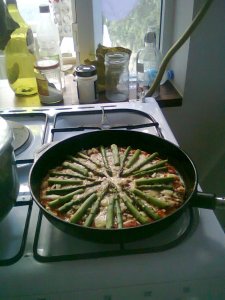
Spears of asparagus radiate from the center of a cast-iron pan on a stove; windows behind
Homemade pizza with asparagus from Elibelinde
Tuesday, May 21, 2024

Continue reading