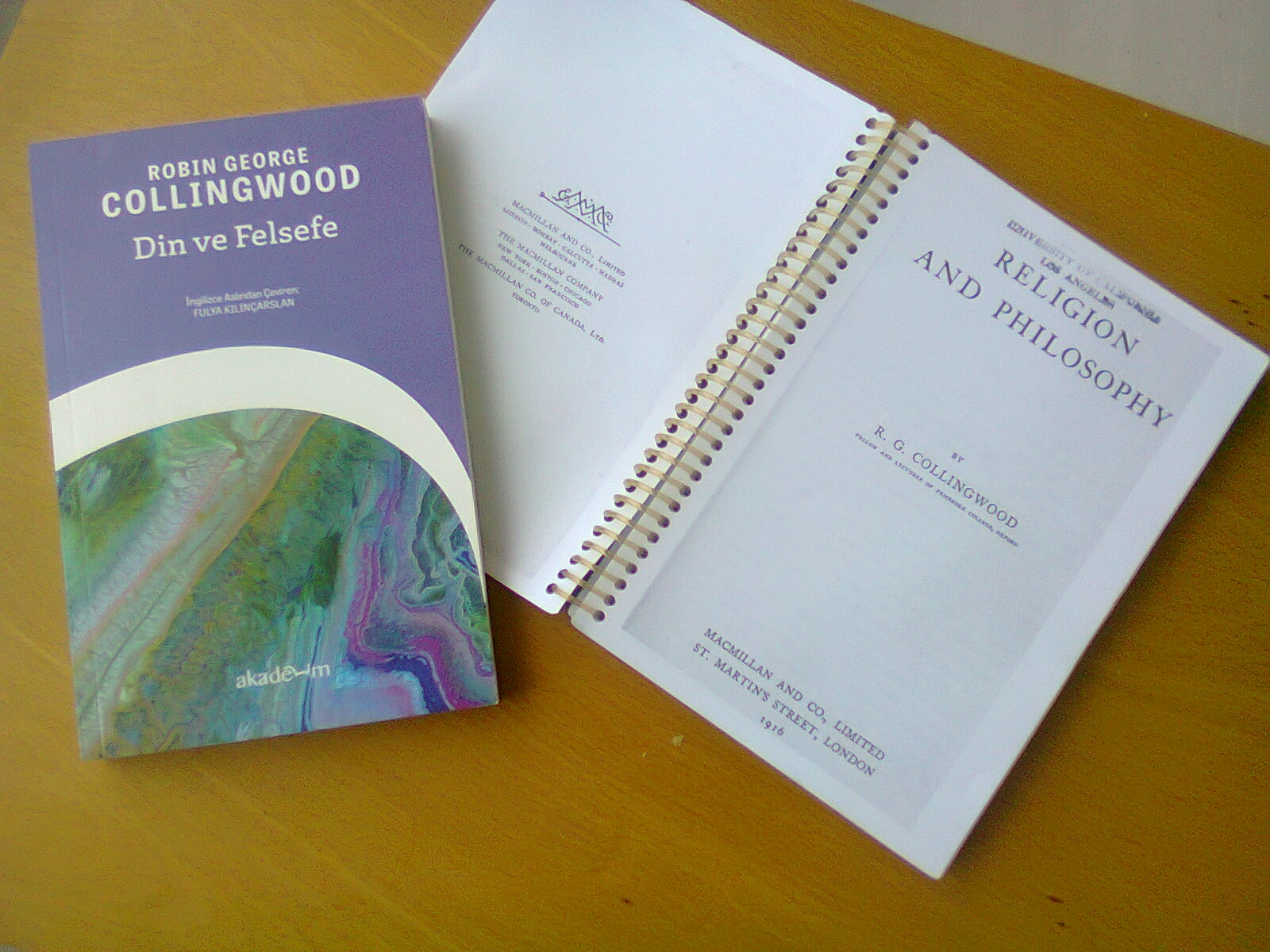
There is a lot about R. G. Collingwood on this blog. Apparently that is why I had the opportunity to write the text below. Something close to it was included in Turkish last year with the Turkish translation of R. G. Collingwood’s Religion and Philosophy.
Din ve Felsefe was published in September, 2022, by Akademim (apparently “My Academy”), and what I wrote for it was a takdim (“an introducing”) or sunuş (“presentation,” from sunmak “to present”). In writing this, I made use of my own annotated version of Collingwood’s book (here as a pdf file, 475 pages, size B6, dated February 2025).
I have already quoted some of the takdim in the post called “‘It Was Good’.” This is based on how God checks his own work, according to the first creation myth in Genesis. The present post is occasioned by a checking of my own work. That work was in the post called “Antitheses,” which I have been reading again because
- a friend announced having listened to Amy-Jill Levine, Sermon on the Mount: A Beginner’s Guide to the Kingdom of Heaven;
- I had based “Antitheses” on that Sermon;
- In writing recently on the final book of Homer’s Iliad, I proposed extremism and moderation as constituting another antithesis.
The “Antitheses” post could use work or even a replacement. When I wrote it, I thought all of its ideas were illuminated by the Antitheses in the Sermon on the Mount; however, this may have been more of a hunch than a conclusion.
I quoted a dictionary definition of antithesis as “an opposition or contrast of [two] ideas.” I would suggest further that those two ideas do not really oppose or contrast with one another, so much as they complement one another. By itself, “An eye for an eye” is ambiguous: is it a warning against too little punishment, or too much? Too much, if we read the injunction, “Resist not evil,” as a refinement of the meaning of the earlier rule.
I agree with Collingwood’s argument, sketched below, that when properly understood, punishment and forgiveness amount to the same thing. This would seem to be a possible interpretation of the teaching of Jesus Christ. There may be other interpretations as well. In any case, Collingwood observes,
The most perfect punishments involve no “incidental” pains at all. The condemnation is expressed simply and quietly in words, and goes straight home.
I can remember being punished in this way by my elders. However, in a conversation last year, when I suggested the possibility of merely verbal punishment, somebody who actually had a daughter was incredulous. Perhaps he would have told me there were alternatives to both of the options that Collingwood mentions:
if we are punishing a child, the tongue is a much more efficient weapon than the stick.
Nonetheless, Collingwood makes an even more extreme suggestion:
It is possible to punish without the word of rebuke; to punish by saying nothing at all, or by an act of kindness. Here again, we cannot refuse the name of punishment because no “physical suffering” is inflicted. The expression of moral feelings, or the attitude of the good will to the bad, may take any form which the wrongdoer can understand.
Collingwood is only working out the Proverb,
If thine enemy be hungry, give him bread to eat; and if he be thirsty, give him water to drink:
For thou shalt heap coals of fire upon his head, and the Lord shall reward thee.
Jesus put it more abstractly:
Love your enemies, bless them that curse you, do good to them that hate you.
Before passing to the actual takdim for Din ve Felsefe, let me note the possibility of broadening the scope of “Antitheses” to include single words that are antitheses in themselves.
- “Automatic” can mean
- both unwilled and self-willed,
- both predictable and unpredictable;
see especially “Automatia,” on the Goddess of Chance, and the examples gathered for consideration with Iliad Book VIII, where the gates of heaven open automatically.
- “License” can be something lawful or something improper, as noted in “Automatia.”
- “Formal” can mean both material and immaterial; see the discussion for Iliad Book XV, where I noted that Achilles wanted from Agamemnon an apology that was both formal and not.
- “Forge” can mean
- move slowly or move quickly,
- make something fake or real;
I noticed this in reading Iliad Book XVIII, because that is where Hephaestus forges Achilles’s new armor.
I think Raymond Smullyan alludes to the antithesis of the automatic in the dialogue called “Is God a Taoist?” The character called God is speaking here:
Often one uses the statement “I am determined to do this” synonymously with “I have chosen to do this.” This very psychological identification should reveal that determinism and choice are much closer than they might appear.
God has already said,
Don’t you see that the so-called “laws of nature” are nothing more than a description of how in fact you and other beings do act?
Compare C. S. Lewis, as quoted in “Sacrifice and Simulation”:
When you say that falling stones always obey the law of gravitation, is not this much the same as saying that the law only means “what stones always do”? You do not really think that when a stone is let go, it suddenly remembers that it is under orders to fall to the ground. You only mean that, in fact, it does fall.
Lewis’s point is that there is another kind of law. Perhaps “law” then is another one-word antithesis.
Published in 1916, during World War I, Religion and Philosophy is the first book of R. G. Collingwood (1889–1943), but contains some of his finest writing and most inspired vision.
The vision is of a unified world. For example, punishment and forgiveness are not two kinds of justice, but one. Justice brings about “the criminal’s … regeneration and recovery into the life of a good society” (III.ii.2.b, page 179). This recovery inevitably involves “the pain of self-condemnation or moral repentance” (III.ii.2.b, page 178). Thus the just response to a crime is both
- to punish it, rather than to ignore it;
- to forgive it, rather than to use it as an excuse to inflict further suffering.
A theological term for justice is atonement. In reviewing Collingwood’s book for the International Journal of Ethics (Jul., 1917, Vol. 27, No. 4, p. 543), T. S. Eliot wrote,
The philosophical interpretation of the Incarnation, of the Atonement and of Miracle, are extremely well handled.
Incarnation and Atonement are the same thing for Collingwood, namely,
that taking-up of humanity into God which is called the Incarnation or the Atonement, according as the emphasis is laid on God’s self-expression through humanity or man’s redemption through the spirit of God. (III.i, page 147)
Miracles cannot be distinguished from ordinary events. For example,
Every cure is equally a miracle, and every doctor (like every other active and creative mind) a miracle-worker, in the only sense which can reasonably be attached to the word. (III.iii.3.a, page 211)
When so many people delight in classifying themselves, as by nationality, religion, sexuality, or football team, it is salutary that Collingwood points out,
To the eye of perfect insight … everything is unique. For such a consciousness there are no classes, there are only individuals; not in chaos, for every individual is related to every other … The true relation between individuals is not the resemblance which connects members of a class, but the co-operation which unites parts of a whole. (III.iii.3.b.ii, pages 213–4)
Collingwood may carry the unifications too far. He says, “there is no distinction whatever between Theology and Religion, so far as the intellectual aspect of religion is concerned” (I.i.2, page 12). Likewise, “the true religion and the true philosophy must coincide,” because “religion and philosophy are views of the same thing—the ultimate nature of the universe” (I.i.3.b, page 18). Even philosophy (or religion) and science are in principle the same:
It is no doubt possible to forget the whole in laying stress on isolated parts, as it is possible to forget details in the general view of a whole. But each of these is a false abstraction; we cannot identify the former with science and the latter with religion or philosophy. The ideal, alike for philosophy and science, is to see the part in its place in the whole, and the whole perfectly exemplified in the part. (I.i.3.c, page 20)
If the reader objects to the identification of theology, religion, and philosophy, Collingwood himself will agree in his next book, Speculum Mentis, in a footnote on the first page of Chapter IV, called “Religion”:
I may perhaps be permitted here to refer to a book called Religion and Philosophy which I published in 1916, and in which I tried to give a general account of the nature of the religious consciousness, tested and illustrated by detailed analyses of the central doctrines of Christianity. With much of what that book contains I am still in agreement; but there are certain principles which I then overlooked or denied, in the light of which many of its faults can be corrected. The chief of these principles is the distinction between implicit and explicit. I contended throughout that religion, theology, and philosophy were identical, and this I should now not so much withdraw as qualify by pointing out that the ‘empirical’ (i.e. real but unexplained) difference between them is that theology makes explicit what in religion as such is always implicit, and so with philosophy and theology. This error led me into a too intellectualistic or abstract attitude towards religion, of which many critics rightly accused me …
Religion, theology, and philosophy together are an example of the key idea of Collingwood’s 1933 book, An Essay on Philosophical Method: the overlap of classes. In one of the examples in the Essay, while doing one’s duty may always bring about or increase happiness, the concepts of duty and the promotion of happiness are not identical, and to think otherwise is what Collingwood calls “the fallacy of identified coincidents.” Thus he himself has committed this fallacy in Religion and Philosophy, regarding the two concepts in the title.
In Religion and Philosophy, Collingwood spends little time on the so-called Ontological Proof. Having delivered a series of lectures on the proof, starting in 1920, Collingwood will devote to it a chapter, called “Philosophy as Categorical Thinking,” of An Essay on Philosophical Method. As an example or application of the Proof, he will show how the philosophical sciences of logic and ethics are not simply descriptive (or empirical), and neither are they simply prescriptive (or normative). They concern not just what we do, in thought or act, but what we try to do, by our own standards. To me, as a logician, this makes perfect sense. I am not a judge who can send you to prison for making bad arguments. I ought to be able to help you make your arguments clearer, if that is something you want.
A science such as logic and ethics (also aesthetics and economics) gives an account—in Greek, a logos (λόγος)—of the criteria that we apply in judging our own efforts. In a word, such a science is criteriological. Collingwood will not actually use this word until The Principles of Art of 1938. He will explicate the concept of a criteriological science more fully in An Essay on Metaphysics of 1940. Meanwhile, in Religion and Philosophy, we can see the germ of the idea, with philosophy as the example:
And if theology is to be a merely empirical science, it has a corresponding right to make uncriticised assumptions. But the sting of the criticism lies in the fact that theology claims to be more than this. It presents itself as a philosophy, a view of the universe as a whole, the ultimate ground of reality; and philosophy can take nothing for granted … a philosopher has no right to construct the nature of morality out of his inner consciousness, and end in the pious hope that the reality may correspond with his “ideal construction.” His business as a philosopher is to discover what actually are the ideals which govern conduct, and not to speak until he has something to tell us about them. (II.i.1.a, pages 59–60)
In An Essay on Metaphysics, Collingwood will observe that, while a purely empirical science of human feeling is possible, and this is what psychology properly is, the same cannot exist for thought. As he will already have pointed out in The Principles of Art, thought differs from feeling by being “bipolar” in the sense that it can be done well or not. Both thought and feeling are in the scope of Collingwood’s work:
- Feeling is the subject of The Principles of Art, where art is found to be the creation of an imaginary experience whereby we express our emotions, by way of understanding them.
- Thinking is the subject of “The Principles of History,” which Collingwood could not complete, though some of the manuscript was published in 1946 in The Idea of History. The point of history is to understand the thought of others, and we normally cannot do this unless that thought has been successful, because otherwise we cannot figure out what those other persons were trying to do in the first place.
As a teacher, I am supposed to judge whether my students are thinking successfully. This is not like judging their health, with blood test or thermometer; for this kind of judging can be done without the subjects’ active participation. A brain scan might show whether students are thinking rather than sleeping; but it will not show whether they are thinking well. On the other hand, the students should be learning how to tell for themselves whether they are thinking well.
For his own understanding of the impossibility of an empirical science of thought, Collingwood, in An Autobiography of 1939, will credit the work that has gone into Religion and Philosophy. He says there, for example,
In conduct generally we have certain actions, individual or social, designed to attain the ends of morality, utility, or the like; psychology will study these actions without asking whether they are right or wrong, but taking them merely as things done. In general, the characteristic of psychology is the refusal to raise ultimate questions. And since that is so, it is plainly not in a position to offer answers to them. (I.iii.1.a, pages 40–1)
One of those ultimate questions is simply whether what we are doing is any good. Collingwood thought he had work to do that was worth doing. During World War II, when he knew he was dying, he managed to publish one last book, The New Leviathan: Man, Society, Civilization, and Barbarism (1942), an account of what he thought was worth defending against the Nazis. The teaching of Jesus of Nazareth that he seems to have taken most to heart is Matthew 5:48,
Be ye therefore perfect, even as your Father which is in heaven is perfect.
For Collingwood, in Religion and Philosophy (I.iii.5, page 53),
the historical life of Jesus is the guarantee that man can be perfect if he will.
Collingwood applies the idea of perfection throughout Religion and Philosophy:
-
“A philosophical problem cannot be insoluble, though it may be too hard for you or me to solve satisfactorily” (II.iv.1.a, pages 123–4).
-
“Pain seems to involve imperfection only in the sense in which any one who has a thing to do and has not yet done it is imperfect; and in that sense imperfection is only another name for activity and perfection for death” (II.iv.1.b.i, page 126).
-
“The world we see around us is not a stationary, already-existing, given totality, but a totality in the making: its unity consists only in the striving towards unity on the part of the minds which constitute it. This does not mean that its completion lies at some point in the future; it is a completion that never is and never will be attained for good and all, but one which is always being attained. The life of the world, like the life of a man, consists in perpetual activity” (II.iv.3.a, pages 140–1).
-
“God’s attitude towards the sins of men must be one which combines condemnation of the sinful will with love and hope for it; these two being combined not as externally connected and internally inconsistent elements of a state of mind, but as being the single necessary expression of his perfect nature towards natures less perfect, but regarded as capable of perfection” (III.ii.3, page 180).
One may raise here the same sort of question that Eliot did:
Mr. Collingwood attacks the problem of evil by conceiving of God “not as imposing his will on the world from without, but as himself sharing in all the experiences of other minds.” “God is the absolute good will.” Mr. Collingwood admits that the universe is a totality only in posse. One is tempted to ask whether the omnipotence and absolute good will of God are also in posse.
Read the book and see what you think!
Edited September 25, 2026, just to link to a more recent annotated version of Collingwood’s Religion and Philosophy