-
-
Meta
-
Archives
-
Categories
- Art (186)
- Music (3)
- Poetry (108)
- Homer (76)
- Sylvia Plath (4)
- T. S. Eliot (12)
- Prose (71)
- Visual Art (26)
- Film (5)
- Education (54)
- Facebook (14)
- History (66)
- Archeology (6)
- Tourism (30)
- Language (36)
- Fowler (6)
- Grammar (12)
- Strunk and White (9)
- Turkish (8)
- Logic (12)
- Mathematics (79)
- Exposition (21)
- Mathematical Topics (10)
- Calculus (4)
- Conic Sections (6)
- Mathematicians (29)
- Archimedes (8)
- Euclid (21)
- G. H. Hardy (7)
- Philosophy of Mathematics (18)
- Nature (28)
- Philosophy (299)
- “God is a circle …” (5)
- Categorical Thinking (6)
- Causation (12)
- Contradiction (8)
- Criteriological Science (8)
- dialectic (28)
- Freedom (23)
- Ontological Proof (6)
- Pacifism (9)
- Persons (246)
- Aristotle (59)
- Collingwood (166)
- absolute presuppositions (18)
- “ceases to be a mind” (5)
- New Leviathan (70)
- overlap of classes (11)
- Principles of Art (46)
- question and answer (5)
- Descartes (18)
- Leo Strauss (11)
- Midgley (13)
- Pirsig (39)
- Plato (100)
- Philosophy of History (27)
- Sex and Gender (12)
- Stoicism (2)
- Psychology (19)
- Science (30)
- Galileo (7)
- Turkey (98)
- coup (3)
- Istanbul (59)
- Bosphorus (5)
- Gezi (8)
- The Islands (3)
- Tophane (3)
- Nesin Mathematics Village (27)
- Uncategorized (8)
- West Virginia (16)
- Art (186)
-
Recent Posts
Category Archives: Collingwood
On Homer’s Iliad Book I
November 29, 2022 – 9:20 am
In Book I of the Iliad, Achilles restrains an impulse to run a sword through Agamemnon.
That may be the greatest act in the whole epic. I say so, having recently completed a reading of Njal’s Saga, which features a lot of impulsive killing. Now I am embarking on the Iliad again, a book at a time. Here I take up Book I, some comparisons with the saga, and some connections with Plato, Augustine, and Collingwood.
I wrote here about Homer’s epic, book by book, between April, 2017, and September, 2019. I was reading Chapman’s Elizabethan translation. In my account of Book I from then, there are details that do not otherwise stand out to me now, when
- I am reading mainly Murray’s translation in the Loeb Classical Library, and
- comparisons with Njal’s Saga are in mind.
Sacrifice and Simulation
September 26, 2022 – 11:04 am
Executive summary. An experiment has been performed to detect whether we are living in a simulation. The experiment is to tell Abraham to sacrifice his son. Whatever he does, he breaks a law. Thus there is more to the world than can be understood by natural science.
Miracles
June 30, 2022 – 7:33 am
This is inspired by Charlotte Brontë’s Villette. After reading this 1853 novel a second time in the summer of 2018, I put some passages I liked into a LaTeX file. I added some commentary and came up with a document more than 90 A5 pages long. I recently reread it and was reminded how much I had enjoyed the novel. I thought some of my commentary could be adapted to stand alone as a blog post – this one.

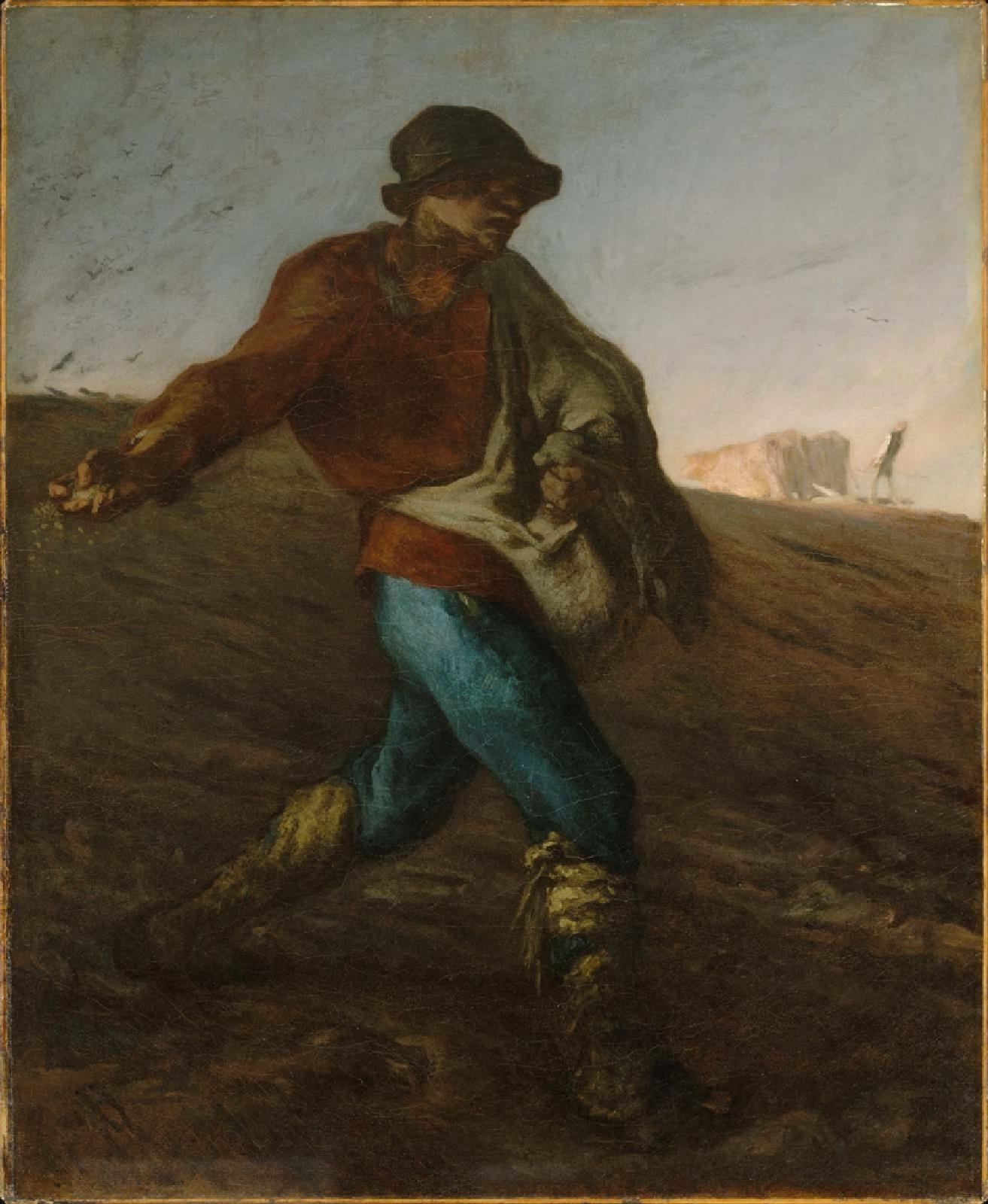
“The Sower,” 1850
Jean-François Millet (French, 1814–1875)
Museum of Fine Arts, Boston
Charles Bell’s Axiomatic Drama
June 21, 2022 – 8:56 am
Here is an annotated transcription of a 1981 manuscript by Charles Greenleaf Bell (1916–2010) called “The Axiomatic Drama of Classical Physics.” A theme is what Heraclitus observed, as in fragment B49a of Diels, LXXXI of Bywater, and D65a of Laks and Most:
We step and we do not step into the same rivers,
we are and we are not.ποταμοῖς τοῖς αὐτοῖς ἐμβαίνομέν τε καὶ οὐκ ἐμβαίνομεν,
εἶμέν τε καὶ οὐκ εἶμεν.
Bell reviews the mathematics, and the thought behind it, of
- free fall,
- the pendulum,
- the Carnot heat engine.
In a postlude called “The Uses of Paradox,” Bell notes:
Forty-five years ago I decided that when reason drives a sheer impasse into an activity which in fact goes on, we have to think of the polar cleavage as both real and unreal.
I like that reference to “an activity which in fact goes on.” In youth it may be hard to recognize that there are activities that go on. We do things then, but that they will get anywhere may be no more than a dream. In any case, Bell himself goes on:
… that is a job as huge and demanding as Aristotle’s, and for me at 70, just begun.
“Look,” my friends say, “Bell’s been doing the same thing since he was 25. About that time he had a vision of Paradox as paradise, and he’s been stuck there ever since.”
Creativity
June 6, 2022 – 6:26 am
In the Platonic dialogues, Socrates frequently mentions τέχνη (technê), which is art in the archaic sense: skill or craft. The concern of this post is how one develops a skill, and what it means to have one in the first place.
The Society of Mathematics
January 22, 2022 – 2:00 pm
This post concerns the Association for Mathematical Research, or AMR. A number of people are upset by its existence. I am not exactly one of them, but am suspicious, mainly because I do not know why a new organization would be needed, when we already have
- the London Mathematical Society (founded 1865);
- the American Mathematical Society (founded 1888);
- the Mathematical Association of America (founded 1915);
- the International Mathematical Union (founded 1920, refounded 1950);
- the European Mathematical Society (founded 1990);
- various other national and international bodies.
The Twitter account of the AMR is dated to April, 2021. The website of the AMR supplies a list of founding members, but no account of when, how, or why they became founders. The site has a brief mission statement:
THE MISSION of the AMR is to SUPPORT MATHEMATICAL RESEARCH and SCHOLARSHIP
Are those other organizations not doing a good job? Continue reading
Plato and Christianity
January 11, 2022 – 9:33 pm
This post uses work of Hannah Arendt, Augustine, R. G. Collingwood, Tom Holland, Somerset Maugham, and Ved Mehta.
In the first post of this series, I gave some reasons to read the Republic, and one of them was the problem of how our political leaders were not always the best. Plato had not solved that problem, since we still had it; but that meant nobody else had solved it either. Plato had at least taught us that people with great worldly power could nonetheless be more miserable than their subjects. In the Republic, Plato has Socrates teach that lesson
- to Thrasymachus, in the latter part of Book I;
- to Glaucon, who concludes at the end of Book IV that if having an unhealthy body is bad, having a vicious soul is worse;
- in Book IX, with the account of the tyrant;
- with the Myth of Er in Book X.
On Reading Plato’s Republic
December 28, 2021 – 2:00 pm
In adolescence, when I started visiting art museums in Washington for my own pleasure, I would visit also the museum shops, hoping to be able to take home a souvenir. Eventually, my own memories were enough to take home.
That is what I remember observing about myself, perhaps around the time when my body stopped growing taller. That time may be used to demarcate adulthood, although in kindergarten, it had made no sense to me that our bodies could ever stop growing.

Cycads outside Selenium Twins
in the valley above Ihlamur Kasırları
on the way to Beşiktaş
December 27, 2021
I have not been to a museum since the advent of Covid-19, but I often want a souvenir when I am reading now. The souvenir may be in the form of pencil marks in a book, or pen marks in a magazine, or various interventions in an electronic file. To be able to make such interventions, I save webpages, usually with a browser’s print function or with Print Friendly.
I may also respond to what I read by writing blog posts. This is why I now have eighteen of those on Plato’s Republic: one for each of the fourteen parts in which the dialogue was divided for an online discussion, and four more for when I had an abundance of ideas.
Where has all of that left me?
On Plato’s Republic, 14
December 13, 2021 – 6:48 pm
In the tenth and final book of Plato’s Republic (Stephanus 595–621), with the help of Glaucon, Socrates does three things:
- Confirm and strengthen the ban on imitative poetry carried out in Book III.
- Prove the immortality of the soul.
- Tell the Myth of Er about how best to make use of that immortality.

Bernard Picart
Glaucus Turned into a Sea-God, 1731
Continue reading