Here are some books that I have read more times than I can remember.
- R. G. Collingwood, The Principles of Art (1938);
- Somerset Maugham, The Razor’s Edge (1944);
- Robert M. Pirsig, Zen and the Art of Motorcycle Maintenance (1974).
The years of my first readings were 1987, 1984, and 1982, respectively, as best I can remember; in any case, their order is opposite to the order of publication.
I want to say some things about the books and their writers. I intend especially to address the last book, which I shall call ZAMM. From Pirsig’s more recent book, Lila, I mention only the author’s description of keeping notes on slips of paper, then arranging and rearranging them, in hopes that he might finally produce a book out of them. The present article might be considered as a collection of such notes, not necessarily forming a coherent whole. There are more notes that I might add in future.
While I was in high school, I paid the price of three dollars and thirty-three cents (plus tax) for the peculiar purple book in square format called Be Here Now. I suppose the title can be taken as a summation of the spiritual advice contained in the book. This advice is apparently derived mainly from Hinduism, though given to us by an American once called Richard Alpert, who spent a lot of time taking LSD with Timothy Leary. After I had gone off to read Great Books at St John’s College in Annapolis in 1983, and transferred to Santa Fe after a year, I learned that the Director of Laboratories on the occidental campus had lived at a sort of monastery or commune, elsewhere in New Mexico, supported by sales of Be Here Now.
The book ends with lists of recommended reading, headed with the warning, “Painted cakes do not satisfy hunger.” There are three lists:
- Books to hang out with.
- Books to visit with now and then.
- Books it’s useful to have met.
The “books to hang out with” are thirty-five authors and teachers and scriptures. Those that I have on my own shelves are the Bhagavad Gita, the Holy Bible, the Tibetan Book of the Dead, the Tao Te Ching, the I Ching, and the poems of Hafiz. I have not really hung out with any of these, except maybe parts of the Bible and the Tao Te Ching (the latter in the 1972 translation of Gia-Fu Feng and Jane English, illustrated with Chinese calligraphy of the former on lovely spare nature photographs by the latter).
From Be Here Now’s longer list of “books to visit with now and then,” I have read only some of the poetry of Rumi and William Blake, along with Hesse’s Siddhartha, Merton’s Seven Story Mountain, Reps’s Zen Flesh, Zen Bones, Rilke’s Duino Elegies, and Thoreau’s Walden. From the final, longest section, of “books it’s useful to have met,” the works that I have read are a curious mix of mostly science fiction and St John’s College Program books, by Asimov, Bradbury, Castaneda, Dante, Descartes, Heinlein, Milton, Pascal, Plotinus, Plato, Saint-Exupéry, Salinger, and Tolkien.
The three books that I listed at the beginning are among the books that I have hung out with. Let me record here a flaw in my memory concerning one of them. Before checking the lists in Be Here Now, I thought I remembered that The Razor’s Edge was there somewhere, if only among the “books it’s useful to have met”. But it is not there. Since it seems to fit the theme of spiritual journeys, I wonder if its absence is due to ignorance or oversight. Possibly Maugham was judged to be a spiritual lightweight. However, because on a web page I said The Razor’s Edge was one of my favorite books, I received emails from a fellow, calling himself the Wanderling, who said that his mentor, and not a fellow called Guy Hague, was the person who had been the source for Maugham’s character Larry Darrell.
Some people never read a book more than once. Some people cannot even conceive of doing this. Jerry Seinfeld would appear to be one of those people. In an early episode of his television series, Jerry ridicules George for wanting to retrieve some already-read books from the girlfriend with whom he has just broken up.
Presumably Seinfeld could conceive of watching a television show more than once. It is only because I have watched Seinfeld episodes more than once that I am able to recall and mention Jerry’s foolishness about books in the first place.
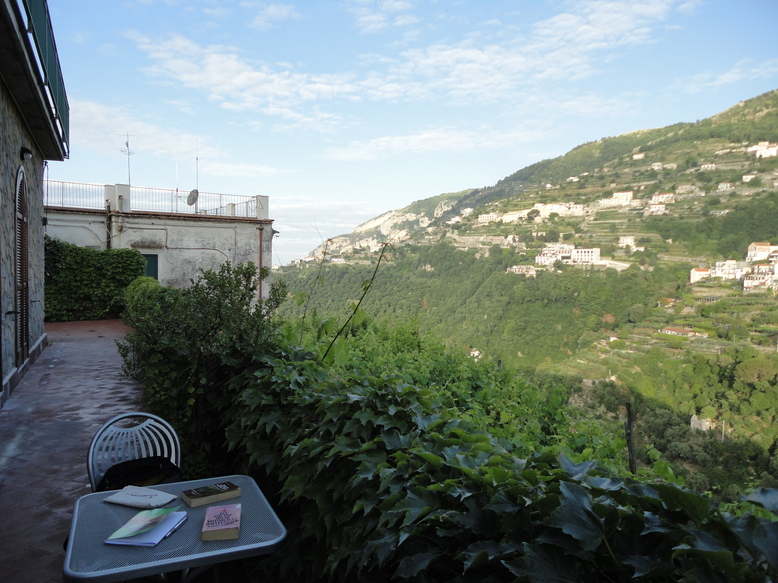
Recently I increased by one the unknown number of my readings of ZAMM. Earlier in this month of June, 2013, above the Tyrrhenian Sea, in the gorgeous hilltop setting of Ravello, where I was attending a mathematics conference, in the early mornings I would rise, sit outside, and either work on mathematics or read ZAMM.

ZAMM in the morning in Ravello
Continue reading →


 Polytropy