Category Archives: Persons

Pacifism

Pacifism is properly pacificism, the making of peace: not a belief or an attitude, but a practice. Mathematics then is pacifist, because learning it means learning that you cannot fight your way to the truth. Might does not make right. If others are going to agree with you, they will have to do it freely. Moreover, you cannot rest until they do agree with you, if you’ve got a piece of mathematics that you think is right; for you could be wrong, if others don’t agree.

The book *Dorothy Healey Remembers,* with photo of subject

Continue reading

Articles on Collingwood

This article gathers, and in some cases quotes and examines, popular articles about R. G. Collingwood (1889–1943).

  • By articles, I mean not blog posts like mine and others’, but essays by professionals in publications that have editors.

  • By popular, I mean written not for other professionals, but for the laity.

Continue reading

Mathematics and Logic

Large parts of this post are taken up with two subjects:

  1. The notion (due to Collingwood) of criteriological sciences, logic being one of them.

  2. Gödel’s theorems of completeness and incompleteness, as examples of results in the science of logic.

Like the most recent in the current spate of mathematics posts, the present one has arisen from material originally drafted for the first post in this series.

In that post, I defined mathematics as the science whose findings are proved by deduction. This definition does not say what mathematics is about. We can say however what logic is about: it is about mathematics quâ deduction, and more generally about reasoning as such. This makes logic a criteriological science, because logic seeks, examines, clarifies and limits the criteria whereby we can make deductions. As examples of this activity, Gödel’s theorems are, in a crude sense to be refined below, that

  • everything true in all possible mathematical worlds can be deduced;

  • some things true in the world of numbers can never be deduced;

  • the latter theorem is one of those things.

Continue reading

More of What It Is

I say that mathematics is the deductive science; and yet there would seem to be mathematicians who disagree. I take up two cases here.

Page of Greek text with diagram
From Archimedes, De Planorum Aequilibriis,
in Heiberg’s edition (Leipzig: Teubner, 1881)

Continue reading

What Mathematics Is

Mathematics “has no generally accepted definition,” according to Wikipedia on September 15, 2020, with two references. On September 14, 2023, the assertion is, “There is no general consensus among mathematicians about a common definition for their academic discipline”; this time, there are no references.

I suggest that what really has no generally accepted definition is the subject of mathematics: the object of study, what mathematics is about. Mathematics itself can be defined by its method. As Wikipedia says also (as of either date given above),

it has become customary to view mathematical research as establishing truth by rigorous deduction from appropriately chosen axioms and definitions.

I would put it more simply. Mathematics is the science whose findings are proved by deduction.

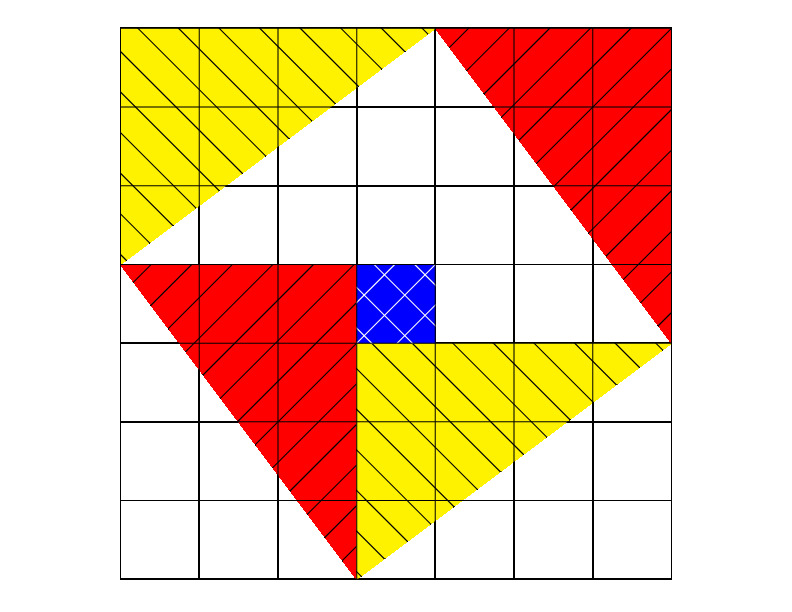
A 7×7 grid of squares, divided into four 3×4 rectangles arranged symmetrically about one square; the rectangles are divided in two by diagonals, which themselves describe a square
The right triangle whose legs are 3 and 4 has hypotenuse 5, because the square on it is
(4 − 3)2 + 2 ⋅ (4 ⋅ 3),
which is indeed 25 or 52. This is also
42 + 32.

Continue reading

Map of Art

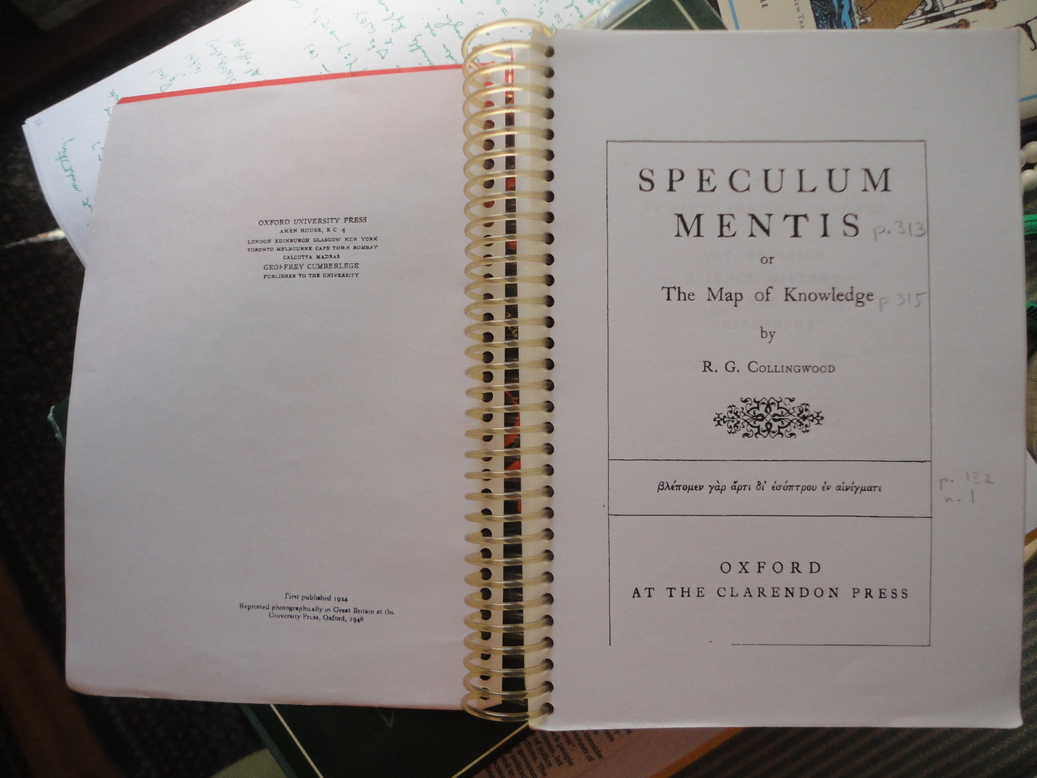
The bulk of this post is a summary of the chapter on art in Collingwood’s Speculum Mentis: or The Map of Knowledge (1924). The motto of the book is the first clause of I Corinthians 13:12:

Βλέπομεν γὰρ ἄρτι δι’ ἐσόπτρου ἐν αἰνίγματι

For now we see through a glass, darkly

The chapter “Art” has eight sections:

Continue reading

An Exercise in Analytic Geometry

This past spring (of 2020), when my university in Istanbul was closed (like all others in Turkey) against the spread of the novel coronavirus, I created for my students an exercise, to serve at least as a distraction for those who could find distraction in learning.

Diagram from textbook page shows, centered at the origin of coordinates, a circle and an ellipse whose four points of intersection are traversed by two lines in red through the origin
From Weeks & Adkins, Second Course in Algebra, p. 395

Note added, April 17, 2023: An account of the mathematics involved in the exercise would ultimately be published as: Pierce, D. (2021). “Conics in Place.” Annales Universitatis Paedagogicae Cracoviensis | Studia Ad Didacticam Mathematicae Pertinentia, 13, 127–150.

Continue reading

Be Sex Binary, We Are Not

Content warning: suicide.

The following sentence is bold in the last paragraph of an essay: “the science is clear and conclusive: sex is not binary, transgender people are real.” I don’t know what the writer means by this. As far as I can tell, as a biological concept used for explaining reproduction, sex has two kinds or parts or sides or aspects, and the essay tacitly affirms this; at the same time, obviously persons called transgender exist.

☾ ♂ ☿ ♃ ♀ ♄ ☉

The title of the essay is a command: “Stop Using Phony Science to Justify Transphobia.” I can support that. I don’t even need the qualifier “phony.” If transphobia is the kind of morbid fear suggested by the suffix “-phobia,” then science ought to help dispel this, not promote it.

One might also just say, Stop using phony science.

Continue reading

Return to Narnia

1

My subject is the Chronicles of Narnia of C. S. Lewis (1898–1963). I consider this heptad of books (published 1950–6) as constituting (1) literature (2) for children (3) that I continue to enjoy in my sixth decade, having started in my first.

  1. By literature, I mean a work of art whose medium is prose. Prose may also be a work of craft, intended to fulfil some purpose. This purpose could be to serve a market for fantasy or children’s books. Art as such has no purpose that can be specified in advance.

  2. Writing for children may take certain liberties that annoy adults.

  3. As with any post in this blog, I write out of my own personal interest. As a child, I read other fantasies, such as those of Lloyd Alexander, John Christopher, Ursula LeGuin, and J.R.R. Tolkien. Only the works of C. S. Lewis have stayed with me. This essay may be considered as an exploration of why, or least an example of how.

The seven books of the Chronicles of Narnia, Collier edition

Continue reading

Thoreau and Anacreon

Note added, October 5, 2023. At the end of this post, from sunny days in the first spring of the Covid pandemic, I take up Anacreon’s poem “The Thracian Filly,” translated as “To a Colt” in A Week on the Concord and Merrimack Rivers. Anacreon was from Teos, whose ruins I have visited. Thoreau may not be sensitive to the sexual connotations of the poem. First I review Thoreau’s book, noting in particular:

  • The book is written, like my blog posts, to please the author, who would rather do without money than sell stuff to get it.
  • The author’s relative indifference to human affairs in the face of nature is becoming less tenable, when a Pacific island inhabited by 40 persons and visited once a month by a boat (and once for all, probably, by a travel writer) is losing its palms to an invasive beetle.

Other books discussed or mentioned (and in my physical library) are

  • Bean, Aegean Turkey;
  • Collingwood, The First Mate’s Log;
  • Lawson, The Drinkers’ Guide to the Middle East;
  • Schalansky, Pocket Atlas of Remote Islands;
  • Thoreau, Walden;
  • Trypanis (ed.), The Penguin Book of Greek Verse;
  • Walls, Henry David Thoreau: A Life.

Gray clouds over blue sky over white clouds over buildings

Continue reading