Category Archives: Philosophy of History

For posts where not only the past, but thinking about the past, is a subject

NL IX: “Retrospect”

Index to this series

“All I want to know about mind,” says Collingwood,

is what it has done on certain definite occasions; not everything it has done, but enough for my purely practical purpose, deciding how to deal with the present attack on civilization.

This is from ¶9. 2 of New Leviathan. Three years ago, I set out here to read and write about this book, chapter by chapter. Continue reading

Thales of Miletus

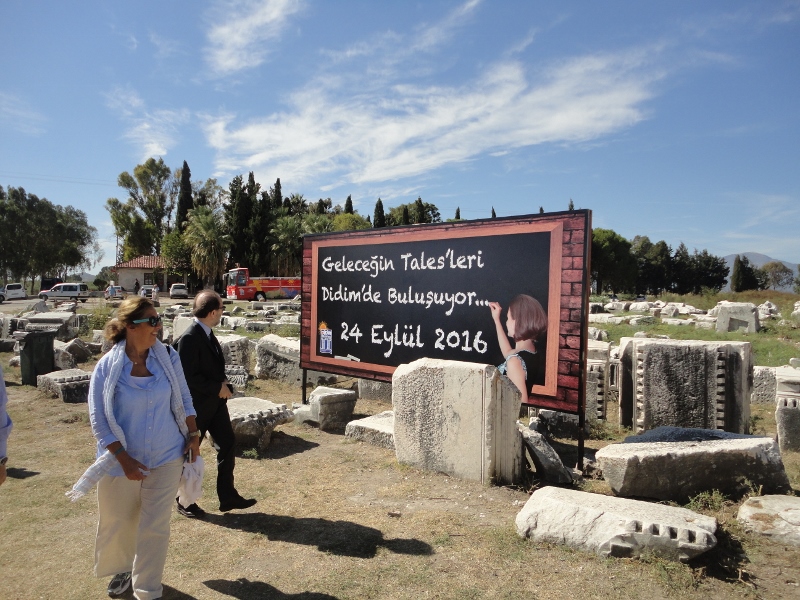
This is about Thales of Miletus and what it means to study him. I am moved to ask what history is in the first place. It is a study of the freedom in which we face our conditions. Thales had his way of understanding the world, and we may benefit from trying to learn it.

“The Thaleses of the future are meeting in Didim, September 24, 2016”

“The Thaleses of the future are meeting in Didim,
September 24, 2016”

Continue reading

Attribution of Fascism

I began writing this article on Saturday, December 10, 2016; I finished the next morning, Istanbul time. I wrote the first three paragraphs last. The planned breakfast did take place, quite pleasantly. The death toll in the bombing rose to 39. No matter how much I read drafts of my articles, I usually want to make changes after they are published. I made one such change visible in the first paragraph. After a friend left some comments, I made some other small changes. Again these are visible. Last I heard, the policy on Diaspora* is that published posts cannot be edited at all, because there should never be any question about which version of a post any resulting comments refer to. WordPress is not so strict, and in future I may just remove all signs of editing. There may not be any point in doing this in an essay that does not say everything that seemed worth saying at the time of writing. Better perhaps to leave the signs of work in progress. In any case, I shall retain access to the older versions.

Everything changes so fast, at least when one has an internet connection and a Twitter feed. As I try to wrap up this essay, I learn of a bombing outside a football stadium not too far from us here in Istanbul. Deaths are said to be in the teens, mostly of police officers. Twenty-nine persons are said to have died, all but two being police officers. Turkey has been in a state of emergency since the summer. Rescue vehicles had trouble getting through the normal traffic. The nearest hospitals are not operational.

Meanwhile, Donald Trump and his would-be appointees are called treasonous; but it is mainly liberals and lefties who are saying this. Russia was the big enemy when it was Communist; now some Republicans do not seem too concerned with its hold over Trump, while Democrats are reinventing the Red Scare.

If I hadn’t hooked up the internet connection, I would just be looking forward to a breakfast with friends later this morning, over on the Asian side of the Bosphorus. I expect this event to happen as planned, despite the bombing.

Now I just want to think a little bit about what fascism means, historically. It does seem to me that if Donald Trump has any ideology at all, it is fascism. Fascism is the doctrine that will guide his Presidency, if he is allowed to assume it. What this means is the main subject of this essay.

Books seen from above on a table: A Collection of Essays by George Orwell, on top of The Rise and Fall of the Third Reich; next to these, The Bones: A Handy, Where-to-Find-It Pocket Reference Companion to Euclid’s Elements

Continue reading

Happiness

If only tangentially sometimes, this is about living in Turkey, especially under the ongoing official state of emergency.

Aristotle, Marx & Engels, and Collingwood

A blog article on Medium recently struck me for its treatment of science. Dated October 3, the article is called “The Purpose Of Life Is Not Happiness: It’s Usefulness,” and its opening section is as follows.

Continue reading

Thinking & Feeling

This essay is written as a distraction from current events, though I make some reference to them. I am prompted by questions of analogy provoked by

  1. the similes of Homer and
  2. a recent theater review in Harper’s that mentions the parables of Jesus.

With sea in the background, on the sand of a beach sits Chapman’s Homer: The Iliad, the cover featuring a 16th-century Flemish tapestry (framed by a circle), Scene from Roman History, showing a number of men, the one in the middle armored; a horse is in the foreground

Continue reading

Academic Freedom

(See also other articles in the Freedom category.)

Yesterday (March 24, 2016) was the first day of the sixth Models and Groups Istanbul meeting. There were participants from the Middle East, Europe, and America. Kıvanç Ersoy was to speak about his own mathematics. He could not speak, because he was in prison. He, Esra Mungan, and Muzaffer Kaya were in prison, because the three of them had publicly insisted that the government of Turkey make peace in the southeast of the country. Absurd, but true. Continue reading

Liberation

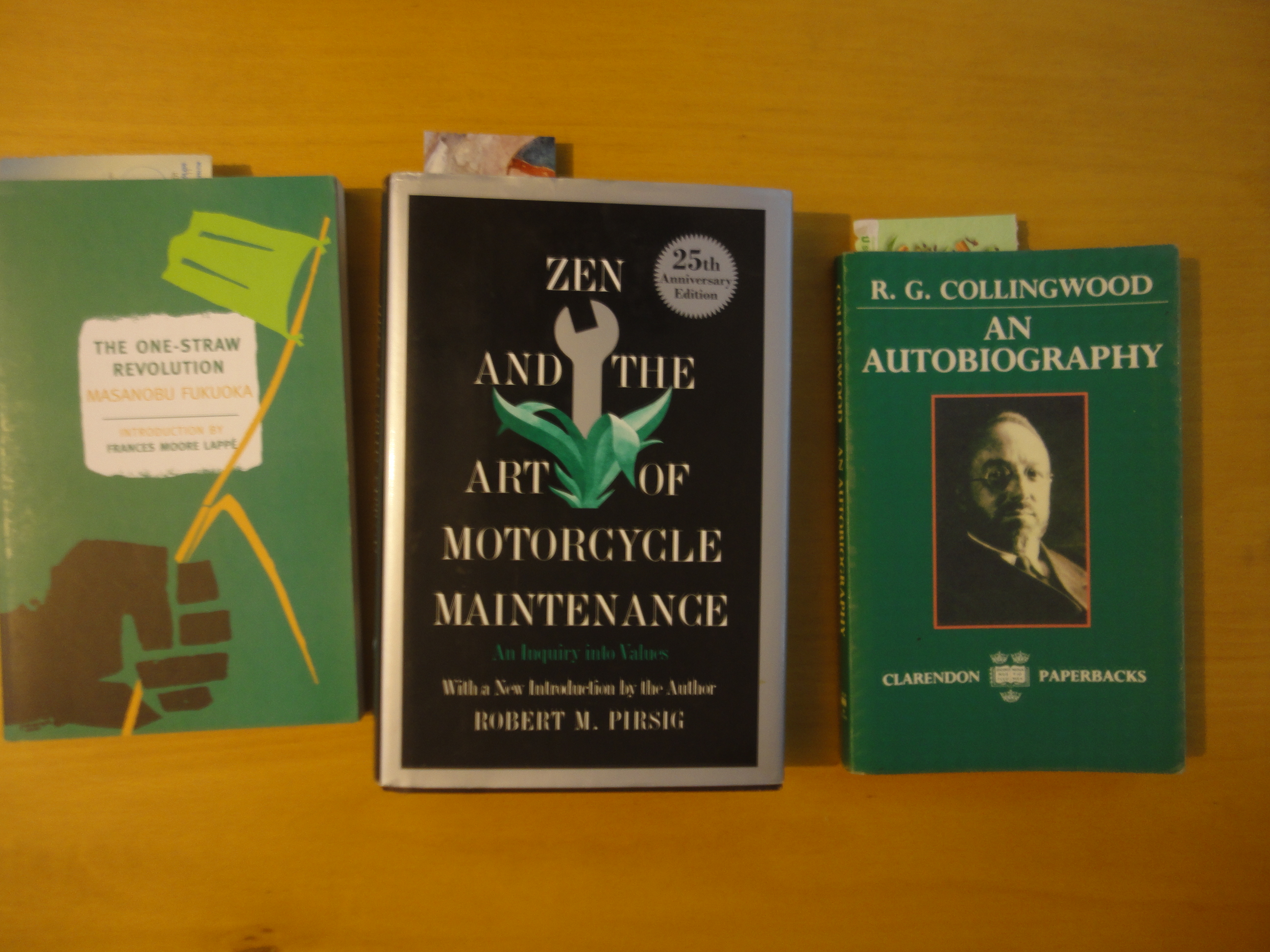
This article is based on quotations from three writers, of three different nationalities, who share a spirit with which I am in sympathy:

Fukuoka
“The ultimate goal of farming is not the growing of crops, but the cultivation and perfection of human beings.”
Pirsig
“The real cycle you’re working on is the cycle called ‘yourself.’ ”
Collingwood
“I thought that the democratic system was not only a form of government but a school of political experience coextensive with the nation.”

The books quoted here: The One-Straw Revolution, Zen and the Art of Motorcycle Maintenance, and An Autobiography. They all have on their covers a similar forest green, along with black

Continue reading

Body and Mind

Does consciousness have a “physical basis” or “material basis”? I am provoked by the suggestion that it does; for the question itself is misleading, if not simply meaningless.

In the September, 2014, issue of Harper’s magazine, Edward O. Wilson begins an essay called “On Free Will” with the following paragraph.

Continue reading

Inurement

This is about getting used to things, and things one should not get used to.

There is a free-speech crisis in Turkey now, brought on in part, but not exclusively, by the murders at the Charlie Hebdo offices in Paris. See an editorial of the Platform for Independent Journalism (P24) for a list of issues.

Continue reading

The Peace of Liberal Education

The wall of Dolmabahçe Sarayı, January 11, 2015

The wall of Dolmabahçe Sarayı, January 11, 2015

The occasion of this article is my discovery of a published Turkish translation of Collingwood’s Speculum Mentis or The Map of Knowledge (Oxford, 1924). Published as Speculum Mentis ya da Bilginin Haritası (Ankara: Doğu Batı, 2014), the translation is by Kubilay Aysevenler and Zerrin Eren. Near the end of the book, Collingwood writes the following paragraph about education, or what I would call more precisely liberal education. The main purpose of this article then is to offer the paragraph to any reader who happens to stop by.

Continue reading