Category Archives: Istanbul

Mîna Urgan on alphabets & Atatürk

mina-urgan-paragraf

In the news in Turkey lately (December 2014) is the vow or threat of the President to make lessons in Ottoman Turkish compulsory for Turkish schoolchildren. How realistic the threat is, I do not know. There is the Constitutional question of what the President’s powers actually are. There is also the practical question of whether it is even possible for most Turkish students to learn Ottoman. Foreign language education in Turkey is not generally very good; and as far as I can tell, Ottoman Turkish is practically a foreign language now. Two paragraphs from Geoffrey Lewis’s Turkish Grammar (Oxford, 1967, pages xx–xxi) are very interesting in this regard:

Continue reading

The Istanbul Seaside

The original purpose of this article was to display and explain two photographs by me: one of a seaside park, the other of an abandoned car. I do this, and I talk about the stresses and compensations of the big city. I continue with the theme of Freedom from an earlier article of that name.

It is now early December in Istanbul, 2014. We have hardly seen the sun for weeks. Some rain falls almost every day. One has to learn to go out when one can. Last Saturday was cloudy, but dry, so we walked down to the Tophane-i Amire—the “Cannon Foundry Imperial.” The name is romantic, because it dates from Ottoman times, and because, like Koh-i-Noor, it is in a Persian grammatical form that is obsolete in Turkish. Today’s name of the cannon foundry would be Amire Tophane.
Continue reading

Latest rise of the old moon

Recent mornings, looking out my window before dawn, I have seen the moon wane narrower and narrower. I suppose today was the last morning it will be seen for a few weeks. Time on the first photo is 6:26, daylight savings time in Istanbul, a few minutes after the prayer call from the mosque down the street.

DSC01672
Continue reading

Graffiti grammar

I happened to notice the words in the photograph below, written on a sidewalk box near the Özel Fransız Lape Hastanesi (the private Hôpital de la Paix), which has apparently been run by the Sisters of St Vincent de Paul since 1858. These must be the Sisters whom I occasionally see on the street.

It seems Gomidas was a patient at the Peace Hospital after his breakdown: a breakdown resulting from his deportation from Istanbul with other Armenian intellectuals in 1915. Gomidas was saved in body, not in spirit. Such is the history of the streets I walk daily.

Are the clouds descending on us?

DSC01607

The words in the photo:

Buraya Gri Boya Gelecek → Geliyor → Gelemedi

To here grey color will come → is coming → could not come

It could only come so far!

Precautions

On Monday morning, September 1, 2014, the car that was to take us to Atatürk Airport for a flight to Tbilisi for the Caucasian Mathematics Conference was late. The dispatcher said there had been a breakdown, but he was sending another car. To wait for this was frustrating; but the new car did come, and we made it to the airport in plenty of time. Indeed, our driver said the roads would be clear (and they were), because a lot of traffic had been tied up on the Bosphorus Bridge. This had been closed, because of a threatened suicide.

Continue reading

Istanbul, August 1, 2014

This is my first full day in Istanbul for three weeks, and I have four observations, on the color of the sky, on the habits political rulers, on public treatment of space, and on the value of art. Continue reading

Two women

On the left, Vincent van Gogh, Mousmé, 1888, National Gallery of Art, Washington. On the right, Stephen Chambers, Woman (Green Background), 2006, private collection, London; currently on display at the Pera Museum, Istanbul, where I saw it on Saturday, June 21, 2014, and made the (slightly tilted) photograph on the right below.

A10433.jpg

The van Gogh image, I downloaded from the National Gallery website. I cropped and resized the Chambers image to be the same height as the van Gogh; then I juxtaposed the two with convert +append van-gogh-la-mousme.jpg chambers-woman.jpg two-women.jpg

I did not know of the artist Stephen Chambers before. The green background of his Woman, and her expression, caused me to think of van Gogh’s Mousmé. The Mousmé’s head is round, but her dotted skirt is as flat as the blouse of the Woman.

Madness, stupidity, or evil?

In Turkey in 2014, May Day was an official holiday, and yet demonstrations in Taksim were banned. They had been banned also in 2013. In June of that year, I opined that the banning had contributed to the rage that erupted in the Gezi protests.

Why would the government ban demonstrations again this year? The only reasons I can think of are suggested by my title.

May Day demonstrations were permitted in 2012, and I remember the day as a joyous occasion. Some photographs of mine should suggest this.

May Day 2012 Istanbul

May Day 2012 Istanbul


Continue reading

Funeral march for Berkin Elvan

Posters around our university building invited us to leave together at two o’clock, to walk to Şişli Meydanı to await the hearse bearing the body of young Berkin Elvan. But for some reason the students left a bit early. Some faculty walked together.

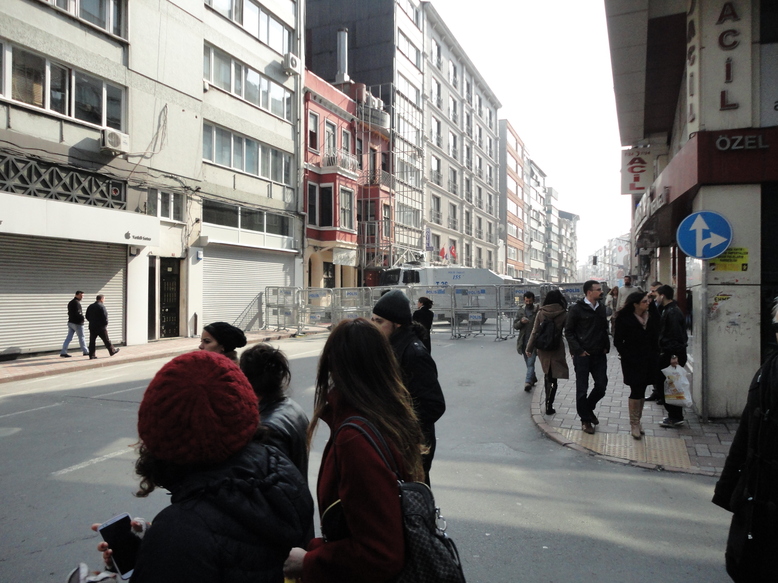
It’s a ten-minute walk to Şişli square. Police had blocked a street that ran parallel to the main avenue that we expected to march along.

DSC09843
Continue reading

NL VI: “Language”

Index to this series

This is about the first section of Chapter VI, “Language,” of The New Leviathan. The whole chapter can be ana­lyzed into five sections, with §N consisting of those paragraphs numbered 6. N or 6. NX. I summarize the sections as follows:

  1. Language is an abstraction from discourse. Discourse is an activity together with what is meant by it. (¶¶6. 1–19)
  2. Through language, we become conscious of our feelings. Becoming conscious of our language is another step, which is taken by artists. (¶¶6. 2–29)
  3. A feeling is not “mediated” by the language we use for it. (¶¶6. 3–36)
  4. Hobbes discovered that language is prior to knowledge. (¶¶6. 4–47)
  5. Those who dispute this finding over­look that not all language is rational. (¶¶6. 5–59)

Continue reading