Monism (Iliad Book XII)

At the end of the first half of the Iliad, as measured by its twenty-four books, the Trojans breech the Achaean defenses, in an assault led by Hector, who smashes through a gate with a stone. Homer describes even the physics involved (lines 457–60, Lattimore translation):

He came and stood very close and taking a strong wide stance threw
at the middle, leaning into the throw, that the cast might not lack
force, and smashed the hinges at either side, and the stone crashed
ponderously in, and the gates groaned deep, and the door-bars …

Before this breakthrough, the two sides have been deadlocked, as in two examples from civilian life.

  • In the first example, neighbors are fixing the property line that divides them (lines 421–4):

    but as two men with measuring ropes in their hands fight bitterly
    about a boundary line at the meeting place of two cornfields,
    and the two of them fight in the strait place over the rights of division,
    so the battlements held these armies apart, and across them

    Two cats, one black, one white, keep their distance from one another at the head of a stone walkway
    Above Kireçburnu (Κλειδὴς καὶ κλεῖθρα Πόντου, Lock and key of the Pontus)
    Sarıyer, Istanbul, Thursday, February 9, 2023

  • Continue reading

Soap (Iliad Book XI)

At the end of Book XI of the Iliad, the Trojans have the upper hand. They have wounded a number of Achaeans, as one of them, Eurypylus, tells Patroclus (lines 822–6):

No longer, illustrious Patroklos, can the Achaians
defend themselves, but they will be piled back into their black ships.
For all of these who were before the bravest in battle
are lying up among the ships with arrow or spear wounds
under the hands of the Trojans whose strength is forever on the uprise.

Nestor has just suggested to Patroclus that he fight in the armor of Achilles. The idea is a key element of the arc of the epic, but will not be realized till Book XVI, when Patroclus proposes it to Achilles without mentioning its provenance.

Perhaps I never thought about whether the idea was original to Patroclus. When I wrote about Book XI in 2018, I did not point out Nestor’s introduction of the idea there.

Orange sky seen through bare trees along an empty four-lane undivided road
ἠὼς δ᾽ ἐκ λεχέων παρ᾽ ἀγαυοῦ Τιθωνοῖο
ὄρνυθ᾽, ἵν᾽ ἀθανάτοισι φόως φέροι ἠδὲ βροτοῖσι
“Now Dawn rose from her couch from beside lordly Tithonus
to bring light to immortals and to mortal men” (Iliad XI.1–2)
Cloudy winter sunrise over Θεραπειά, Sarıyer, Istanbul
Saturday, February 4, 2023

Continue reading

Points of an Ellipse

This is about an image that is intended

  • to be decorative,
  • to establish the mathematical construction, with ruler and compass, of points of an ellipse.

Diagram with colored regions whose borders are discussed in the text

Continue reading

Verity (Iliad Book X)

The Trojans are watching, lest the Achaeans sail away in the night. Achilles is staying in his own camp. As we open Book X of the Iliad, Agamemnon cannot sleep. He worries, not just about the Trojans, but about whether his own men are properly worried.

A swimming man leaves a wake in a calm sea, whose gravelly bottom is seen in the foreground
One of two men I found swimming near Kireçburnu
Sarıyer, Istanbul
Sunday, New Year’s Day, 2023

Continue reading

Loneliness (Iliad Book IX)

I could have called this post “Democracy versus Autocracy.”

Four pigeons on a street face away from one another. The body of a cat on all fours is directed at them, but the cat’s head is turned away
Four pigeons and a cat
Tarabya Bayır Caddesi / Yücelevler Sokağı
(We live in the development behind the retaining wall)
Tarabya, Sarıyer, Istanbul
Wednesday morning, January 4, 2023

Continue reading

Emotional Contagion (Iliad VIII)

On the day recounted in Book VIII of the Iliad,

  • on earth, the Achaeans are twice driven behind their new walls;
    • during the first rout,
      • Odysseus does not hear when Diomedes urges him to come to the aid of Nestor;
      • Hector thinks he will be able to burn the Achaean ships and kill all the men;
      • Agamemnon prays for mere survival;
    • the second time, Hector calls for fires to be lit, lest the Greeks try to escape in the night;
  • in heaven, Zeus
    • weighs out a heavier fate for the Achaeans;
    • declares that it shall be so until Achilles is roused by the death of Patroclus;
    • warns Hera and Athena not to interfere (though they try to anyway).

I wrote a fuller summary in 2017. Because I was reading it, I also talked about Huysmans, Against Nature, and the belief of the main character that the prose poem could

contain within its small compass, like beef essence, the power of a novel, while eliminating its tedious analyses and superfluous descriptions.

Now I shall find reason to bring up Herodotus, Plato, Aristotle, Thoreau, and Freud, and especially William James and Collingwood on the subject of emotion.

Morning sun, obscured by overcast skies, still shines on waters in turmoil in the Bosphorus Strait
Waters of the Bosphorus, Sarıyer, Istanbul
Wednesday morning, January 11, 2023

Continue reading

On Homer’s Iliad Book VII

Book VII of the Iliad shows us the paradox of men at war who can still work together.

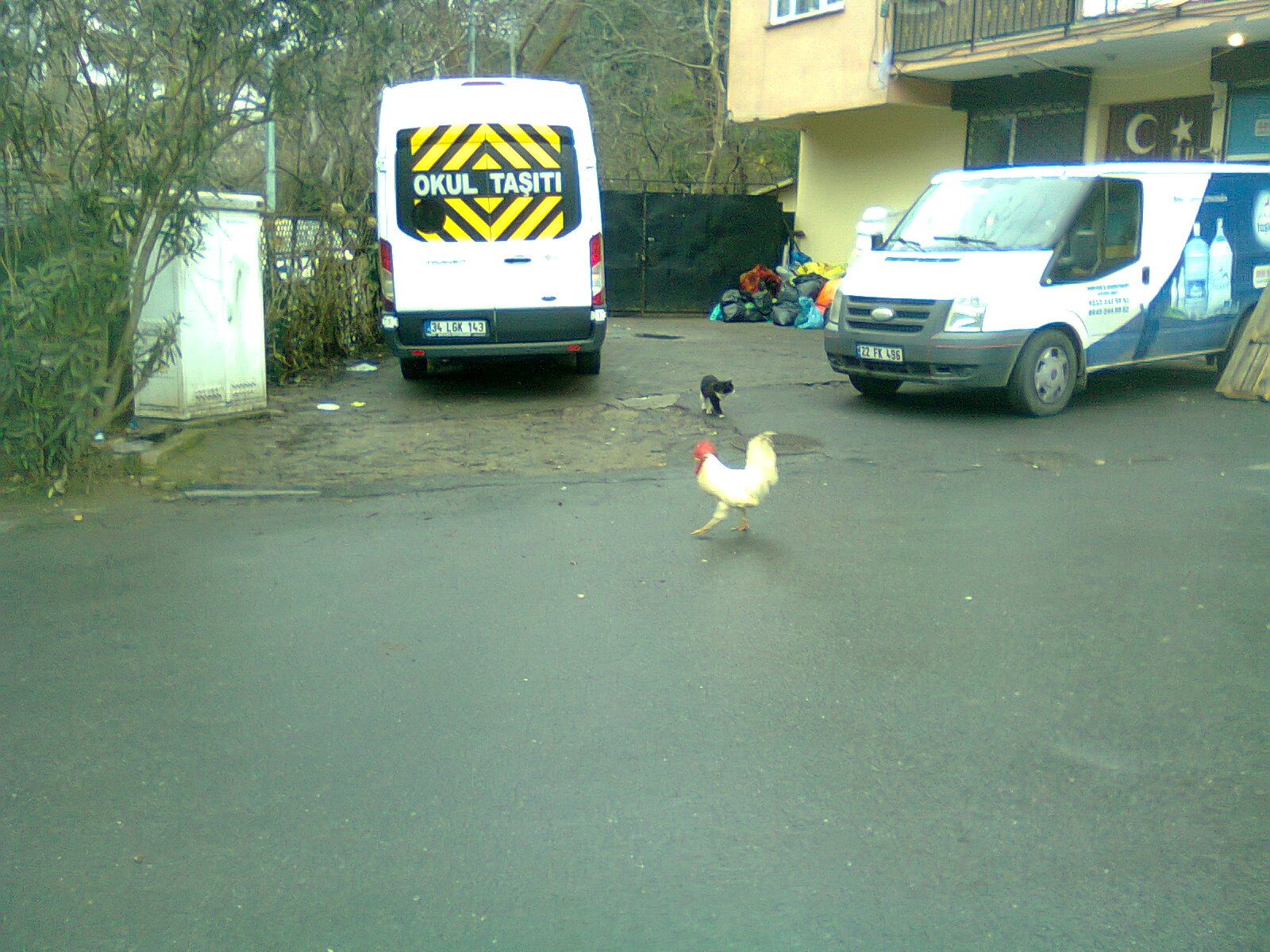
Street scene: a rooster walks down the road while, on his right side, a cat faces him. A minibus, car, and building are in the background, along with some greenery
Cock and cat on a village street
near a stream channelled between concrete walls
Tarabya, Sarıyer, Istanbul
Wednesday, January 11, 2023

Continue reading

Biological History

Sailboats and sun, seen through a mist and reflected in calm water
Tarabya Marina, Sarıyer, Istanbul
January 1, 2023

“As is the generation of leaves, so is that of humanity.” Glaucus says that to Diomedes in the Iliad, when the two warriors meet on the battlefield, and Diomedes wants to know whether he is facing man or god.

Humans are multitudinous and ephemeral, like the folia of trees, says Glaucus; why should his own tree be of interest to anybody else? It’s a pro forma question, perhaps, since Glaucus does proceed to describe his family.

Continue reading

On Homer’s Iliad Book VI

View from a height (with tree branch in upper right corner): on the ground below, a settlement; beyond it, a bend in a strait (the Bosphorus), the waters plied by a ship; beyond that, the two sides of the straight, opening to a sea (the Black Sea)
Kireçburnu, Sarıyer, Istanbul
Friday, December 30, 2022

On the last Wednesday of 2022, I first noted the existence of Andrew Tate. I was reading a blog post dated the previous day, December 27. The post was “Time Out,” by Neville Morley, who recalled,

there was a flurry last month when the loathsome Andrew Tate declared the pointlessness of all books and book-learning and was widely denounced on the Twitter.

Maybe I had noticed some of the flurry, while paying it little mind. Continue reading

On Homer’s Iliad Book V

Tangles of rebar from a building demolition sit, with a backhoe on top, on a narrow street paved with setts
Creative destruction
Arpa Suyu Sokağı, Şişli, Istanbul
Thursday, December 22, 2022

In Book V of the Iliad, the battlefield deaths that started in Book IV continue. Some of them are caused by Diomedes, who also stalks higher prey:

  • Giving him the power to recognize gods, Athena tells him to avoid all of them but Aphrodite, whom he then wounds.
  • When Athena gives him permission and encouragement to attack Ares, Diomedes wounds him too.

In echo of Achilles’s summoning of Thetis in Book I, the wounded gods go crying to their parents.