Pressure
Istanbul is a crowded, paved city. Consider the graphic below, showing public green space in Istanbul, London, New York, Berlin, Hong Kong, and Paris. The green space of Istanbul is almost invisible.
Istanbul is a crowded, paved city. Consider the graphic below, showing public green space in Istanbul, London, New York, Berlin, Hong Kong, and Paris. The green space of Istanbul is almost invisible.
Contents of this article:

View from Yeniköy, European Istanbul, October 9, 2023
In my writing about Collingwood’s New Leviathan, I am for the moment jumping ahead to Chapter XIII, “Choice.” I want to offer up the long excerpt below for comparison with a recent article, “Happiness and Its Discontents,” by Mari Ruti (1964–2023), in the Chronicle of Higher Education, January 20, 2014. That article begins:
As a critical theorist working at the intersection of Continental philosophy, psychoanalysis, and feminist and queer theory, I make observations about human life that are speculative rather than empirical.
What does this mean?
Ruti’s opening paragraph continues:
That may explain why my definition of character pertains to what is least tangible, least intelligible about our being, including the inchoate frequencies of desire that sometimes cause us to behave in ways that work against our rational understanding of how our lives are supposed to turn out.
I think I know what desire is, but I do not know what its inchoate frequencies would be. Is Ruti suggesting a metaphor of
Perhaps she is looking for another way to say what Pascal did in the Pensées, Sellier 680, “Discours de la Machine”:
She continues with another paragraph (the bolding is mine):
If identity captures something about the relatively polished social persona we present to the world, then character – in my view – captures something about the wholly idiosyncratic and potentially rebellious energies that, every so often, break the facade of that persona. From this perspective, our character leaps forth whenever we do something “crazy,” such as suddenly dissolving a committed relationship or leaving a promising career path. At such moments, what is fierce and unapologetic about us undermines our attempts to lead a “reasonable” life, causing us to follow an inner directive that may be as enigmatic as it is compelling. We may not know why we feel called to a new destiny, but we sense that not heeding that call will stifle what is most alive within us.
It sounds as Ruti hurt somebody badly, or they her, but Wikipedia has nothing of her adult personal life. It appears she distinguishes character from identity. Doing crazy things shows you have character. I quote one more paragraph:
Unfortunately, we live in a culture that finds such insurrections threatening, not least because they make us less predictable and therefore harder to control. This is one reason we’re constantly reminded of the importance of leading a happy, balanced life – the kind of life that “makes sense” from the viewpoint of the dominant social order. Many of us have, in fact, internalized the ideal of a happy, balanced life to such an extent that we find it hard to imagine alternatives. As Freud has already claimed, there is little doubt about what most people want out of life: “They want to become happy and to remain so.”
How is it unfortunate to live in a culture that is threatened by crazy behavior? Craziness is threatening to culture, almost by definition. One might perhaps speak of cultures that are more or less tolerant of nonconformity. An individual might move, physically, from one culture to another, as I have moved from the United States to Turkey. The shopping malls here are still filled with shops bearing the same names found in the U.S. and western Europe.
A slogan of one of these shops that I recall from the U.S. (albeit over two decades ago) is “Sometimes you gotta break the rules.” Is this a sign of a tolerant culture? It might rather be taken as a sign of a culture that wants to rein in nonconformity, by directing it into less threatening channels. Any culture will want to do this, be it with commercialism or tear gas.
Ultimately culture is created by us. I do not want to try to say more now, except to note a theme of Ruti that is shared with Collingwood: the rejection of happiness, and the subsequent discovery of something better. Here then Collingwood:
13. 1. A man about to choose finds himself aware of a situation in which alternative courses of action are open to him. It is between these that he chooses.
13. 11. I distinguish choice from decision only as two words which mean nearly enough the same thing to be left here undistinguished.
13. 12. The kind of choice with which I am concerned in this chapter is only one kind: the simplest; mere choice or mere decision, uncomplicated by any reason why it should be made in this way and not that; in fact, caprice.
13. 13. If the reader thinks that caprice is a subject unworthy of his attention, let him skip this chapter.
13. 14. Choice is not preference, though the words are sometimes used as synonyms. Preference is desire as involving alternatives. A man who ‘prefers’ a to b does not choose at all; he suffers desire for a and aversion towards b, and goes where desire leads him.
13. 15. Preference involves a situation where there are alternatives, but closed alternatives. There are alternatives, for a man who cannot control his fear of bulls, between walking calmly past this one’s nose and running away; but preference closes the alternative and forces him to run away.
13. 16. Choice presupposes that the alternatives are open. A man in a position to choose whether he shall walk calmly in front of the bull’s nose has open alternatives to choose from (13. 1).
13. 17. This leads us to the problem of free will. There are many pseudo-problems of free will. There is the question: ‘Are we free?’ Clever men have invented arguments to prove that ‘we’ are not. Thus arose the controversy in which Dr. Johnson (creditably, for a man so addicted to argument) refused to take part, with the memorable pronouncement, ‘Sir, we know that we are free, and there’s an end on’t’.
13. 18. Johnson was pointing out (correctly) that freedom is a first-order object of consciousness to every man whose mental development has reached the ability to choose. In choosing, every man is immediately conscious of being free; free, that is, to choose between alternatives. Arguments as to whether this immediate consciousness is to be trusted are futile, as involving the Fallacy of Misplaced Argument (4. 73).
[There is no ¶13. 19.]
13. 2. The problem of free will is not whether men are free (for every one is free who has reached the level of development that enables him to choose) but, how does a man become free? For he must be free before he can make a choice; consequently no man can become free by choosing.
13. 21. The act of becoming free cannot be done to a man by anything other than himself. Let us call it, then, an act of self-liberation. This act cannot be voluntary.
13. 22. ‘Liberation from what?’ From dominance of desire. ‘Liberation to do what?’ To make decisions.
13. 27. Negatively, [freedom of will] is the act of refusing to let oneself be dictated to by desire. We hear of a man ‘controlling his appetites’; but under what circumstances can this really be done?
13. 28. The process that is nipped in the bud is strictly speaking not the process from unsatisfied appetite to satisfaction, but the process from the unhappiness of ungratified desire to the happiness of gratified desire. A little thought will show the reader why this must be so.
13. 29. Positively, this act is the acceptance of unhappiness; the acceptance of badness in oneself and weakness in relation to other things; the renunciation of virtue and power as things one no longer cares to pursue.
13. 3. Since the desiring self simply consists of the practical ‘urge’ from unhappiness to happiness, this act is a cutting off of all that is going on in the life of the man who does it; as a kind of suicide, it goes by a name intolerably debased in the passage from mouth to mouth: self-denial.
13. 31. The acceptance of unhappiness by a man who wishes for nothing but happiness, and is nothing but the act of wishing, is certainly a strange and improbable thing to happen, though not an impossible one; it is the only way by which a man attains a more valuable thing than happiness, freedom; and the consciousness of being free, self-respect.
13. 32. The man who denies himself and gains self-respect is richly rewarded; but that is not why he does it. His act of self-denial, not being a voluntary act (13. 21), cannot be a utilitarian act, the exchange of one thing for something more valuable.
13. 33. And if he knew what he stands to gain, he would not value it. What charm has self-respect for a man whose desires are concentrated on happiness?
13. 34. Can such an act be explained by appeal to something like what Freud calls the ‘death-instinct’?
13. 35. Not unless the sleep-producing property of opium can be explained by reference to a vertus dormativa.
13. 38. … It is a good rule that most men, most of the time, pursue happiness; so good, indeed, that it is worth betting on. But the rule cannot be stated in such a way as to explain the exceptions to itself, and make you win the bets you have lost.
13. 39. In defiance of psychological probability, men do sometimes neglect or defy what is called their ‘duty to themselves’, and in consequence make the strange discovery of freedom. Whether any non-human animal has ever done this I do not know; among human animals more, perhaps, have been credited with doing it than have actually done it.
13. 4. There is no sense in asking, when a man is found behaving in this way, ‘why’ he does it. The word ‘why’ has many well-established senses; none is appropriate here.
13. 41. But there is much sense in asking ‘how’ he does it; and the answer is: ‘By the use of speech’.
13. 42. A man liberates himself from a particular desire by naming it; not giving it any name that comes at haphazard into his head, but giving it its right name, the name it really has in the language he really talks.
13. 43. Once he has done this he can do it again; most easily for another desire of the same kind; but in principle, with more or less difficulty, for any desire whatever.
13. 44. Such at least is the doctrine common to Spinoza, the authors and divulgators of fairy-tales, and psycho-analysts.
Perhaps one should note again that liberation from a desire is more precisely liberation from its dominance, not from having it at all.
Edited October 18, 2023, when I added that last sentence. Posting “Freeness” this morning did not end suffering in Gaza, Israel, Ukraine, Armenia, Afghanistan, or anywhere else, but calmed my thoughts somewhat.
In Chapter I of The New Leviathan, we stipulated that natural science, the “science of body,” must be free to pursue its own aims. But we ourselves are doing science of mind, and:
1. 85. The sciences of mind, unless they preach error or confuse the issue by dishonest or involuntary obscurity, can tell us nothing but what each can verify for himself by reflecting on his own mind.
All of us can be scientists of mind, if only we are capable of reflection: Continue reading
Added May 7, 2019. My project to read and write a blog post about each of the 45 chapters of Collingwood’s New Leviathan (1942) began in January, 2014. A month and five years later, in February, 2019, the project was complete, in the sense that I had indeed written an article about each chapter of the book. Now I can go back to reread the earlier chapters, and revise the earlier articles, knowing better where they lead. ¶ Near the beginning, I wrote this post as an explanation of the project and an index to its articles. The passing of time and my reading of the book has changed my understanding of the project. From a way to satisfy intellectual curiosity, the project has become a response to threats as serious as the war of conquest by Germany to which Collingwood was responding.

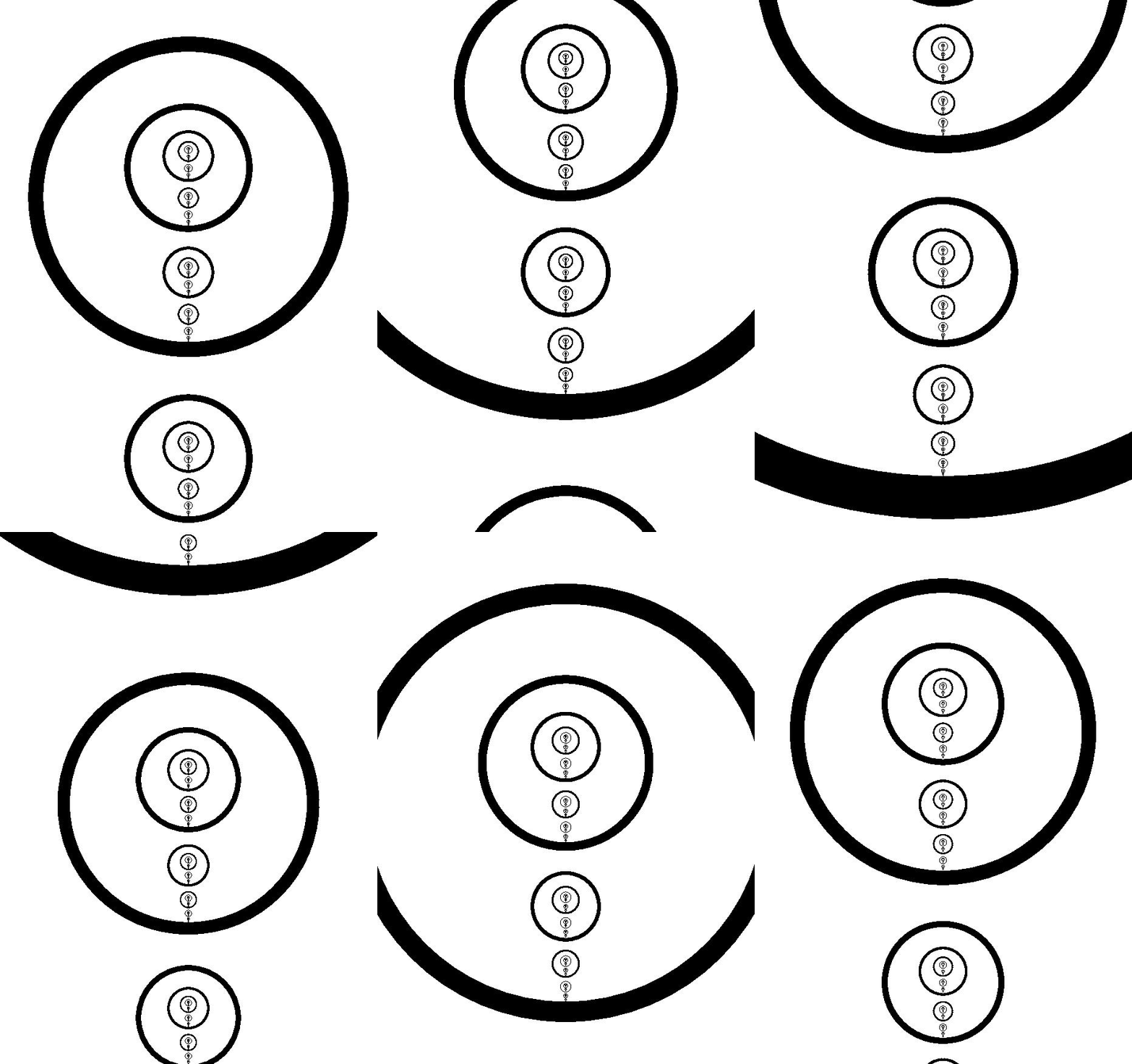
Here is an image that I made when preparing the article Self-similarity nine months ago. The image appeared as a draft in the list of all of my articles on this blog. Here it is officially:
I continue making notes on The New Leviathan of R. G. Collingwood (1889–1943). Now my main concern is with the second chapter, “The Relation Between Body and Mind”; but I shall range widely, as I did for the first chapter.
Some writers begin with an outline, which they proceed to fill out with words. At least, they do this if they do what they are taught in school, according to Robert Pirsig:
He showed how the aspect of Quality called unity, the hanging-togetherness of a story, could be improved with a technique called an outline. The authority of an argument could be jacked up with a technique called footnotes, which gives authoritative reference. Outlines and footnotes are standard things taught in all freshman composition classes, but now as devices for improving Quality they had a purpose.
That is from Zen and the Art of Motorcycle Maintenance, chapter 17.
Does anybody strictly follow the textbook method of writing? Continue reading
A march from Taksim Square to the offices of Agos newspaper, where Hrant Dink was assassinated seven years ago today, January 19, 2014.

Seller of water and whistles

“We are all Hrant, we are all Armenian” (in Armenian, Turkish, and Kurdish)
Below is a provocative passage from the conclusion of R. G. Collingwood, The Principles of Art (page 325). Oxford first published the book in 1938, and its 1958 paperback edition is still in print. I assume the book continues to be printed without a copyright notice; at any rate, my own paperback copy, from the nineteenth printing, purchased in 1988, has no copyright notice.
I typed up the passage below and put it on my departmental website years ago. I have placed the passage here, because of an article that I chanced upon through the Arts & Letters Daily site. The article itself is on the Poetry Foundation website, is by Ruth Graham, and is called “Word Theft: Why did 2013 become the year of the plagiarists?”
I gather from the article that some contemporary poets have been found to have plagiarized from other contemporary poets; and what is especially annoying about the plagiarism is that the plagiarists are not actually improving what they are appropriating. In this case, they are not following Collingwood’s recommendation, though possibly they are ineptly trying:
To begin by developing a general point already made in the preceding chapter: we must get rid of the conception of artistic ownership. In this sphere, whatever may be true of others, la propriété c’est le vol. We try to secure a livelihood for our artists (and God knows they need it) by copyright laws protecting them against plagiarism; but the reason why our artists are in such a poor way is because of that very individualism which these laws enforce. If an artist may say nothing except what he has invented by his own sole efforts, it stands to reason he will be poor in ideas. If he could take what he wants wherever he could find it, as Euripides and Dante and Michelangelo and Shakespeare and Bach were free, his larder would always be full, and his cookery might be worth tasting.
This is a simple matter, and one in which artists can act for themselves without asking help (which I am afraid they would ask in vain) from lawyers and legislators. Let every artist make a vow, and here among artists I include all such as write or speak on scientific or learned subjects, never to prosecute or lend himself to a prosecution under the law of copyright. Let any artist who appeals to that law be cut by his friends, asked to resign from his clubs, and cold-shouldered by any society in which right-thinking artists have influence. It would not be many years before the law was a dead letter, and the strangle-hold of artistic individualism in this one respect a thing of the past.
This, however, will not be enough unless the freedom so won is used. Let all such artists as understand one another, therefore, plagiarize each other’s work like men. Let each borrow his friends’ best ideas, and try to improve on them. If A thinks himself a better poet than B, let him stop hinting it in the pages of an essay; let him re-write B’s poems and publish his own improved version. If X is dissatisfied with Y’s this-year Academy picture, let him paint one caricaturing it; not a sketch in Punch, but a full-sized picture for next year’s Academy. I will not rely upon the hanging committee’s sense of humour to the extent of guaranteeing that they would exhibit it; but if they did, we should get brighter Academy exhibitions. Or if he cannot improve on his friends’ ideas, at least let him borrow them; it will do him good to try fitting them into works of his own, and it will be an advertisement for the creditor. An absurd suggestion? Well, I am only proposing that modern artists should treat each other as Greek dramatists or Renaissance painters or Elizabethan poets did. If any one thinks that the law of copyright has fostered better art than those barbarous times could produce, I will not try to convert them.
Collingwood’s book suggests the author’s admiration for T. S. Eliot, and the two contemporary thinkers seem to share an opinion about copying. Eliot’s verbalization of the idea is apparently the more memorable one and is quoted by Ms Graham in the article on the Poetry Foundation website:
T. S. Eliot, who relied on other sources for much of “The Waste Land” (plagiarism or allusion?), famously wrote, “Immature poets imitate; mature poets steal.” Less often quoted is the next line, “Bad poets deface what they take.” This is what seems to gall many victims of plagiarists: to see their poems reprinted in weaker versions than the original.
Give childhood back to children.
via Give childhood back to children.
I created this article by pressing a button beneath the friend’s article that is linked to above. That article links in turn to an article by Peter Gray in The Independent with the headline “Give childhood back to children: if we want our offspring to have happy, productive and moral lives, we must allow more time for play, not less”. Gray writes,
I’m lucky. I grew up in the United States in the 1950s, at the tail end of what the historian Howard Chudacoff refers to as the “golden age” of children’s free play. The need for child labour had declined greatly, decades earlier, and adults had not yet begun to take away the freedom that children had gained.
I don’t think Gray quite says this, but it seems to me that making young people study in school for the sake of their future remunerative employment is just another form of child labor, even if it is supposed to be for their own good. As angry children are supposedly wont to say, they didn’t ask to be born in the first place.

 Polytropy