Tag Archives: 2019

On Chapman’s Homer’s Iliad, Book XXII

Note added September 9, 2024: In “Potential (Iliad Book XIII)” and “Femininity (Iliad Book XIV),” I wondered whether an editor would remove Books XII and XIII (or at least the latter) for featuring neither Agamemnon (wounded in Book XI) nor Achilles (still on strike, despite the pleas in Book IX). An editor might remove or trim Books XX and XXI too, for being “only” about a warrior gone berserk. After Achilles has

  • recognized his foolishness in Book XVIII,
  • patched things up with Agamemnon in Book XIX,

that could be enough, even for an epic. I continue to wonder about the function of the ensuing two books. Do they show how words of contrition may not represent a real change of heart? As well as Aeneas and his genealogy, the books give us Polydorus and Lycaon, sons of Laothoë, daughter of Altes; killed by Achilles, the boys will be missed by their father, Priam, in Book XXII. This book is a relief, not because Achilles gives anybody any relief; that will come in Book XIV.

Andromache draws a hot bath, for Hector to slip into when he comes home from the war. Actually she has her maids heat the water, while she herself weaves flowers into a tapestry.

Rocks in foreground, houses in background, and in front of them, a spit of sand; rippling sea on the left, still water on the right, with a narrow passage between
Mouth of stream forming border between Balıkesir and İzmir
Continue reading

On Chapman’s Homer’s Iliad, Book XXI

Jove allowed the gods to aid whom they would, in the previous book of the Iliad; now, in Book XXI, they fight with one another. The god of fire attacks a river god; the god of war, the goddess of wisdom. This calls into question the notion of gods as personifications of abstract concepts.

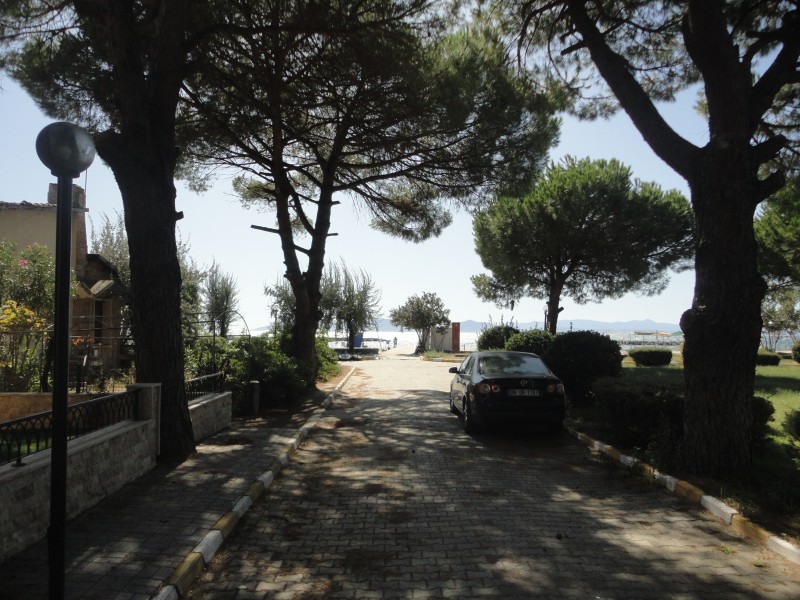
Road to beach, shaded by pines

Continue reading

On Chapman’s Homer’s Iliad, Book XX

The Wikipedia article “Superhero” traces the word itself to “at least 1917,” giving “such folkloric heroes as Robin Hood” as “Antecedents of the archetype.” I don’t know why Achilles should not be considered as an antecedent. According to the opening description,

A superhero is a type of heroic stock character, usually possessing supernatural or superhuman powers, who is dedicated to fighting the evil of their universe, protecting the public, and usually battling super-villains.

Achilles has superhuman powers; he has supernatural powers, when aided by the gods; and now in Book XX of the Iliad, as far as the Greeks are concerned, he is fighting the evil of their universe. However, the Trojans are not evil in Homer’s universe. There is no Manichaean principle of evil, and much less is Achilles personally devoted to fighting it.

Nonetheless, Book XX would seem to be a battle of the superheroes.

Spreading pine branches
The scene from where I read as the sun went down

Continue reading

On Chapman’s Homer’s Iliad, Book XIX

Book XIX of the Iliad consists mostly of speeches.

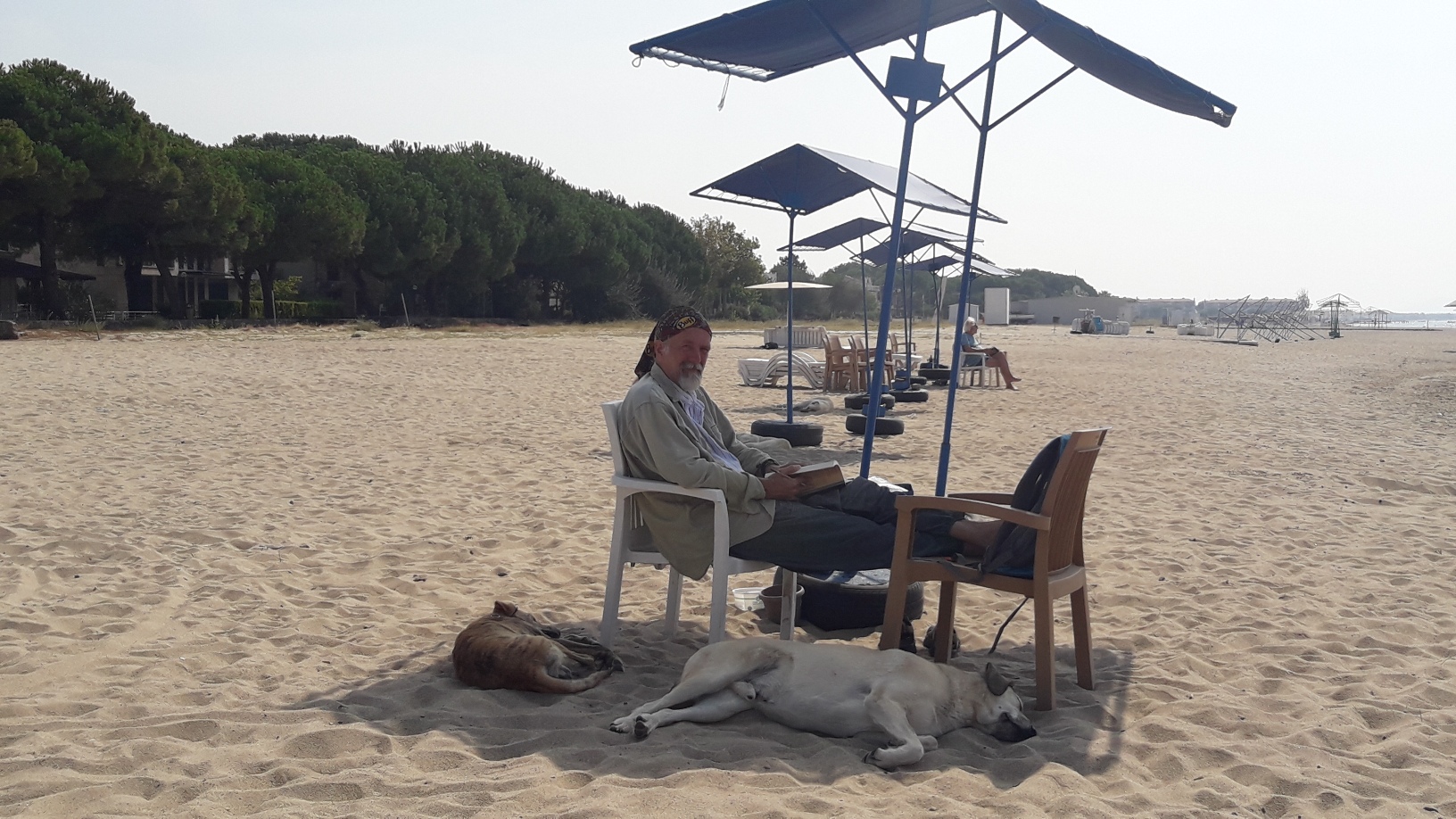
Myself on the beach with dogs, pines behind

Continue reading

On Chapman’s Homer’s Iliad, Book XVIII

I analyze Book XVIII of the Iliad into seven scenes.

Branches against sky

Continue reading

On Chapman’s Homer’s Iliad, Book XVII

Book XVI of the Iliad ended with the death of Patroclus; Book XVIII will begin with Achilles’s learning of the death. Book XVII gives us the fight over the body.

Dogs in the shade on the beach in the waning summer

Continue reading

On Chapman’s Homer’s Iliad, Book XVI

It is the story of Icarus. A man gets wings, flies too high, and is burned. Icarus is Patroclus, the wings are Achilles’s armaments, and flying too high is assaulting the very walls of Troy.

Seen from below, a wooden minaret appears as a triangle, transected by the line of a roof
Kocabey Mosque, Şavşat, Artvin

Continue reading

On Chapman’s Homer’s Iliad, Book XV

After a year, I return to reading the Iliad on the Asian mainland of Turkey. I am opposite Lesbos, south of Mount Ida, where in the last episode, Juno seduced Jove, so that he would not see Neptune’s interference on behalf of the Greeks, in the war down at Troy.

We were here in Altınova (in the province of Balıkesir) in July, but my mind then was on mathematics, including mathematics coming out of my April post here, “Elliptical Affinity.” I went on to speak of this mathematics in two other countries, one of these the homeland of Medea. In the other country, I was moved to write a post concerning the book I had already blogged a lot about. Now Ayşe and other Peace Academics are being cleared of charges, our fall semester does not begin till October, and we can spend time at the beach.

The silhouette of this edifice is roughly triangular. The floor plan is a nonconvex polygon, but above the walls is a smaller cylinder with a conical roof
Twelve Apostles, a former Armenian church, now a mosque, in Kars

Continue reading

A Final Statement

This concludes the series that began with “An Indictment” and continued with “A Defense.”

Ayşe and Meriç her lawyer

Continue reading

Math, Maugham, and Man

Note added, August 28, 2023. The main purpose of this post of September 1, 2019, seems to have been to assemble some information about the etymologies of “man” and “woman,” because of ongoing controversy about what the words even mean today. I started to take up the controversy itself on December 30 of that year, in “Sex and Gender.” Meanwhile, this post suggests, or points out:

  • a generic “person” may still be male in people’s minds;
  • becoming a woman may be like becoming Jewish;
  • there are no gendered pronouns in Turkish;
  • the series freshman, sophomore, junior, senior is like pinkie, ring finger, middle finger;
  • Greek does not have such an interesting series for the fingers;
  • Greek mathematics includes Thales’s Theorem and Pappus’s Hexagon Theorem.

There does not seem to be any connection between the mathematics and the etymology here, except that I was studying both at the same time. I must have been reading The Razor’s Edge too, where Maugham

  • places himself in a tradition founded by Herodotus;
  • uses “he/him” for for somebody who can be a woman as well as a man.

More themes I took up:

  • what it means to be natural;
  • that I don’t consider myself ADHD;
  • the etymology of “squirrel”;
  • the Etymological Fallacy.

A dog lying in the shade of a beach umbrella looks at us; behind him are a woman and a man sitting facing away from us, towards the sea
Woman, man, and dog
Friday, August 18, 2023
Altınova, Balıkesir, Türkiye

Continue reading