Tag Archives: Douglas Hofstadter

Omniscience

I have been working on a post that could have been the result of the following prompt:

Write on Gödel’s Incompleteness Theorem and AI, using such thinkers as

  • Yuval Noah Harari (b. 1976),
  • William Deresiewicz (b. 1964),
  • Annie Dillard (b. 1945),
  • Roger Penrose (b. 1931),
  • Robert Pirsig (1928–2017),
  • George Orwell (1903–50),
  • E.B. White (1899–1985),
  • Michael Attaleiates (c. 1022–80), and
  • Plato (fl. 4th cent. b.c.e.).

Not until I had finished a first draft did I actually know that all of those people would feature. My real prompt had been more like,

In the style of David Pierce, write on Gödel’s Incompleteness Theorem and AI, as discussed by Roger Penrose in his “Précis of The Emperor’s New Mind.

So instructed, could an LLM have come up with the connections that I did? Well, sure. Anything that has happened, could have happened, even in some other way. The real question is whether I would want AI to write my next post.

The present post consists of things I wanted to say at the beginning of that other post, after I had a first draft.

          ⯅          

Note added September 27, 2025. The next post after this one was

  • Prairie Life,” comparing Robert Pirsig and Wendell Berry, because I was reading them both.

After that came the two posts that the draft mentioned above turned into:

After those came

  • The System,” on what was bothering Pirsig; this led me to the resurgence of fascism today.

I was trying to work all of this out in the place in the photo below.

          ⯆          

Two tall bushes, lit up by the sun, rise in front of a low wall, next to a pine trunk; crowns of pines behind

Laurels in the garden
Altınova, Ayvalik, Balıkesir
September 2, 2025

Continue reading

Loneliness (Iliad Book IX)

I could have called this post “Democracy versus Autocracy.”

Four pigeons on a street face away from one another. The body of a cat on all fours is directed at them, but the cat’s head is turned away
Four pigeons and a cat
Tarabya Bayır Caddesi / Yücelevler Sokağı
(We live in the development behind the retaining wall)
Tarabya, Sarıyer, Istanbul
Wednesday morning, January 4, 2023

Continue reading

Gödel, Grammar, and Mathematics

Preface

This attempt at exposition of Gödel’s Incompleteness Theorem was inspired or provoked by somebody else’s attempt at the same thing, in a blog post that a friend directed me to. I wanted in response to set the theorem in the context of mathematics rather than computer science.

Continue reading

Mathematics and Logic

Large parts of this post are taken up with two subjects:

  1. The notion (due to Collingwood) of criteriological sciences, logic being one of them.

  2. Gödel’s theorems of completeness and incompleteness, as examples of results in the science of logic.

Like the most recent in the current spate of mathematics posts, the present one has arisen from material originally drafted for the first post in this series.

In that post, I defined mathematics as the science whose findings are proved by deduction. This definition does not say what mathematics is about. We can say however what logic is about: it is about mathematics quâ deduction, and more generally about reasoning as such. This makes logic a criteriological science, because logic seeks, examines, clarifies and limits the criteria whereby we can make deductions. As examples of this activity, Gödel’s theorems are, in a crude sense to be refined below, that

  • everything true in all possible mathematical worlds can be deduced;

  • some things true in the world of numbers can never be deduced;

  • the latter theorem is one of those things.

Continue reading

Multiplicity of Mathematics

I continue with the recent posts about mathematics, which so far have been as follows.

  1. What Mathematics Is”: As distinct from the natural sciences, mathematics is the science whose findings are proved by deduction. I say this myself, and I find it at least implicit in an address by Euphemia Lofton Haynes.
  2. More of What It Is”: Some mathematicians do not distinguish mathematics from physics.
  3. Knottedness”: Topologically speaking, there is a sphere whose outside is not that of a sphere. The example is Alexander’s Horned Sphere, but it cannot be constructed physically.
  4. Why It Works”: Why there can be such a thing as the horned sphere.

When I first drafted the first post above, I said a lot more than I eventually posted. I saved it for later, and later is starting to come now.

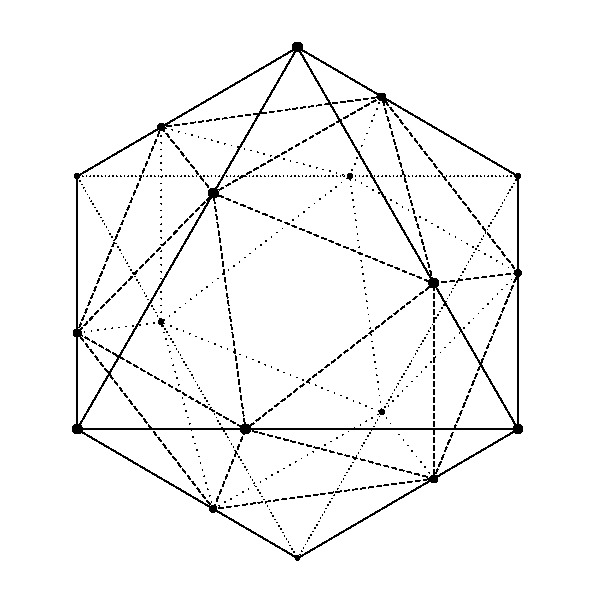
Octahedron with edges divided in the Golden Ratio by the vertices of an icosahedron

Continue reading

Why It Works

The last post, “Knottedness,” constructed Alexander’s Horned Sphere and proved, or sketched the proof, that

  • the horned sphere itself is topologically a sphere, and in particular is simply connected, meaning

    • it’s path-connected: there’s a path from every point to every other point;

    • loops contract to points—are null-homotopic;

  • the space outside of the horned sphere is not simply connected.

This is paradoxical. You would think that if any loop sitting on the horned sphere can be drawn to a point, and any loop outside the horned sphere can be made to sit on the sphere and then drawn to a point, then we ought to be able to get the loop really close to the horned sphere, and let it contract it to a point, just the way it could, if it were actually on the horned sphere.

You would think that, but you would be wrong. Continue reading

Writing, Typography, and Nature

Note added February 10, 2019: I return to this rambling essay, two years later in the Math Village. The main points are as follows.

  • Writing is of value, even if you never again read what you write.
  • There is also value to reading again, as in the present case.
  • A referee rejected a submitted article of mine in the history of mathematics because its order did not make sense – to that referee, though a fellow mathematician thought well of the article. A revision was eventually published as “On Commensurability and Symmetry.”
  • In the preface to The Elements of Typographical Style, Robert Bringhurst wonders how he can write a rulebook when we are all free to be different. He thus sets up an antithesis, such as I would investigate later in “Antitheses.”
  • From being simply a means of copying, typography has become a means of expression.
  • Yet typography should not draw attention to itself, just as, according to Fowler in A Dictionary of Modern English Usage, pronunciation (notably of foreign words) should not.
  • Through my own experience of typography with LaTeX [and HTML, as in this blog], I have developed some opinions differing from some others’.
  • Bringhurst samples Thoreau,
    • whose ridicule of letters sent by post applies today to electronic media, and
    • who rightly bemoans how enjoying the woods is thought idle; cutting them down, productive.
  • In Gödel, Escher, Bach, Douglas Hofstadter wonders how a message can be recognized by any intelligence. Bringhurst restricts the question to concern intelligences on this earth.
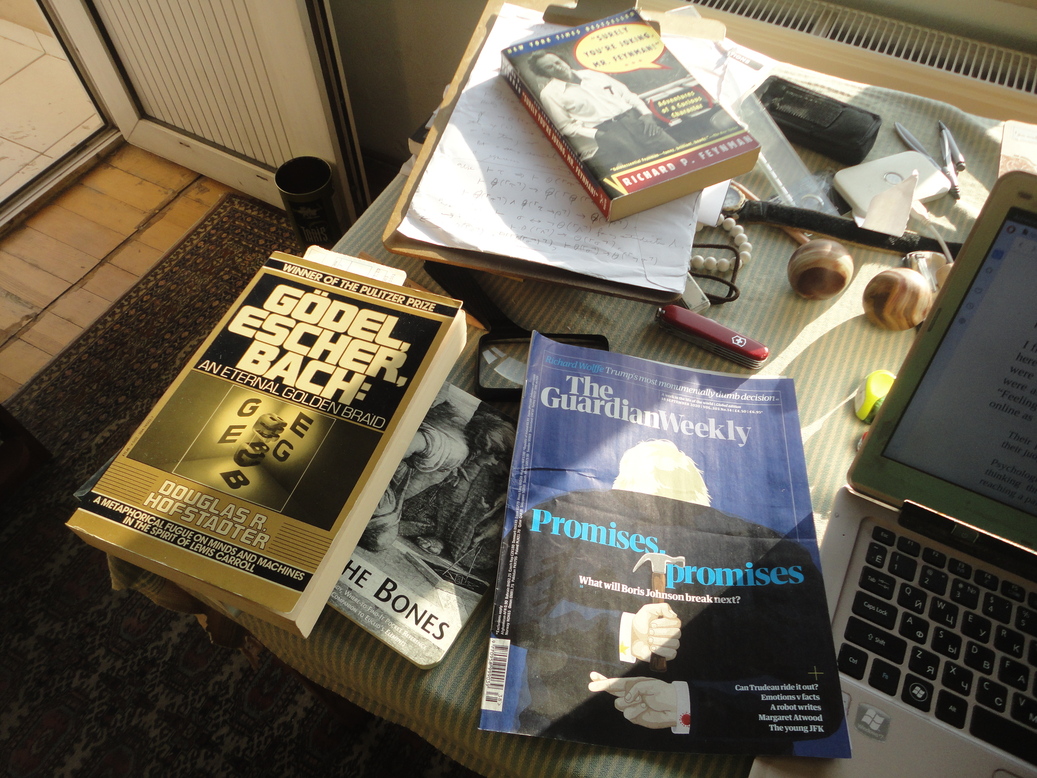
  • In my youth, Hofstadter introduced me to Zen Flesh, Zen Bones, (edited by Reps and Senzaki), whose influence on me I consider.
  • The Zen story about whether “this very mind is Buddha” suggests a further development of Collingwood’s “logic of question and answer.”
  • Through looking at another translation, I consider how Reps and Senzaki turned Chinese into English.
  • Rereading this blog led me back to Hofstadter.

Here are some meditations on some books read during a stay in the Nesin Mathematics Village, January, 2017. I originally posted this article from the Village; now, back in Istanbul, a few days into February, recovering from the flu that I started coming down with in the Village, I am correcting some errors and trying to clarify some obscurities.

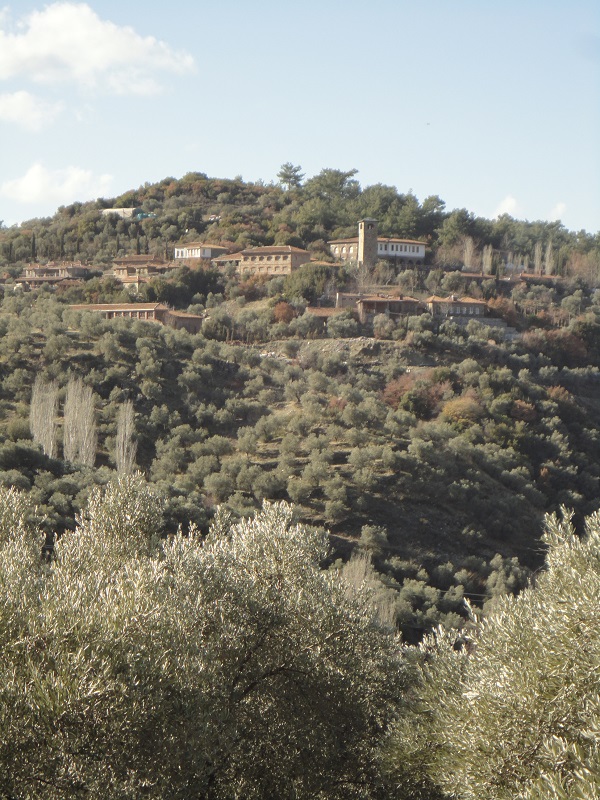
From below, a wooded hill, with buildings near the crest
Nesin Mathematics Village from the east
Wednesday, January 18, 2017

Continue reading

Science and anti-science

I published most of the following as a Note on Facebook, Wednesday, October 3, 2010.

Is there an ongoing or perhaps an increasing antipathy to science, and if so, are scientists to blame? The passage below treats this question, but was written 75 years ago, in December, 1935. The author could remember the war of 1914–1918, a war that he described in his Autobiography as “an unprecedented disgrace to the human intellect”, but “an unprecedented triumph for natural science.” Continue reading