Tag Archives: John Donne

Reading and Talking

Reading a book as if it had “no introduction, no notes, no aids or guides, no nothing but the naked text” (as William Deresiewicz puts it): such a reading seemed to need a defense. Here is my elaborate one, which seemed in the end to fall into nine sections as summarized below.

Let me note first that searching on “ahistorical reading” led me to a textbook chapter called “What Is Ahistorical Reading?” (in Intro to Poetry, by Alan Lindsay and Candace Bergstrom). The chapter seems to say well what every high-school graduate ought to know, though unfortunately they may not in fact. If you don’t want to slog through what I wrote, read that.

1. Some Novels and Novelists.
These may be read in school or for pleasure – mine, or that of writer and blogger Hai Di Nguyen. There can be epics such as War and Peace, Moby-Dick, and Zen and the Art of Motorcycle Maintenance. George Steiner finds the last two comparable. There can be an unreliable narrator.
2. Reading Comprehension.
This may be challenged by some poetry, such as Wordsworth’s, and annotations may not help.
3. Reading Without Preconceptions.
St John’s College accustomed me to this.
4. Reading Groups.
There are many that (thanks to the Catherine Project) I have been able to join and enjoy, all pursued in the St-John’s way as I understand it.
5. Story.
Mythos or logos. We inevitably tell it in our own words (unless perhaps somebody else has fed us the words).
6. Giving What Is Wanted.
“Ask me no questions, and I’ll tell you no fibs.” (To Goldsmith’s comedy She Stoops to Conquer, the saying is traced by Grammarist, which however has “lies” for “fibs”; Wikipedia currently repeats this apparent misquotation, citing Grammarist.) People are trained now to give most of their attention to their mobiles; in school we may be trained to supply what teachers want to hear.
7. Historicism.
I continue not to understand the objection of Leo Strauss to the “historicism” of R. G. Collingwood, but I agree with such ahistorical reading as is practiced at St John’s and was defended in my day (as I recall) by Strauss’s student and my teacher, David Bolotin.
8. The Classics.
There is something to be said for being assigned to read what one might not otherwise. My example is John Donne.
9. Re-Enactment.
Collingwood came to understand history as the re-enactment of thought, but this can be misunderstood, either when reading a poet such as John Donne, or when thinking of a certain major general who happened to read poetry while getting ready for battle.
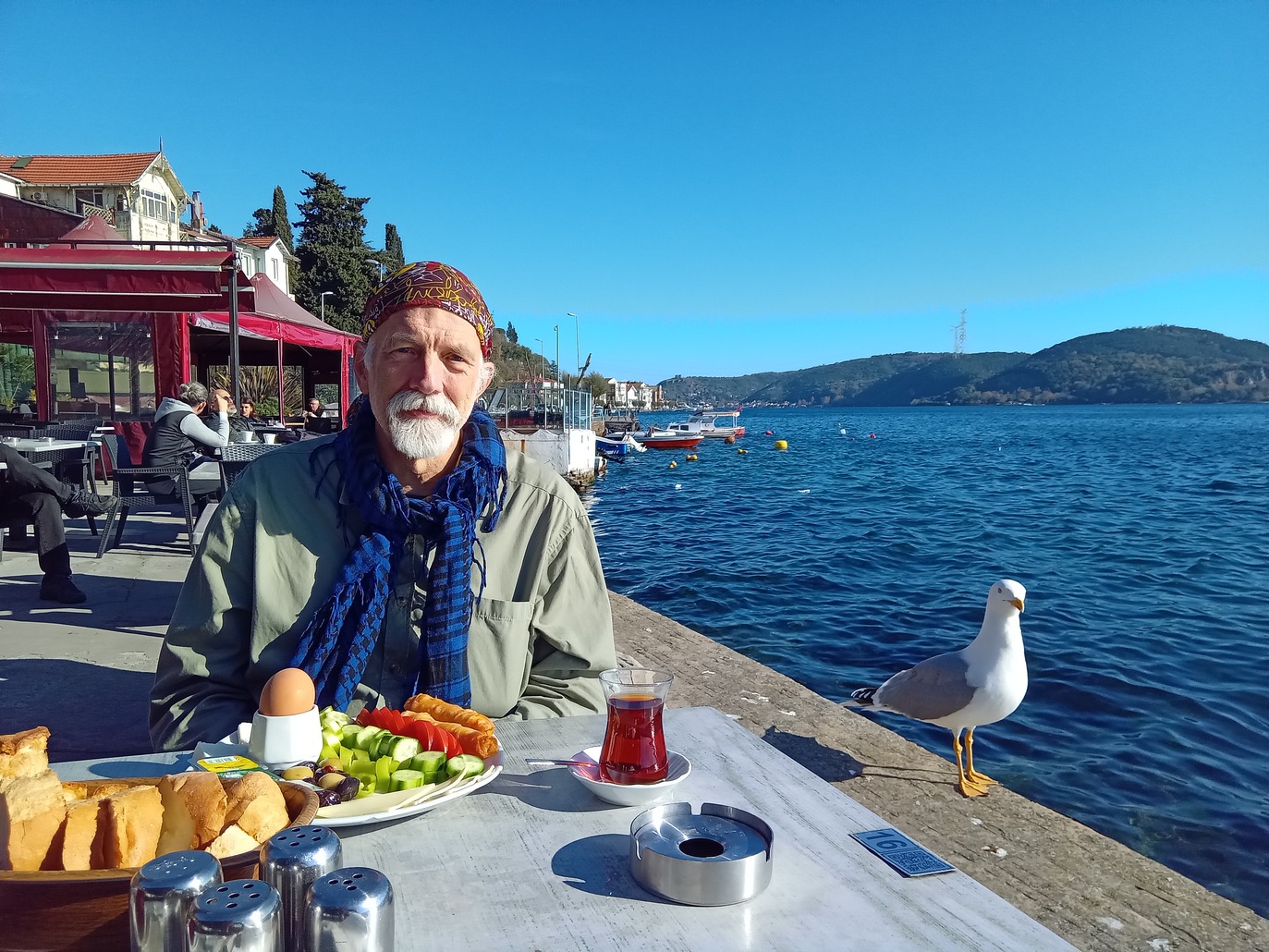
Seaside on a sunny day. Seagull, and human with tea and breakfast plate in front of him

Beyazpark Liseliler Kafe
Sarıyer, Istanbul
November 25, 2025

Continue reading

Perception Deception


John Donne, Holy Sonnet XIX
(on the last line, “make” should be “ſhake”)

This post involves:

  • “the” philosopher –
    • Aristotle;
  • two mathematicians –
    • Euclid,
    • David Hilbert;
  • three persons associated with Black Mountain College –
    • Josef Albers,
    • Dorothea Rockburne,
    • Max Dehn;
  • one person (in addition to myself and Dehn) associated with St John’s College –
    • David Bolotin.

Continue reading

Resurrection

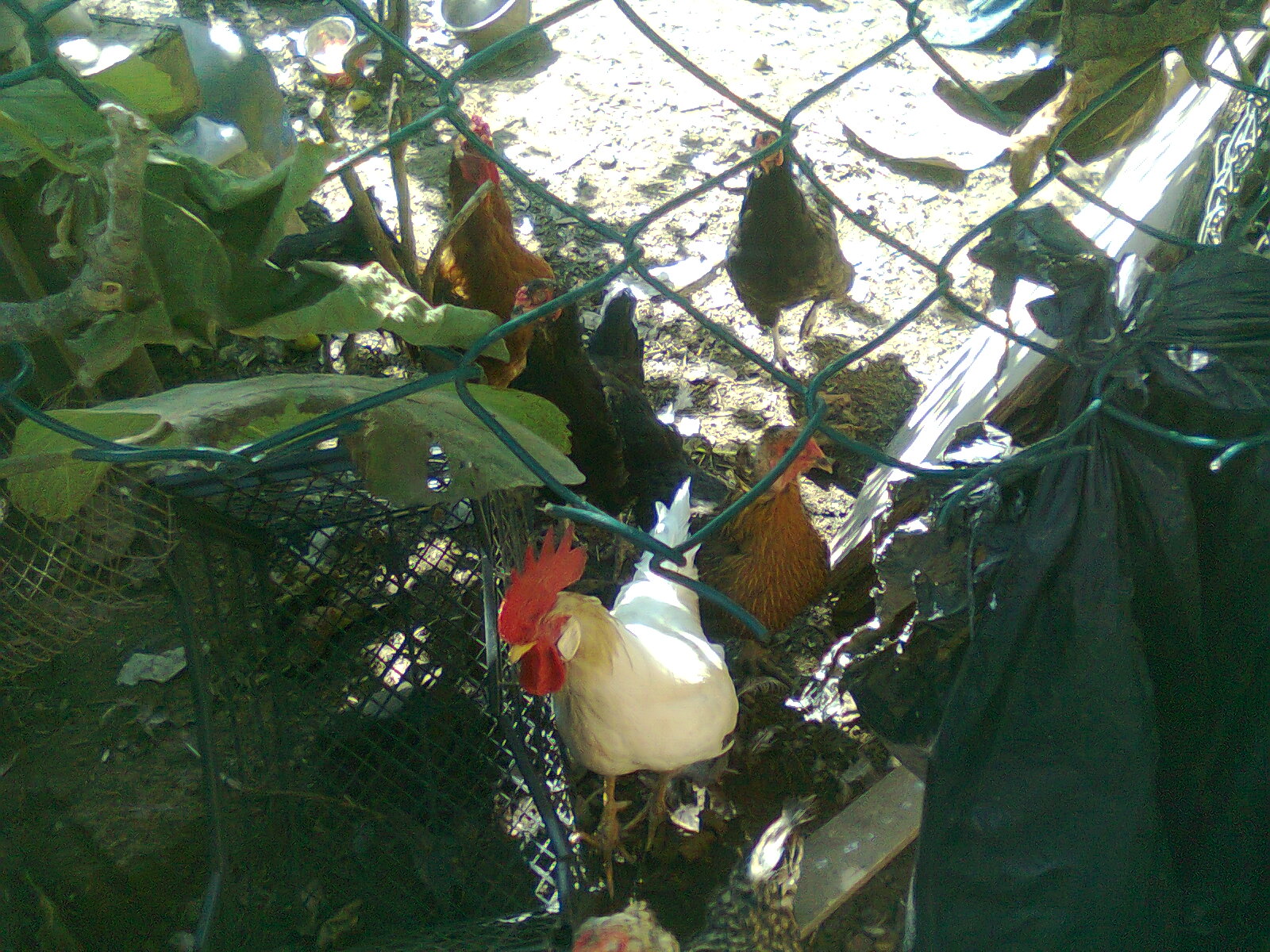
White rooster, brown chickens, behind a chain-link fence
From a walk around the neighborhood
Tarabya, Istanbul, Wednesday, October 9, 2024

There were a couple of tweets on the eve of Easter:

Just a reminder to make sure that you preach a doctrine of the resurrection tomorrow that is not reducible to that of the old IWW song “Joe Hill”


It’s a good song! I find it moving! But if that’s all we have to say about the resurrection (and I have heard many sermons that suggest that it is) – well, we should all be doing something else with our lives.

Fortunately, of course, it’s not all we have to say.

Continue reading

Donne’s Undertaking

To ease the strain of pandemic restrictions, I was recently called on to recommend a poem. I chose “The Undertaking” of John Donne. I want to say here why. Briefly:

  1. The poem (which I transcribe below) has a sound that impressed me when I first read it, more than thirty years ago.
  2. The poem alludes to ideals:
    • of recognizing what is good for its own sake, and
    • of climbing a rung or two on Diotima’s ladder of love.
  3. The sound of Donne’s poem may seduce one into thinking the ideals worthy.

          ⯅          

I also indulge myself here in reminiscences not obviously relevant to “The Undertaking.” They do conclude with my sitting down to read Donne for myself. (Note added November 3, 2025.)

          ⯆          

Diotima’s ladder, or stairway, is recounted by Socrates in Plato’s Symposium (211c, here in the translation of Jowett, which is the one I read at school, though it may not be the most faithful; the bullets and insertions from the Greek text are mine):

And the true order of going, or being led by another, to the things of love (τὰ ἐρωτικά), is to begin from the beauties of earth and mount upwards for the sake of that other beauty, using these as steps (οἳ ἐπαναβαθμοί) only, and from

  • one going on to
  • two, and from two to
  • all fair forms (τὰ καλὰ σώματα), and from fair forms to
  • fair practices (τὰ καλὰ ἐπιτηδεύματα), and from fair practices to
  • fair notions (τὰ καλὰ μαθήματα), until from fair notions he arrives at
  • the notion of absolute beauty, and at last knows what the essence of beauty is (ὃ ἔστι καλόν).

Analytic Geometry and Donne’s complete poetry
Two books that were my mother’s

Continue reading

Mood

Executive summary. The English grammatical moods – indicative, imperative, subjunctive – were not understood till the nineteenth century, according to an 1882 doctoral dissertation, On the Use of the Subjunctive Mood in Anglo-Saxon. Considering illustrative passages that happen to be from Plato, Alfred Douglas, Evelyn Waugh, and especially John Donne; looking ultimately at John McWhorter’s 2015 essay, “English is not normal”; I review the subjunctive mood, grammar in general, and my own lack of understanding till I was in college.

The copyright page has, with the preceding pages and cover, fallen away from the rest of the book with use
Copyright and contents pages of the Concise Oxford Dictionary, 6th edition

Continue reading