Tag Archives: Sappho

Mind (Iliad Book XVII)

At the end of Book XVI of the Iliad, Hector

  • pulled his spear from the body of Patroclus,
  • took off in pursuit of Automedon, his victim’s charioteer, who was being drawn by Achilles’s immortal horses.

Around the mossy trunk of a plane tree, four chickens—two white, one brown, one black—scratch in the little dirt that has been left uncovered by the setts that pave a road through a settlement
Postacı Halil Sokağı (Street of Halil the Postman)
Tarabya (Θεραπειά), Sarıyer, Istanbul
Thursday morning, March 2, 2023

Continue reading

On Plato’s Republic, 7

Index to this series

(Note added October 23, 2022.) As I return to the analysis of the philosopher in the Republic, I think of two or three recent encounters with resistance to what I would call philosophical thought. See my comments added at the end. Meanwhile, here is a table contents for this post:

The Philosopher

We are going to define the lovers of knowledge or wisdom: the philosophers. Socrates’s definition is at Stephanus 480a, at the end of our seventh reading in Plato’s Republic. The reading constitutes, of Book V, the latter part, beginning at 472a. Socrates concludes,

Τοὺς αὐτὸ ἄρα ἕκαστον τὸ ὂν ἀσπαζομένους
φιλοσόφους ἀλλ’ οὐ φιλοδόξους κλητέον.

We might translate the first part word by word as follows.

τοὺς αὐτὸ ἄρα ἕκαστον τὸ ὂν ἀσπαζομένους,
those-who-are itself therefore each thing-that-is being delighting-in.

The whole sentence then is literally,

Therefore those who are delighting in each thing that is being, itself,
are to be called philosophers, but not “philodoxers.”

Here are five published translations; take your pick.

Continue reading

Thoreau and Anacreon

Note added, October 5, 2023. At the end of this post, from sunny days in the first spring of the Covid pandemic, I take up Anacreon’s poem “The Thracian Filly,” translated as “To a Colt” in A Week on the Concord and Merrimack Rivers. Anacreon was from Teos, whose ruins I have visited. Thoreau may not be sensitive to the sexual connotations of the poem. First I review Thoreau’s book, noting in particular:

  • The book is written, like my blog posts, to please the author, who would rather do without money than sell stuff to get it.
  • The author’s relative indifference to human affairs in the face of nature is becoming less tenable, when a Pacific island inhabited by 40 persons and visited once a month by a boat (and once for all, probably, by a travel writer) is losing its palms to an invasive beetle.

Other books discussed or mentioned (and in my physical library) are

  • Bean, Aegean Turkey;
  • Collingwood, The First Mate’s Log;
  • Lawson, The Drinkers’ Guide to the Middle East;
  • Schalansky, Pocket Atlas of Remote Islands;
  • Thoreau, Walden;
  • Trypanis (ed.), The Penguin Book of Greek Verse;
  • Walls, Henry David Thoreau: A Life.

Gray clouds over blue sky over white clouds over buildings

Continue reading

Some Say Poetry

In a poetry review, a remark on being a student has drawn my attention:

In My Poets, a work of autobiographical criticism with occasional ventriloquial interludes, McLane recalls two “early impasses in reading,” freshman-year encounters with Charles Olson and Frank O’Hara. She writes about not “getting it” but wanting to get it, about a desire to get it that was left wanting by code-breaking and analysis and satisfied by hearing and feeling.

This is from the second half of a “New Books” column by Christine Smallwood, in the Reviews section of Harper’s, July 2017. After quoting Smallwood’s review, I want to say something about learning and creating, in poetry and also in mathematics.

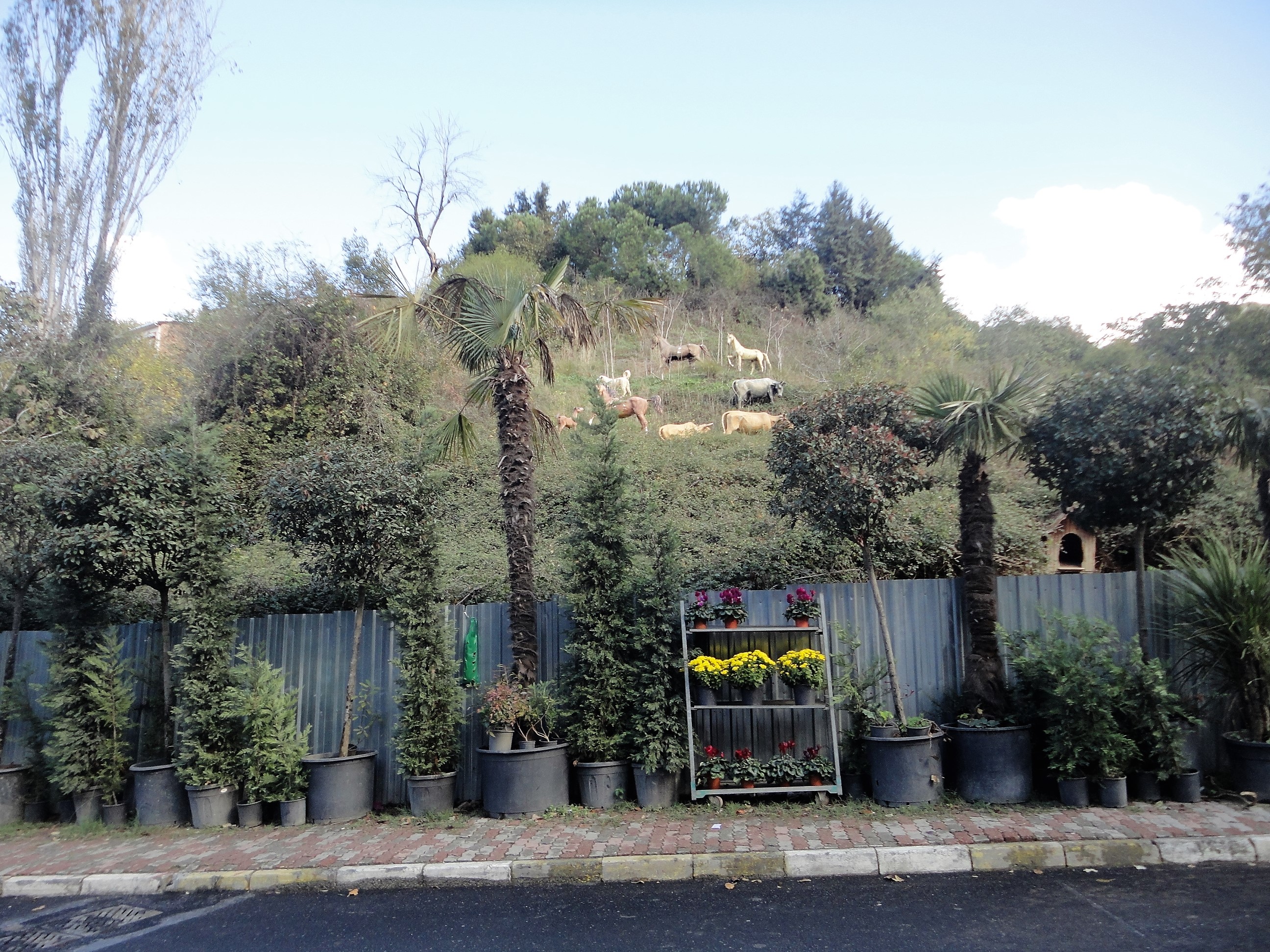
Potted palms with plaster farm animals on hillside behind
Kuzguncuk, 2017.11.05

Continue reading

Feyhaman Duran

Born on the Asian side of Istanbul in Kadıköy in 1886, İbrahim Feyhaman was orphaned nine years later. His father had been a poet and calligrapher. His mother’s dying wish was that Feyhaman attend the Lycée Impérial Ottoman de Galata-Sérai; his maternal grandfather, Duran Çavuş, saw that this happened. Some time after graduation, headmaster Tevfik Fikret had Feyhaman come back to Galatasaray to teach calligraphy.


Garden of Aşiyan, September 10, 2015

Continue reading