Tag Archives: William Deresiewicz

Reading and Talking

Reading a book as if it had “no introduction, no notes, no aids or guides, no nothing but the naked text” (as William Deresiewicz puts it): such a reading seemed to need a defense. Here is my elaborate one, which seemed in the end to fall into nine sections as summarized below.

Let me note first that searching on “ahistorical reading” led me to a textbook chapter called “What Is Ahistorical Reading?” (in Intro to Poetry, by Alan Lindsay and Candace Bergstrom). The chapter seems to say well what every high-school graduate ought to know, though unfortunately they may not in fact. If you don’t want to slog through what I wrote, read that.

1. Some Novels and Novelists.
These may be read in school or for pleasure – mine, or that of writer and blogger Hai Di Nguyen. There can be epics such as War and Peace, Moby-Dick, and Zen and the Art of Motorcycle Maintenance. George Steiner finds the last two comparable. There can be an unreliable narrator.
2. Reading Comprehension.
This may be challenged by some poetry, such as Wordsworth’s, and annotations may not help.
3. Reading Without Preconceptions.
St John’s College accustomed me to this.
4. Reading Groups.
There are many that (thanks to the Catherine Project) I have been able to join and enjoy, all pursued in the St-John’s way as I understand it.
5. Story.
Mythos or logos. We inevitably tell it in our own words (unless perhaps somebody else has fed us the words).
6. Giving What Is Wanted.
“Ask me no questions, and I’ll tell you no fibs.” (To Goldsmith’s comedy She Stoops to Conquer, the saying is traced by Grammarist, which however has “lies” for “fibs”; Wikipedia currently repeats this apparent misquotation, citing Grammarist.) People are trained now to give most of their attention to their mobiles; in school we may be trained to supply what teachers want to hear.
7. Historicism.
I continue not to understand the objection of Leo Strauss to the “historicism” of R. G. Collingwood, but I agree with such ahistorical reading as is practiced at St John’s and was defended in my day (as I recall) by Strauss’s student and my teacher, David Bolotin.
8. The Classics.
There is something to be said for being assigned to read what one might not otherwise. My example is John Donne.
9. Re-Enactment.
Collingwood came to understand history as the re-enactment of thought, but this can be misunderstood, either when reading a poet such as John Donne, or when thinking of a certain major general who happened to read poetry while getting ready for battle.
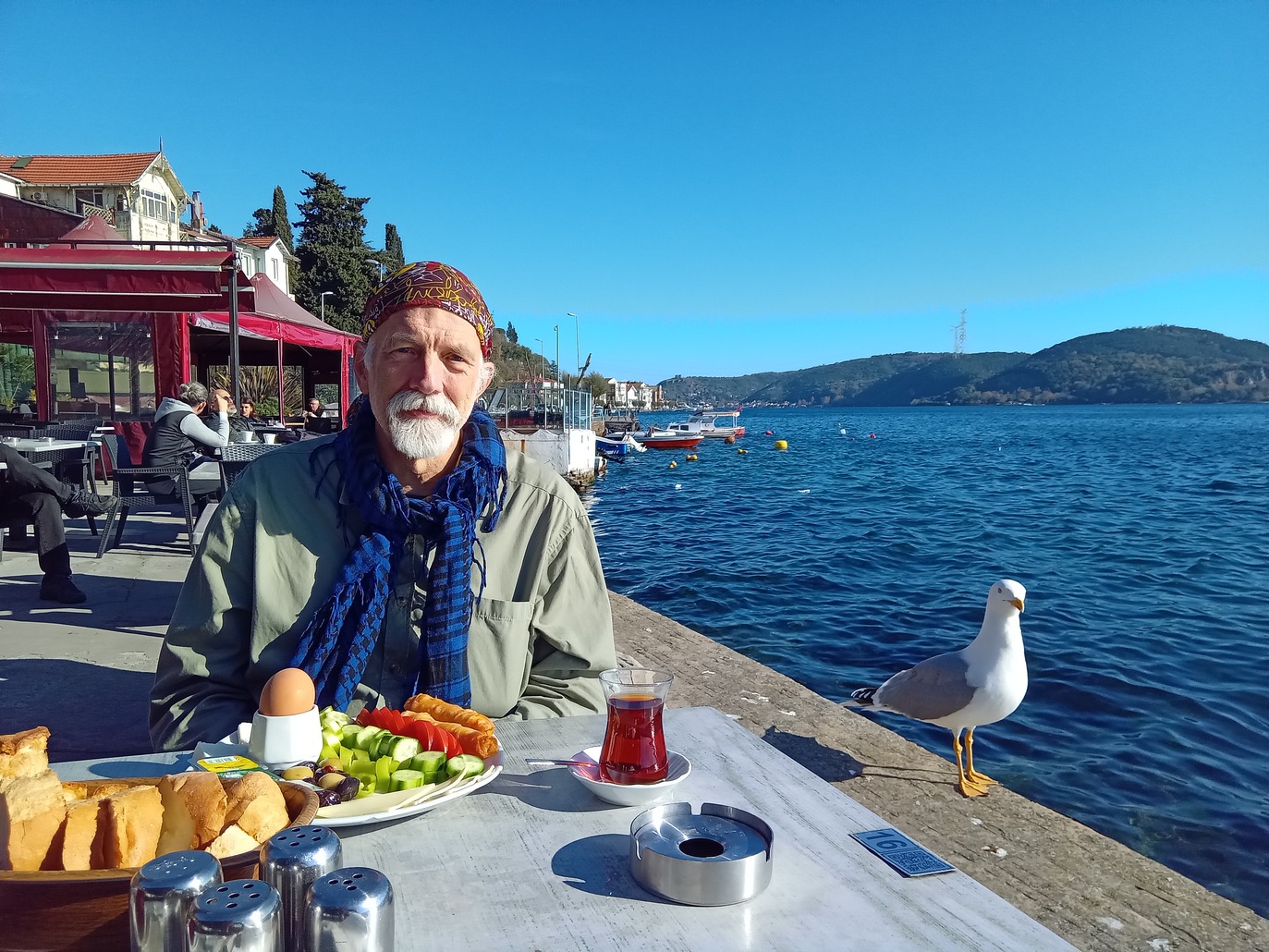
Seaside on a sunny day. Seagull, and human with tea and breakfast plate in front of him

Beyazpark Liseliler Kafe
Sarıyer, Istanbul
November 25, 2025
Continue reading

Artificial Language

TL;DR: AI writing is like human writing. Of course it is, since its model is human writing. But then what AI produces is like bad human writing.

My sources include Plato, Wendell Berry, George Orwell, E. B. White, William Deresiewicz, Hadley Freeman, Andrew Kay, Kenneth G. Crawford, Hollis Robbins, Yuval Noah Harari, William Egginton, Megan Fritts, and Vi Hart.


About preparing certain seeds for human consumption in an infusion:

For sensory attributes, I’m admittedly Platonic and believe that since coffee is a fruit, it should taste something like a fruit. (And it’s not just any fruit – it’s a cherry!) My roasting philosophy comes from the same conviction. Generally, I’m after bright, juicy, fruity, syrupy goodness.

Thus Caleb Bilgen, founder of Ánimo Coffee Roasters in Asheville, North Carolina.

          ⯅          

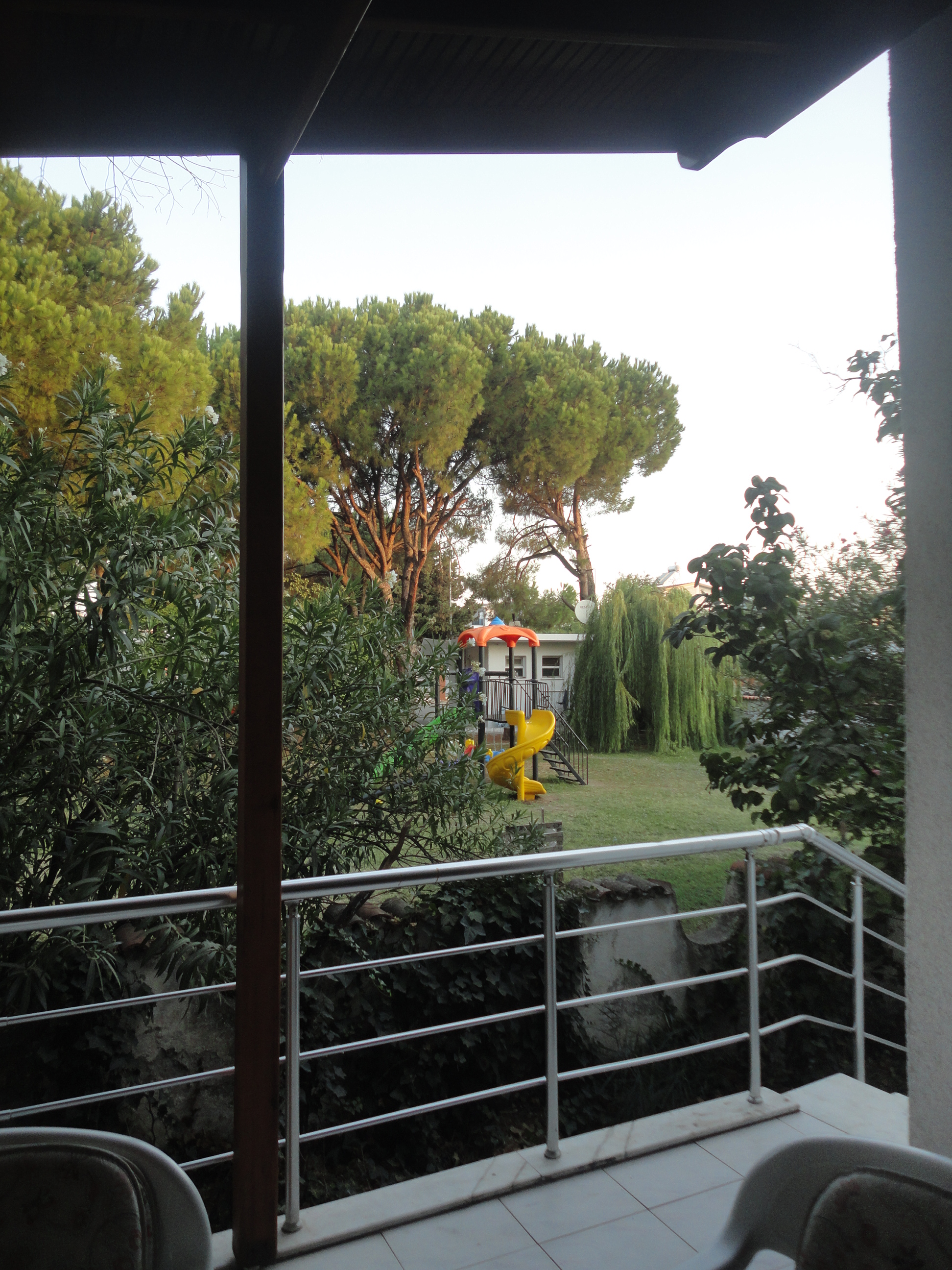
From a terrace beneath an awning, a low wall obscured by ivy, oleander, and quince; on the other side, a lawn with a jungle gym; beyond this, a weeping willow and a small white house beneath umbrella pines

What I see as the sun rises
Altınova, Ayvalik, Balıkesir
September 5, 2025

          ⯆          

Continue reading

Necessity

I quoted, last time, a writer I admire, who was in turn quoting a Nobelist in literature on how a certain devotee of Aristotle “had nothing useful to offer on the conduct of life.” I don’t admire that comment. A life spent in devotion to the Philosopher may itself  be well conducted. I don’t know whether it was, in the case of Mortimer Adler.

The sentence by Saul Bellow was,

Mortimer Adler had much to tell us about Aristotle’s Ethics, but I had only to look at him to see that he had nothing useful to offer on the conduct of life.

I don’t know how this is not rank prejudice. It does recall the two exchanges that are all I remember from A Passage to India of E. M. Forster (my father once gave me a copy, but I don’t seem to have kept it):

“You understand me, you know what others feel. Oh, if others resembled you!”

Rather surprised, she replied: “I don’t think I understand people very well. I only know whether I like or dislike them.”

“Then you are an Oriental.”


“Don’t you think me unkind any more?”

“No.”

“How can you tell, you strange fellow?”

“Not difficult, the one thing I always know.”

“Can you always tell whether a stranger is your friend?”

“Yes.”

“Then you are an Oriental.”

In “A Note on This Book” – namely Strunk and White, The Elements of Style (New York: Macmillan, 1959; paperback edition, 1962) – E. B. White says that the final chapter, “An Approach to Style,” written by himself alone,

is addressed particularly those who feel that English prose composition is not only a necessary skill but a sensible pursuit as well – a way to spend one’s days.

I am glad to have lived in a time when this could be believed.

A novel or movie might portray an admirable or sympathetic figure as sacrificing everything else for painting, writing, or music. In Good Will Hunting, the title character does set his art aside for love; however, this “art” is mathematics. I heard a complaint about this from a fellow postdoc at the Mathematical Sciences Research Institute in Berkeley in 1998.

Perhaps Carl Friedrich Gauss had nothing useful to offer on the conduct of life, at least to the likes of Saul Bellow, or for that matter William Deresiewicz. Nonetheless, by the age of 24, he had solved a problem that (as far as I know) had stumped mathematicians for two thousand years, even since the time of Aristotle.

Regular 17-gon, bisected by a straight line through one vertex, with perpendiculars dropped from the other vertices

Continue reading

Anarchy

Some distinctions are important, some are not. Telling which is which is important for life – and for reading Aristotle, who opens Book VII of the Nicomachean Ethics by recalling that κακία

  • is something to be avoided,
  • is opposed to ἀρετή.

Presently, in § i.4, what is paired with ἀρετή is not κακία, but μοχθηρία. Is there a difference?

Four billboards, by a road, obscure the trees behind
Four advertisements, all for margarine, a different proud baker in each. One person differs from the others in wearing a headscarf; none differs in sex.
Tarabya Bayırı, Sarıyer, Istanbul, Friday, January 26, 2024

Continue reading

Creativity

In the Platonic dialogues, Socrates frequently mentions τέχνη (technê), which is art in the archaic sense: skill or craft. The concern of this post is how one develops a skill, and what it means to have one in the first place.

Books quoted or mentioned in the text, by Midgley, Simone Weil, Thoreau, Amy Mandelker (on Tolstoy), Oliver Byrne (on Euclid), Wittgenstein, Arendt, and Caroline Alexander (on Homer)

Continue reading

On The Human Condition of Hannah Arendt 10

Index to this series

CHAPTER V Action [3]

We come to the end of Arendt’s chapter on action. Action has two components:

  1. Getting it started (ἄρχειν).
  2. Keeping it going (πράττειν).

Anybody can do the first, but then the second is out of his (or her) exclusive control. This is a problem. You can try to avoid the problem, either by making other people your slaves, or by being a Stoic. You can also just recognize that the problem can be mitigated by the actions of promising and forgiving.

Picnic table among trees
Yıldız Parkı, April 16, 2022
Where I did some of the next reading

Continue reading

Donne’s Undertaking

To ease the strain of pandemic restrictions, I was recently called on to recommend a poem. I chose “The Undertaking” of John Donne. I want to say here why. Briefly:

  1. The poem (which I transcribe below) has a sound that impressed me when I first read it, more than thirty years ago.
  2. The poem alludes to ideals:
    • of recognizing what is good for its own sake, and
    • of climbing a rung or two on Diotima’s ladder of love.
  3. The sound of Donne’s poem may seduce one into thinking the ideals worthy.

          ⯅          

I also indulge myself here in reminiscences not obviously relevant to “The Undertaking.” They do conclude with my sitting down to read Donne for myself. (Note added November 3, 2025.)

          ⯆          

Diotima’s ladder, or stairway, is recounted by Socrates in Plato’s Symposium (211c, here in the translation of Jowett, which is the one I read at school, though it may not be the most faithful; the bullets and insertions from the Greek text are mine):

And the true order of going, or being led by another, to the things of love (τὰ ἐρωτικά), is to begin from the beauties of earth and mount upwards for the sake of that other beauty, using these as steps (οἳ ἐπαναβαθμοί) only, and from

  • one going on to
  • two, and from two to
  • all fair forms (τὰ καλὰ σώματα), and from fair forms to
  • fair practices (τὰ καλὰ ἐπιτηδεύματα), and from fair practices to
  • fair notions (τὰ καλὰ μαθήματα), until from fair notions he arrives at
  • the notion of absolute beauty, and at last knows what the essence of beauty is (ὃ ἔστι καλόν).

Analytic Geometry and Donne’s complete poetry
Two books that were my mother’s

Continue reading