Author Archives: David Pierce

Mathematician & logician; amateur of philosophy; relation of journalists; alumnus of St John’s College (USA)

On Chapman’s Homer’s Iliad, Book XIV

Index to this series | Text of Chapman’s Homer’s Iliad

When Neptune was helping the Greeks stave off certain defeat, I tried to suggest that divine intervention in the course of events might be understood as human resolve to change that course. This was in Book XIII of the Iliad, where Neptune took the form of one of the Greeks – Calchas – in order to exhort the others. They would have listened to Calchas anyway; he was a prophet. Ajax Oileus said he could tell Calchas was “really” a god; we can read this to mean Calchas was inspiring. We can say this of somebody today, without meaning to suggest any supernatural influence.

Mostly a calm sea, with heads of two swimmers; behind, a strip of pink sky with setting sun

Continue reading

NL XXIX: External Politics

Index to this series

Executive summary (added September 13, 2018, edited July 19, 2019, and May 19, 2026): Dealing with other bodies politic is the third stage of political life, after societies’

  • formation (as if by marriage),
  • dominion over non-social communities (as if by having children).

Having been used in the first two stages, dialectic can be used in the third, to make peace rather than war. Being the eristic of external politics, war has no psychological cause that would absolutely prevent the making of peace. War is a state of mind, which does not think non-agreement can become agreement. Pacifism has this state of mind.


External politics are international relations. These represent the third of the “stages” in political life (29. 1), which we enumerate:

  1. The joining of wills into a society, which rules itself (29. 11).
  2. Such a society’s ruling over a non-social community in a body politic (29. 12).
  3. Dealing with other bodies politic (29. 13).

Beach scene: Against a calm sea, a man in trunks walks along the shore, while a woman seen in profile sits next to somebody in a chair whose back is towards is. In the foreground are several empty beach chairs

Continue reading

On Chapman’s Homer’s Iliad, Book XIII

Index to this series | Text of Chapman’s Homer’s Iliad

Usually when your defenses are breached, you are lost. Thus when the Ottoman Turks under Mehmet I found a way through the Theodosian Walls on Tuesday morning, May 29, 1453, the city of Constantinople was theirs.

Path to a gate in a crenellated stone wall; people gathered around the plaque next to the gate
The gate where the invasion of Constantinople is supposed to have been made

Continue reading

NL XXVIII: The Forms of Political Action

Index to this series

Executive summary (added September 12, 2018), To condemn political discussion is to wish for tyranny: this continues a thought from the previous chapter. The ruling class need not share their deliberations with the ruled class, but it is better if they do. As our understanding of the reason for an action evolves—at first the action is merely useful, but later it conforms to a rule—, so ruling, originally by decree, has evolved to include legislation. However, to be enforced, law does not require a formal structure; international law is an example. The best reason for an action is duty. Though the German Treitschke says our highest duty is to the state, he gives the state no duty, and so his politics are entirely utilitarian.


In Plato’s Republic, Socrates seeks understanding of the just human being through examination of the just state. In Collingwood’s New Leviathan, the order is reversed. What we first considered in somebody, we now look at in the “body politic.”

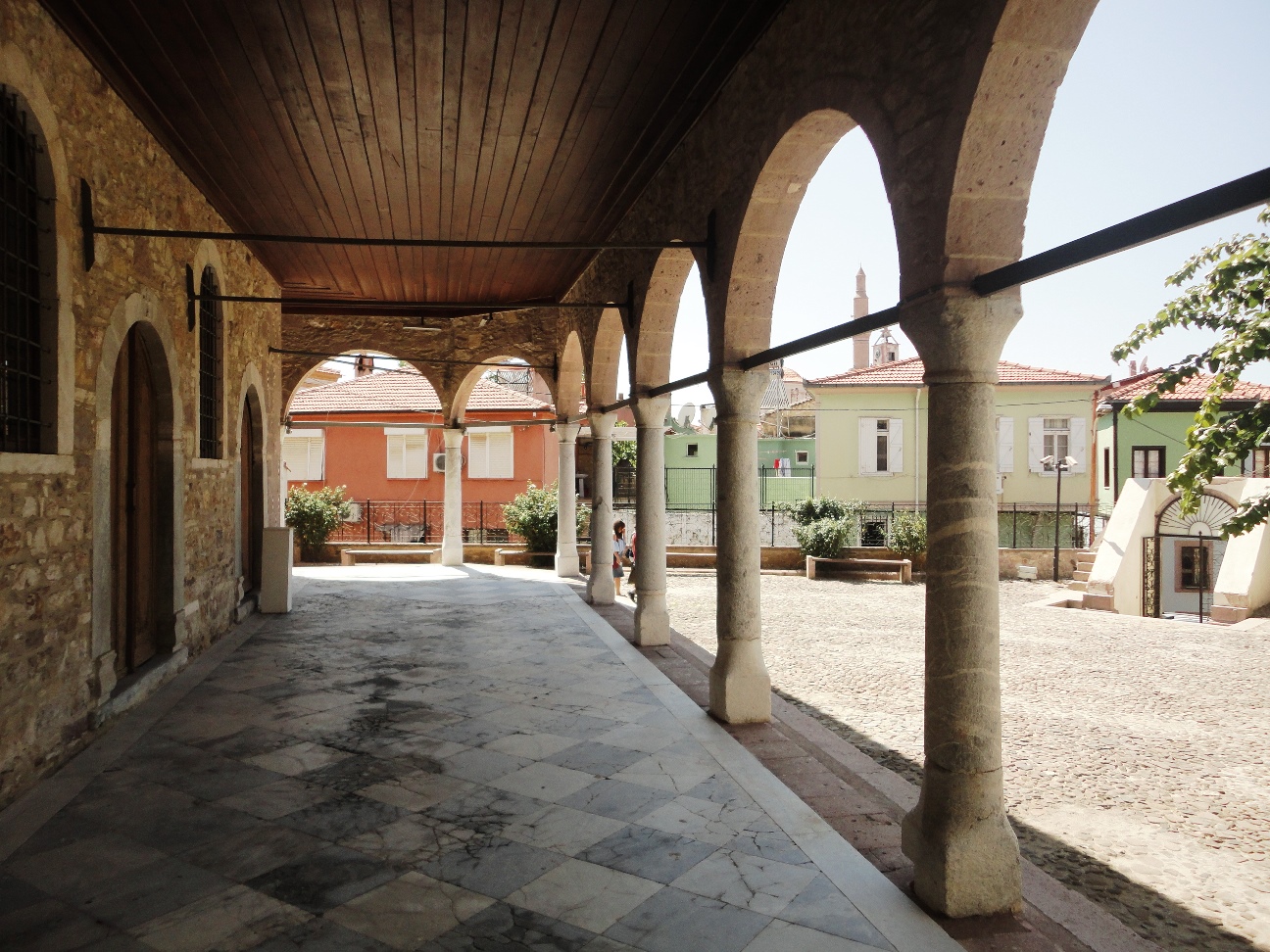
Narthex of the former Taksiyarhis Church (now museum), Ayvalık, Balıkesir, Turkey, August 30, 2018

Continue reading

On Chapman’s Homer’s Iliad, Book XII

Index to this series | Text of Chapman’s Homer’s Iliad

Both first and last place may be prominent in a narrative.

So may be the middle – perhaps I meant that to be implicit when first posting this review on September 1, 2018. Then I wrote an impressionistic account, as I did again in “Monism (Iliad Book XII)” in February, 2023. Or it is a moralistic account, looking mainly at the lesson taught by Sarpedon – also the severely monotheistic lesson of Hector, in the 2023 account. Below I add a systematic review of the action. Note added August 28, 2024.

Occurring three-quarters of the way into Book XII of the Iliad, but presented last below, Sarpedon’s great speech on leadership ought to be known by everybody with authority and power.

A child’s sand shovels on the beach; calm sea beyond

Continue reading

NL XXVII: Force in Politics

Index to this series

Executive summary (added September 12, 2018): When persons cannot rule themselves, they are ruled by force, as a duty, by other persons, for the benefit and pleasure of all. Force includes fraud and deceit; but their use must be limited, if those persons who are being ruled by force now will one day join the ruling class themselves. If a liberal and a conservative party take up respectively the ideals of democracy and aristocracy discussed in the last chapter, the parties must understand that each needs the other, in order to engage in the dialectic that aims for the best society. If somebody thinks the two parties waste energy, either in pretending to be in opposition to one another, or in actually being opposed, then that person is effectively wishing for tyranny.


In my last post on the New Leviathan (which was my first for this year), I said Collingwood would discuss the British parliament in Chapter XXVII. That chapter is now my subject.

The ruling class must incorporate new members from time to time, whether anybody thinks about it or not (27. 75). Anybody who does think about it may take up one of two goals (27. 77).

27. 79. To hasten the percolation of liberty throughout every part of the body politic was the avowed aim of the Liberal party; to retard it was the avowed aim of the Conservative party.

27. 8. The relation between them was consciously dialectical. They were not fundamentally in disagreement. Both held it as an axiom that the process of percolation must go on. Both held that given certain circumstances, which might very well change from time to time, there was an optimum rate for it, discoverable within a reasonable margin of error by experiment.

Continue reading

On Chapman’s Homer’s Iliad, Book XI

Index to this series | Text of Chapman’s Homer’s Iliad

After the active night of Book X comes the dawn of a thrilling day (lines 1 & 2).

AVrora, out of restfull bed, did from bright Tython rise,
To bring each deathlesse essence light, and vse, to mortall eyes.

The deathless essence called Jove sends Discord to the Greeks. She lights on the ship of Ulysses, in the middle of the fleet, so all can hear as she belts out her “Orthian song” (lines 13 & 14).

And presently was bitter warre, more sweet a thousand times
Then any choice in hollow keeles, to greet their natiu climes.

Continue reading

NL XXVI: Democracy and Aristocracy

Index to this series

Executive summary (added September 12, 2018, edited January 26, 2019).

  1. Aristocracy and democracy are abstractions (§§26. 1[0]–28). Inseparable from one another, they are properly understood as correlative rules for the ruling class:

    1. Don’t let in anybody who is unqualified.
    2. Don’t keep out anybody who is.
  2. By what Collingwood will call, in Chapter XXXI of the New Leviathan, the Principle of the Limited Objective, (which was recognized by the Early Church Fathers,) the ruling class should be prepared to solve, not every problem (as Plato wanted), but those problems that are expected to come up (§§26. 3[0]–34).

  3. The democratic and aristocratic principles have been at work throughout the history of Europe: in Greece, in Rome, under the feudalism of the Middle Ages. The French Revolution was not only democratic, but also aristocratic, for aiming to give power to the bourgeoisie, not the entire population (§§26. 4[0]–66).

  4. Adapted from the literary concept of peripety, the concept of revolution actually has no place in history, where there are no heroes or villains, just human beings, partly good and partly bad (§§26. 7[0]–82).

  5. The concept of a revolution in history is even dangerous, if it leads you to think a political problem can have been solved once for all (§§26. 9[0]–96).


There can be no pure democracy, not for a length of time, not if we understand a democracy to be a society whose ruling class is the whole of it. Even the most extreme democrat of ancient Greece never contemplated citizenship for women, slaves, or resident foreigners. We may be more liberal today, at least regarding women and slavery. Still we do not open the ruling class to foreigners, such as myself where I am; nor do we open it to children. We could do so, in the sense of extending the franchise to all human residents. Both possibilities were discussed favorably in the early 1990s in The Nation, as I recall, in one case by a legal minor. However, perhaps most children could not be given such adminstrative duties as used to be assigned by lot to Athenian citizens. Even if they could, what of the animals that live among us—shall they be citizens?


Edward Hicks (American, 1780-1849),
The Cornell Farm, 1848, oil on canvas,
Gift of Edgar William and Bernice Chrysler Garbisch,
National Gallery of Art Continue reading

On Chapman’s Homer’s Iliad, Book X

Index to this series | Text of Chapman’s Homer’s Iliad

In Book X of the Iliad, Diomedes and Ulysses go to spy on the Trojan camp at night. When they return to the Greek camp (lines 482 & 3),

Then entred they the meere maine sea, to cleanse their honord sweate
From off their feet, their thighes and neckes: and when their vehement heate …

I can enter the same sea now. After more than ten months, I return to my reading of Homer, and Chapman’s Homer, as I have returned to the place where I was doing it last year, on the Aegean coast opposite Lesbos.

Continue reading

Eastern Black Sea Yayla Tour

Here are some photos from our recent tour (July 21–29, 2018), in chronological order. More then ten times as many photos, along with a verbal account, not always in chronological order, are on a page of this website (as opposed to a post, like the present one); the page is called Karadeniz, which is the Turkish for Black Sea.