It is the story of Icarus. A man gets wings, flies too high, and is burned. Icarus is Patroclus, the wings are Achilles’s armaments, and flying too high is assaulting the very walls of Troy.

Kocabey Mosque, Şavşat, Artvin
It is the story of Icarus. A man gets wings, flies too high, and is burned. Icarus is Patroclus, the wings are Achilles’s armaments, and flying too high is assaulting the very walls of Troy.
Kocabey Mosque, Şavşat, Artvin
After a year, I return to reading the Iliad on the Asian mainland of Turkey. I am opposite Lesbos, south of Mount Ida, where in the last episode, Juno seduced Jove, so that he would not see Neptune’s interference on behalf of the Greeks, in the war down at Troy.
We were here in Altınova (in the province of Balıkesir) in July, but my mind then was on mathematics, including mathematics coming out of my April post here, “Elliptical Affinity.” I went on to speak of this mathematics in two other countries, one of these the homeland of Medea. In the other country, I was moved to write a post concerning the book I had already blogged a lot about. Now Ayşe and other Peace Academics are being cleared of charges, our fall semester does not begin till October, and we can spend time at the beach.

Twelve Apostles, a former Armenian church, now a mosque, in Kars
We may speculate, and it is interesting that we do speculate, because I think the questions do not ultimately make sense – not the sense that seems to be intended anyway, whereby something can be got for nothing.

View from Şavşat
The post below is a way to record a passage in the Euthyphro where Socrates says something true and important about mathematics.
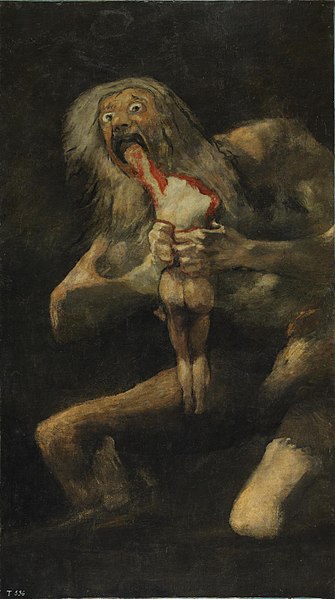
Goya, [Cronus] Devouring His Son
(see below)
The passage is on a list of Platonic passages that I recently found, having written it in a notebook on May 23, 2018. The other passages are in the Republic; here they are, for the record, with some indication of why they are worth noting (translations are Shorey’s, originally from 1930 and 1935 in the old Loeb edition):
Index to this series | Text of Chapman’s Homer’s Iliad
When Neptune was helping the Greeks stave off certain defeat, I tried to suggest that divine intervention in the course of events might be understood as human resolve to change that course. This was in Book XIII of the Iliad, where Neptune took the form of one of the Greeks – Calchas – in order to exhort the others. They would have listened to Calchas anyway; he was a prophet. Ajax Oileus said he could tell Calchas was “really” a god; we can read this to mean Calchas was inspiring. We can say this of somebody today, without meaning to suggest any supernatural influence.

Index to this series | Text of Chapman’s Homer’s Iliad
Usually when your defenses are breached, you are lost. Thus when the Ottoman Turks under Mehmet I found a way through the Theodosian Walls on Tuesday morning, May 29, 1453, the city of Constantinople was theirs.

The gate where the invasion of Constantinople is supposed to have been made
Executive summary (added September 12, 2018), To condemn political discussion is to wish for tyranny: this continues a thought from the previous chapter. The ruling class need not share their deliberations with the ruled class, but it is better if they do. As our understanding of the reason for an action evolves—at first the action is merely useful, but later it conforms to a rule—, so ruling, originally by decree, has evolved to include legislation. However, to be enforced, law does not require a formal structure; international law is an example. The best reason for an action is duty. Though the German Treitschke says our highest duty is to the state, he gives the state no duty, and so his politics are entirely utilitarian.
In Plato’s Republic, Socrates seeks understanding of the just human being through examination of the just state. In Collingwood’s New Leviathan, the order is reversed. What we first considered in somebody, we now look at in the “body politic.”
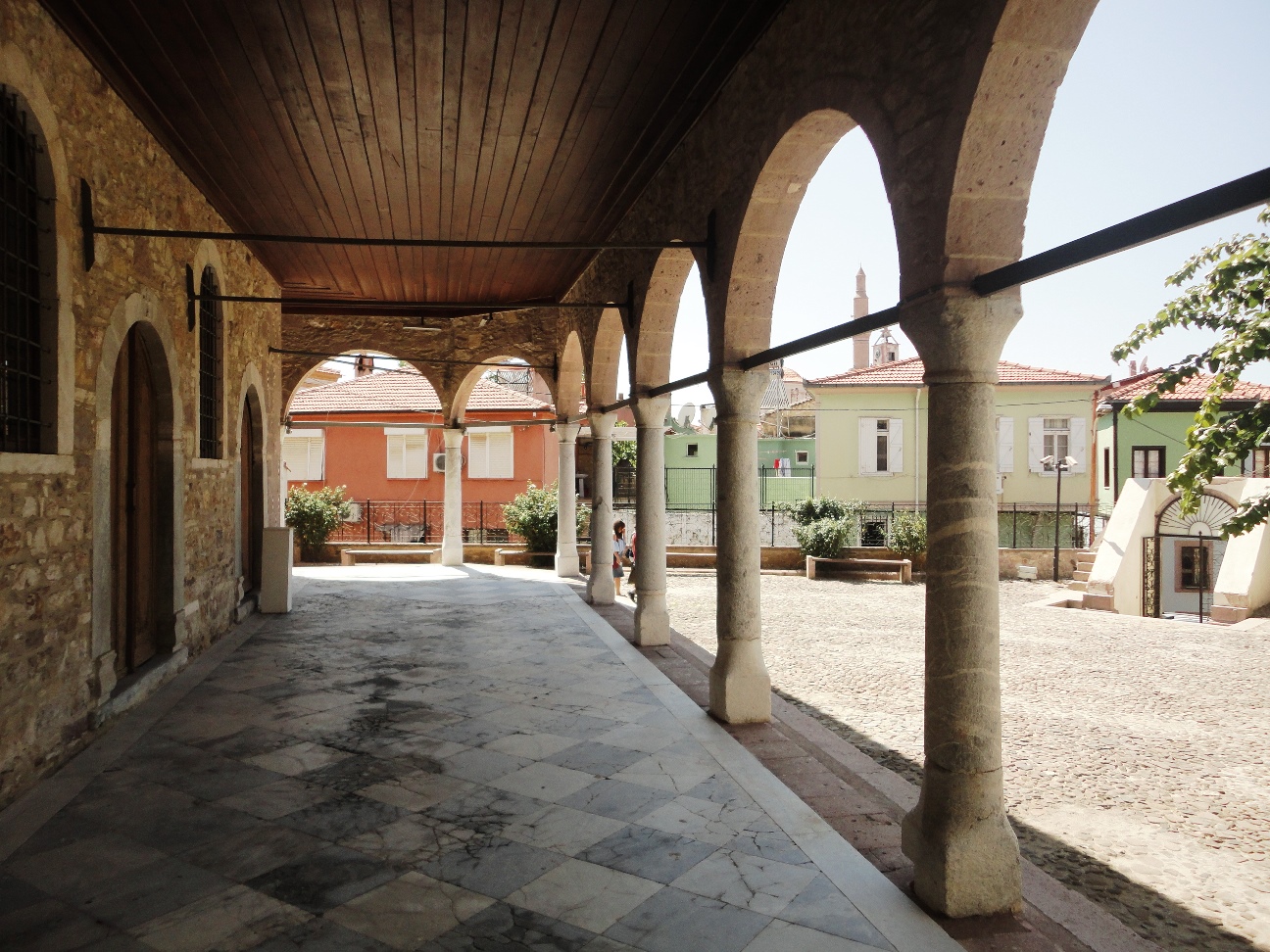
Narthex of the former Taksiyarhis Church (now museum), Ayvalık, Balıkesir, Turkey, August 30, 2018
Index to this series | Text of Chapman’s Homer’s Iliad
Both first and last place may be prominent in a narrative.
So may be the middle – perhaps I meant that to be implicit when first posting this review on September 1, 2018. Then I wrote an impressionistic account, as I did again in “Monism (Iliad Book XII)” in February, 2023. Or it is a moralistic account, looking mainly at the lesson taught by Sarpedon – also the severely monotheistic lesson of Hector, in the 2023 account. Below I add a systematic review of the action. Note added August 28, 2024.
Occurring three-quarters of the way into Book XII of the Iliad, but presented last below, Sarpedon’s great speech on leadership ought to be known by everybody with authority and power.

Index to this series | Text of Chapman’s Homer’s Iliad
After the active night of Book X comes the dawn of a thrilling day (lines 1 & 2).
AVrora, out of restfull bed, did from bright Tython rise,
To bring each deathlesse essence light, and vse, to mortall eyes.
The deathless essence called Jove sends Discord to the Greeks. She lights on the ship of Ulysses, in the middle of the fleet, so all can hear as she belts out her “Orthian song” (lines 13 & 14).
And presently was bitter warre, more sweet a thousand times
Then any choice in hollow keeles, to greet their natiu climes.
Index to this series | Text of Chapman’s Homer’s Iliad
In Book X of the Iliad, Diomedes and Ulysses go to spy on the Trojan camp at night. When they return to the Greek camp (lines 482 & 3),
Then entred they the meere maine sea, to cleanse their honord sweate
From off their feet, their thighes and neckes: and when their vehement heate …
I can enter the same sea now. After more than ten months, I return to my reading of Homer, and Chapman’s Homer, as I have returned to the place where I was doing it last year, on the Aegean coast opposite Lesbos.
 Polytropy