Category Archives: Thoreau

Henry David Thoreau

Anthropology of Mathematics

This essay was long when originally published; now, on November 30, 2019, I have made it longer, in an attempt to clarify some points.

The essay begins with two brief quotations, from Collingwood and Pirsig respectively, about what it takes to know people.

  • The Pirsig quote is from Lila, which is somewhat interesting as a novel, but naive about metaphysics; it might have benefited from an understanding of Collingwood’s Essay on Metaphysics.

  • A recent article by Ray Monk in Prospect seems to justify my interest in Collingwood; eventually I have a look at the article.

Ideas that come up along the way include the following.

  1. For C. S. Lewis, the reality of moral truth shows there is something beyond the scope of natural science.

  2. I say the same for mathematical truth.

  3. Truths we learn as children are open to question. In their educational childhoods, mathematicians have often learned wrongly the techniques of induction and recursion.

  4. The philosophical thesis of physicalism is of doubtful value.

  5. Mathematicians and philosophers who ape them (as in a particular definition of physicalism) use “iff” needlessly.

  6. A pair of mathematicians who use “iff” needlessly seem also to misunderstand induction and recursion.

  7. Their work is nonetheless admirable, like the famous expression of universal equality by the slave-driving Thomas Jefferson.

  8. Mathematical truth is discovered and confirmed by thought.

  9. Truth is a product of every kind of science; it is not an object of natural science.

  10. The distinction between thinking and feeling is a theme of Collingwood.

  11. In particular, thought is self-critical: it judges whether itself is going well.

  12. Students of mathematics must learn their right to judge what is correct, along with their responsibility to reach agreement with others about what is correct. I say this.

  13. Students of English must learn not only to judge their own work, but even that they can judge it. Pirsig says this.

  14. For Monk, Collingwood’s demise has meant Ryle’s rise: unfortunately so since, for one thing, Ryle has no interest in the past.

  15. In a metaphor developed by Matthew Arnold, Collingwood and Pirsig are two of my touchstones.

  16. Thoreau is another. He affects indifference to the past, but his real views are more subtle.

  17. According to Monk, Collingwood could have been a professional violinist; Ryle had “no ear for tunes.”

  18. For Collingwood, Victoria’s memorial to Albert was hideous; for Pirsig, Victorian America was the same.

  19. Again according to Monk, some persons might mistake Collingwood for Wittgenstein.

  20. My method of gathering together ideas, as outlined above, resembles Pirsig’s method, described in Lila, of collecting ideas on index cards.

  21. Our problems are not vague, but precise.


When Donald Trump won the 2016 U.S. Presidential election, which opinion polls had said he would lose, I wrote a post here called “How To Learn about People.” I thought for example that just calling people up and asking whom they would vote for was not a great way to learn about them, even if all you wanted to know was whom they would vote for. Why should people tell you the truth?

Saturn eclipse mosaic from Cassini

Continue reading

On Chapman’s Homer’s Iliad, Book XXII

Note added September 9, 2024: In “Potential (Iliad Book XIII)” and “Femininity (Iliad Book XIV),” I wondered whether an editor would remove Books XII and XIII (or at least the latter) for featuring neither Agamemnon (wounded in Book XI) nor Achilles (still on strike, despite the pleas in Book IX). An editor might remove or trim Books XX and XXI too, for being “only” about a warrior gone berserk. After Achilles has

  • recognized his foolishness in Book XVIII,
  • patched things up with Agamemnon in Book XIX,

that could be enough, even for an epic. I continue to wonder about the function of the ensuing two books. Do they show how words of contrition may not represent a real change of heart? As well as Aeneas and his genealogy, the books give us Polydorus and Lycaon, sons of Laothoë, daughter of Altes; killed by Achilles, the boys will be missed by their father, Priam, in Book XXII. This book is a relief, not because Achilles gives anybody any relief; that will come in Book XIV.

Andromache draws a hot bath, for Hector to slip into when he comes home from the war. Actually she has her maids heat the water, while she herself weaves flowers into a tapestry.

Rocks in foreground, houses in background, and in front of them, a spit of sand; rippling sea on the left, still water on the right, with a narrow passage between
Mouth of stream forming border between Balıkesir and İzmir

Continue reading

On Causation

Causation seems commonly to be understood as a physical concept, like being a fossil. The paleontologist seeks the one right answer to the question of when a particular dinosaur bone became part of the fossil record; likewise readers of international news seem to think there is one right answer to the question of whether Donald Trump or Ali Khamenei caused the shooting down of Ukraine International Airlines Flight 752 on January 8, 2020.

There is not one right answer. If you are Trump, you caused 176 civilian deaths by attacking the Iranians and provoking their response. If you are Mitch McConnell, you caused the deaths by inhibiting the removal of Trump from office. If you are Khamenei, you did it by meeting Trump’s fire with fire.

Being a cause does not mean you deserve condemnation or praise: that is another matter.

Continue reading

We the Pears of the Wild Coyote Tree

This is a preliminary report on two recent films:

  • The Wild Pear Tree, by Nuri Bilge Ceylan;
  • We the Coyotes, by Marco La Via and Hanna Ladoul.

The report is preliminary, not because there is going to be another, but because I have seen each film only once, and I may see one of them again.

I remember that François Truffaut liked to see films at least twice. I believe I read this in The Washington Post, and I might have guessed it was in an appreciation published when Truffaut died; however, he died on October 21, 1984, during the first semester of my sophomore year at St John’s College in Santa Fe, and I would not have been reading the Post then.

While in college, I did enjoy seeing some films twice, or a second time; Truffaut’s own 400 Coups was an example, a French teacher having shown it to us in high school.

The two films that I am reviewing now concern young adults trying to find their own way in the world, in defiance of their elders. We all have to do this. In every generation, some will do it more defiantly than others. Heraclitus can be defiant, he of Ephesus and thus one of the Ionian philosophers, whose spirit I imagine to haunt the Nesin Mathematics Village. A further reason to bring up Heraclitus will be a theme that is explicit in Pear Tree, implicit (or metaphorical) in Coyotes: gold.

A book, whose cover shows a bonfire, sits on a rock dampened by waves of the sea, which laps on the sand beyond
A copy of The Logos of Heraclitus,
by Eva Brann,
on Marmara Island, July, 2012

Continue reading

NL XXV: The Three Laws of Politics

Index to this series

Executive summary (added September 11, 2018): The the three laws of politics are that (1) within the body politic, there is a ruling class, which is a society proper; (2) the ruling class can take in members from the ruled class; (3) the ruled and ruling classes will resemble one another, so that e.g. rulers of slaves will become slavish themselves. I compare such laws with physical laws, as discussed by Einstein; but on this subject, a look ahead to Chapter XXXI, “Classical Physics and Classical Politics,” would be in order. Meanwhile, by the Second Law, the body politic, or its ruling class, can be a permanent society; Nazi claims about the youth or senility of different states are bogus. There are further gradations within the ruling and ruled classes, according to strength of will; a weak will can be strengthened by another person’s stronger will through induction.


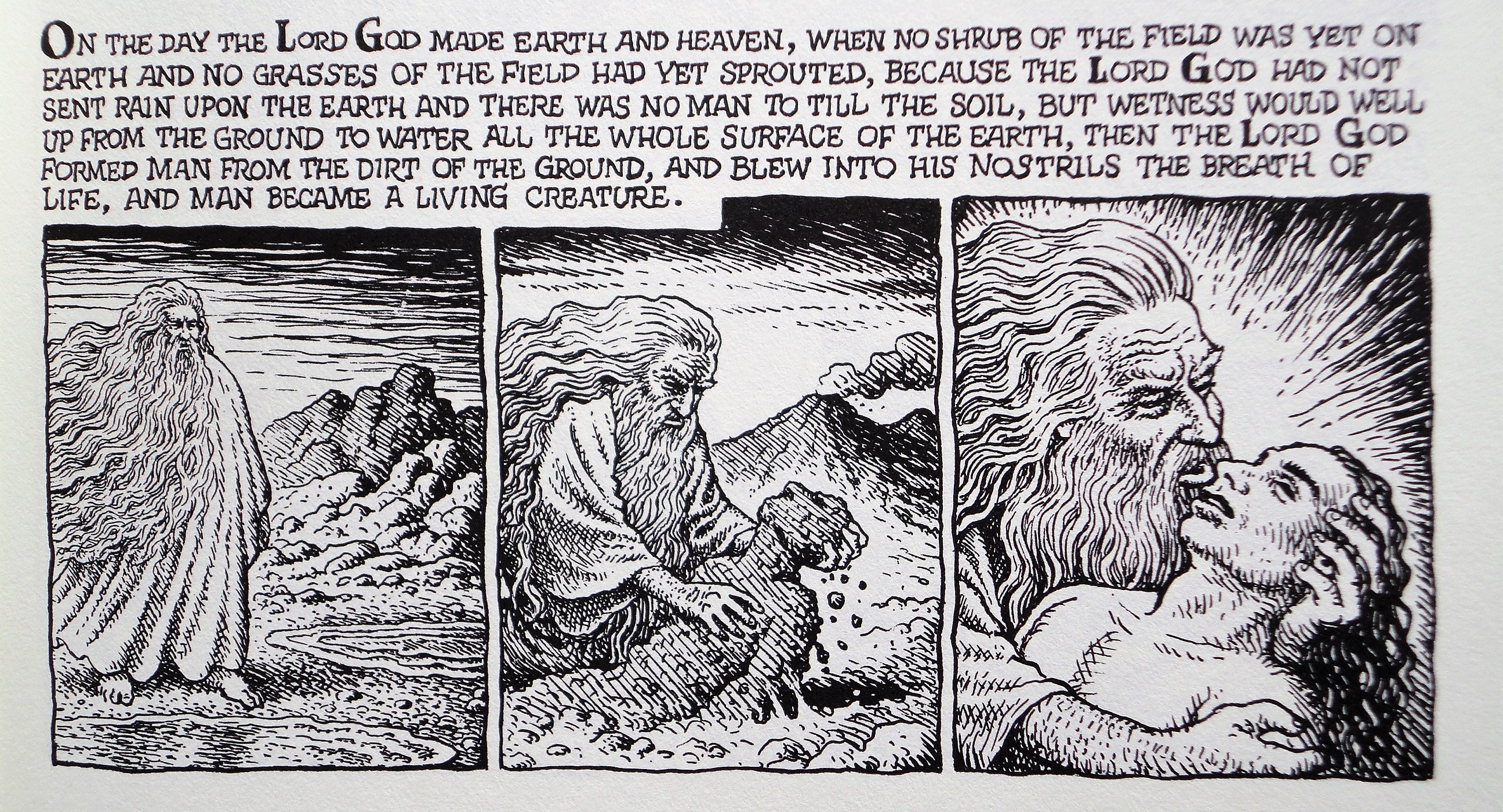
A pervading theme of the New Leviathan is freedom of will. Whether we actually have it is only a pseudo-problem (13. 17). Some persons have been fooled into thinking it a problem, perhaps by the misleading myth that free will is a divine gift, like life itself, breathed into our nostrils when, in Genesis 2:7, God forms us of the dust of the ground. As Collingwood observes at the end of Chapter XXIII, “The Family As a Society,” we are born neither free nor in chains. We have to grow up. Growing up is becoming free.

The Book of Genesis Illustrated by Robert Crumb (New York: Norton, 2009)

Continue reading

The Private, Unskilled One

I went into Istanbul’s Pandora Bookshop a month ago, looking for an English translation of War and Peace, since the Garnett translation I had read at college was falling apart. I was told the Oxford World’s Classics edition (with the Maude translation) was coming the next week, and it did come.

Elif Batuman, The Idiot, in Nesin Matematik Köyü, Kayser Dağı Mevkii, Şirince, Selçuk, İzmir, Turkey, 2017.05.18

Continue reading

Writing, Typography, and Nature

Note added February 10, 2019: I return to this rambling essay, two years later in the Math Village. The main points are as follows.

  • Writing is of value, even if you never again read what you write.
  • There is also value to reading again, as in the present case.
  • A referee rejected a submitted article of mine in the history of mathematics because its order did not make sense – to that referee, though a fellow mathematician thought well of the article. A revision was eventually published as “On Commensurability and Symmetry.”
  • In the preface to The Elements of Typographical Style, Robert Bringhurst wonders how he can write a rulebook when we are all free to be different. He thus sets up an antithesis, such as I would investigate later in “Antitheses.”
  • From being simply a means of copying, typography has become a means of expression.
  • Yet typography should not draw attention to itself, just as, according to Fowler in A Dictionary of Modern English Usage, pronunciation (notably of foreign words) should not.
  • Through my own experience of typography with LaTeX [and HTML, as in this blog], I have developed some opinions differing from some others’.
  • Bringhurst samples Thoreau,
    • whose ridicule of letters sent by post applies today to electronic media, and
    • who rightly bemoans how enjoying the woods is thought idle; cutting them down, productive.
  • In Gödel, Escher, Bach, Douglas Hofstadter wonders how a message can be recognized by any intelligence. Bringhurst restricts the question to concern intelligences on this earth.
  • In my youth, Hofstadter introduced me to Zen Flesh, Zen Bones, (edited by Reps and Senzaki), whose influence on me I consider.
  • The Zen story about whether “this very mind is Buddha” suggests a further development of Collingwood’s “logic of question and answer.”
  • Through looking at another translation, I consider how Reps and Senzaki turned Chinese into English.
  • Rereading this blog led me back to Hofstadter.

Here are some meditations on some books read during a stay in the Nesin Mathematics Village, January, 2017. I originally posted this article from the Village; now, back in Istanbul, a few days into February, recovering from the flu that I started coming down with in the Village, I am correcting some errors and trying to clarify some obscurities.

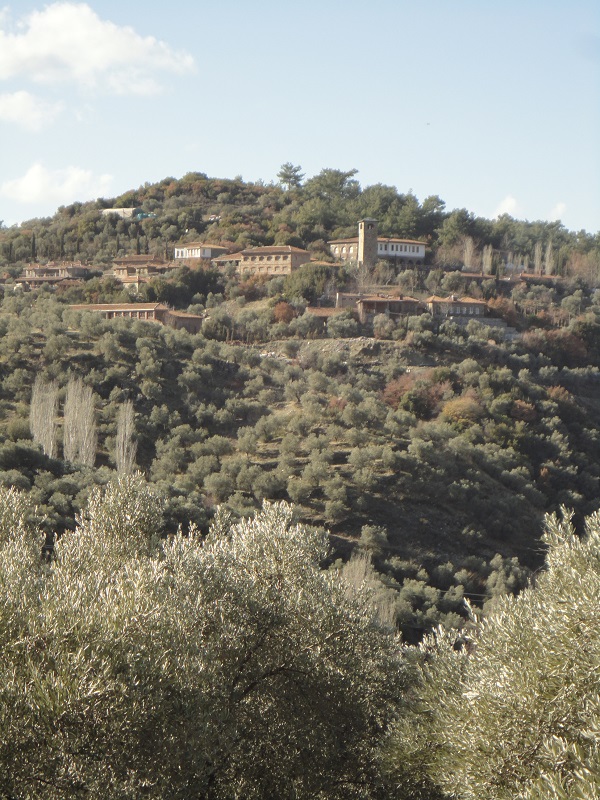
From below, a wooded hill, with buildings near the crest
Nesin Mathematics Village from the east
Wednesday, January 18, 2017

Continue reading

Life in Wartime

Turkey has given me a lot. My spouse would be enough; but life in Turkey offers various pleasures, and—for me at least—time to enjoy them. Hard work may be considered a virtue in the United States. Not so in Turkey. I am still driven to do things here, but perhaps only in the way that Thoreau was driven. He was driven to do what he wanted to do. One thing he wanted to do was write as follows.

I sometimes wonder that we can be so frivolous, I may almost say, as to attend to the gross but somewhat foreign form of servitude called Negro Slavery, there are so many keen and subtle masters that enslave both North and South. It is hard to have a Southern overseer; it is worse to have a Northern one; but worst of all when you are the slave-driver of yourself. Talk of a divinity in man! Look at the teamster on the highway, wending to market by day or night; does any divinity stir within him? His highest duty to fodder and water his horses!

For how many Americans is the highest duty to go to work to pay for the car that they drive to work?

Thoreau’s journal on the beach
Thoreau’s Journal
in the abridgement by Damion Searls
Profesörler Sitesi, Altınova, Balıkesir, Türkiye
Friday, August 28, 2015
See “Thoreau by the Aegean” of the following day

Continue reading

Narnia

The following notes about the Chronicles of Narnia by C. S. Lewis are from four emails that I wrote in the fall of 2015 (with some noted additions in the spring of 2020 and some additional editing on November 25, 2021). The emails rebut various objections to the Narnia books. I have put my emails here, because I noticed that a friend on Facebook was wondering whether her daughter was ready to read the Chronicles, or perhaps to be read to from them. I do not wish to write much on Facebook, for reasons detailed elsewhere in this blog; so I asked interested persons to read me here.

My explorations continue in “Return to Narnia.”

Side of boxed set of The Chronicles of Narnia from 1970s

Continue reading

One & Many

0

This essay – these notes for an essay, this draft of an essay – is inspired by Robert Pirsig’s first book. I have made sectional divisions where they seemed to occur naturally.

Photo of paperback and hardback editions of Zen and the Art of Motorcycle Maintenance

Continue reading