Category Archives: Grammar

Gödel, Grammar, and Mathematics

Preface

This attempt at exposition of Gödel’s Incompleteness Theorem was inspired or provoked by somebody else’s attempt at the same thing, in a blog post that a friend directed me to. I wanted in response to set the theorem in the context of mathematics rather than computer science.

Continue reading

Automatia

One day during the Trojan War, Apollo and Athena decide to give the combatants a break. The general conflict is to be replaced with a one-on-one. The Olympians induce Helenus to tell his brother Hector to take on whichever of the Greeks is up for it.

Twilight beach scene
Day or night?
Sunset over Lesbos
From the Anatolian mainland
Tuesday, August 1, 2023

Continue reading

Mood

Executive summary. The English grammatical moods – indicative, imperative, subjunctive – were not understood till the nineteenth century, according to an 1882 doctoral dissertation, On the Use of the Subjunctive Mood in Anglo-Saxon. Considering illustrative passages that happen to be from Plato, Alfred Douglas, Evelyn Waugh, and especially John Donne; looking ultimately at John McWhorter’s 2015 essay, “English is not normal”; I review the subjunctive mood, grammar in general, and my own lack of understanding till I was in college.

The copyright page has, with the preceding pages and cover, fallen away from the rest of the book with use
Copyright and contents pages of the Concise Oxford Dictionary, 6th edition

Continue reading

On Chapman’s Homer’s Iliad, Book XVIII

I analyze Book XVIII of the Iliad into seven scenes.

Branches against sky

Continue reading

NL XLV: The Germans

Index to this series

At the end of Collingwood’s New Leviathan (1942), we reach a chapter whose theme is that of my more recent articles on grammar.

By August Macke – The Yorck Project (2002) 10.000 Meisterwerke der Malerei (DVD-ROM), distributed by DIRECTMEDIA Publishing GmbH. ISBN: 3936122202., Public Domain, Link

As history, Collingwood’s last chapter is difficult, for the reasons that trouble Herbert Read at the beginning of his Concise History of Modern Painting (revised 1968, augmented 1974). Read opens his first chapter with a passage from Collingwood’s Speculum Mentis (1924):

Continue reading

Writing Rules

Executive summary (added July 16, 2018): I have had enough of misrepresentation by experts of what other experts have to say about grammar.


An ongoing concern of this blog is the subject taught in school called grammar. See for example

  • the previous post, “Writing and Inversion,” about how a supposed rule against the passive voice might be better understood as a rule to avoid certain inversions of order (namely those inversions that add words and torpor);
  • the post before that, “A New Kind of Science,” presenting a theory that grammar is properly neither prescriptive nor descriptive, but “criteriological,” because it examines the criteria that we apply to our own speaking and writing;
  • an early expression (from six years ago) of some of those ideas: “Strunk and White.”

Grammar causes anxiety. Every aspect of school would seem to cause anxiety in somebody. Decades after they have left school, how many persons have nightmares of missing an examination? Quite a few, it would seem; see the evidence appended to this post. My mother and her brother were such persons, as I learned when growing up. I seem not to be such a person, though I once dreamt of missing a plane.

How much support of current US President Donald Trump is due to memories of belittlement by teachers at school? Similar questions may be raised about

  • UK government minister Michael Gove’s saying, “people in this country have had enough of experts …”;
  • the rise in Turkey of Recep Tayyip Erdoğan, who has perceived a special threat from the Peace Academics.

On that last matter, see my blog essay of March, 2016, “Academic Freedom.”

In the blog generally, I may criticize some of my fellow academics; but I criticize them for their own criticism of fellow academics and thinkers. Thus in the article “Strunk and White” listed above, I say Geoffrey Pullum was stupid to decry, in 2009, the “50 Years of Stupid Grammar Advice” offered by Strunk and White’s Elements of Style.

Still I have respected Pullum’s recommendation of Style: Toward Clarity and Grace, by Joseph M. Williams. I bought Williams’s book, and in this post I focus on some of his advice.

I thought Williams’s book might be more “democratic” than Strunk and White’s, in the sense of being aimed at a broader audience. That broader audience might include students whose parents didn’t go to college or grow up speaking English.

Now I have doubts that Williams has such an audience in mind. In his final chapter, called “Usage,” Williams writes (on page 176) of

Three Kinds of Rules

1. Some rules characterize the basic structure of English … No native speaker of English has to think about these rules at all.

2. Some rules distinguish standard from nonstandard speech … The only writers and speakers who worry about these rules are those upwardly mobile types who are striving to join the educated class of writers and speakers …

3. Finally, some grammarians try to impose on those who already write educated standard English particular items of usage that they think those educated writers should observe – don’t split infinitives; use that, not which for restrictive clauses …

This may not be much evidence to go on; but judging from the style of #1, I’m not sure Williams has considered the possibility of having readers who are not native speakers of English. In #2, by referring pejoratively to “those upwardly mobile types,” Williams seems to think they are not readers either.

Appearances are corroborated on the next page, after Williams describes again his three kinds of rules:

1. Some rules account for the fundamental structure of English …

2. Some rules distinguish the dialects of the educated and the uneducated …

3. And some rules belong to that category of rules observed by some well-educated people, and ignored by others equally well-educated …

Ordinarily, the first set of rules concerns us not at all. And if you are interested in this book, you probably aren’t much concerned with the second set either. It is the third set of rules that concern – sometimes obsess – already competent but not entirely secure writers. They are the rules of usage out of which the Pop Grammarians have created their cottage industry.

In faithfully transcribing Williams’s words about rules of usage, I have noticed that they violate a certain rule: “Enclose parenthetic expressions between commas.” Indeed, in the first block quotation above, giving the first list of “Three Kinds of Rules,” look again at the last clause (itself a rule):

use that, not which for restrictive clauses.

Here the phrase “not which” is parenthetic, but is not printed that way. Since a comma precedes it, a comma ought also to follow it, at least if one agrees with the rule that I stated, “Enclose parenthetic expressions between commas.”

That rule happens to be Rule 3 of Strunk’s original eight “Elementary Rules of Usage.” It is still Rule 3 in the version of The Elements of Style edited by E. B. White, although some of the other rules have been changed.

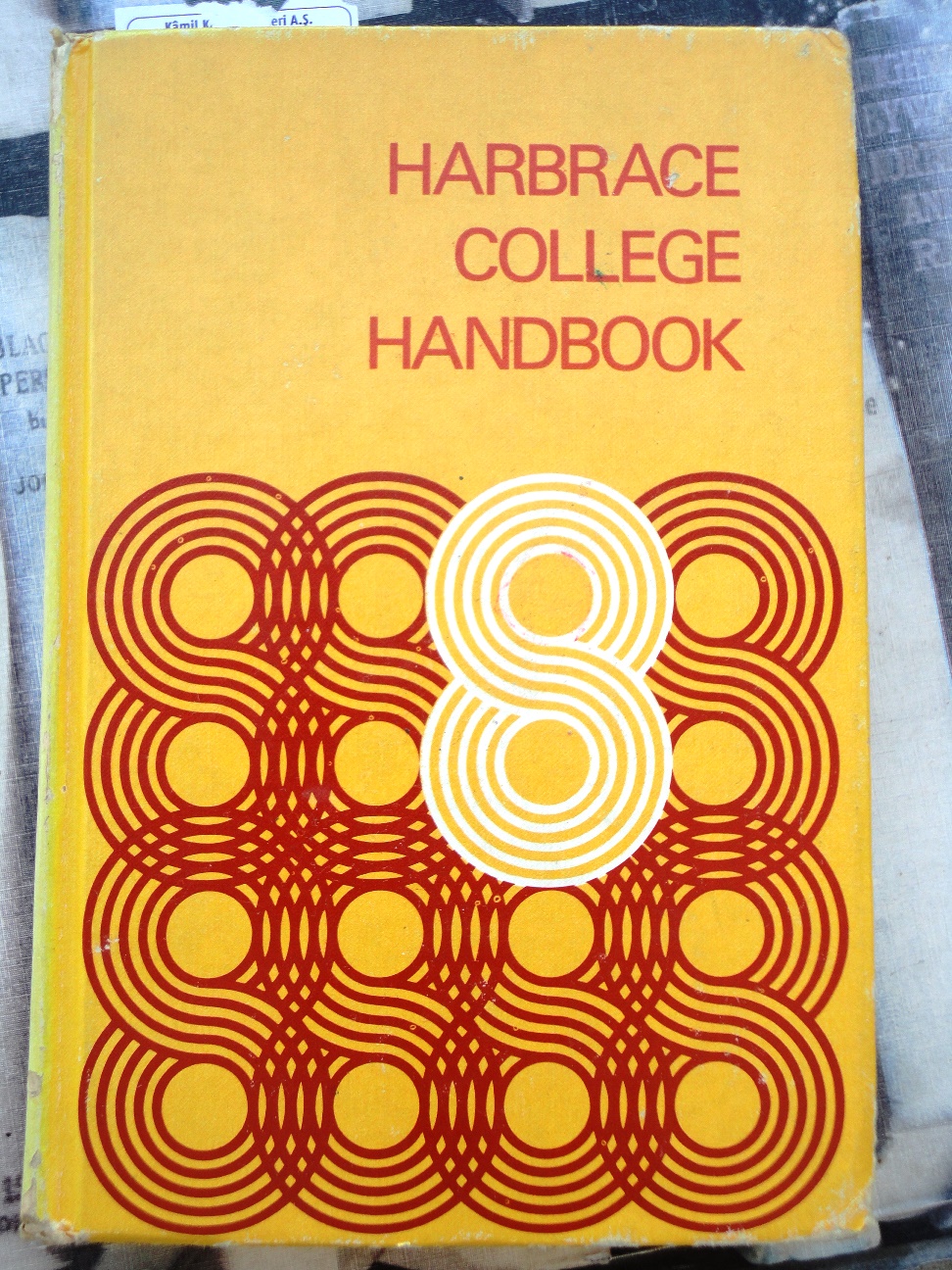
I find the same rule also as part of Rule 12d in the Harbrace College Handbook (8th edition, 1977), used in the ninth-grade English class at my private, college-preparatory school for boys in Washington. According to the Handbook:

Commas set off nonrestrictive clauses and phrases and other parenthetical and miscellaneous elements, such as transitional expressions, items in dates, words used in direct address, and so on. Restrictive clauses and phrases are not set off by commas.

Surely I was taught this rule in earlier years too. The rule seems unobjectionable and even natural to me now, and I do not recall any difficulty with it.

Yellow cover of Harbrace College Handbook 8

Continue reading

Writing and Inversion

Executive summary: The “voice” of a transitive verb may be active or passive. A piece of writing may be vigorous or torpid. There is not an exact correspondence between passive verbs and torpid writing. However, a passive verb is used to effect inversion of subject and object. One may also invert subject and auxiliary verb, subject and predicate, or two clauses, always adding new words. Each inversion may lead to torpid writing. This is what Strunk warned about in The Elements of Style, by issuing the command, “Use the active voice.” The command must be followed with discretion. Williams makes the same case, more elaborately, in Style: Towards Clarity and Grace. There is no foolproof executive summary of how to write well.


When E. B. White revised William Strunk’s original Elements of Style, he did not retain Strunk’s “Introductory,” whose first paragraph said of the book,

The experience of its writer has been that once past the essentials, students profit most by individual instruction based on the problems of their own work, and that each instructor has his own body of theory, which he may prefer to that offered by any textbook.

Perhaps many students today cannot receive individual instruction. They are just given textbooks that try to spell out everything. Continue reading

A New Kind of Science

Executive summary. Some sciences are called descriptive, empirical, or natural; others, prescriptive or normative. We should recognize a third kind of science, which studies the criteria as such that a thinking being imposes on itself as it tries to achieve success. I propose linguistics as an example. Collingwood introduced the term criteriological for the third kind of science. This was in The Principles of Art (1938), though I find the germ of the concept in earlier work, even in Collingwood’s first book, Religion and Philosophy (1916), in the passage on psychology that the author would recall in An Autobiography (1939).

Collingwood’s examples of criteriological sciences are logic, ethics, aesthetics, and economics. Pirsig effectively (and independently) works out rhetoric as an example in Zen and the Art of Motorcycle Maintenance (1974). We may benefit from clarity here, given how people can have a strong reaction to being lectured by experts. For Collingwood, such a reaction is found in Nazi Germany; see the last chapter of The New Leviathan (1942). Reactions to grammar are the subject of my own two ensuing articles, “Writing and Inversion” and “Writing Rules.”


Some sciences are not recognized for what they are. The sciences themselves are not new, but a proper understanding of them may be new to some of us, including myself.

Continue reading

Facts (NL IX, ‘Retrospect,’ first 6 paragraphs)

Index to this series

A certain person says,

I am not better than you or more virtuous than you. If you see me on the right path, help me. If you see me on the wrong path, advise me and halt me. And obey me as far as I obey God.

How should one hear these words: as an eminently reasonable expression of benevolent humility such as any of us might honorably make? Well, no matter how qualified, the command obey me might be a warning sign. The words are in fact from a recently published video, as quoted in the Guardian Weekly (Vol 190 No 5, 11–17 July 2014, p. 4). The speaker is the man whose nom de guerre is Abu Bakr al-Baghdadi, on whose head the Department of State of the United States of America placed a ten-million-dollar bounty in 2011. He now styles himself Ibrahim, Caliph of the Islamic State, a new entity that is supposed to restore the lost Muslim glory of past centuries. This restoration is to be achieved through war. War requires military discipline, with punishments meted out for infractions like insubordination, not to mention the slaughter of those perceived as enemies. So al-Baghdadi’s request to be advised and halted if seen to be in the wrong must be interpreted rather carefully.

It is difficult to know how to interpret somebody’s words. With that I pass to the transitional chapter in the first part, “Man,” of Collingwood’s New Leviathan.

Continue reading

Cogito ne demek?

Why the late Geoffrey Lewis’s Turkish Grammar (2d ed., Oxford, 2000) is exceptional:

At the beginning of a clause demek, demek ki, or demek oluyor ki (‘it becomes to say’) signifies ‘that is to say’: düşünüyorum, demek ki varım ‘I am thinking, which means I exist.’ (This Turkish translation of Descartes’ Cogito ergo sum is right—‘I am thinking’—and the usual English version—‘I think’—is wrong.)


I sent the foregoing to Facebook this morning, but this was not the best medium for the typographical features of boldface, italics, directional quotation marks, and indented quotations.

I had been aware that Lewis had died, Continue reading