Category Archives: Mathematics

Ethics of Mathematics

The 12 blue edges of a cube and the 12 green edges of an octahedron respectively bisect one another at right angles

Zometool construction, Ankara, November 20, 2010

The main point of this post is to share a passage from an essay by the late William Thurston:

1 What is it that mathematicians accomplish?

… We are not trying to meet some abstract production quota of definitions, theorems and proofs. The measure of our success is whether what we do enables people to understand and think more clearly and effectively about mathematics.

Therefore, we need to ask ourselves:

2 How do people understand mathematics?

This is a very hard question. Understanding is an individual and internal matter that is hard to be fully aware of, hard to understand and often hard to communicate …

Continue reading

Astronomy Anomaly

Aristotle was the subject of the last three posts on this blog:

Perception Deception
The Philosopher asserts in De Anima that the eyes cannot be in error about color; Josef Albers contradicts this.
Imitation Limitation
In the Poetics, Aristotle seems to use mimêsis as a differentia of poiêsis among the technai. Arts not poetry are nonetheless imitative, but perhaps artists are to be distinguished for imitating themselves.
Purity Obscurity
Does catharsis clean the emotions, or wash them away?

Two more posts might have taken up the latter half of the Poetics, but they never materialized.

I turn now to the work held under the arm of Aristotle’s teacher, at the center of Raphael’s School of Athens.


Small book atop a pile of rubble on a beach, sea beyond

Altınova, Balıkesir, Monday, June 16, 2025

Continue reading

Perception Deception


John Donne, Holy Sonnet XIX
(on the last line, “make” should be “ſhake”)

This post involves:

  • “the” philosopher –
    • Aristotle;
  • two mathematicians –
    • Euclid,
    • David Hilbert;
  • three persons associated with Black Mountain College –
    • Josef Albers,
    • Dorothea Rockburne,
    • Max Dehn;
  • one person (in addition to myself and Dehn) associated with St John’s College –
    • David Bolotin.

Continue reading

A Five Line Locus

In high school, if not sooner, one learns theorems established more than two millenia ago by Euclid and Archimedes. I am thinking of the theorems expressed today by the equations

𝐶 = 2π𝑟,
𝐴 = π𝑟²

for the circumference and area of a circle whose radius is 𝑟, and

𝐴 = 4π𝑟²,
𝑉 = (4/3)π𝑟³

for the surface area and volume of a sphere whose radius is 𝑟. One may also learn about the curves that Apollonius called parabola, ellipse, and hyperbola and that are given today by instances of the general quadratic equation

𝐴𝑥² + 𝐵𝑥𝑦 + 𝐶𝑦² + 𝐷𝑥 + 𝐸𝑦 + 𝐹 = 0.

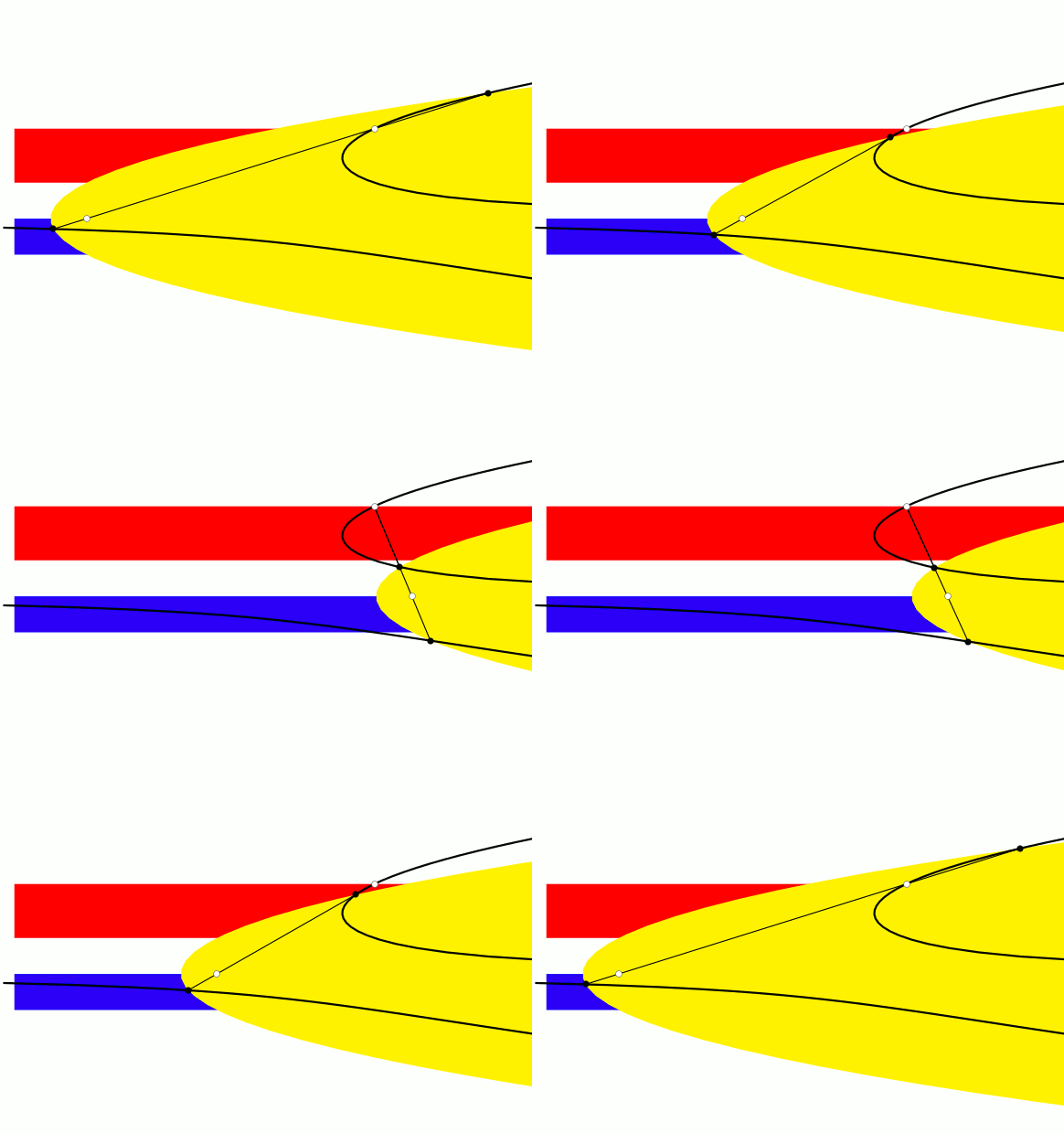
Such notation as this was introduced in the seventeenth century by Descartes, who apparently used it also to understand the curve given by the cubic equation

(𝑦² − 𝑎²)(𝑦 − 𝑏) = 𝑎𝑥𝑦.

Decartes showed that the curve in question could be generated as in the animation below, where a parabola slides along its axis, and a straight line has one point fixed and one point moving with the parabola, and the points of intersection of this straight line with the parabola give us the desired curve.

Animation described in text

Continue reading

Free Groups and Topology

My title alludes to some notes for the layperson that I rediscovered recently. I have reviewed and edited them, and they are below, in the following sections (linked to by the titles after the three main bullets; other links are to Wikipedia).

  • Quasicrystals,” based on an email of mine sent to a group of alumni of St John’s College on October 8, 2011. This was my contribution to a thread in which somebody said that
    • Dan Schechtman (whom she called Danny) was a worthy recipient of that year’s Nobel Prize in Chemistry for the discovery of quasicrystals, but
    • John Cahn deserved credit, even the prize itself, as the real discoverer.

    My wife and I had recently moved to Istanbul, and the Istanbul Model Theory Seminar had just got going. The Nobel Prize and quasicrystals had been mentioned there too.

  • Free Groups,” based on an email of October 10, 2011. I tried to describe free groups to somebody who expressed interest, but who also called himself the world’s worst mathematician.
  • Topology” – a draft of an attempt to describe that subject. In graduate school, I got excited about the definition of a topological space when I first encountered it. Here I try to motivate the definition by abstracting from the properties of the Cartesian plane as a metric space. I give the example of the Zariski topology on the same plane. I start to talk about the topology derived from the Gromov–Hausdorff metric on the space of groups with n generators, but then I stop.

A green landscape
Vegetable plot in Yeniköy (where Cavafy lived a while), Istanbul, Saturday, September 28, 2024

Continue reading

Rethinking

Last week, a student wrote me, “Is there going to be a proof question on the number theory exam?”

I answered,

As far as I’m concerned, the answer to every mathematical question is a proof, because everybody can check whether the answer is right.

I meant that the answer should provide the means for the reader to re-enact the answerer’s thought.

A bay seen from a hill across trees and houses, with green hills beyond (and heavier development at the top)
View from Büyükdere, Sarıyer, Istanbul
We live near the big building at Hacıosman
just over the horizon on the right
Sunday, June 30, 2024

Continue reading

Points of an Ellipse

This is about an image that is intended

  • to be decorative,
  • to establish the mathematical construction, with ruler and compass, of points of an ellipse.

Diagram with colored regions whose borders are discussed in the text

Continue reading

Creativity

In the Platonic dialogues, Socrates frequently mentions τέχνη (technê), which is art in the archaic sense: skill or craft. The concern of this post is how one develops a skill, and what it means to have one in the first place.

Books quoted or mentioned in the text, by Midgley, Simone Weil, Thoreau, Amy Mandelker (on Tolstoy), Oliver Byrne (on Euclid), Wittgenstein, Arendt, and Caroline Alexander (on Homer)

Continue reading

On Playing Zpordle

After Wordle appeared, a number of variants came out. One of the least popular may be Zpordle, or ℤp-ordle. I imagine it could be more popular, if people knew it did not require advanced mathematics. It still involves numbers, to which some people declare an allergy. Nonetheless, I think Zpordle can be explained in elementary-school terms, and that is what I shall try to do here.

Zpordle screenshot
Screenshot of the Zpordle game won on May 27, 2022

Continue reading

Gödel, Grammar, and Mathematics

Preface

This attempt at exposition of Gödel’s Incompleteness Theorem was inspired or provoked by somebody else’s attempt at the same thing, in a blog post that a friend directed me to. I wanted in response to set the theorem in the context of mathematics rather than computer science.

Continue reading