Here is the model that I made of the hyperbola, or rather the conjugate hyperbolae, as Apollonius calls them.
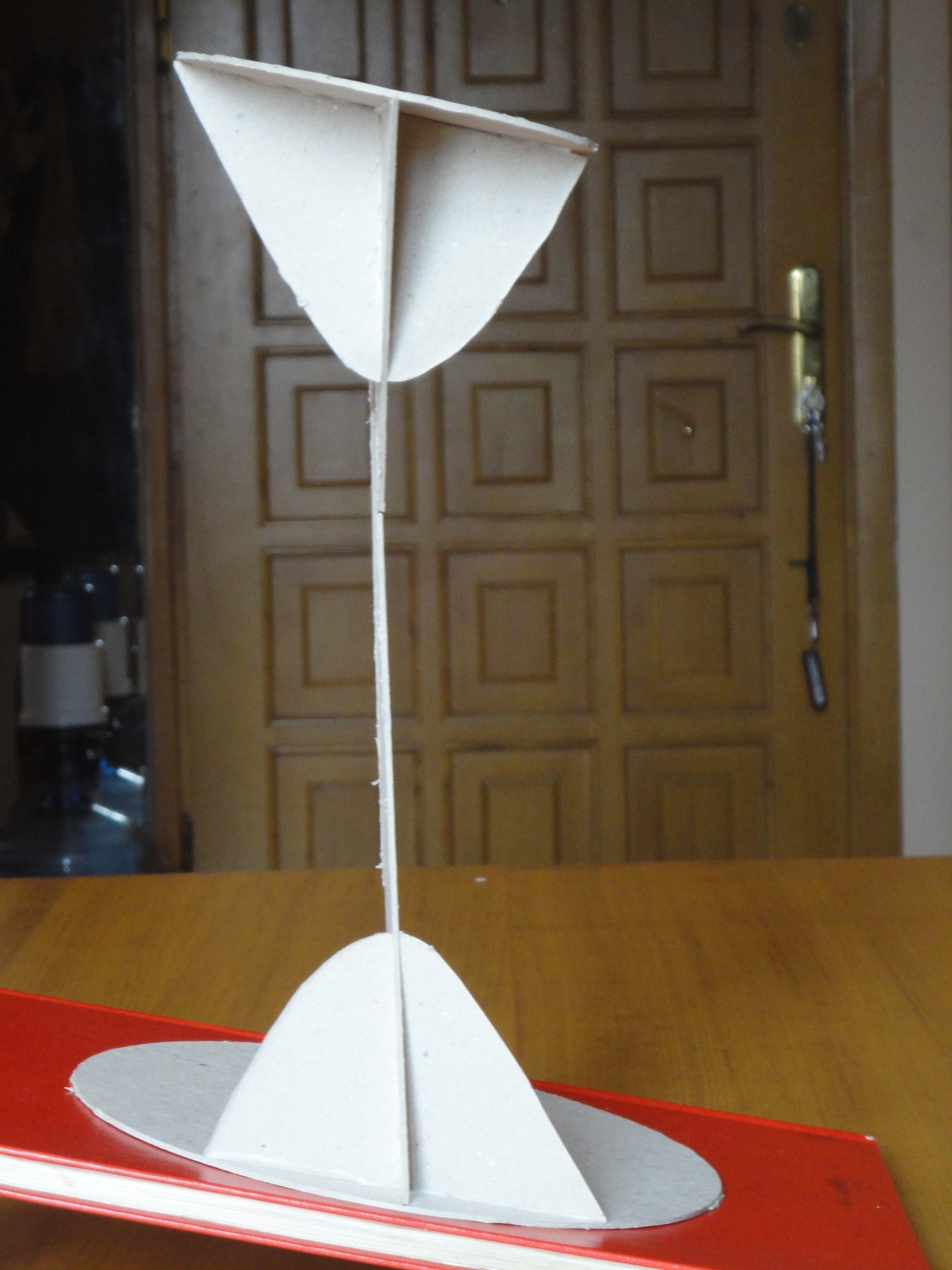
Conjugate hyperbolae and their common diameter
Continue reading
Here is the model that I made of the hyperbola, or rather the conjugate hyperbolae, as Apollonius calls them.
Conjugate hyperbolae and their common diameter
I do not now recall my specific inspiration; but in January of 2012, sitting at home in Istanbul, I cut up a cardboard box in order to make a model of a parabola quâ conic section.

January 14, 2012
A certain person says,
I am not better than you or more virtuous than you. If you see me on the right path, help me. If you see me on the wrong path, advise me and halt me. And obey me as far as I obey God.
How should one hear these words: as an eminently reasonable expression of benevolent humility such as any of us might honorably make? Well, no matter how qualified, the command obey me
might be a warning sign. The words are in fact from a recently published video, as quoted in the Guardian Weekly (Vol 190 No 5, 11–17 July 2014, p. 4). The speaker is the man whose nom de guerre is Abu Bakr al-Baghdadi, on whose head the Department of State of the United States of America placed a ten-million-dollar bounty in 2011. He now styles himself Ibrahim, Caliph of the Islamic State, a new entity that is supposed to restore the lost Muslim glory of past centuries. This restoration is to be achieved through war. War requires military discipline, with punishments meted out for infractions like insubordination, not to mention the slaughter of those perceived as enemies. So al-Baghdadi’s request to be advised and halted
if seen to be in the wrong must be interpreted rather carefully.
It is difficult to know how to interpret somebody’s words. With that I pass to the transitional chapter in the first part, “Man,” of Collingwood’s New Leviathan.
This is about our second visit to the Nesin Mathematical Village in Şirince this year. The first visit was to attend the Summer School Around Valuation Theory, May 22–26. Now we have come back to teach, as usual, in the Turkish Mathematical Society Undergraduate and Graduate Summer School. This time we are teaching not just one week, but two: July 14–27. My own course, as several times in the past, is on nonstandard analysis. Each course meets every day but Thursday, two hours a day.
The Math Village only increases in beauty every year, as I mean to suggest by posting a few photographs below.
Feeling differs from thought. Thought is founded in feeling; thought is erected on feeling; thought needs feeling. Thought needs feelings that are strong enough to support it. But thought itself is not strong (or weak); it has (or can have) other properties, like precision and definiteness. Thought can be remembered and shared in a way that feeling cannot.
The New Leviathan is a work of thought. One might say that a work of thought cannot properly explain feeling. Collingwood himself says this, more or less, in Chapter V, even in its very title: “The Ambiguity of Feeling.” Continue reading
In Chapter I of The New Leviathan, we stipulated that natural science, the “science of body,” must be free to pursue its own aims. But we ourselves are doing science of mind, and:
1. 85. The sciences of mind, unless they preach error or confuse the issue by dishonest or involuntary obscurity, can tell us nothing but what each can verify for himself by reflecting on his own mind.
All of us can be scientists of mind, if only we are capable of reflection: Continue reading
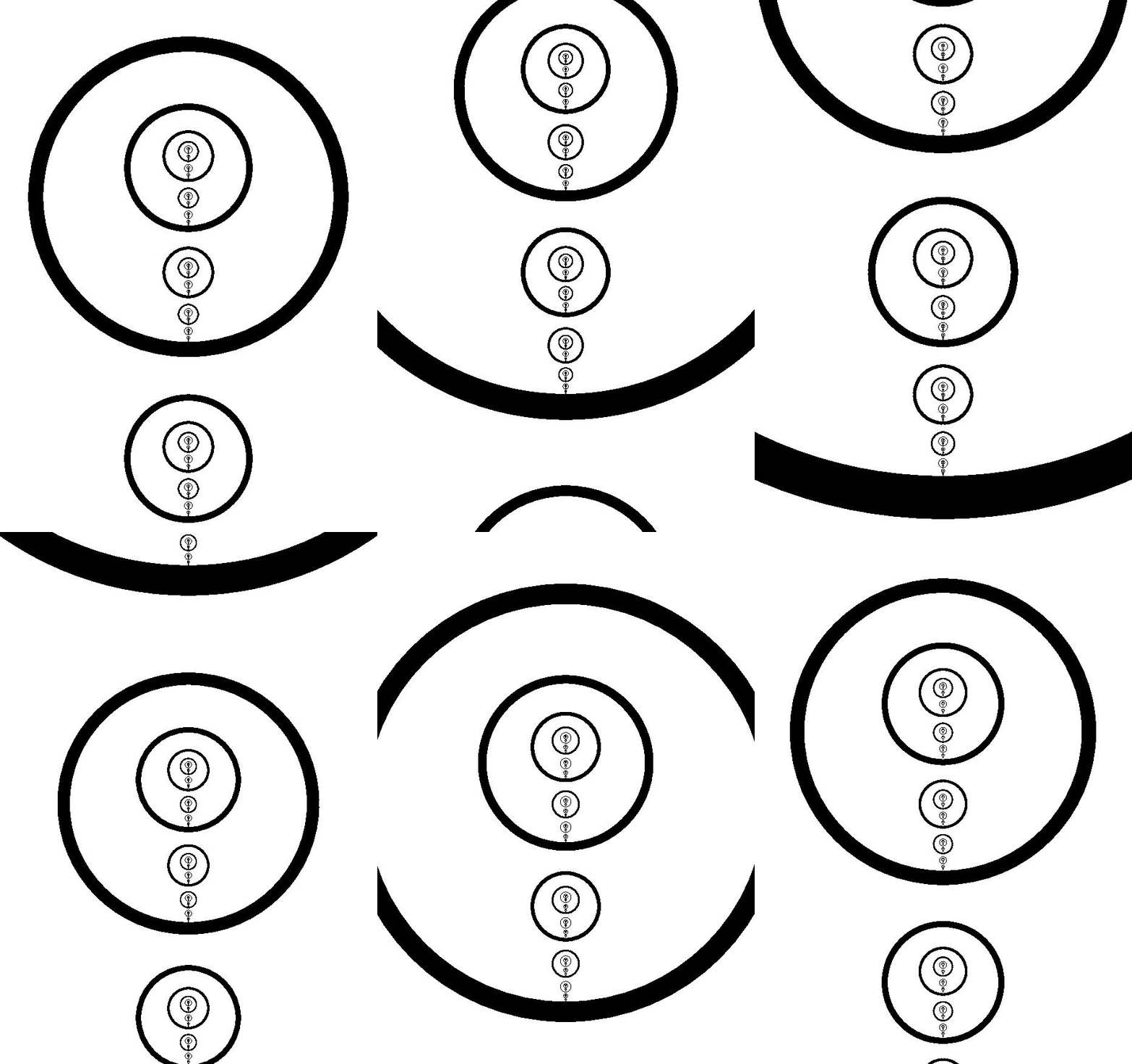
Here is an image that I made when preparing the article Self-similarity nine months ago. The image appeared as a draft in the list of all of my articles on this blog. Here it is officially:
I continue making notes on The New Leviathan of R. G. Collingwood (1889–1943). Now my main concern is with the second chapter, “The Relation Between Body and Mind”; but I shall range widely, as I did for the first chapter.
Some writers begin with an outline, which they proceed to fill out with words. At least, they do this if they do what they are taught in school, according to Robert Pirsig:
He showed how the aspect of Quality called unity, the hanging-togetherness of a story, could be improved with a technique called an outline. The authority of an argument could be jacked up with a technique called footnotes, which gives authoritative reference. Outlines and footnotes are standard things taught in all freshman composition classes, but now as devices for improving Quality they had a purpose.
That is from Zen and the Art of Motorcycle Maintenance, chapter 17.
Does anybody strictly follow the textbook method of writing? Continue reading
 Polytropy