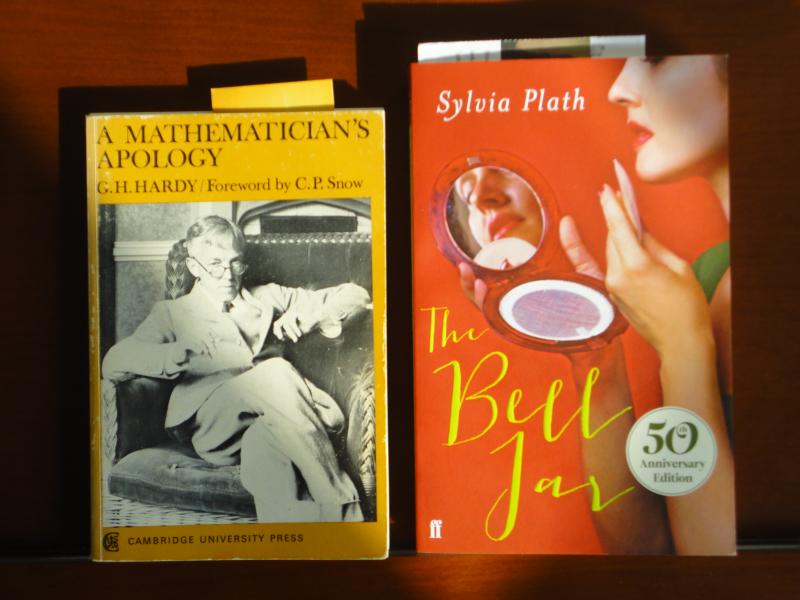
This is about G. H. Hardy and Sylvia Plath: Hardy quâ author of A Mathematician’s Apology (1940); Plath, The Bell Jar (1963).
I first read Plath only recently, after encountering The Bell Jar by chance in the Istanbul bookshop called Pandora. After I finished reading it next day in Espresso Lab on İstiklâl, a woman who had earlier been speaking Turkish asked in English to look at the book. She pondered the front and the back before handing the book back to me. When I asked whether she knew of it, she simply said yes. She may not have understood my meaning; but I did not put her English (or my Turkish) to the test. Had she been made curious by the cover, showing a woman applying powder with the aid of a compact mirror? Did that cover accurately reflect the novel?
On an airplane once I was reading a paperback whose cover displayed a painting of ruins beneath the Acropolis of Athens. “I love historical fiction!” gushed a flight attendant. The term might be stretched to cover what I was reading; but it was the Oxford World’s Classics edition of Plato’s Republic.
I had first read Hardy’s Apology in high school, thanks to the suggested reading at the end of Spivak’s Calculus. A couple of weeks ago, I somehow found a blog that took its title from the end of Hardy’s opening paragraph. That paragraph reads:
It is a melancholy experience for a professional mathematician to find himself writing about mathematics. The function of a mathematician is to do something, to prove new theorems, to add to mathematics, and not to talk about what he or other mathematicians have done. Statesmen despise publicists, painters despise art-critics, and physiologists, physicists, or mathematicians have usually similar feelings: there is no scorn more profound, or on the whole more justifiable, than that of the men who make for the men who explain. Exposition, criticism, appreciation, is work for second-rate minds.
The blog was called just that: Second Rate Minds. “We quote Hardy with irony,” says one of the two creators,
because we do not agree with him.
I believe there is great importance in communicating mathematics as widely as possible. I think it is important that children are encouraged to enjoy mathematics so that they might take further interest in the subject. Equally important is the view of mathematics held by the general public. Despite Hardy’s disdain for applications, mathematics nevertheless pervades the modern world and benefits from society valuing its role.
This is all fine; except I wonder if the writer has been corrupted by the same culture that made Hardy into somebody he found himself in disagreement with. This is the culture of judging people against one another, in order to rank them. Hardy gives a hint of this culture in the closing section of his essay:
I cannot remember ever having wanted to be anything but a mathematician. I suppose that it was always clear that my specific abilities lay that way, and it never occurred to me to question the verdict of my elders. I do not remember having felt, as a boy, any passion for mathematics, and such notions as I may have had of the career of a mathematician were far from noble. I thought of mathematics in terms of examinations and scholarships: I wanted to beat other boys, and this seemed to be the way in which I could do so most decisively.
I do not remember just what I thought of Hardy’s Apology in high school. I was at a school for boys, where I won prizes for mathematics and other subjects. I did not wish to emulate Hardy, either in pursuing just one thing, or in trying to beat others at it. Nonetheless, at the end of my freshman year at St John’s College in Annapolis, I bought my own copy of Hardy’s Apology in the College bookshop. The manager remarked that the book had decided her against pursuing mathematics. She had had dreams of doing good for the world; by Hardy’s account, mathematics was about personal glory.
I did want to do mathematics, as I ultimately understood. But this final understanding came after four more years: three in college, and one at large. I was working at a farm when I understood in a dream that I must learn modern mathematics. I cannot say that Hardy had any role in this, one way or other. Still, I would suggest now that, if Hardy does discourage you from pursuing mathematics, this may be just as well. You will have to focus like a laser if you want to do mathematics; you will be judged mercilessly, as mathematical truth is merciless; and you will suffer self-doubt, when it seems that the hardest you can work is still not good enough.
I am sorry that Hardy continued to be preoccupied with comparing himself to others:
I still say to myself when I am depressed, and find myself forced to listen to pompous and tiresome people, ‘Well, I have done one the thing you could never have done, and that is to have collaborated with both Littlewood and Ramanujan on something like equal terms.’
At least Hardy can accept that he was not quite at the level of his two collaborators. The mathematician must guard against all illusions.
In the end, I say, think what you like about Hardy; but give him credit for giving us a window into his life. Reading his essay yet again, I am impressed by the clarity and rhythm of the language, and by the frankness of the writer.
Sylvia Plath reminds me of Hardy. This is not because she ultimately gives up her virginity to a mathematician, at least in her novel. Like Hardy, she appears early on as an unpleasant person.
Plath’s character Esther proposes to Doreen that they ditch a party and have drinks with a man who wears cowboy boots and a lumber shirt. Doreen agrees to go up to Lenny’s apartment, as long as Esther will go. In the apartment, Doreen asks Esther to stick around. Still, Esther slips out; and back at the hotel, when a drunken Doreen pounds on her door, Esther won’t let her in. She allows Doreen to pass out in the corridor, since she won’t remember the incident anyway.
Maybe this was all part of the Girls’ Code, though it would seem to be a violation. Esther did not seem very nice to me. But then, trying to kill yourself is not very nice either, and Esther will do this repeatedly. There is a lot to investigate and contemplate here, including an academic system that squeezed both Plath and Hardy. It is odd that a bell jar is a place where the pressure is taken off. Now I want just to appreciate both Plath and Hardy, for laying themselves bare.
Written January, 2017. Revisited August 27, 2022. Later in 2017, I wrote more about Plath (and a little more about Hardy) in “Women and Men.”