Category Archives: Philosophy of Mathematics

This category could also be a subcategory of Philosophy

Salvation

Because Herman Wouk was going to put physicists in a novel, Richard Feynman advised him to learn calculus: “It’s the language God talks.” I think I know what Feynman meant. Calculus is the means by which we express the laws of the physical universe. This is the universe that, according to the mythology, God brought into existence with such commands as, “Let there be light.” Calculus has allowed us to refine those words of creation from the Biblical account. Credited as a discover of calculus, as well as of physical laws, Isaac Newton was given an epitaph (ultimately not used) by Alexander Pope:

Nature and Nature’s laws lay hid in night:
God said, Let Newton be! and all was light.

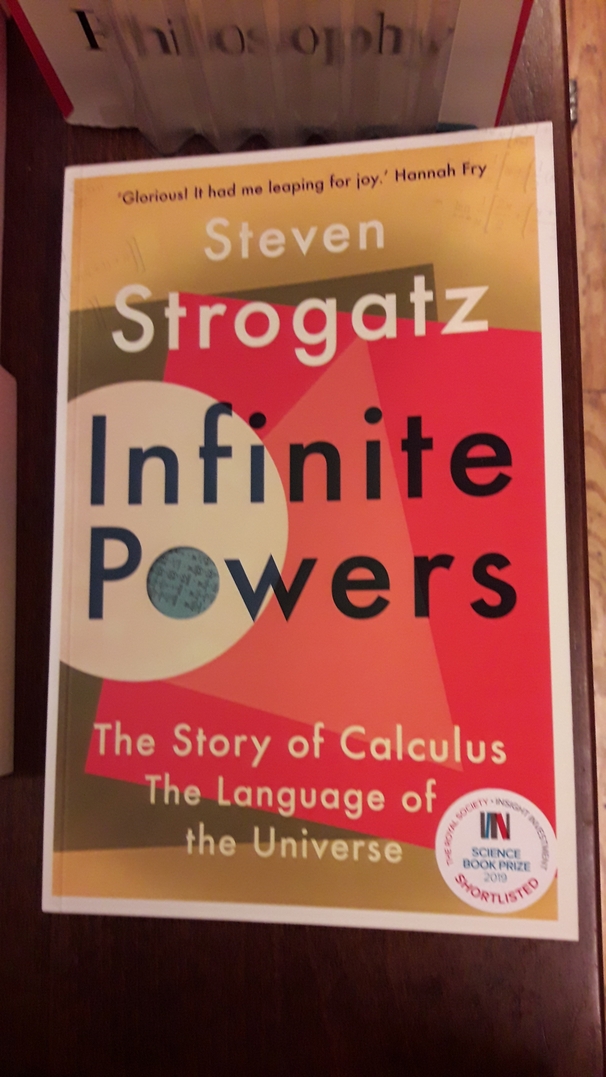
I don’t know, but maybe Steven Strogatz quotes Pope’s words in his 2019 book, Infinite Powers: How Calculus Reveals the Secrets of the Universe. This is where I found out about Wouk’s visit with Feynman. I saw the book recently (Saturday, February 22, 2020) in Pandora Kitabevi here in Istanbul. I looked in the book for a certain topic that was of interest to me, but did not find it; then I found a serious misunderstanding.

book cover: Steven Strogatz, Infinite Powers

Continue reading

Anthropology of Mathematics

This essay was long when originally published; now, on November 30, 2019, I have made it longer, in an attempt to clarify some points.

The essay begins with two brief quotations, from Collingwood and Pirsig respectively, about what it takes to know people.

  • The Pirsig quote is from Lila, which is somewhat interesting as a novel, but naive about metaphysics; it might have benefited from an understanding of Collingwood’s Essay on Metaphysics.

  • A recent article by Ray Monk in Prospect seems to justify my interest in Collingwood; eventually I have a look at the article.

Ideas that come up along the way include the following.

  1. For C. S. Lewis, the reality of moral truth shows there is something beyond the scope of natural science.

  2. I say the same for mathematical truth.

  3. Truths we learn as children are open to question. In their educational childhoods, mathematicians have often learned wrongly the techniques of induction and recursion.

  4. The philosophical thesis of physicalism is of doubtful value.

  5. Mathematicians and philosophers who ape them (as in a particular definition of physicalism) use “iff” needlessly.

  6. A pair of mathematicians who use “iff” needlessly seem also to misunderstand induction and recursion.

  7. Their work is nonetheless admirable, like the famous expression of universal equality by the slave-driving Thomas Jefferson.

  8. Mathematical truth is discovered and confirmed by thought.

  9. Truth is a product of every kind of science; it is not an object of natural science.

  10. The distinction between thinking and feeling is a theme of Collingwood.

  11. In particular, thought is self-critical: it judges whether itself is going well.

  12. Students of mathematics must learn their right to judge what is correct, along with their responsibility to reach agreement with others about what is correct. I say this.

  13. Students of English must learn not only to judge their own work, but even that they can judge it. Pirsig says this.

  14. For Monk, Collingwood’s demise has meant Ryle’s rise: unfortunately so since, for one thing, Ryle has no interest in the past.

  15. In a metaphor developed by Matthew Arnold, Collingwood and Pirsig are two of my touchstones.

  16. Thoreau is another. He affects indifference to the past, but his real views are more subtle.

  17. According to Monk, Collingwood could have been a professional violinist; Ryle had “no ear for tunes.”

  18. For Collingwood, Victoria’s memorial to Albert was hideous; for Pirsig, Victorian America was the same.

  19. Again according to Monk, some persons might mistake Collingwood for Wittgenstein.

  20. My method of gathering together ideas, as outlined above, resembles Pirsig’s method, described in Lila, of collecting ideas on index cards.

  21. Our problems are not vague, but precise.

When Donald Trump won the 2016 U.S. Presidential election, which opinion polls had said he would lose, I wrote a post here called “How To Learn about People.” I thought for example that just calling people up and asking whom they would vote for was not a great way to learn about them, even if all you wanted to know was whom they would vote for. Why should people tell you the truth?

Saturn eclipse mosaic from Cassini

Continue reading

On Gödel’s Incompleteness Theorem

This is an appreciation of Gödel’s Incompleteness Theorem of 1931. I am provoked by a depreciation of the theorem.

I shall review the mathematics of the theorem, first in outline, later in more detail. The mathematics is difficult. I have trouble reproducing it at will and even just confirming what I have already written about it below (for I am adding these words a year after the original publication of this essay).

The difficulty of Gödel’s mathematics is part of the point of this essay. A person who thinks Gödel’s Theorem is unsurprising is probably a person who does not understand it.

Next to a slice from a tree trunk, a worn copy of the book Frege and Gödel: Two Fundamental Texts in Mathematical Logic, edited by Jean van Heijenoort

Continue reading

The geometry of numbers in Euclid

This is about how the Elements of Euclid shed light, even on the most basic mathematical activity, which is counting. I have tried to assume no more in the reader than elementary-school knowledge of how whole numbers are added and multiplied.

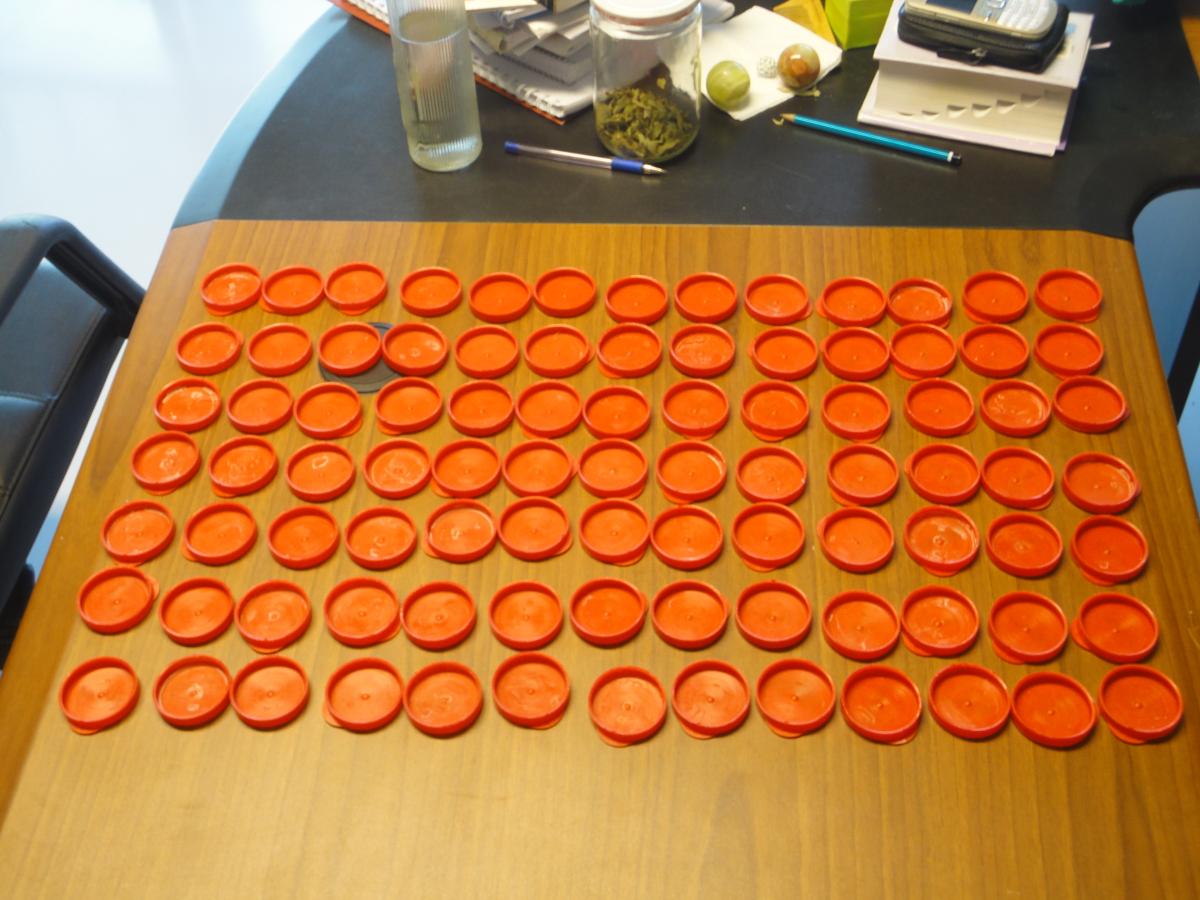
How come 7 ⋅ 13 = 13 ⋅ 7? We can understand the product 7 ⋅ 13 as the number of objects that can be arranged into seven rows of thirteen each.

Bottlecaps arranged on a desk in seven rows, thirteen columns
Seven times thirteen

If we turn the rows into columns, then we end up with thirteen rows of seven each; now the number of objects is 13 ⋅ 7.

The same bottlecaps, now seen from another side as thirteen rows, seven columns
Thirteen times seven

Continue reading

Academic Freedom

(See also other articles in the Freedom category.)

Yesterday (March 24, 2016) was the first day of the sixth Models and Groups Istanbul meeting. There were participants from the Middle East, Europe, and America. Kıvanç Ersoy was to speak about his own mathematics. He could not speak, because he was in prison. He, Esra Mungan, and Muzaffer Kaya were in prison, because the three of them had publicly insisted that the government of Turkey make peace in the southeast of the country. Absurd, but true. Continue reading

Learning mathematics

This is mostly reminiscences about high school. I also give some opinions about how mathematics ought to be learned. The post originally formed one piece with my last article, “Limits.”

I learned calculus, and the epsilon-delta definition of limit, in Washington D.C., in my last two years at St Albans School, in a course taught by a peculiar fellow named Donald J. Brown. The first of these two years was officially called Precalculus Honors, but some time in that year, we started in on calculus proper.

Continue reading

Limits

This is about limits in mathematics: both the technical notion that arises in calculus, and the barriers to comprehension that one might reach in one’s own studies. I am going to say a few technical things about the technical notion, but there is no reason why this should be a barrier to your reading: you can just skip the paragraphs that have special symbols in them.

Looking up something else in the online magazine called Slate, I noted a reprint of an article called “What It Feels Like to Be Bad at Math” from a blog called Math With Bad Drawings by Ben Orlin. Now teaching high-school mathematics, Mr Orlin recalls his difficulties in an undergraduate topology course. His memories help him understand the difficulties of his own students. When students do not study, why is this? It is because studying makes them conscious of how much they do not understand. They feel stupid, and they do not like this feeling. Continue reading

The Point of Teaching Mathematics

This essay was provoked in part by a New York Times opinion piece by Andew Hacker (July 28, 2012) called “Is Algebra Necessary?” (the suggested answer being No):

Continue reading