Category Archives: Collingwood

Concerning the philosopher R. G. Collingwood (1889–1943). Many if not most of my posts concern Collingwood somehow, so this category may not be of much use. See Articles on Collingwood for some articles by other persons

NL XIII: “Choice”

Index to this series

Adolph Gottlieb, “Centrifugal,” gouache on paperboard, 1961 (National Gallery of Art, Washington; gift of the Woodward Foundation)

Adolph Gottlieb, “Centrifugal,” 1961 (National Gallery of Art, Washington; gift of the Woodward Foundation)

The key idea of Chapter XIII of New Leviathan is the correct statement of the “problem of free will”:

Continue reading

NL XII: “Happiness”

Index to this series

Judith Leyster (Dutch, 1609–1660), Self-Portrait, c. 1630, oil on canvas (National Gallery of Art, Washington; gift of Mr. and Mrs. Robert Woods Bliss)
Judith Leyster (Dutch, 1609–1660)
Self-Portrait, c. 1630, oil on canvas
National Gallery of Art, Washington
Gift of Mr. and Mrs. Robert Woods Bliss

I gave ad hoc consideration to Chapter XII of Collingwood’s New Leviathan on November 3 of last year (2016), just before the American Presidential election. This was in an article sharing the title of the chapter: “Happiness.” The idea was that in dreadful times, unhappiness is “parasitic” on happiness.

Allowing himself “a certain freedom of interpretation” (12. 15), Collingwood agrees with Aristotle that “happiness” is the general term for what we desire (12. 11).

Continue reading

NL XI: “Desire”

Index to this series

The four parts of Collingwood’s New Leviathan (1942) are Man, Society, Civilization, and Barbarism. From the first part, we are considering Chapter XI, “Desire.”

Pablo Picasso, The Lovers (1923; National Gallery of Art, Washington)
Pablo Picasso, “The Lovers,” 1923
National Gallery of Art, Washington

Continue reading

NL X: “Passion”

Index to this series

Passion is literally the correlate of action, as suffering is the correlate of doing. In the ordinary, vulgar sense, passion is our response to what we suffer. This is how we shall understand it.

Above, from a cross made of steel I-beams, a stone figure hangs, while others mourn at his feet; below, more stone figures, one bearing a cross, another, back to us, with robe bearing the image of a face

Sagrada Familia, Passion Façade, November, 2008

Continue reading

NL IX: “Retrospect”

Index to this series

“All I want to know about mind,” says Collingwood,

is what it has done on certain definite occasions; not everything it has done, but enough for my purely practical purpose, deciding how to deal with the present attack on civilization.

This is from ¶9. 2 of New Leviathan. Three years ago, I set out here to read and write about this book, chapter by chapter. Continue reading

Writing, Typography, and Nature

Note added February 10, 2019: I return to this rambling essay, two years later in the Math Village. The main points are as follows.

  • Writing is of value, even if you never again read what you write.
  • There is also value to reading again, as in the present case.
  • A referee rejected a submitted article of mine in the history of mathematics because its order did not make sense – to that referee, though a fellow mathematician thought well of the article. A revision was eventually published as “On Commensurability and Symmetry.”
  • In the preface to The Elements of Typographical Style, Robert Bringhurst wonders how he can write a rulebook when we are all free to be different. He thus sets up an antithesis, such as I would investigate later in “Antitheses.”
  • From being simply a means of copying, typography has become a means of expression.
  • Yet typography should not draw attention to itself, just as, according to Fowler in A Dictionary of Modern English Usage, pronunciation (notably of foreign words) should not.
  • Through my own experience of typography with LaTeX [and HTML, as in this blog], I have developed some opinions differing from some others’.
  • Bringhurst samples Thoreau,
    • whose ridicule of letters sent by post applies today to electronic media, and
    • who rightly bemoans how enjoying the woods is thought idle; cutting them down, productive.
  • In Gödel, Escher, Bach, Douglas Hofstadter wonders how a message can be recognized by any intelligence. Bringhurst restricts the question to concern intelligences on this earth.
  • In my youth, Hofstadter introduced me to Zen Flesh, Zen Bones, (edited by Reps and Senzaki), whose influence on me I consider.
  • The Zen story about whether “this very mind is Buddha” suggests a further development of Collingwood’s “logic of question and answer.”
  • Through looking at another translation, I consider how Reps and Senzaki turned Chinese into English.
  • Rereading this blog led me back to Hofstadter.

Here are some meditations on some books read during a stay in the Nesin Mathematics Village, January, 2017. I originally posted this article from the Village; now, back in Istanbul, a few days into February, recovering from the flu that I started coming down with in the Village, I am correcting some errors and trying to clarify some obscurities.

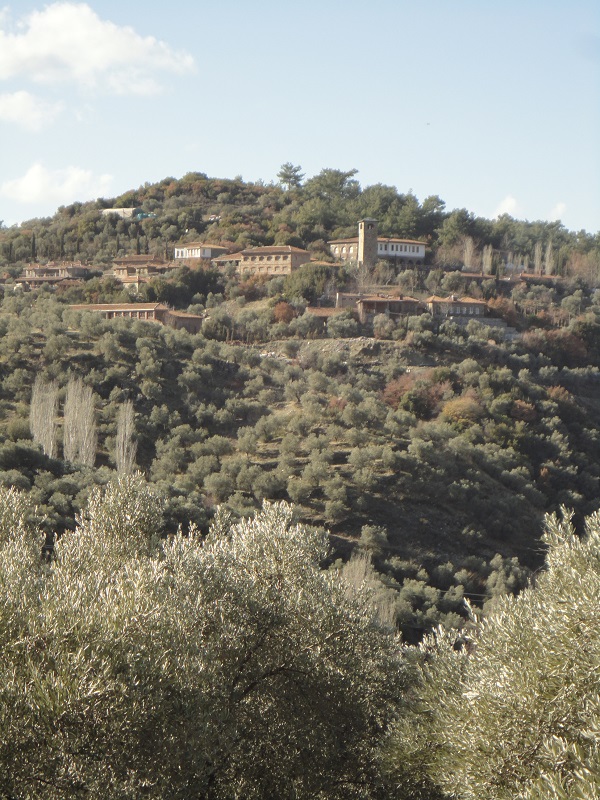
From below, a wooded hill, with buildings near the crest
Nesin Mathematics Village from the east
Wednesday, January 18, 2017

Continue reading

Thales of Miletus

This is about Thales of Miletus and what it means to study him. I am moved to ask what history is in the first place. It is a study of the freedom in which we face our conditions. Thales had his way of understanding the world, and we may benefit from trying to learn it.

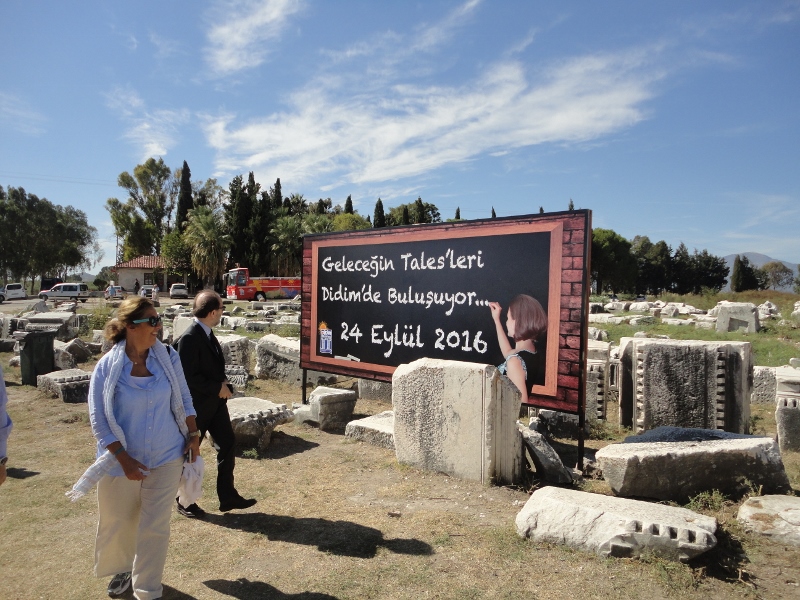
“The Thaleses of the future are meeting in Didim, September 24, 2016”

“The Thaleses of the future are meeting in Didim,
September 24, 2016”

Continue reading

Attribution of Fascism

I began writing this article on Saturday, December 10, 2016; I finished the next morning, Istanbul time. I wrote the first three paragraphs last. The planned breakfast did take place, quite pleasantly. The death toll in the bombing rose to 39. No matter how much I read drafts of my articles, I usually want to make changes after they are published. I made one such change visible in the first paragraph. After a friend left some comments, I made some other small changes. Again these are visible. Last I heard, the policy on Diaspora* is that published posts cannot be edited at all, because there should never be any question about which version of a post any resulting comments refer to. WordPress is not so strict, and in future I may just remove all signs of editing. There may not be any point in doing this in an essay that does not say everything that seemed worth saying at the time of writing. Better perhaps to leave the signs of work in progress. In any case, I shall retain access to the older versions.

Everything changes so fast, at least when one has an internet connection and a Twitter feed. As I try to wrap up this essay, I learn of a bombing outside a football stadium not too far from us here in Istanbul. Deaths are said to be in the teens, mostly of police officers. Twenty-nine persons are said to have died, all but two being police officers. Turkey has been in a state of emergency since the summer. Rescue vehicles had trouble getting through the normal traffic. The nearest hospitals are not operational.

Meanwhile, Donald Trump and his would-be appointees are called treasonous; but it is mainly liberals and lefties who are saying this. Russia was the big enemy when it was Communist; now some Republicans do not seem too concerned with its hold over Trump, while Democrats are reinventing the Red Scare.

If I hadn’t hooked up the internet connection, I would just be looking forward to a breakfast with friends later this morning, over on the Asian side of the Bosphorus. I expect this event to happen as planned, despite the bombing.

Now I just want to think a little bit about what fascism means, historically. It does seem to me that if Donald Trump has any ideology at all, it is fascism. Fascism is the doctrine that will guide his Presidency, if he is allowed to assume it. What this means is the main subject of this essay.

Books seen from above on a table: A Collection of Essays by George Orwell, on top of The Rise and Fall of the Third Reich; next to these, The Bones: A Handy, Where-to-Find-It Pocket Reference Companion to Euclid’s Elements

Continue reading

How to Learn about People

A chance encounter with a Medieval definition of God, used as the title of a sculpture, leads to an ancient plane tree and to more consideration of what can go wrong with public opinion polls.

Ancient plane tree of Bayır, Marmaris Peninsula, September 9, 2010

Continue reading

Happiness

If only tangentially sometimes, this is about living in Turkey, especially under the ongoing official state of emergency.

Aristotle, Marx & Engels, and Collingwood

A blog article on Medium recently struck me for its treatment of science. Dated October 3, the article is called “The Purpose Of Life Is Not Happiness: It’s Usefulness,” and its opening section is as follows.

Continue reading