Category Archives: Philosophy

Map of Art

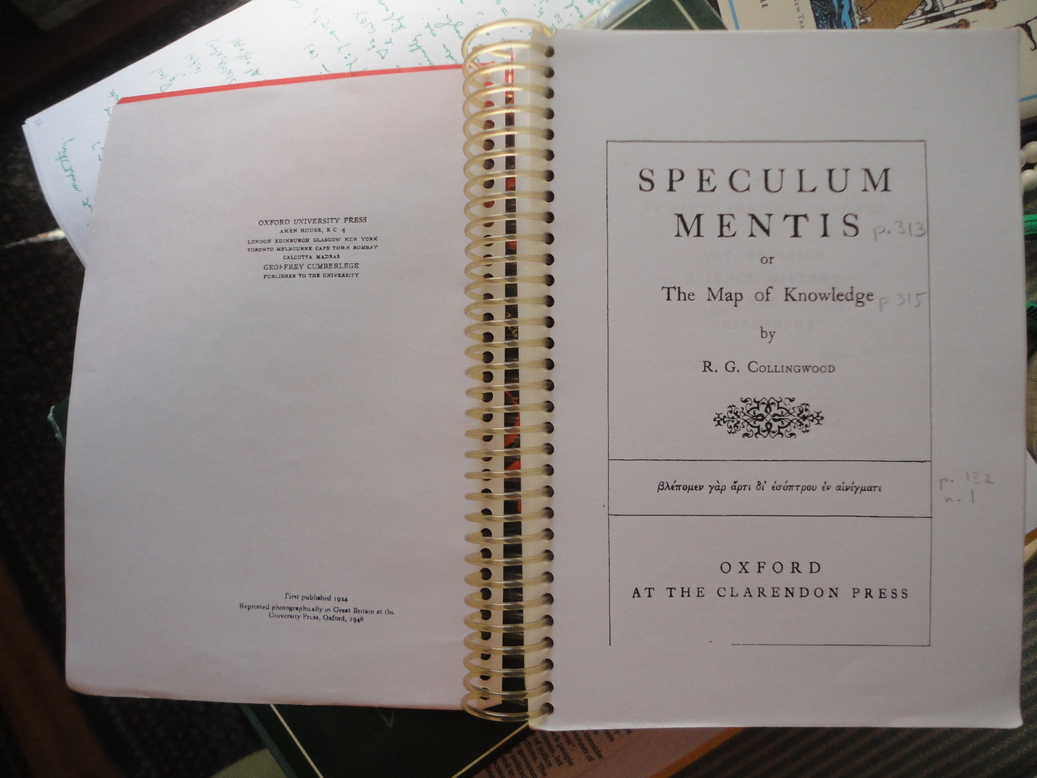
The bulk of this post is a summary of the chapter on art in Collingwood’s Speculum Mentis: or The Map of Knowledge (1924). The motto of the book is the first clause of I Corinthians 13:12:

Βλέπομεν γὰρ ἄρτι δι’ ἐσόπτρου ἐν αἰνίγματι

For now we see through a glass, darkly

The chapter “Art” has eight sections:

Continue reading

An Exercise in Analytic Geometry

This past spring (of 2020), when my university in Istanbul was closed (like all others in Turkey) against the spread of the novel coronavirus, I created for my students an exercise, to serve at least as a distraction for those who could find distraction in learning.

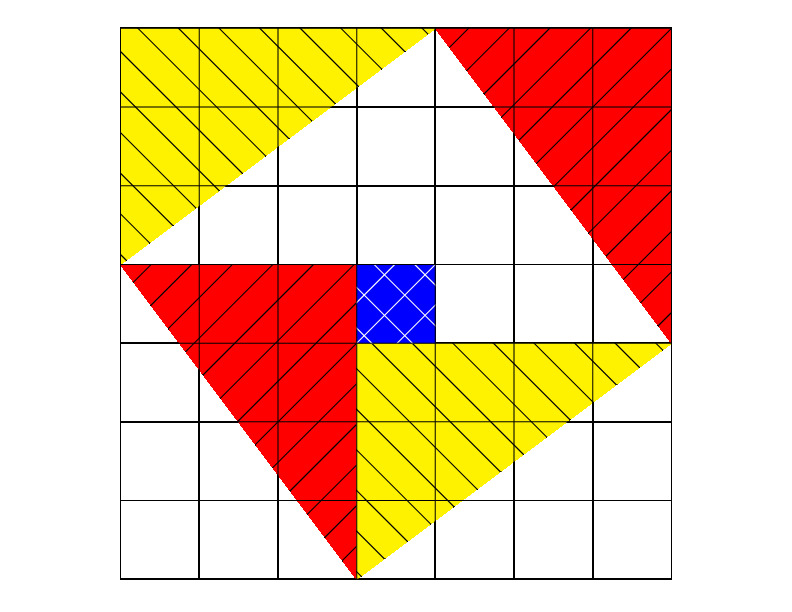
Diagram from textbook page shows, centered at the origin of coordinates, a circle and an ellipse whose four points of intersection are traversed by two lines in red through the origin
From Weeks & Adkins, Second Course in Algebra, p. 395

Note added, April 17, 2023: An account of the mathematics involved in the exercise would ultimately be published as: Pierce, D. (2021). “Conics in Place.” Annales Universitatis Paedagogicae Cracoviensis | Studia Ad Didacticam Mathematicae Pertinentia, 13, 127–150.

Continue reading

Be Sex Binary, We Are Not

Content warning: suicide.

The following sentence is bold in the last paragraph of an essay: “the science is clear and conclusive: sex is not binary, transgender people are real.” I don’t know what the writer means by this. As far as I can tell, as a biological concept used for explaining reproduction, sex has two kinds or parts or sides or aspects, and the essay tacitly affirms this; at the same time, obviously persons called transgender exist.

☾ ♂ ☿ ♃ ♀ ♄ ☉

The title of the essay is a command: “Stop Using Phony Science to Justify Transphobia.” I can support that. I don’t even need the qualifier “phony.” If transphobia is the kind of morbid fear suggested by the suffix “-phobia,” then science ought to help dispel this, not promote it.

One might also just say, Stop using phony science.

Continue reading

Return to Narnia

1

My subject is the Chronicles of Narnia of C. S. Lewis (1898–1963). I consider this heptad of books (published 1950–6) as constituting (1) literature (2) for children (3) that I continue to enjoy in my sixth decade, having started in my first.

  1. By literature, I mean a work of art whose medium is prose. Prose may also be a work of craft, intended to fulfil some purpose. This purpose could be to serve a market for fantasy or children’s books. Art as such has no purpose that can be specified in advance.

  2. Writing for children may take certain liberties that annoy adults.

  3. As with any post in this blog, I write out of my own personal interest. As a child, I read other fantasies, such as those of Lloyd Alexander, John Christopher, Ursula LeGuin, and J.R.R. Tolkien. Only the works of C. S. Lewis have stayed with me. This essay may be considered as an exploration of why, or least an example of how.

The seven books of the Chronicles of Narnia, Collier edition

Continue reading

Thoreau and Anacreon

Note added, October 5, 2023. At the end of this post, from sunny days in the first spring of the Covid pandemic, I take up Anacreon’s poem “The Thracian Filly,” translated as “To a Colt” in A Week on the Concord and Merrimack Rivers. Anacreon was from Teos, whose ruins I have visited. Thoreau may not be sensitive to the sexual connotations of the poem. First I review Thoreau’s book, noting in particular:

  • The book is written, like my blog posts, to please the author, who would rather do without money than sell stuff to get it.
  • The author’s relative indifference to human affairs in the face of nature is becoming less tenable, when a Pacific island inhabited by 40 persons and visited once a month by a boat (and once for all, probably, by a travel writer) is losing its palms to an invasive beetle.

Other books discussed or mentioned (and in my physical library) are

  • Bean, Aegean Turkey;
  • Collingwood, The First Mate’s Log;
  • Lawson, The Drinkers’ Guide to the Middle East;
  • Schalansky, Pocket Atlas of Remote Islands;
  • Thoreau, Walden;
  • Trypanis (ed.), The Penguin Book of Greek Verse;
  • Walls, Henry David Thoreau: A Life.

Gray clouds over blue sky over white clouds over buildings

Continue reading

Reading shallow and deep

Executive summary (added July 28, 2020): I read an article praising so-called deep reading, one of whose exponents is Henry Kissinger. The world is apparently being corrupted by people who do not read deeply; and this includes ourselves, if we allow ourselves to be distracted by social media. I myself find the article corrupted by references to neuroscience, and I am sorry that the writer, Adam Garfinkle, does not tell us about his own experience of reading. His article comes recommended by George Will, whose tenure at the Washington Post can be blamed on my grandfather. I reminisce about him and about my own deep or at least long reading, in college and more recently. I take a hedonistic view of this reading.

Seeing a tweet condemning the superficiality of Twitter, I could not pass up the challenge. I read the linked essay, “What we lost when we stopped reading” (The Washington Post, April 17, 2020). That was by George Will, summarizing and recommending a longer essay, by Adam Garfinkle, “The Erosion of Deep Literacy” (National Affairs, number 43, spring 2020). I read that, yesterday evening and this morning (April 21, 2020).

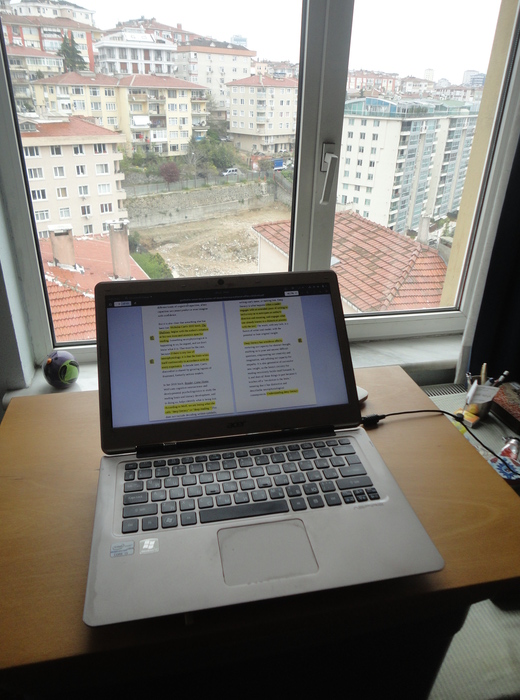
My computer showing two pages of text in front of a window

Continue reading

Donne’s Undertaking

To ease the strain of pandemic restrictions, I was recently called on to recommend a poem. I chose “The Undertaking” of John Donne. I want to say here why. Briefly:

  1. The poem (which I transcribe below) has a sound that impressed me when I first read it, more than thirty years ago.
  2. The poem alludes to ideals:
    • of recognizing what is good for its own sake, and
    • of climbing a rung or two on Diotima’s ladder of love.
  3. The sound of Donne’s poem may seduce one into thinking the ideals worthy.

          ⯅          

I also indulge myself here in reminiscences not obviously relevant to “The Undertaking.” They do conclude with my sitting down to read Donne for myself. (Note added November 3, 2025.)

          ⯆          

Diotima’s ladder, or stairway, is recounted by Socrates in Plato’s Symposium (211c, here in the translation of Jowett, which is the one I read at school, though it may not be the most faithful; the bullets and insertions from the Greek text are mine):

And the true order of going, or being led by another, to the things of love (τὰ ἐρωτικά), is to begin from the beauties of earth and mount upwards for the sake of that other beauty, using these as steps (οἳ ἐπαναβαθμοί) only, and from

  • one going on to
  • two, and from two to
  • all fair forms (τὰ καλὰ σώματα), and from fair forms to
  • fair practices (τὰ καλὰ ἐπιτηδεύματα), and from fair practices to
  • fair notions (τὰ καλὰ μαθήματα), until from fair notions he arrives at
  • the notion of absolute beauty, and at last knows what the essence of beauty is (ὃ ἔστι καλόν).

Analytic Geometry and Donne’s complete poetry
Two books that were my mother’s

Continue reading

Mood

Executive summary. The English grammatical moods – indicative, imperative, subjunctive – were not understood till the nineteenth century, according to an 1882 doctoral dissertation, On the Use of the Subjunctive Mood in Anglo-Saxon. Considering illustrative passages that happen to be from Plato, Alfred Douglas, Evelyn Waugh, and especially John Donne; looking ultimately at John McWhorter’s 2015 essay, “English is not normal”; I review the subjunctive mood, grammar in general, and my own lack of understanding till I was in college.

The copyright page has, with the preceding pages and cover, fallen away from the rest of the book with use
Copyright and contents pages of the Concise Oxford Dictionary, 6th edition

Continue reading

Doing and Suffering

To do injustice is worse than to suffer it. Socrates proves this to Polus and Callicles in the dialogue of Plato called the Gorgias.

I wish to review the proofs, because I think they are correct, and their result is worth knowing.

Loeb Plato III cover

Or is the result already clear to everybody?

Whom would you rather be: a Muslim in India, under attack by a Hindu mob, or a member of that mob?

You would rather not be involved; but if you had to choose, which option would be less bad: to be driven to an insane murderous fury, or to be the object of that fury?

Continue reading

Evolution of Reality

I enjoy and recommend Robert Wright’s Nonzero Newsletter, which presents thought on both American politics and thought itself.

Tiny green plants on red tile roof, cloudy day

In a 2017 post of this blog, I quoted Wright’s 1988 article in The Atlantic Monthly about Edward Fredkin. Somewhat differently from Fredkin, I spelled out my title, “What Philosophy Is,” without actually being a professional philosopher. I touched on a theme that I shall take up now: that thinkers today could benefit from knowing the thought of R. G. Collingwood.

Continue reading