Category Archives: absolute presuppositions

That metaphysics is the historical science of absolute presuppositions is worked by Collingwood in An Essay on Metaphysics (1940); it is a development of the logic of question and answer

Free Groups and Topology

My title alludes to some notes for the layperson that I rediscovered recently. I have reviewed and edited them, and they are below, in the following sections (linked to by the titles after the three main bullets; other links are to Wikipedia).

  • Quasicrystals,” based on an email of mine sent to a group of alumni of St John’s College on October 8, 2011. This was my contribution to a thread in which somebody said that
    • Dan Schechtman (whom she called Danny) was a worthy recipient of that year’s Nobel Prize in Chemistry for the discovery of quasicrystals, but
    • John Cahn deserved credit, even the prize itself, as the real discoverer.

    My wife and I had recently moved to Istanbul, and the Istanbul Model Theory Seminar had just got going. The Nobel Prize and quasicrystals had been mentioned there too.

  • Free Groups,” based on an email of October 10, 2011. I tried to describe free groups to somebody who expressed interest, but who also called himself the world’s worst mathematician.
  • Topology” – a draft of an attempt to describe that subject. In graduate school, I got excited about the definition of a topological space when I first encountered it. Here I try to motivate the definition by abstracting from the properties of the Cartesian plane as a metric space. I give the example of the Zariski topology on the same plane. I start to talk about the topology derived from the Gromov–Hausdorff metric on the space of groups with n generators, but then I stop.

A green landscape
Vegetable plot in Yeniköy (where Cavafy lived a while), Istanbul, Saturday, September 28, 2024
Continue reading

Miracles

This is inspired by Charlotte Brontë’s Villette. After reading this 1853 novel a second time in the summer of 2018, I put some passages I liked into a LaTeX file. I added some commentary and came up with a document more than 90 A5 pages long. I recently reread it and was reminded how much I had enjoyed the novel. I thought some of my commentary could be adapted to stand alone as a blog post – this one.

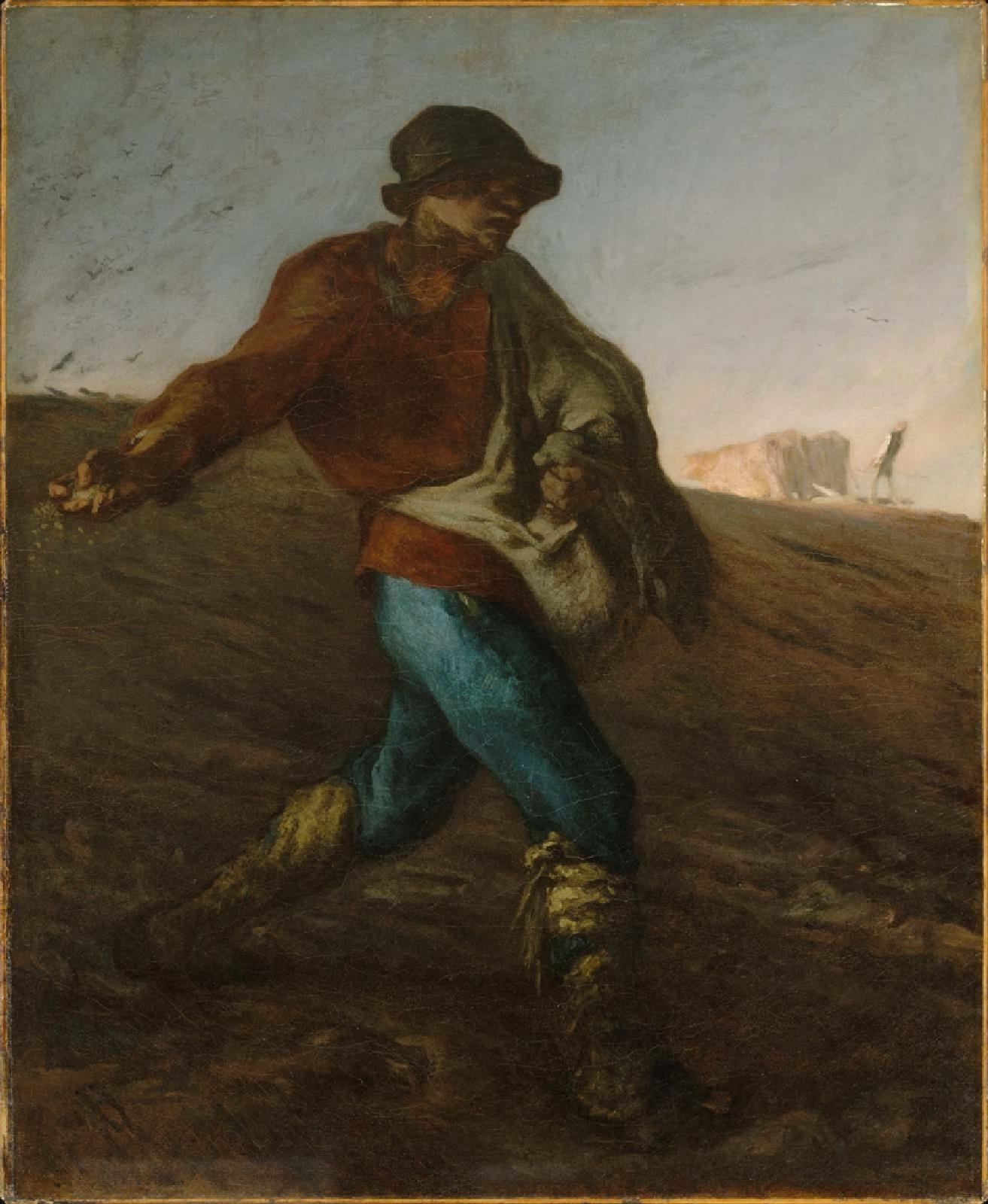
Man in a field, sack over left shoulder, casts seeds with his right hand
The Sower,” 1850
Jean-François Millet (French, 1814–1875)
Museum of Fine Arts, Boston

Continue reading

The Divided Line

Index to this series

We are still in the latter part of Book VI of Plato’s Republic, where Socrates undertakes to explain the education of the philosopher-kings (502c–d). They are not literally so called, as we noted last time. They are going to need to “be able to bear the greatest studies” (503e), and “the idea of the good is the greatest study” (505a). People are confused about what the good is:

  • many say it is pleasure;
  • a few, knowledge (505b).

It rather the case that

  • so the Good makes it possible to have
    • knowledge (508d), and perhaps even
    • pleasure (509a),
  • as the sun makes it possible to see (508b–d).

We looked at that much last time.

Sun through the leaves of planes
Dünya Barış Parkı 2021.10.30

Continue reading

Nature

Index to this series

Can Socrates really “find a natural support for justice,” as Allan Bloom says he must? It is strictly impossible, as I say in “Bloom, Badiou, Ryle, Shorey.” Inevitably there is more that can be said, and I shall try to say some of it here.

Sand, sea, mountains, sky
Anatolian sand, Aegean sea, Lesbian mountains
Uranus over all
Profesörler Sitesi, Altınova, Balıkesir, Turkey
September 24, 2021

Continue reading

More of What It Is

I say that mathematics is the deductive science; and yet there would seem to be mathematicians who disagree. I take up two cases here.

Page of Greek text with diagram
From Archimedes, De Planorum Aequilibriis,
in Heiberg’s edition (Leipzig: Teubner, 1881)

Continue reading

Anthropology of Mathematics

This essay was long when originally published; now, on November 30, 2019, I have made it longer, in an attempt to clarify some points.

The essay begins with two brief quotations, from Collingwood and Pirsig respectively, about what it takes to know people.

  • The Pirsig quote is from Lila, which is somewhat interesting as a novel, but naive about metaphysics; it might have benefited from an understanding of Collingwood’s Essay on Metaphysics.

  • A recent article by Ray Monk in Prospect seems to justify my interest in Collingwood; eventually I have a look at the article.

Ideas that come up along the way include the following.

  1. For C. S. Lewis, the reality of moral truth shows there is something beyond the scope of natural science.

  2. I say the same for mathematical truth.

  3. Truths we learn as children are open to question. In their educational childhoods, mathematicians have often learned wrongly the techniques of induction and recursion.

  4. The philosophical thesis of physicalism is of doubtful value.

  5. Mathematicians and philosophers who ape them (as in a particular definition of physicalism) use “iff” needlessly.

  6. A pair of mathematicians who use “iff” needlessly seem also to misunderstand induction and recursion.

  7. Their work is nonetheless admirable, like the famous expression of universal equality by the slave-driving Thomas Jefferson.

  8. Mathematical truth is discovered and confirmed by thought.

  9. Truth is a product of every kind of science; it is not an object of natural science.

  10. The distinction between thinking and feeling is a theme of Collingwood.

  11. In particular, thought is self-critical: it judges whether itself is going well.

  12. Students of mathematics must learn their right to judge what is correct, along with their responsibility to reach agreement with others about what is correct. I say this.

  13. Students of English must learn not only to judge their own work, but even that they can judge it. Pirsig says this.

  14. For Monk, Collingwood’s demise has meant Ryle’s rise: unfortunately so since, for one thing, Ryle has no interest in the past.

  15. In a metaphor developed by Matthew Arnold, Collingwood and Pirsig are two of my touchstones.

  16. Thoreau is another. He affects indifference to the past, but his real views are more subtle.

  17. According to Monk, Collingwood could have been a professional violinist; Ryle had “no ear for tunes.”

  18. For Collingwood, Victoria’s memorial to Albert was hideous; for Pirsig, Victorian America was the same.

  19. Again according to Monk, some persons might mistake Collingwood for Wittgenstein.

  20. My method of gathering together ideas, as outlined above, resembles Pirsig’s method, described in Lila, of collecting ideas on index cards.

  21. Our problems are not vague, but precise.


When Donald Trump won the 2016 U.S. Presidential election, which opinion polls had said he would lose, I wrote a post here called “How To Learn about People.” I thought for example that just calling people up and asking whom they would vote for was not a great way to learn about them, even if all you wanted to know was whom they would vote for. Why should people tell you the truth?

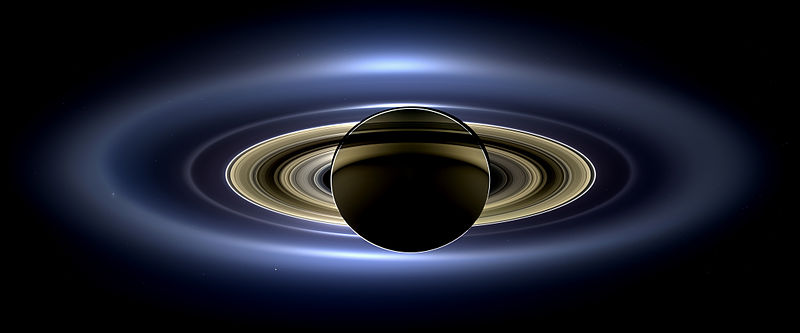
Saturn eclipse mosaic from Cassini

Continue reading

On Causation

Causation seems commonly to be understood as a physical concept, like being a fossil. The paleontologist seeks the one right answer to the question of when a particular dinosaur bone became part of the fossil record; likewise readers of international news seem to think there is one right answer to the question of whether Donald Trump or Ali Khamenei caused the shooting down of Ukraine International Airlines Flight 752 on January 8, 2020.

There is not one right answer. If you are Trump, you caused 176 civilian deaths by attacking the Iranians and provoking their response. If you are Mitch McConnell, you caused the deaths by inhibiting the removal of Trump from office. If you are Khamenei, you did it by meeting Trump’s fire with fire.

Being a cause does not mean you deserve condemnation or praise: that is another matter.

Continue reading

NL I: “Body and Mind” Again

Index to this series

“We are beginning an inquiry into civilization,” writes Collingwood, “and the revolt against it which is the most conspicuous thing going on at the present time.” The time is the early 1940s.

Human tourists photographing sculptured supine blue ape with chrome testicles outside the Intercontinental Hotel, Prague Continue reading

NL XXXI: Classical Physics and Classical Politics

Index to this series

As my beach holiday winds down, so perhaps does the current spate of blog posts. Here is one more. Setting aside Homer, I continue immediately with Collingwood, in part because, in the 2000 paperback impression of the 1992 Revised Edition of the New Leviathan that I take to the shore, I have now also read the Editor’s Introduction by David Boucher. (Back at the cottage, I have to type out the quotes from this that I make below; for quotes of Collingwood himself, I cut and paste from a scan of the 1947 corrected reprint of the 1942 First Edition.)

As I could infer from my pencil-marks, I had read Boucher’s introduction some time before; but I could remember little of it. I think it is aimed at professional philosophers, rather than at anybody who would admire Collingwood for saying, as he does in An Autobiography (page 6), when he describes getting prepared to go to Rugby School,

The ghost of a silly seventeenth-century squabble still haunts our classrooms, infecting teachers and pupils with the lunatic idea that studies must be either ‘classical’ or ‘modern’. I was equally well fitted to specialize in Greek and Latin, or in modern history and languages (I spoke and read French and German almost as easily as English), or in the natural sciences; and nothing would have afforded my mind its proper nourishment except to study equally all three.

Continue reading

On Chapman’s Homer’s Iliad, Book XIV

Index to this series | Text of Chapman’s Homer’s Iliad

When Neptune was helping the Greeks stave off certain defeat, I tried to suggest that divine intervention in the course of events might be understood as human resolve to change that course. This was in Book XIII of the Iliad, where Neptune took the form of one of the Greeks – Calchas – in order to exhort the others. They would have listened to Calchas anyway; he was a prophet. Ajax Oileus said he could tell Calchas was “really” a god; we can read this to mean Calchas was inspiring. We can say this of somebody today, without meaning to suggest any supernatural influence.

Mostly a calm sea, with heads of two swimmers; behind, a strip of pink sky with setting sun

Continue reading