Category Archives: Collingwood

Concerning the philosopher R. G. Collingwood (1889–1943). Many if not most of my posts concern Collingwood somehow, so this category may not be of much use. See Articles on Collingwood for some articles by other persons

Pascal, Pensées, S 183–254

By the account of Martha Nussbaum, philosophy is one of two things:

  1. A form of inquiry pursued through conversation among equals.
  2. An activity of “a lonely thinker of profound thoughts.”

Nussbaum prefers the first, though having appeared in a film that promotes the second.

I watched and enjoyed the film, which is by Astra Taylor and is called Examined Life (2008). I first found it through a touching fragment, featuring a stroll in San Francisco by Judith Butler and Taylor’s sister Sunaura. Because they have a conversation at all, and on the theme that we all need one another’s help, the film becomes less subject to Nussbaum’s charge:

Portraying philosophers as authority figures is a baneful inversion of the entire Socratic process, which aimed to replace authority with reason.

Continue reading

Reason in Pascal

In some of the Pensées, Pascal contrasts reason with instinct, passions, folly, the senses, and imagination.

Here I investigate Pascal’s raison, after one session of an ongoing discussion of the Pensées that is being carried out on Zoom.

Continue reading

Feminist Epistemology

To this post, I am adding this introduction in July 2021. I have returned to some of the ideas of the post, and I see that I left them in a jumble. They may still be that, but I am trying to straighten up a bit.

Beyond this introduction, the post has three parts. Part III takes up more than half of the whole post and consists of my notes on

  1. Elizabeth Anderson, “Feminist Epistemology and Philosophy of Science,” Stanford Encyclopedia of Philosophy, February 13, 2020. 61 pages.

In Anderson’s article I see – as I note below – ideas that are familiar, thanks to my previous reading of philosophers such as Robin George Collingwood, Mary Midgley, and Robert Pirsig. Henry David Thoreau may not exactly be one of those philosophers, but he is somehow why I came to write this post in the first place.

Here is a table of contents for the whole post:

Continue reading

Pacifism

Pacifism is properly pacificism, the making of peace: not a belief or an attitude, but a practice. Mathematics then is pacifist, because learning it means learning that you cannot fight your way to the truth. Might does not make right. If others are going to agree with you, they will have to do it freely. Moreover, you cannot rest until they do agree with you, if you’ve got a piece of mathematics that you think is right; for you could be wrong, if others don’t agree.

The book *Dorothy Healey Remembers,* with photo of subject

Continue reading

Articles on Collingwood

This article gathers, and in some cases quotes and examines, popular articles about R. G. Collingwood (1889–1943).

  • By articles, I mean not blog posts like mine and others’, but essays by professionals in publications that have editors.

  • By popular, I mean written not for other professionals, but for the laity.

Continue reading

Mathematics and Logic

Large parts of this post are taken up with two subjects:

  1. The notion (due to Collingwood) of criteriological sciences, logic being one of them.

  2. Gödel’s theorems of completeness and incompleteness, as examples of results in the science of logic.

Like the most recent in the current spate of mathematics posts, the present one has arisen from material originally drafted for the first post in this series.

In that post, I defined mathematics as the science whose findings are proved by deduction. This definition does not say what mathematics is about. We can say however what logic is about: it is about mathematics quâ deduction, and more generally about reasoning as such. This makes logic a criteriological science, because logic seeks, examines, clarifies and limits the criteria whereby we can make deductions. As examples of this activity, Gödel’s theorems are, in a crude sense to be refined below, that

  • everything true in all possible mathematical worlds can be deduced;

  • some things true in the world of numbers can never be deduced;

  • the latter theorem is one of those things.

Continue reading

More of What It Is

I say that mathematics is the deductive science; and yet there would seem to be mathematicians who disagree. I take up two cases here.

Page of Greek text with diagram
From Archimedes, De Planorum Aequilibriis,
in Heiberg’s edition (Leipzig: Teubner, 1881)

Continue reading

What Mathematics Is

Mathematics “has no generally accepted definition,” according to Wikipedia on September 15, 2020, with two references. On September 14, 2023, the assertion is, “There is no general consensus among mathematicians about a common definition for their academic discipline”; this time, there are no references.

I suggest that what really has no generally accepted definition is the subject of mathematics: the object of study, what mathematics is about. Mathematics itself can be defined by its method. As Wikipedia says also (as of either date given above),

it has become customary to view mathematical research as establishing truth by rigorous deduction from appropriately chosen axioms and definitions.

I would put it more simply. Mathematics is the science whose findings are proved by deduction.

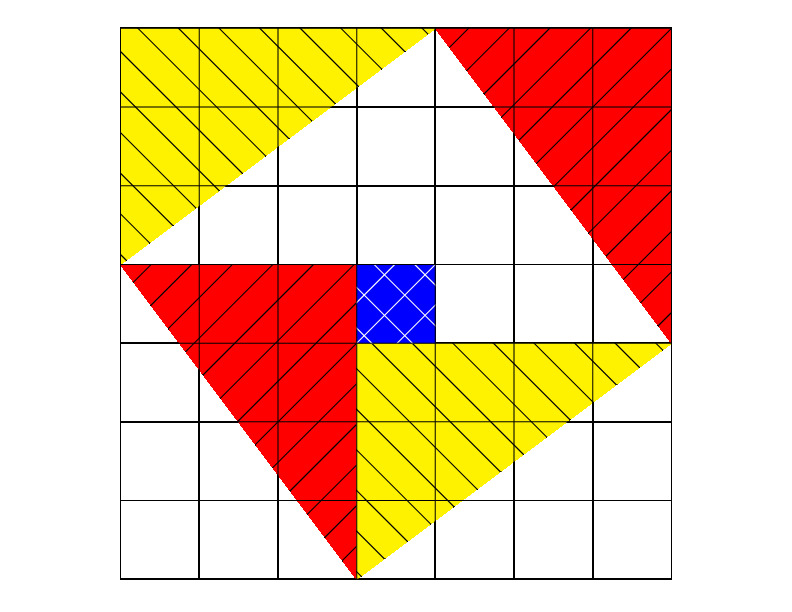
A 7×7 grid of squares, divided into four 3×4 rectangles arranged symmetrically about one square; the rectangles are divided in two by diagonals, which themselves describe a square
The right triangle whose legs are 3 and 4 has hypotenuse 5, because the square on it is
(4 − 3)2 + 2 ⋅ (4 ⋅ 3),
which is indeed 25 or 52. This is also
42 + 32.

Continue reading

Map of Art

The bulk of this post is a summary of the chapter on art in Collingwood’s Speculum Mentis: or The Map of Knowledge (1924). The motto of the book is the first clause of I Corinthians 13:12:

Βλέπομεν γὰρ ἄρτι δι’ ἐσόπτρου ἐν αἰνίγματι

For now we see through a glass, darkly

The chapter “Art” has eight sections:

Continue reading

Return to Narnia

1

My subject is the Chronicles of Narnia of C. S. Lewis (1898–1963). I consider this heptad of books (published 1950–6) as constituting (1) literature (2) for children (3) that I continue to enjoy in my sixth decade, having started in my first.

  1. By literature, I mean a work of art whose medium is prose. Prose may also be a work of craft, intended to fulfil some purpose. This purpose could be to serve a market for fantasy or children’s books. Art as such has no purpose that can be specified in advance.

  2. Writing for children may take certain liberties that annoy adults.

  3. As with any post in this blog, I write out of my own personal interest. As a child, I read other fantasies, such as those of Lloyd Alexander, John Christopher, Ursula LeGuin, and J.R.R. Tolkien. Only the works of C. S. Lewis have stayed with me. This essay may be considered as an exploration of why, or least an example of how.

The seven books of the Chronicles of Narnia, Collier edition

Continue reading