Category Archives: Principles of Art

Victor Vasarely

Tophane-i Amire
Tophane-i Amire, 2017.03.25

Last week I wrote about the Turkish Impressionist Feyhaman Duran, born in 1886. Now my subject is the Hungarian-French Op Artist born twenty years later as Győző Vásárhelyi. His “Rétrospective en Turquie” is at the Tophane-i Amire Culture and Art Center in an Ottoman cannon foundry.

Vasarely show Continue reading

Nature and Death

Thoughts on mortality and the evolution of the universe, occasioned by a funeral and by Collingwood’s Idea of Nature and Plato’s Phaedo

Cebeci, Ankara, 2016.05.17

When the husband of my second-grade teacher died, I wanted to pay my respects. My father took me to the funeral home, where I hid behind him as he greeted the family of the deceased. My teacher was not among them. When invited to view the body, I looked over and saw it, lying off to the side in an open casket. I had never seen the man when he was alive. I declined the opportunity to gaze at his lifeless form. Until I came to Turkey, this was my closest approach to the materiality of death—except for a visit to the medical school of the University of New Mexico in Albuquerque. There, as part of the laboratory program at St John’s College in Santa Fe, students viewed dissected human cadavers.

Continue reading

NL XVII: “Duty”

Index to this series

New England Primer

“In Adam’s Fall,
We sinned all”
(New England Primer)

We are trying to understand reason in its original form, practical reason. Why do we do what we do? It may be useful for something else, or right according to some law or rule. A third possibility is that what we do may be our duty: the fulfilment of an obligation. Continue reading

NL XIII: “Choice”

Index to this series

Adolph Gottlieb, “Centrifugal,” gouache on paperboard, 1961 (National Gallery of Art, Washington; gift of the Woodward Foundation)

Adolph Gottlieb, “Centrifugal,” 1961 (National Gallery of Art, Washington; gift of the Woodward Foundation)

The key idea of Chapter XIII of New Leviathan is the correct statement of the “problem of free will”:

Continue reading

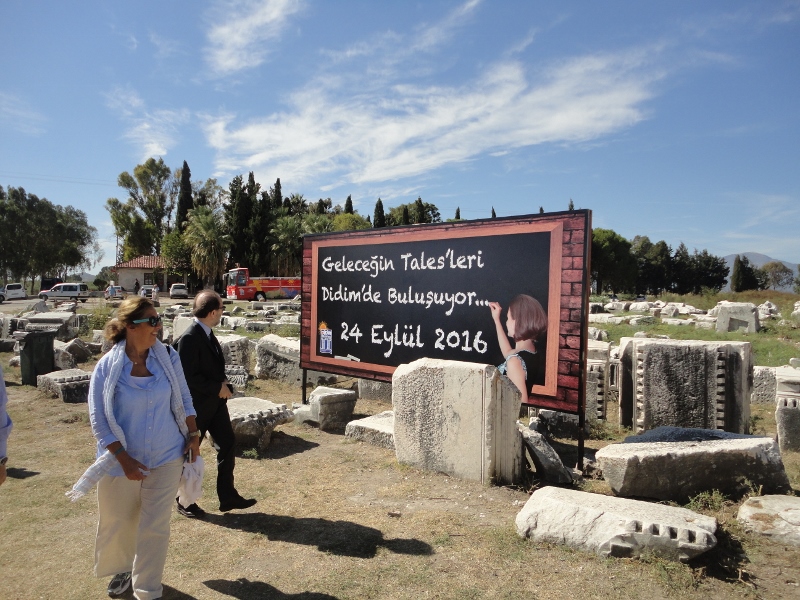
Thales of Miletus

This is about Thales of Miletus and what it means to study him. I am moved to ask what history is in the first place. It is a study of the freedom in which we face our conditions. Thales had his way of understanding the world, and we may benefit from trying to learn it.

“The Thaleses of the future are meeting in Didim, September 24, 2016”

“The Thaleses of the future are meeting in Didim,
September 24, 2016”

Continue reading

Happiness

If only tangentially sometimes, this is about living in Turkey, especially under the ongoing official state of emergency.

Aristotle, Marx & Engels, and Collingwood

A blog article on Medium recently struck me for its treatment of science. Dated October 3, the article is called “The Purpose Of Life Is Not Happiness: It’s Usefulness,” and its opening section is as follows.

Continue reading

Thinking & Feeling

This essay is written as a distraction from current events, though I make some reference to them. I am prompted by questions of analogy provoked by

  1. the similes of Homer and
  2. a recent theater review in Harper’s that mentions the parables of Jesus.

With sea in the background, on the sand of a beach sits Chapman’s Homer: The Iliad, the cover featuring a 16th-century Flemish tapestry (framed by a circle), Scene from Roman History, showing a number of men, the one in the middle armored; a horse is in the foreground

Continue reading

One & Many

0

This essay – these notes for an essay, this draft of an essay – is inspired by Robert Pirsig’s first book. I have made sectional divisions where they seemed to occur naturally.

Photo of paperback and hardback editions of Zen and the Art of Motorcycle Maintenance

Continue reading

35th Istanbul Film Festival, 2016

After a preamble on freedom, this is an account of nine movies in three parts.

This part:

  • Thirst

  • Rain the Color of Blue With a Little Red in It

  • Fire at Sea

Part 2:

  • The Demons

  • The Music of Strangers: Yo-Yo Ma and the Silk Road Ensemble

  • Florida

Part 3:

  • Interruption

  • Under the Sun

  • News from Planet Mars

Photo of books referred to in this article

In the summer of 1994, I was a graduate student at the University of Maryland, and I had lived in the state since 1989. My roommate in a suburban apartment complex was finishing her own degree and moving away. I decided to move across the border into the city of Washington, where I had already become involved in some bicycle activism. I found a congenial vegetarian group house. I would bicycle the nine miles to the College Park campus. But moving to the city raised a moral question: should I really give up my political right to a meaningful vote?

Continue reading

Nicole at the Golden Horn

The setting was gorgeous. We were atop a hotel (and former convent) opposite the compound of the Italian Consulate—the Italian Embassy, in Ottoman times, before Mustafa Kemal founded the Turkish Republic and moved the capital to Ankara. We looked out over old trees. The street just below us was closed to cars; off to the right it became a stairway and a narrow passage up to İstiklâl Caddesi. Beyond the trees of the Consulate were the Golden Horn and Seraglio Point, with the Bosphorus and the Sea of Marmara beyond. As night fell, electric lights illuminated the Seraglio itself—Topkapı Palace—along with the Hagia Sophia.
Continue reading