Category Archives: Leo Strauss

Reading and Talking

Reading a book as if it had “no introduction, no notes, no aids or guides, no nothing but the naked text” (as William Deresiewicz puts it): such a reading seemed to need a defense. Here is my elaborate one, which seemed in the end to fall into nine sections as summarized below.

Let me note first that searching on “ahistorical reading” led me to a textbook chapter called “What Is Ahistorical Reading?” (in Intro to Poetry, by Alan Lindsay and Candace Bergstrom). The chapter seems to say well what every high-school graduate ought to know, though unfortunately they may not in fact. If you don’t want to slog through what I wrote, read that.

1. Some Novels and Novelists.
These may be read in school or for pleasure – mine, or that of writer and blogger Hai Di Nguyen. There can be epics such as War and Peace, Moby-Dick, and Zen and the Art of Motorcycle Maintenance. George Steiner finds the last two comparable. There can be an unreliable narrator.
2. Reading Comprehension.
This may be challenged by some poetry, such as Wordsworth’s, and annotations may not help.
3. Reading Without Preconceptions.
St John’s College accustomed me to this.
4. Reading Groups.
There are many that (thanks to the Catherine Project) I have been able to join and enjoy, all pursued in the St-John’s way as I understand it.
5. Story.
Mythos or logos. We inevitably tell it in our own words (unless perhaps somebody else has fed us the words).
6. Giving What Is Wanted.
“Ask me no questions, and I’ll tell you no fibs.” (To Goldsmith’s comedy She Stoops to Conquer, the saying is traced by Grammarist, which however has “lies” for “fibs”; Wikipedia currently repeats this apparent misquotation, citing Grammarist.) People are trained now to give most of their attention to their mobiles; in school we may be trained to supply what teachers want to hear.
7. Historicism.
I continue not to understand the objection of Leo Strauss to the “historicism” of R. G. Collingwood, but I agree with such ahistorical reading as is practiced at St John’s and was defended in my day (as I recall) by Strauss’s student and my teacher, David Bolotin.
8. The Classics.
There is something to be said for being assigned to read what one might not otherwise. My example is John Donne.
9. Re-Enactment.
Collingwood came to understand history as the re-enactment of thought, but this can be misunderstood, either when reading a poet such as John Donne, or when thinking of a certain major general who happened to read poetry while getting ready for battle.
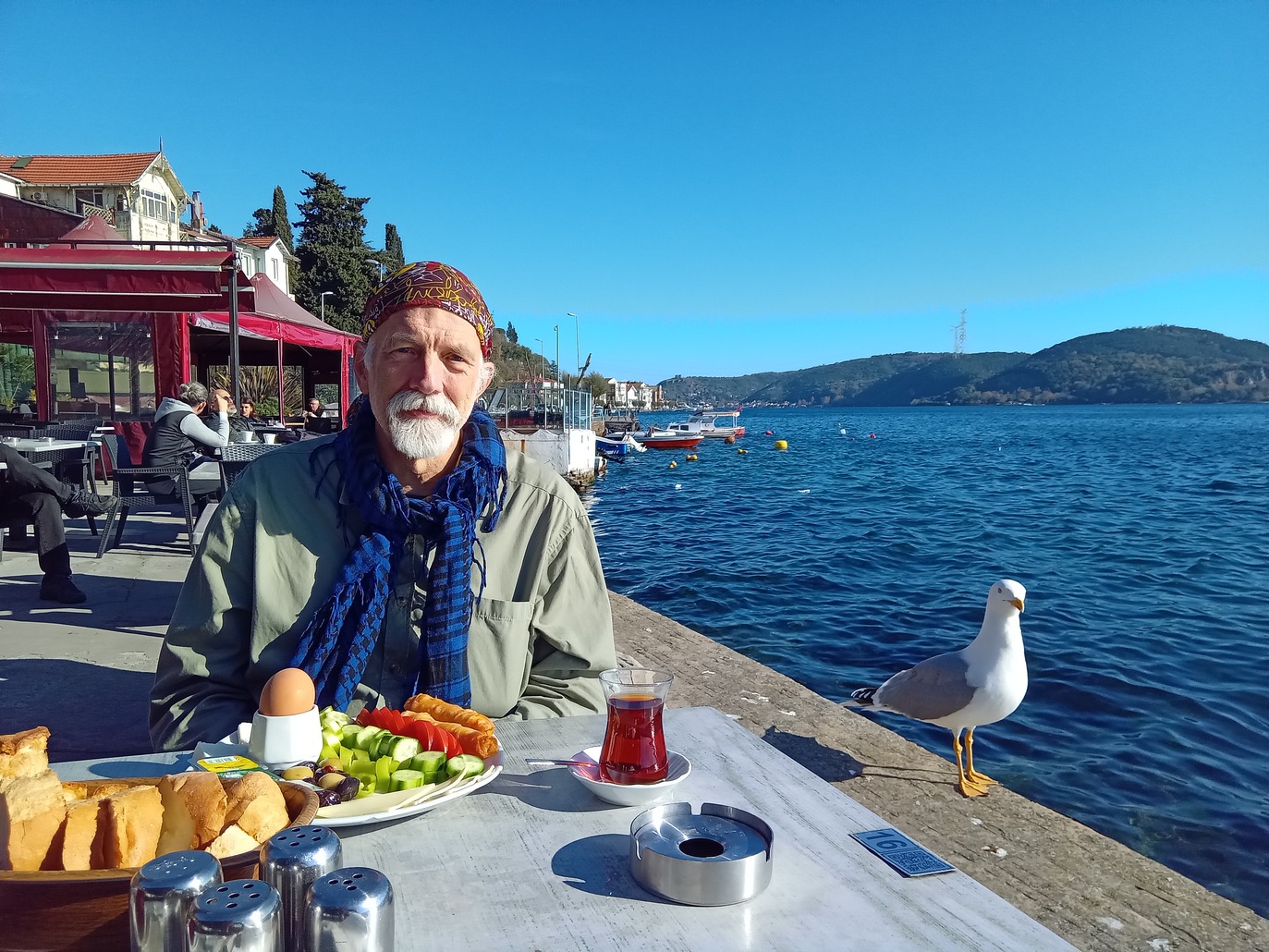
Seaside on a sunny day. Seagull, and human with tea and breakfast plate in front of him

Beyazpark Liseliler Kafe
Sarıyer, Istanbul
November 25, 2025

Continue reading

Rethinking

Last week, a student wrote me, “Is there going to be a proof question on the number theory exam?”

I answered,

As far as I’m concerned, the answer to every mathematical question is a proof, because everybody can check whether the answer is right.

I meant that the answer should provide the means for the reader to re-enact the answerer’s thought.

A bay seen from a hill across trees and houses, with green hills beyond (and heavier development at the top)
View from Büyükdere, Sarıyer, Istanbul
We live near the big building at Hacıosman
just over the horizon on the right
Sunday, June 30, 2024

Continue reading

Nature

Index to this series

Can Socrates really “find a natural support for justice,” as Allan Bloom says he must? It is strictly impossible, as I say in “Bloom, Badiou, Ryle, Shorey.” Inevitably there is more that can be said, and I shall try to say some of it here.

Sand, sea, mountains, sky
Anatolian sand, Aegean sea, Lesbian mountains
Uranus over all
Profesörler Sitesi, Altınova, Balıkesir, Turkey
September 24, 2021

Continue reading

On Plato’s Republic, 3

Index to this series

We are reading now Book II of Plato’s Republic, Stephanus pages 357–83, covering:

  1. The conventional arguments in favor of injustice and justice, reviewed by Plato’s brothers Glaucon and Adeimantus respectively.
  2. The beginning of the construction of the city in speech, wherein the advent of justice is to be discerned; the guardians of the city are to be like dogs and to be given a traditional education, although with none of the traditional stories, since they talk about things like parricide and bad luck.

A book next to a dog lying on the beach

Dog with copy of Alain Badiou, Plato’s Republic:
A Dialogue in Sixteen Chapters, with a Prologue and an Epilogue, 2012
Profesörler Sitesi, Altınova, Balıkesir, Turkey, September 2, 2021

Continue reading

NL XXVI: Democracy and Aristocracy

Index to this series

Executive summary (added September 12, 2018, edited January 26, 2019).

  1. Aristocracy and democracy are abstractions (§§26. 1[0]–28). Inseparable from one another, they are properly understood as correlative rules for the ruling class:

    1. Don’t let in anybody who is unqualified.
    2. Don’t keep out anybody who is.
  2. By what Collingwood will call, in Chapter XXXI of the New Leviathan, the Principle of the Limited Objective, (which was recognized by the Early Church Fathers,) the ruling class should be prepared to solve, not every problem (as Plato wanted), but those problems that are expected to come up (§§26. 3[0]–34).

  3. The democratic and aristocratic principles have been at work throughout the history of Europe: in Greece, in Rome, under the feudalism of the Middle Ages. The French Revolution was not only democratic, but also aristocratic, for aiming to give power to the bourgeoisie, not the entire population (§§26. 4[0]–66).

  4. Adapted from the literary concept of peripety, the concept of revolution actually has no place in history, where there are no heroes or villains, just human beings, partly good and partly bad (§§26. 7[0]–82).

  5. The concept of a revolution in history is even dangerous, if it leads you to think a political problem can have been solved once for all (§§26. 9[0]–96).


There can be no pure democracy, not for a length of time, not if we understand a democracy to be a society whose ruling class is the whole of it. Even the most extreme democrat of ancient Greece never contemplated citizenship for women, slaves, or resident foreigners. We may be more liberal today, at least regarding women and slavery. Still we do not open the ruling class to foreigners, such as myself where I am; nor do we open it to children. We could do so, in the sense of extending the franchise to all human residents. Both possibilities were discussed favorably in the early 1990s in The Nation, as I recall, in one case by a legal minor. However, perhaps most children could not be given such adminstrative duties as used to be assigned by lot to Athenian citizens. Even if they could, what of the animals that live among us—shall they be citizens?


Edward Hicks (American, 1780-1849),
The Cornell Farm, 1848, oil on canvas,
Gift of Edgar William and Bernice Chrysler Garbisch,
National Gallery of Art Continue reading

Re-enactment

Two whiteboards, one above the other, with geometrical diagrams and equations
My whiteboards from Tuesday, November 3, 2015,
concerning Pappus of Alexandria,
in the course “Geometriler


Executive summary (added October 6, 2018). Historian Niall Ferguson praises Collingwood as a philosopher of history, while showing no sign of understanding Collingwood’s actual philosophy. This provokes me. My comments are in the following sections.

Continue reading

Effectiveness

Preface

First posted May 17, 2018, this essay concerns Eugene Wigner’s 1960 article “The Unreasonable Effectiveness of Mathematics in the Natural Sciences.” I wrote a lot, which I now propose to summarize by section. (The meditations also continue in the next article.)

  • Some things are miraculous. Among Wigner’s examples are

    • that mathematics is possible at all, and
    • that “regularities” in the physical world can be discovered, as by Galileo and Newton.

    For Wigner, we should be grateful for the undeserved gift of a mathematial formulation of the laws of physics. This makes no sense theologically – and here I agree with the character Larry Darrell in Somerset Maugham’s novel The Razor’s Edge. Wigner’s idea that our mathematical reasoning power has been brought to perfection makes no sense to me either.

  • Everything is miraculous. Here I agree with Collingwood in Religion and Philosophy. A miracle cannot be the breaking of a natural law, since such a thing cannot be broken. A great artist like Beethoven follows no rules in the first place, or makes them up as he goes along; and he is like God in this way.

  • Natural law. That it cannot be broken is part of the very concept of natural law. Quantum phenomena and the theory of relativity have not in fact been brought under a single law; for Wigner, it may not be possible.

  • Mystery. Not only can we not define miracles, but (as we should have observed in the first place) we cannot even say when they happen. If like Wigner we call something miraculous, this means it cleanses our own doors of perception, in the sense of William Blake.

  • Definitions. In his treatment of miracle in Religion and Philosophy, Collingwood shows the futility of trying to define a term when you are not sure how to use it. He makes this futility explicit in The Principles of Art. If we are going to think about the use of mathematics in natural science, this means we ought to be mathematician, natural scientist, and philosopher; and not just “natural scientist,” but physicist and biologist, since if mathematics is effective in physics, it would seem to be ineffective in biology.

  • Being a philosopher. We are all philosophers, in the sense that Maugham describes in the story “Appearance and Reality,” if only we think. All thought is for the sake of action. This does not mean that thought occurs separately from an action and is to be judged by the action. We may value “pure” thought, such as doing mathematics or making music or living the contemplative life of a monk. This however moves me to a give a thought to the disaster of contemporary politics.

  • Philosophizing about science. For present purposes, compart­ment­al­ization of knowledge is a problem. So is the dominance of analytic philosophy, for suggesting (as one cited person seems to think) that big problems can be broken into little ones and solved independently. In mathematics, students should learn their right to question somebody else’s solutions to problems. In philosophy, the problems themselves will be our own. Philosophy as such cannot decide what the problems of physics or biology are, though it may help to understand the “absolute presuppositions” that underlie the problems. Philosophers quâ metaphysicians cannot determine once for all what the general structure of the universe is. This does not mean they should do “experimental philosophy,” taking opinion polls about supposedly philosophical questions. What matters is not what people say, but what they mean and are trying to mean. As Collingwood observes, metaphysics is an historical science.

For more on the last points, see a more recent article, “Re-enactment.” (This Preface added June 3, 2018.)


I am writing from the Math Village, and here I happen to have read that Abraham Lincoln kept no known diary as such, but noted his thoughts on loose slips of paper. Admired because he “could simply sit down and write another of his eloquent public letters,”

Lincoln demurred. “I had it nearly all in there,” he said, pointing to an open desk drawer. “It was in disconnected thoughts, which I had jotted down from time to time on separate scraps of paper.” This was how he worked, the president explained. It was on such scraps of paper, accumulating over the years into a diaristic density, that Lincoln saved and assembled what he described to the visitor as his “best thoughts on the subject.”

Thus Ronald C. White, “Notes to Self,” Harper’s, February 2018. My own notes to self are normally in bound notebooks, and perhaps later in blog articles such as the present one, which is inspired by the 1960 article called “The Unreasonable Effectiveness of Mathematics in the Natural Sciences,” by Eugene Wigner.

Papers on a table with a view of trees and a distant hill between stone columns

Continue reading

On Knowing Ourselves

In a 2012 post in this blog, I criticized a 2009 essay called “50 Years of Stupid Grammar Advice.” The putative advice was that of Strunk and White. However, what these two had written was not the elements of grammar, but The Elements of Style. They gave style advice by precept and example. The advice is good, if well understood. The critic should recognize that, as I wrote, “Rules of style are supposed to induce thinking, not obedience.”

View between two hotel buildings from one mountainside to another, with a bit of the sea beyond
All photos taken in Delphi, July 12–14, 2017

Continue reading

NL XXV: The Three Laws of Politics

Index to this series

Executive summary (added September 11, 2018): The the three laws of politics are that (1) within the body politic, there is a ruling class, which is a society proper; (2) the ruling class can take in members from the ruled class; (3) the ruled and ruling classes will resemble one another, so that e.g. rulers of slaves will become slavish themselves. I compare such laws with physical laws, as discussed by Einstein; but on this subject, a look ahead to Chapter XXXI, “Classical Physics and Classical Politics,” would be in order. Meanwhile, by the Second Law, the body politic, or its ruling class, can be a permanent society; Nazi claims about the youth or senility of different states are bogus. There are further gradations within the ruling and ruled classes, according to strength of will; a weak will can be strengthened by another person’s stronger will through induction.


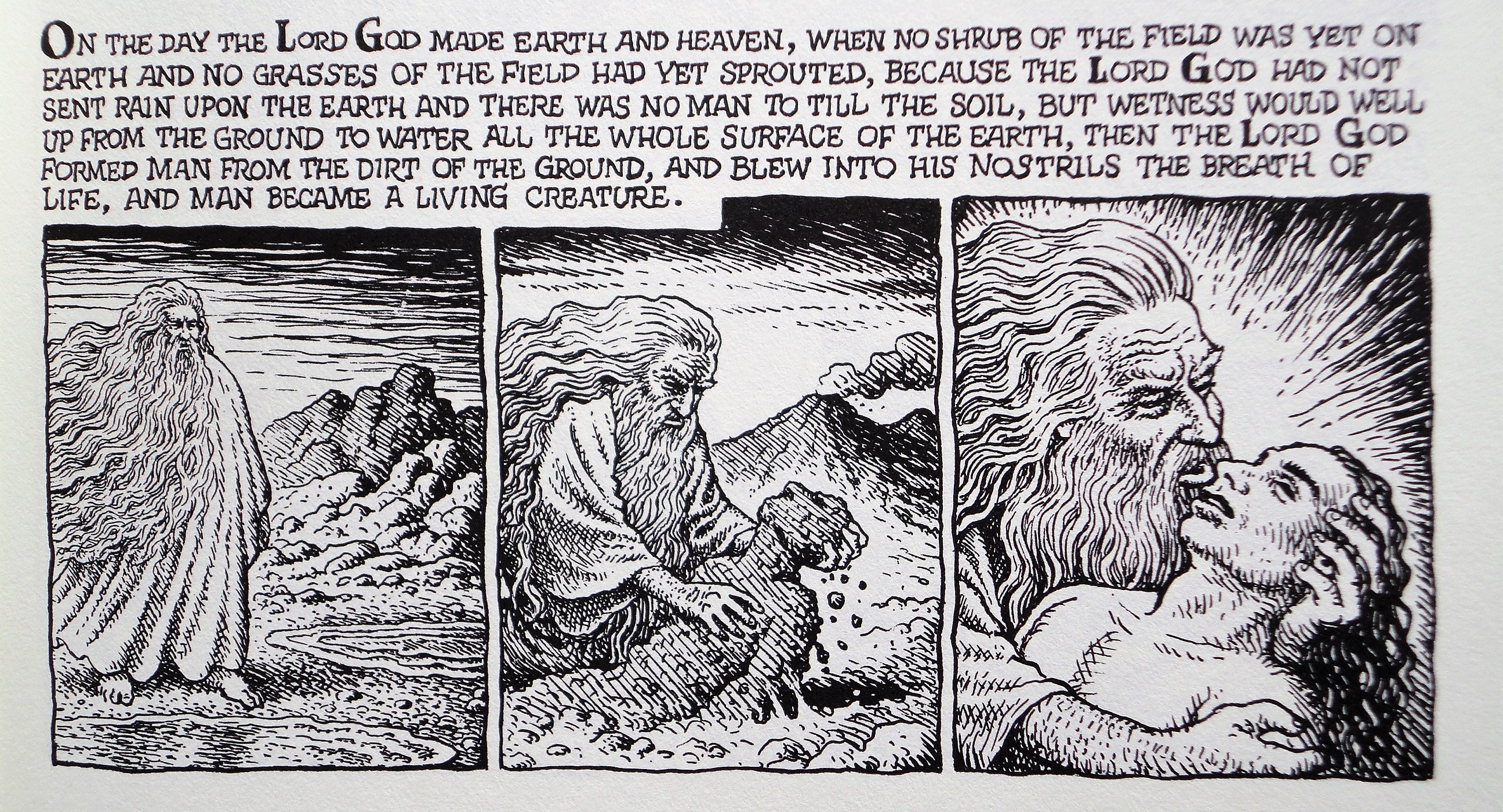
A pervading theme of the New Leviathan is freedom of will. Whether we actually have it is only a pseudo-problem (13. 17). Some persons have been fooled into thinking it a problem, perhaps by the misleading myth that free will is a divine gift, like life itself, breathed into our nostrils when, in Genesis 2:7, God forms us of the dust of the ground. As Collingwood observes at the end of Chapter XXIII, “The Family As a Society,” we are born neither free nor in chains. We have to grow up. Growing up is becoming free.

The Book of Genesis Illustrated by Robert Crumb (New York: Norton, 2009)

Continue reading

Nature and Death

Thoughts on mortality and the evolution of the universe, occasioned by a funeral and by Collingwood’s Idea of Nature and Plato’s Phaedo

Cebeci, Ankara, 2016.05.17

When the husband of my second-grade teacher died, I wanted to pay my respects. My father took me to the funeral home, where I hid behind him as he greeted the family of the deceased. My teacher was not among them. When invited to view the body, I looked over and saw it, lying off to the side in an open casket. I had never seen the man when he was alive. I declined the opportunity to gaze at his lifeless form. Until I came to Turkey, this was my closest approach to the materiality of death—except for a visit to the medical school of the University of New Mexico in Albuquerque. There, as part of the laboratory program at St John’s College in Santa Fe, students viewed dissected human cadavers.

Continue reading