In the last chapter of the last book of the Nicomachean Ethics, Aristotle prepares us for his next collection of books, the Politics.

Süleyman Nazif Sokağı, Şişli, İstanbul
Friday, June 7, 2024
In the last chapter of the last book of the Nicomachean Ethics, Aristotle prepares us for his next collection of books, the Politics.

Süleyman Nazif Sokağı, Şişli, İstanbul
Friday, June 7, 2024
Thanks to Stephen Greenleaf, whom I met through this blog in the first place, my attention has lit on some words of Charles S. Pierce:
When a man desires ardently to know the truth, his first effort will be to imagine what that truth can be … there is, after all, nothing but imagination that can ever supply him an inkling of the truth. He can stare stupidly at phenomena; but in the absence of imagination they will not connect themselves together in any rational way.
I am not sure now that “staring stupidly at phenomena” is not Aristotle’s definition of perfect happiness.
Pleasure and pain are a guide to something, but there is no sure guide to what is good; this is rather what should guide us.
Although the word telezzüz is absent from one Turkish dictionary (Arkadaş Türkçe Sözlük, 2004), I find it in a couple of Turkish-English dictionaries. Its length recalls Ottoman times, when Turkish speakers freely borrowed from Persian and Arabic.
Native Turkish words can be extended to great length with grammatical endings, as in gelemeyebilirim. I once heard a taxi driver say that to a colleague who was making tea. He was saying literally, “I am able to be unable to come”; he meant, “Maybe I can’t come have tea, because I’ve got to take this guy out to the airport.” The single word for all of that was built up from the single syllable gel- “come” by addition of -eme- “be unable,” -y- (buffer), -ebil- “be able,” -ir- (marking an aorist verb), and -im “I.” By contrast, telezzüz has no such analysis, at least not in Turkish. This brands the word as foreign, at least to my understanding, the way sesquipedality in an English word connotes a borrowing from Latin or Greek.
As I have just learned, the word telezzüz is used as the name of an upscale vegetarian restaurant, over on the Asian side of Istanbul, near an Ottoman kiosk that my wife and I have visited. Perhaps one day we will dine at the restaurant, for a taste of luxury, the way we dined at Nicole, in European Istanbul, almost nine years ago. Unfortunately, for us at least, that restaurant wasn’t vegetarian.

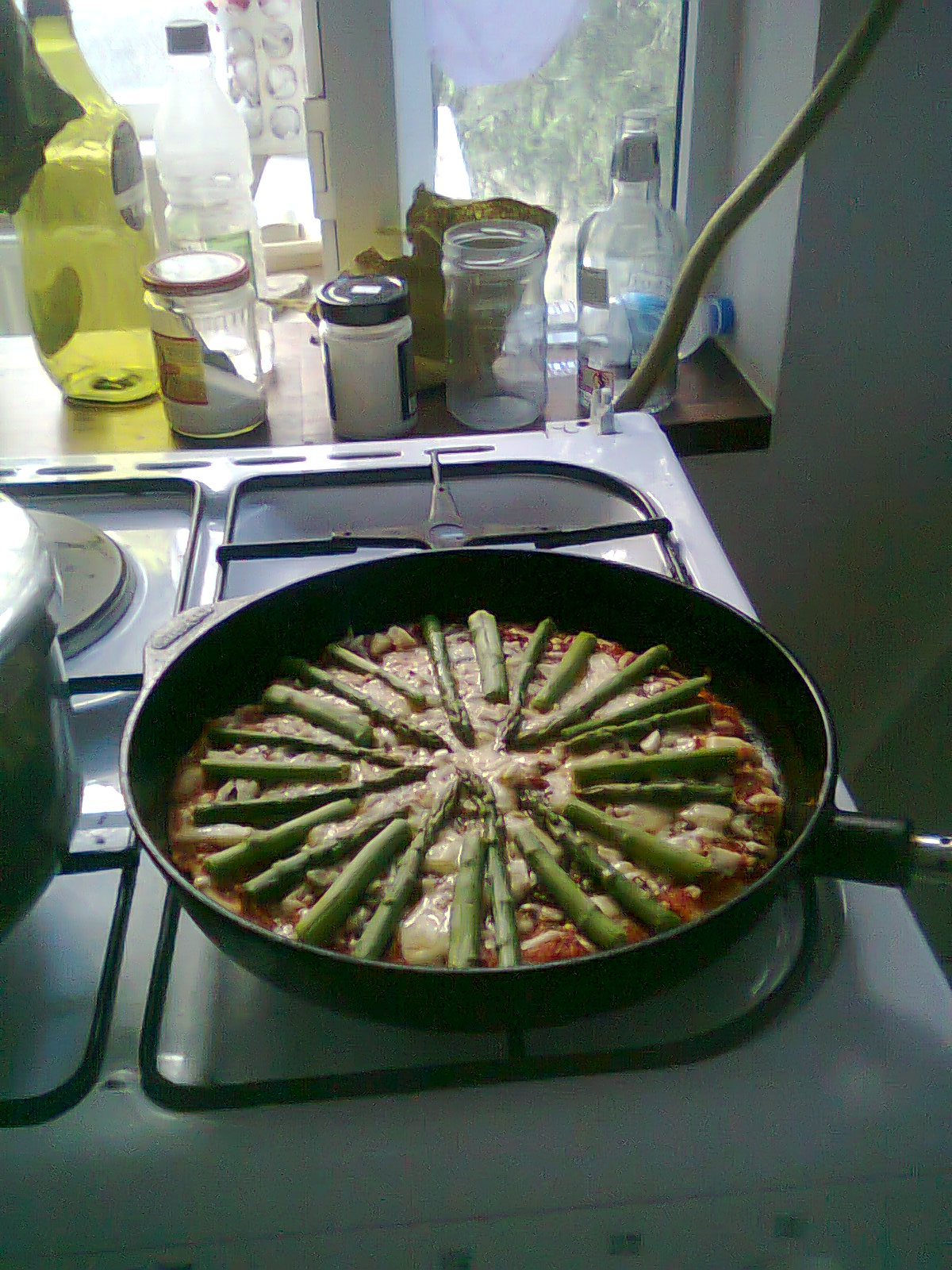
Homemade pizza with asparagus from Elibelinde
Tuesday, May 21, 2024
We now finish Aristotle’s account of friendship, in Books VIII and IX of the Nicomachean Ethics. Of the latter book, chapters x–xii are below. I wonder whether the last one or six chapters of the book are meant as a culmination or a dénouement. Are we to see a panorama, having reached the high point of our deliberations, or are we just tying up some loose ends?
Aristotle sets the example that Thomas Aquinas follows in the Summa. We are reading chapters viii and ix of Book IX of the Nicomachean Ethics. The Philosopher makes the best case against two positions that he ultimately argues for:

In “Sanity” I used a photo of the same skeletal building from the other side
Does this sound like Aristotle?
It might seem like it’s easier to love others than to love yourself, but it’s tough to build healthy relationships if you don’t love yourself first.
The sentence is from a WikiHow page, “How to Love Yourself: Treat Yourself Like Your Own Best Friend.” Back in in the 1970s, I thought something like it was an excuse for self-indulgence.
Wealth can keep you from going to hell. At least, that’s what a rich old man tells Socrates, in Book I of the Republic of Plato. Cephalus gives us a prime example of an assertion made, not because it is true, but because the speaker fears it might not be true.

One of the few moments of the year when the rising sun crosses our living room and reaches the kitchen.
Monday, April 8, 2024
Cephalus must be nervous about how he built up his riches in the first place. As he explains,
According to the last three chapters of Book VIII of the Nicomachean Ethics:
In the Nicomachean Ethics, this third of eight readings on friendship (φιλία) is the first of three on the connection with the just (τὸ δίκαιον). A lot of the reading might be summarized in a table:
| Polity | | | Analogue | | | Perversion | | | Analogues |
|---|---|---|---|---|---|---|
| kingdom | | | fatherhood | | | tyranny | | | |
Persian fatherhood slave-owning |
| aristocracy | | | marriage | | | oligarchy | | | |
man does all woman rules |
| timocracy | | | brotherhood | | | democracy | | | |
no master weak master |
We are reading chapters ix–xi of Book VIII. The table is based on chapter x and is elaborated on in chapter xi. Chapter ix introduces the idea that friendship and justice go together in communities, and all communities are formed within political communities, or polities, which they somehow reflect.