Category Archives: Persons

Discipline

With this third reading (of chapters vii–x) in Book VII of the Nicomachean Ethics, we complete the discussion of continence and incontinence, hardness and softness. An explicit notice at the end of chapter x tells us so.

Three gulls on a green cable running across the water to the side of a boat
Gulls are not perching birds, but evidently are able to balance on a cable, if it is thick enough and still enough.
Kireçburnu, Wednesday, January 17, 2024

Continue reading

Necessity

I quoted, last time, a writer I admire, who was in turn quoting a Nobelist in literature on how a certain devotee of Aristotle “had nothing useful to offer on the conduct of life.” I don’t admire that comment. A life spent in devotion to the Philosopher may itself  be well conducted. I don’t know whether it was, in the case of Mortimer Adler.

The sentence by Saul Bellow was,

Mortimer Adler had much to tell us about Aristotle’s Ethics, but I had only to look at him to see that he had nothing useful to offer on the conduct of life.

I don’t know how this is not rank prejudice. It does recall the two exchanges that are all I remember from A Passage to India of E. M. Forster (my father once gave me a copy, but I don’t seem to have kept it):

“You understand me, you know what others feel. Oh, if others resembled you!”

Rather surprised, she replied: “I don’t think I understand people very well. I only know whether I like or dislike them.”

“Then you are an Oriental.”


“Don’t you think me unkind any more?”

“No.”

“How can you tell, you strange fellow?”

“Not difficult, the one thing I always know.”

“Can you always tell whether a stranger is your friend?”

“Yes.”

“Then you are an Oriental.”

In “A Note on This Book” – namely Strunk and White, The Elements of Style (New York: Macmillan, 1959; paperback edition, 1962) – E. B. White says that the final chapter, “An Approach to Style,” written by himself alone,

is addressed particularly those who feel that English prose composition is not only a necessary skill but a sensible pursuit as well – a way to spend one’s days.

I am glad to have lived in a time when this could be believed.

A novel or movie might portray an admirable or sympathetic figure as sacrificing everything else for painting, writing, or music. In Good Will Hunting, the title character does set his art aside for love; however, this “art” is mathematics. I heard a complaint about this from a fellow postdoc at the Mathematical Sciences Research Institute in Berkeley in 1998.

Perhaps Carl Friedrich Gauss had nothing useful to offer on the conduct of life, at least to the likes of Saul Bellow, or for that matter William Deresiewicz. Nonetheless, by the age of 24, he had solved a problem that (as far as I know) had stumped mathematicians for two thousand years, even since the time of Aristotle.

Regular 17-gon, bisected by a straight line through one vertex, with perpendiculars dropped from the other vertices

Continue reading

Anarchy

Some distinctions are important, some are not. Telling which is which is important for life – and for reading Aristotle, who opens Book VII of the Nicomachean Ethics by recalling that κακία

  • is something to be avoided,
  • is opposed to ἀρετή.

Presently, in § i.4, what is paired with ἀρετή is not κακία, but μοχθηρία. Is there a difference?

Four billboards, by a road, obscure the trees behind
Four advertisements, all for margarine, a different proud baker in each. One person differs from the others in wearing a headscarf; none differs in sex.
Tarabya Bayırı, Sarıyer, Istanbul, Friday, January 26, 2024

Continue reading

Foresight

Stairway of solid blocks, lined with ivy and shrubs
Stairway up from Dereiçi Sokağı
(“Inside the Stream Street,” the old road down to the bay)
to Tarabya Bayırı Caddesi (“Therapy Slope Avenue”)
Tarabya, Sarıyer, Istanbul
Monday, January 15, 2024

Continue reading

Sources

This is about intellect, wisdom, and prudence. They are strange subjects for discussion.

  • If you have them, are you going to spend time talking about them?
  • If you haven’t got them, what can you say about them?

Apparently I did talk about them with my classmates when we were undergraduates, even freshmen: too young for prudence, although not for wisdom, by Aristotle’s account below, at least in special pursuits such as geometry and mathematics.

Does that sound like wisdom? According to the Concise Oxford Dictionary (6th edition, 1976), wisdom is

experience and knowledge together with the power of applying them critically or practically; sagacity, prudence, common sense.

Aristotle is talking about σοφία though, and this can mean cleverness. Intellect and prudence are νούς and φρόνησις. Last time we saw the claim that the latter is prudence only in the older sense of “practical judgment,” not the sense of “playing it safe” that is current today.

  Chinese character, possibly 原 or 道, but looking more like 障  
“The First Principle,” ostensibly

Continue reading

Memory

We saw the soul divided in two, in Book I of the Nicomachean Ethics. In the present reading, of the first five of the 13 chapters of Book VI, Aristotle returns to the division, and he tells us he is returning. At least, what we are given in the text is,

πρότερον μὲν οὖν ἐλέχθη δύ᾽ εἶναι μέρη τῆς ψυχῆς.

It was stated previously, then, that there are two parts of the soul.

“It was stated previously.” The passive voice may mean that somebody else added this comment. We may also ask whether the comment is actually referring to an earlier passage of the work that we are now reading.

Illuminated bookshelves in the corner of a room; twilight comes through windows on either side

This is a difficulty of reading Aristotle. We don’t know, or at least I don’t know, whether Aristotle himself created the Ethics as a single work, comprising ten books, to be read in order; and if he did, whether he finished the work to his own satisfaction; and if he did, how well the text that has come down to us (apparently through Andronicus of Rhodes) represents Aristotle’s work.

Continue reading

The Miraculous

The miracles recounted in the Gospels are not violations of the laws of nature, because the Evangelists had no conception of those laws in the first place. So I argued in a post of June, 2022. Having encountered resistance to the argument, I return to it now.

Man wrapped in towel stands under bare trees near a ladder down to the sea; other people walk past in their winter coats
One person did swim in the Bosphorus
here at Kireçburnu on New Year’s Day, 2024

Continue reading

Righteousness

Words of Martin Luther King are on my mind:

No, no, we are not satisfied, and we will not be satisfied until justice rolls down like waters and righteousness like a mighty stream.

My mother was there, at the March on Washington. She must then have heard a particular singer, whom my wife and I heard in concert, fifty-two years later. I wrote about this in “Joan Baez in Istanbul.”

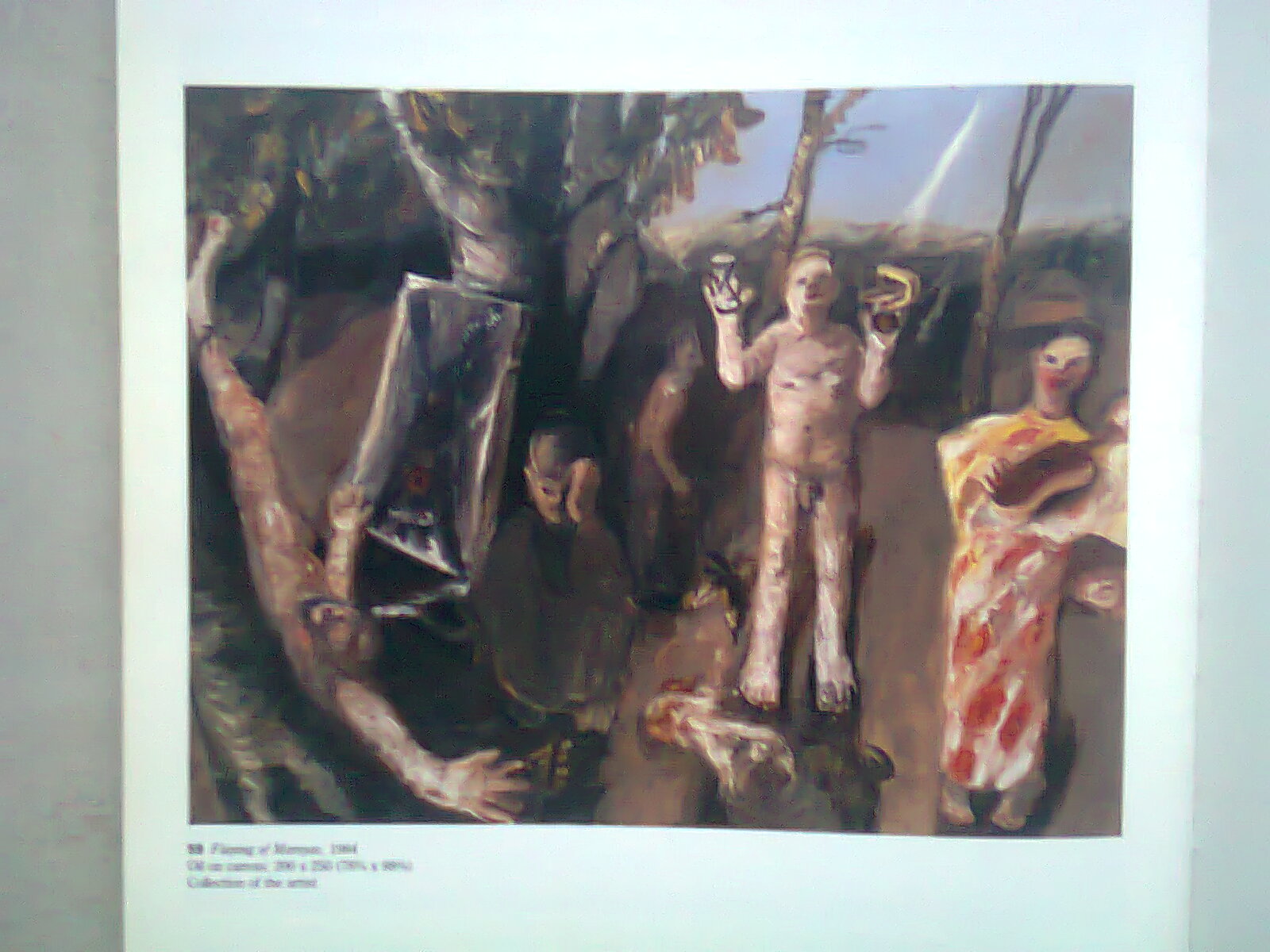
Several crudely painted figures
Klaus Fussmann, “Flaying of Marsyas,” 1984
as reproduced in
Joe Shannon, Representation Abroad
(Hirshhorn Museum, Smithsonian Institution, 1985)
catalogue of an exhibit I visited several times
in the summer after my sophomore year of college

Continue reading

Fire

There was a remark near the end of the last reading, in § v.18:

τοῦ δὲ ἀδικήματος
τὸ μὲν ἔλαττον ἀδικεῖσθαί ἐστι,
τὸ δὲ μεῖζον τὸ ἀδικεῖν.

And with an unjust transaction,
having injustice done to one is less than the mean,
and doing the injustice is in excess of it.
(Sachs)

Of the injustice done,
the smaller part is the suffering
and the larger part is the doing of injustice.
(Rackham)

At first glance – my first glance, anyway – Aristotle alludes here to the teaching of Socrates, which I tried to work out in “Doing and Suffering”: suffering injustice is less bad than doing it.

Beside a road, a wall covered in vines and overtopped by trees is lit by the evening sun
Şalcıkır Caddesi
The road through the stream valley
that drains into Tarabya Bay
Sarıyer, Istanbul
November 14, 2023

Continue reading

Symmetry

In the account of justice – the dicaeology – that I looked at last time, equality was a nominal concern. I said it might not be what we mean today by equality before the law. We may come closer to that in the present reading, but I’m not sure.

We have reached the part of the Nicomachean Ethics that I dipped into more than six years ago, when writing what ultimately became a long mathematical and historical paper, “On Commensurability and Symmetry” (Journal of Humanistic Mathematics, Volume 7 Issue 2 [July 2017], pages 90–148, DOI). Back then, I made only a precision raid, as if by helicopter, using coordinates supplied by the LSJ lexicon for the words of interest (σύμμετρος and συμμετρία). Now, in a party, we have been working our way in on foot.

Two loaves, split lengthwise along the top, rest on two rectangular pans; behind them, a teapot
Bread: money
Two loaves: equality
The flour is siyez (einkorn)
The leaven is sourdough
Both are from İstiklal Yolu in Kastamonu

Continue reading