Category Archives: Plato

NL V: “The Ambiguity of Feeling”

Index to this series

Feeling differs from thought. Thought is founded in feeling; thought is erected on feeling; thought needs feeling. Thought needs feelings that are strong enough to support it. But thought itself is not strong (or weak); it has (or can have) other properties, like precision and definiteness. Thought can be remembered and shared in a way that feeling cannot.

The New Leviathan is a work of thought. One might say that a work of thought cannot properly explain feeling. Collingwood himself says this, more or less, in Chapter V, even in its very title: “The Ambiguity of Feeling.” Continue reading

NL IV: “Feeling”

Index to this series

Contents of this article:

  • The Fallacy of Misplaced Argument. Do not argue about what is immediately given to consciousness
  • Feeling and Thought. An analysis of feeling is not immediately given to consciousness
  • Summary of the chapter, as analyzed into nine parts

    Continue reading

  • NL III: “Body As Mind”

    Index to this series

    In Chapter I of The New Leviathan, we stipulated that natural science, the “science of body,” must be free to pursue its own aims. But we ourselves are doing science of mind, and:

    1. 85. The sciences of mind, unless they preach error or confuse the issue by dishonest or involuntary obscurity, can tell us nothing but what each can verify for himself by reflecting on his own mind.

    All of us can be scientists of mind, if only we are capable of reflection: Continue reading

    NL II: “The Relation Between Body and Mind”

    Index to this series

    I continue making notes on The New Leviathan of R. G. Collingwood (1889–1943). Now my main concern is with the second chapter, “The Relation Between Body and Mind”; but I shall range widely, as I did for the first chapter.

    Preliminaries

    Some writers begin with an outline, which they proceed to fill out with words. At least, they do this if they do what they are taught in school, according to Robert Pirsig:

    He showed how the aspect of Quality called unity, the hanging-togetherness of a story, could be improved with a technique called an outline. The authority of an argument could be jacked up with a technique called footnotes, which gives authoritative reference. Outlines and footnotes are standard things taught in all freshman composition classes, but now as devices for improving Quality they had a purpose.

    That is from Zen and the Art of Motorcycle Maintenance, chapter 17.

    Does anybody strictly follow the textbook method of writing? Continue reading

    NL I: “Body and Mind”

    Index to this series. See also a later, shorter article on this chapter

    The Chapter in Isolation

    “Body and Mind” is the opening chapter of Collingwood’s New Leviathan. The chapter is a fine work of rhetoric that could stand on its own, though it invites further reading. In these respects it resembles the first of the ten traditional books of Plato’s Republic, or even the first of the thirteen books of Euclid’s Elements. The analogy with Euclid becomes a bit tighter when we consider that each chapter of The New Leviathan is divided into short paragraphs, which are numbered sequentially for ease of reference.

    Continue reading

    A personal overview of Collingwood’s New Leviathan

    These are the notes of an amateur of the work of the philosopher R. G. Collingwood.

    Published in 1942, The New Leviathan was the last book that Collingwood wrote. He finished it in some haste, because he knew he was dying—albeit of a condition brought on or at least exacerbated by overwork in the first place. He did die in 1943. Having been born in 1889, he was not so old as Socrates at death; but like Socrates, he had a babe in arms. Continue reading

    The Tradition of Western Philosophy

    Note added October 16, 2018: Here I compare two projects of re-examining the philosophical tradition named in my title. The projects are those of

    • R. G. Collingwood in An Essay on Philosophical Method (Oxford, 1933);

    • Stringfellow Barr and Scott Buchanan at St John’s College in Annapolis, Maryland, beginning in 1937.

    I review

    • how I ended up as a student at St John’s;

    • how Collingwood has been read (or not read) by myself and others, notably Simon Blackburn;

    • how Collingwood’s Essay is based on the hypothesis of the “overlap of classes.”

    Continue reading

    Books hung out with

    Here are some books that I have read more times than I can remember.

    1. R. G. Collingwood, The Principles of Art (1938);
    2. Somerset Maugham, The Razor’s Edge (1944);
    3. Robert M. Pirsig, Zen and the Art of Motorcycle Maintenance (1974).

    The years of my first readings were 1987, 1984, and 1982, respectively, as best I can remember; in any case, their order is opposite to the order of publication.

    I want to say some things about the books and their writers. I intend especially to address the last book, which I shall call ZAMM. From Pirsig’s more recent book, Lila, I mention only the author’s description of keeping notes on slips of paper, then arranging and rearranging them, in hopes that he might finally produce a book out of them. The present article might be considered as a collection of such notes, not necessarily forming a coherent whole. There are more notes that I might add in future.


    While I was in high school, I paid the price of three dollars and thirty-three cents (plus tax) for the peculiar purple book in square format called Be Here Now. I suppose the title can be taken as a summation of the spiritual advice contained in the book. This advice is apparently derived mainly from Hinduism, though given to us by an American once called Richard Alpert, who spent a lot of time taking LSD with Timothy Leary. After I had gone off to read Great Books at St John’s College in Annapolis in 1983, and transferred to Santa Fe after a year, I learned that the Director of Laboratories on the occidental campus had lived at a sort of monastery or commune, elsewhere in New Mexico, supported by sales of Be Here Now.

    The book ends with lists of recommended reading, headed with the warning, “Painted cakes do not satisfy hunger.” There are three lists:

    1. Books to hang out with.
    2. Books to visit with now and then.
    3. Books it’s useful to have met.

    The “books to hang out with” are thirty-five authors and teachers and scriptures. Those that I have on my own shelves are the Bhagavad Gita, the Holy Bible, the Tibetan Book of the Dead, the Tao Te Ching, the I Ching, and the poems of Hafiz. I have not really hung out with any of these, except maybe parts of the Bible and the Tao Te Ching (the latter in the 1972 translation of Gia-Fu Feng and Jane English, illustrated with Chinese calligraphy of the former on lovely spare nature photographs by the latter).

    From Be Here Now’s longer list of “books to visit with now and then,” I have read only some of the poetry of Rumi and William Blake, along with Hesse’s Siddhartha, Merton’s Seven Story Mountain, Reps’s Zen Flesh, Zen Bones, Rilke’s Duino Elegies, and Thoreau’s Walden. From the final, longest section, of “books it’s useful to have met,” the works that I have read are a curious mix of mostly science fiction and St John’s College Program books, by Asimov, Bradbury, Castaneda, Dante, Descartes, Heinlein, Milton, Pascal, Plotinus, Plato, Saint-Exupéry, Salinger, and Tolkien.


    The three books that I listed at the beginning are among the books that I have hung out with. Let me record here a flaw in my memory concerning one of them. Before checking the lists in Be Here Now, I thought I remembered that The Razor’s Edge was there somewhere, if only among the “books it’s useful to have met”. But it is not there. Since it seems to fit the theme of spiritual journeys, I wonder if its absence is due to ignorance or oversight. Possibly Maugham was judged to be a spiritual lightweight. However, because on a web page I said The Razor’s Edge was one of my favorite books, I received emails from a fellow, calling himself the Wanderling, who said that his mentor, and not a fellow called Guy Hague, was the person who had been the source for Maugham’s character Larry Darrell.


    Some people never read a book more than once. Some people cannot even conceive of doing this. Jerry Seinfeld would appear to be one of those people. In an early episode of his television series, Jerry ridicules George for wanting to retrieve some already-read books from the girlfriend with whom he has just broken up.

    Presumably Seinfeld could conceive of watching a television show more than once. It is only because I have watched Seinfeld episodes more than once that I am able to recall and mention Jerry’s foolishness about books in the first place.

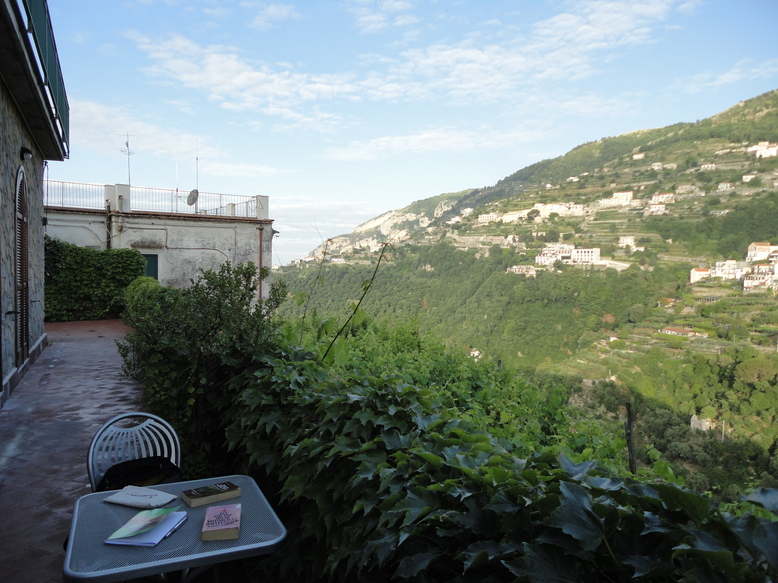
    Recently I increased by one the unknown number of my readings of ZAMM. Earlier in this month of June, 2013, above the Tyrrhenian Sea, in the gorgeous hilltop setting of Ravello, where I was attending a mathematics conference, in the early mornings I would rise, sit outside, and either work on mathematics or read ZAMM.

    photo of terrace in Ravello
    ZAMM in the morning in Ravello

    Continue reading

    Limits

    This is about limits in mathematics: both the technical notion that arises in calculus, and the barriers to comprehension that one might reach in one’s own studies. I am going to say a few technical things about the technical notion, but there is no reason why this should be a barrier to your reading: you can just skip the paragraphs that have special symbols in them.

    Looking up something else in the online magazine called Slate, I noted a reprint of an article called “What It Feels Like to Be Bad at Math” from a blog called Math With Bad Drawings by Ben Orlin. Now teaching high-school mathematics, Mr Orlin recalls his difficulties in an undergraduate topology course. His memories help him understand the difficulties of his own students. When students do not study, why is this? It is because studying makes them conscious of how much they do not understand. They feel stupid, and they do not like this feeling. Continue reading

    Aristotle on Heraclitus

    Along with various fellow alumni of St John’s College (Annapolis and Santa Fe), I am currently reading Eva Brann, The Logos of Heraclitus (Paul Dry Books, 2011). This may inspire some incidental posts, such as the present one, which considers the same sentence about Heraclitus by Aristotle in three languages, mainly because of the oddity of a published Turkish translation. The oddity is in the treatment of opinion and knowledge. The distinction between them is important in, for example, Plato’s Republic; but I shall not really have anything to say here about the distinction as such.

    Miss Brann spends III.A (pages 15–19) considering Fragment 50 (by the Diels reckoning):

    οὐκ ἐμοῦ, ἀλλὰ τοῦ λόγου ἀκούσαντας ὁμολογεῖν σοφόν ἐστιν ἓν πάντα εἶναι

    Continue reading