Category Archives: Plato

On Chapman’s Homer’s Iliad, Book III

Index | Text

The Iliad is about the feud between Achilles and Agamemnon, a feud that occurs during the Trojan War. Book III of the Iliad has nothing to do with Achilles, a little to do with Agamemnon, and everything to do with why the whole war is happening at all.

Note added August 19, 2024: The war is happening because Paris is God’s gift to women. By his own account, he is excellent in the “gifts of peace,” and these are “as little to be scorn’d, / As to be wonne with strength, wealth, state …” It is good to recognize that some things cannot be obtained by “strength” or force. Achilles recognizes this in Book I when he refrains from killing Agamemnon. However, Paris scorns not only strength, but also wealth and state. I suppose it is “state” that lets Hector and Agamemnon come to an agreement about a duel between Paris and Menelaus that will end the war. Paris breaks the agreement by running away to visit the prize of his excellence, namely Helen. Homer has Venus spirit Paris away, but I take this to be a poetic embellishment, agreeing with Eva Brann in Homeric Moments: Clues to Delight in Reading the Odyssey and the Iliad (Paul Dry Books, 2002; pages 41–3):

But the gods’ face-off effects nothing; at least nothing happens that could not happen without them. And so it is always; Zeus himself disclaims responsibility for human fate right at the beginning of the Odyssey


To be sure, as I said above, nothing is ever done that could not have been done by the humans themselves …

Photo of the tower of books used for this article

Continue reading

The Hands of an Angry Deity

I first drafted the following essay in late October, 2011, a few days after the first of the earthquakes in Van, and a few weeks after moving from Ankara to Istanbul. I rediscovered the essay recently by chance. It seems worth revisiting now, in the spring of 2017, given the political upheaval in the United States last fall, and the potential for more around the world.

Body of minivan with missing windows on overgrown grassy slope
Above Mehmetçik Caddesi in Şişli, one of the most densely populated of Istanbul’s 39 boroughs; 2017.04.02

Continue reading

Nature and Death

Thoughts on mortality and the evolution of the universe, occasioned by a funeral and by Collingwood’s Idea of Nature and Plato’s Phaedo

Cebeci, Ankara, 2016.05.17

When the husband of my second-grade teacher died, I wanted to pay my respects. My father took me to the funeral home, where I hid behind him as he greeted the family of the deceased. My teacher was not among them. When invited to view the body, I looked over and saw it, lying off to the side in an open casket. I had never seen the man when he was alive. I declined the opportunity to gaze at his lifeless form. Until I came to Turkey, this was my closest approach to the materiality of death—except for a visit to the medical school of the University of New Mexico in Albuquerque. There, as part of the laboratory program at St John’s College in Santa Fe, students viewed dissected human cadavers.

Continue reading

Community

Concerning a proposal (not by me) to make a “strategic withdrawal” from public life in order to restore the imagined virtues of the Middle Ages.

What in the 1960s was a commune is now an intentional community. I lived in one in the mid-1990s, when I was in graduate school.

Mont Saint-Michel, in the image that heads Dreher’s linked article

Continue reading

NL XIV: “Reason”

Index to this series

Summary added January 29, 2019, revised May 8, 2019. Practical reason is the support of one intention by another; theoretical, one proposition by another. Reasoning is thus always “motivated reasoning”: we engage in it to relieve the distress of uncertainty. Reason is primarily practical, only secondarily theoretical; and the reason for saying this is the persistence of anthropomorphism in theoretical reasoning: by the Law of Primitive Survivals in Chapter IX, we tend to think even of inanimate objects as forming intentions the way we do.

Reasons for adding this summary of Chapter XIV of Collingwood’s New Leviathan include

  • the tortuousness of the following post on the chapter,
  • the provocation of a Guardian column by Oliver Burkeman on motivated reasoning.

Says Burkeman, whose “problem” is apparently motivated reasoning itself,

One of the sneakier forms of the problem, highlighted in a recent essay by the American ethicist Jennifer Zamzow, is “solution aversion”: people judge the seriousness of a social problem, it’s been found, partly based on how appetising or displeasing they find the proposed solution. Obviously, that’s illogical …

On the contrary, how we reason cannot be “illogical,” any more than how we speak can be “ungrammatical.” Logic is an account, or an analysis, of how we do actually reason; grammar, of how we speak. Of course we may make errors, by our own standards.

Rogier van der Weyden (Netherlandish, 1399/1400-1464), Portrait of a Lady, c. 1460, oil on panel, Andrew W. Mellon Collection
Rogier van der Weyden (Netherlandish, 1399/1400–1464),
Portrait of a Lady, c. 1460, oil on panel
National Gallery of Art, Washington; Andrew W. Mellon Collection

Context

There was a rumor that Collingwood had become a communist. According to David Boucher, editor of the revised (1992) edition of The New Leviathan, the rumor was one of the “many reasons why [that book] failed to attract the acclaim which had been afforded Collingwood’s other major works.” Continue reading

NL XI: “Desire”

Index to this series

The four parts of Collingwood’s New Leviathan (1942) are Man, Society, Civilization, and Barbarism. From the first part, we are considering Chapter XI, “Desire.”

Pablo Picasso, The Lovers (1923; National Gallery of Art, Washington)
Pablo Picasso, “The Lovers,” 1923
National Gallery of Art, Washington

Continue reading

NL X: “Passion”

Index to this series

Passion is literally the correlate of action, as suffering is the correlate of doing. In the ordinary, vulgar sense, passion is our response to what we suffer. This is how we shall understand it.

Above, from a cross made of steel I-beams, a stone figure hangs, while others mourn at his feet; below, more stone figures, one bearing a cross, another, back to us, with robe bearing the image of a face

Sagrada Familia, Passion Façade, November, 2008

Continue reading

Confessions

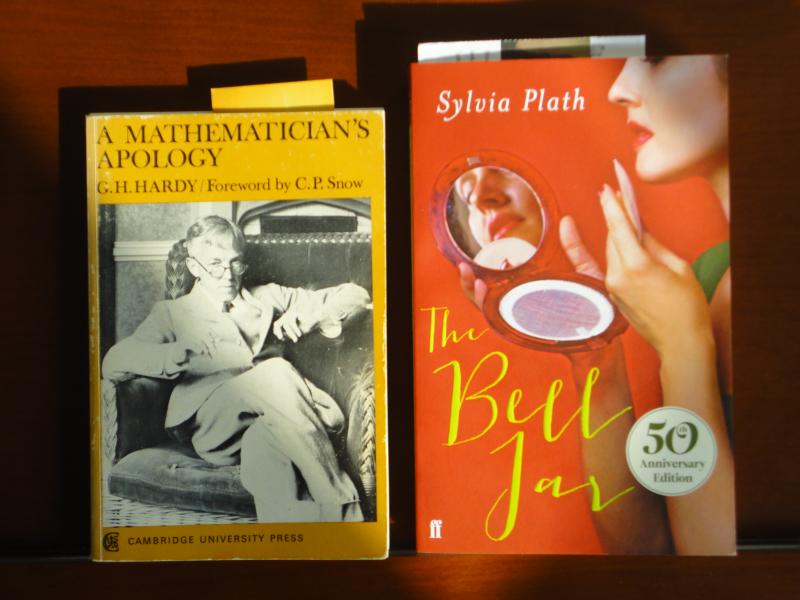
This is about G. H. Hardy and Sylvia Plath: Hardy quâ author of A Mathematician’s Apology (1940); Plath, The Bell Jar (1963).

Photo: the Hardy and Plath books

I first read Plath only recently, after encountering The Bell Jar by chance in the Istanbul bookshop called Pandora. After I finished reading it next day in Espresso Lab on İstiklâl, a woman who had earlier been speaking Turkish asked in English to look at the book. She pondered the front and the back before handing the book back to me. When I asked whether she knew of it, she simply said yes. She may not have understood my meaning; but I did not put her English (or my Turkish) to the test. Had she been made curious by the cover, showing a woman applying powder with the aid of a compact mirror? Did that cover accurately reflect the novel?

On an airplane once I was reading a paperback whose cover displayed a painting of ruins beneath the Acropolis of Athens. “I love historical fiction!” gushed a flight attendant. The term might be stretched to cover what I was reading; but it was the Oxford World’s Classics edition of Plato’s Republic.

Plato’s Republic

I had first read Hardy’s Apology in high school, thanks to the suggested reading at the end of Spivak’s Calculus. A couple of weeks ago, I somehow found a blog that took its title from the end of Hardy’s opening paragraph. That paragraph reads:

It is a melancholy experience for a professional mathematician to find himself writing about mathematics. The function of a mathematician is to do something, to prove new theorems, to add to mathematics, and not to talk about what he or other mathematicians have done. Statesmen despise publicists, painters despise art-critics, and physiologists, physicists, or mathematicians have usually similar feelings: there is no scorn more profound, or on the whole more justifiable, than that of the men who make for the men who explain. Exposition, criticism, appreciation, is work for second-rate minds.

The blog was called just that: Second Rate Minds. “We quote Hardy with irony,” says one of the two creators,

because we do not agree with him.

I believe there is great importance in communicating mathematics as widely as possible. I think it is important that children are encouraged to enjoy mathematics so that they might take further interest in the subject. Equally important is the view of mathematics held by the general public. Despite Hardy’s disdain for applications, mathematics nevertheless pervades the modern world and benefits from society valuing its role.

This is all fine; except I wonder if the writer has been corrupted by the same culture that made Hardy into somebody he found himself in disagreement with. This is the culture of judging people against one another, in order to rank them. Hardy gives a hint of this culture in the closing section of his essay:

I cannot remember ever having wanted to be anything but a mathematician. I suppose that it was always clear that my specific abilities lay that way, and it never occurred to me to question the verdict of my elders. I do not remember having felt, as a boy, any passion for mathematics, and such notions as I may have had of the career of a mathematician were far from noble. I thought of mathematics in terms of examinations and scholarships: I wanted to beat other boys, and this seemed to be the way in which I could do so most decisively.

I do not remember just what I thought of Hardy’s Apology in high school. I was at a school for boys, where I won prizes for mathematics and other subjects. I did not wish to emulate Hardy, either in pursuing just one thing, or in trying to beat others at it. Nonetheless, at the end of my freshman year at St John’s College in Annapolis, I bought my own copy of Hardy’s Apology in the College bookshop. The manager remarked that the book had decided her against pursuing mathematics. She had had dreams of doing good for the world; by Hardy’s account, mathematics was about personal glory.

I did want to do mathematics, as I ultimately understood. But this final understanding came after four more years: three in college, and one at large. I was working at a farm when I understood in a dream that I must learn modern mathematics. I cannot say that Hardy had any role in this, one way or other. Still, I would suggest now that, if Hardy does discourage you from pursuing mathematics, this may be just as well. You will have to focus like a laser if you want to do mathematics; you will be judged mercilessly, as mathematical truth is merciless; and you will suffer self-doubt, when it seems that the hardest you can work is still not good enough.

I am sorry that Hardy continued to be preoccupied with comparing himself to others:

I still say to myself when I am depressed, and find myself forced to listen to pompous and tiresome people, ‘Well, I have done one the thing you could never have done, and that is to have collaborated with both Littlewood and Ramanujan on something like equal terms.’

At least Hardy can accept that he was not quite at the level of his two collaborators. The mathematician must guard against all illusions.

In the end, I say, think what you like about Hardy; but give him credit for giving us a window into his life. Reading his essay yet again, I am impressed by the clarity and rhythm of the language, and by the frankness of the writer.

Sylvia Plath reminds me of Hardy. This is not because she ultimately gives up her virginity to a mathematician, at least in her novel. Like Hardy, she appears early on as an unpleasant person.

Plath’s character Esther proposes to Doreen that they ditch a party and have drinks with a man who wears cowboy boots and a lumber shirt. Doreen agrees to go up to Lenny’s apartment, as long as Esther will go. In the apartment, Doreen asks Esther to stick around. Still, Esther slips out; and back at the hotel, when a drunken Doreen pounds on her door, Esther won’t let her in. She allows Doreen to pass out in the corridor, since she won’t remember the incident anyway.

Maybe this was all part of the Girls’ Code, though it would seem to be a violation. Esther did not seem very nice to me. But then, trying to kill yourself is not very nice either, and Esther will do this repeatedly. There is a lot to investigate and contemplate here, including an academic system that squeezed both Plath and Hardy. It is odd that a bell jar is a place where the pressure is taken off. Now I want just to appreciate both Plath and Hardy, for laying themselves bare.

Written January, 2017. Revisited August 27, 2022. Later in 2017, I wrote more about Plath (and a little more about Hardy) in “Women and Men.”

One & Many

0

This essay – these notes for an essay, this draft of an essay – is inspired by Robert Pirsig’s first book. I have made sectional divisions where they seemed to occur naturally.

Photo of paperback and hardback editions of Zen and the Art of Motorcycle Maintenance

Continue reading

35th Istanbul Film Festival, 2016, part 3

Part 1 | Part 2

Between the composing of parts 1 and 2 of this account came the death of Prince, whose work had inspired Rain the Color of Blue with a Little Red in It. Between the composing of parts 2 and 3 came the release of the four Turkish peace activists, whose imprisonment had given poignancy to The Demons and The Music of Strangers. There is a certain absurdity associated with each event.

Photo of book, Shakyamuni Buddha

Nikkyô Niwano, Shakyamuni Buddha: A Narrative Biography
(Tokyo: Kôsei Publishing Co., 1980; fifth printing, 1989)

On the cover, a modern copy by Ryûsen Miyahara,
owned by Risshô Kôsei-kai, of
“The Nirvana of the Buddha,”
painted in 1086 and owned by temple Kongôbu-ji,
Wakayama Prefecture, Japan

Continue reading