NL XIV: “Reason”

Index to this series

Summary added January 29, 2019, revised May 8, 2019. Practical reason is the support of one intention by another; theoretical, one proposition by another. Reasoning is thus always “motivated reasoning”: we engage in it to relieve the distress of uncertainty. Reason is primarily practical, only secondarily theoretical; and the reason for saying this is the persistence of anthropomorphism in theoretical reasoning: by the Law of Primitive Survivals in Chapter IX, we tend to think even of inanimate objects as forming intentions the way we do.

Reasons for adding this summary of Chapter XIV of Collingwood’s New Leviathan include

  • the tortuousness of the following post on the chapter,
  • the provocation of a Guardian column by Oliver Burkeman on motivated reasoning.

Says Burkeman, whose “problem” is apparently motivated reasoning itself,

One of the sneakier forms of the problem, highlighted in a recent essay by the American ethicist Jennifer Zamzow, is “solution aversion”: people judge the seriousness of a social problem, it’s been found, partly based on how appetising or displeasing they find the proposed solution. Obviously, that’s illogical …

On the contrary, how we reason cannot be “illogical,” any more than how we speak can be “ungrammatical.” Logic is an account, or an analysis, of how we do actually reason; grammar, of how we speak. Of course we may make errors, by our own standards.

Rogier van der Weyden (Netherlandish, 1399/1400-1464), Portrait of a Lady, c. 1460, oil on panel, Andrew W. Mellon Collection
Rogier van der Weyden (Netherlandish, 1399/1400–1464),
Portrait of a Lady, c. 1460, oil on panel
National Gallery of Art, Washington; Andrew W. Mellon Collection

Context

There was a rumor that Collingwood had become a communist. According to David Boucher, editor of the revised (1992) edition of The New Leviathan, the rumor was one of the “many reasons why [that book] failed to attract the acclaim which had been afforded Collingwood’s other major works.” Continue reading

NL XIII: “Choice”

Index to this series

Adolph Gottlieb, “Centrifugal,” gouache on paperboard, 1961 (National Gallery of Art, Washington; gift of the Woodward Foundation)

Adolph Gottlieb, “Centrifugal,” 1961 (National Gallery of Art, Washington; gift of the Woodward Foundation)

The key idea of Chapter XIII of New Leviathan is the correct statement of the “problem of free will”:

Continue reading

NL XII: “Happiness”

Index to this series

Judith Leyster (Dutch, 1609–1660), Self-Portrait, c. 1630, oil on canvas (National Gallery of Art, Washington; gift of Mr. and Mrs. Robert Woods Bliss)
Judith Leyster (Dutch, 1609–1660)
Self-Portrait, c. 1630, oil on canvas
National Gallery of Art, Washington
Gift of Mr. and Mrs. Robert Woods Bliss

I gave ad hoc consideration to Chapter XII of Collingwood’s New Leviathan on November 3 of last year (2016), just before the American Presidential election. This was in an article sharing the title of the chapter: “Happiness.” The idea was that in dreadful times, unhappiness is “parasitic” on happiness.

Allowing himself “a certain freedom of interpretation” (12. 15), Collingwood agrees with Aristotle that “happiness” is the general term for what we desire (12. 11).

Continue reading

NL XI: “Desire”

Index to this series

The four parts of Collingwood’s New Leviathan (1942) are Man, Society, Civilization, and Barbarism. From the first part, we are considering Chapter XI, “Desire.”

Pablo Picasso, The Lovers (1923; National Gallery of Art, Washington)
Pablo Picasso, “The Lovers,” 1923
National Gallery of Art, Washington

Continue reading

NL X: “Passion”

Index to this series

Passion is literally the correlate of action, as suffering is the correlate of doing. In the ordinary, vulgar sense, passion is our response to what we suffer. This is how we shall understand it.

Above, from a cross made of steel I-beams, a stone figure hangs, while others mourn at his feet; below, more stone figures, one bearing a cross, another, back to us, with robe bearing the image of a face

Sagrada Familia, Passion Façade, November, 2008

Continue reading

NL IX: “Retrospect”

Index to this series

“All I want to know about mind,” says Collingwood,

is what it has done on certain definite occasions; not everything it has done, but enough for my purely practical purpose, deciding how to deal with the present attack on civilization.

This is from ¶9. 2 of New Leviathan. Three years ago, I set out here to read and write about this book, chapter by chapter. Continue reading

Writing, Typography, and Nature

Note added February 10, 2019: I return to this rambling essay, two years later in the Math Village. The main points are as follows.

  • Writing is of value, even if you never again read what you write.
  • There is also value to reading again, as in the present case.
  • A referee rejected a submitted article of mine in the history of mathematics because its order did not make sense – to that referee, though a fellow mathematician thought well of the article. A revision was eventually published as “On Commensurability and Symmetry.”
  • In the preface to The Elements of Typographical Style, Robert Bringhurst wonders how he can write a rulebook when we are all free to be different. He thus sets up an antithesis, such as I would investigate later in “Antitheses.”
  • From being simply a means of copying, typography has become a means of expression.
  • Yet typography should not draw attention to itself, just as, according to Fowler in A Dictionary of Modern English Usage, pronunciation (notably of foreign words) should not.
  • Through my own experience of typography with LaTeX [and HTML, as in this blog], I have developed some opinions differing from some others’.
  • Bringhurst samples Thoreau,
    • whose ridicule of letters sent by post applies today to electronic media, and
    • who rightly bemoans how enjoying the woods is thought idle; cutting them down, productive.
  • In Gödel, Escher, Bach, Douglas Hofstadter wonders how a message can be recognized by any intelligence. Bringhurst restricts the question to concern intelligences on this earth.
  • In my youth, Hofstadter introduced me to Zen Flesh, Zen Bones, (edited by Reps and Senzaki), whose influence on me I consider.
  • The Zen story about whether “this very mind is Buddha” suggests a further development of Collingwood’s “logic of question and answer.”
  • Through looking at another translation, I consider how Reps and Senzaki turned Chinese into English.
  • Rereading this blog led me back to Hofstadter.

Here are some meditations on some books read during a stay in the Nesin Mathematics Village, January, 2017. I originally posted this article from the Village; now, back in Istanbul, a few days into February, recovering from the flu that I started coming down with in the Village, I am correcting some errors and trying to clarify some obscurities.

From below, a wooded hill, with buildings near the crest
Nesin Mathematics Village from the east
Wednesday, January 18, 2017

Continue reading

Şirince January 2017

Having enjoyed spending a January week at the Nesin Mathematics Village in 2016, this year I came back for two weeks. My spouse will join me for the second week. Meanwhile, here are some photographs from this amazing place. Continue reading

Confessions

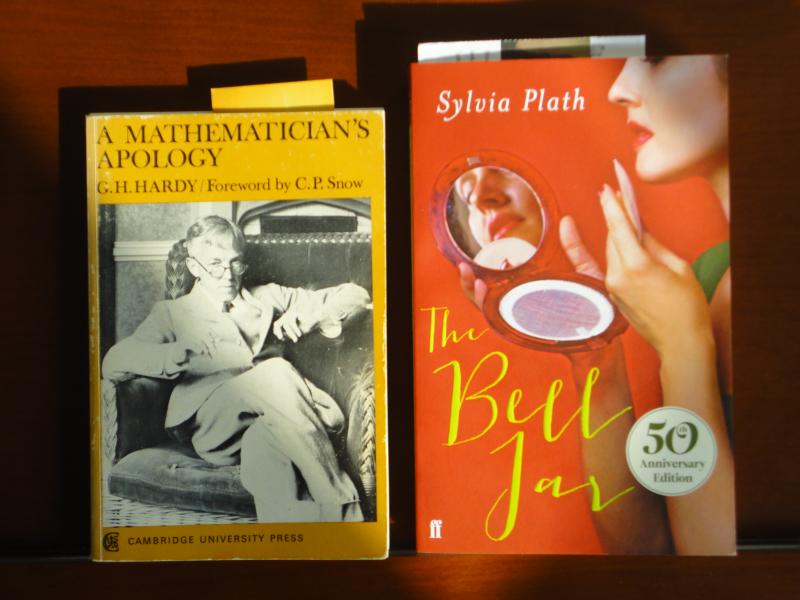
This is about G. H. Hardy and Sylvia Plath: Hardy quâ author of A Mathematician’s Apology (1940); Plath, The Bell Jar (1963).

Photo: the Hardy and Plath books

I first read Plath only recently, after encountering The Bell Jar by chance in the Istanbul bookshop called Pandora. After I finished reading it next day in Espresso Lab on İstiklâl, a woman who had earlier been speaking Turkish asked in English to look at the book. She pondered the front and the back before handing the book back to me. When I asked whether she knew of it, she simply said yes. She may not have understood my meaning; but I did not put her English (or my Turkish) to the test. Had she been made curious by the cover, showing a woman applying powder with the aid of a compact mirror? Did that cover accurately reflect the novel?

On an airplane once I was reading a paperback whose cover displayed a painting of ruins beneath the Acropolis of Athens. “I love historical fiction!” gushed a flight attendant. The term might be stretched to cover what I was reading; but it was the Oxford World’s Classics edition of Plato’s Republic.

Plato’s Republic

I had first read Hardy’s Apology in high school, thanks to the suggested reading at the end of Spivak’s Calculus. A couple of weeks ago, I somehow found a blog that took its title from the end of Hardy’s opening paragraph. That paragraph reads:

It is a melancholy experience for a professional mathematician to find himself writing about mathematics. The function of a mathematician is to do something, to prove new theorems, to add to mathematics, and not to talk about what he or other mathematicians have done. Statesmen despise publicists, painters despise art-critics, and physiologists, physicists, or mathematicians have usually similar feelings: there is no scorn more profound, or on the whole more justifiable, than that of the men who make for the men who explain. Exposition, criticism, appreciation, is work for second-rate minds.

The blog was called just that: Second Rate Minds. “We quote Hardy with irony,” says one of the two creators,

because we do not agree with him.

I believe there is great importance in communicating mathematics as widely as possible. I think it is important that children are encouraged to enjoy mathematics so that they might take further interest in the subject. Equally important is the view of mathematics held by the general public. Despite Hardy’s disdain for applications, mathematics nevertheless pervades the modern world and benefits from society valuing its role.

This is all fine; except I wonder if the writer has been corrupted by the same culture that made Hardy into somebody he found himself in disagreement with. This is the culture of judging people against one another, in order to rank them. Hardy gives a hint of this culture in the closing section of his essay:

I cannot remember ever having wanted to be anything but a mathematician. I suppose that it was always clear that my specific abilities lay that way, and it never occurred to me to question the verdict of my elders. I do not remember having felt, as a boy, any passion for mathematics, and such notions as I may have had of the career of a mathematician were far from noble. I thought of mathematics in terms of examinations and scholarships: I wanted to beat other boys, and this seemed to be the way in which I could do so most decisively.

I do not remember just what I thought of Hardy’s Apology in high school. I was at a school for boys, where I won prizes for mathematics and other subjects. I did not wish to emulate Hardy, either in pursuing just one thing, or in trying to beat others at it. Nonetheless, at the end of my freshman year at St John’s College in Annapolis, I bought my own copy of Hardy’s Apology in the College bookshop. The manager remarked that the book had decided her against pursuing mathematics. She had had dreams of doing good for the world; by Hardy’s account, mathematics was about personal glory.

I did want to do mathematics, as I ultimately understood. But this final understanding came after four more years: three in college, and one at large. I was working at a farm when I understood in a dream that I must learn modern mathematics. I cannot say that Hardy had any role in this, one way or other. Still, I would suggest now that, if Hardy does discourage you from pursuing mathematics, this may be just as well. You will have to focus like a laser if you want to do mathematics; you will be judged mercilessly, as mathematical truth is merciless; and you will suffer self-doubt, when it seems that the hardest you can work is still not good enough.

I am sorry that Hardy continued to be preoccupied with comparing himself to others:

I still say to myself when I am depressed, and find myself forced to listen to pompous and tiresome people, ‘Well, I have done one the thing you could never have done, and that is to have collaborated with both Littlewood and Ramanujan on something like equal terms.’

At least Hardy can accept that he was not quite at the level of his two collaborators. The mathematician must guard against all illusions.

In the end, I say, think what you like about Hardy; but give him credit for giving us a window into his life. Reading his essay yet again, I am impressed by the clarity and rhythm of the language, and by the frankness of the writer.

Sylvia Plath reminds me of Hardy. This is not because she ultimately gives up her virginity to a mathematician, at least in her novel. Like Hardy, she appears early on as an unpleasant person.

Plath’s character Esther proposes to Doreen that they ditch a party and have drinks with a man who wears cowboy boots and a lumber shirt. Doreen agrees to go up to Lenny’s apartment, as long as Esther will go. In the apartment, Doreen asks Esther to stick around. Still, Esther slips out; and back at the hotel, when a drunken Doreen pounds on her door, Esther won’t let her in. She allows Doreen to pass out in the corridor, since she won’t remember the incident anyway.

Maybe this was all part of the Girls’ Code, though it would seem to be a violation. Esther did not seem very nice to me. But then, trying to kill yourself is not very nice either, and Esther will do this repeatedly. There is a lot to investigate and contemplate here, including an academic system that squeezed both Plath and Hardy. It is odd that a bell jar is a place where the pressure is taken off. Now I want just to appreciate both Plath and Hardy, for laying themselves bare.

Written January, 2017. Revisited August 27, 2022. Later in 2017, I wrote more about Plath (and a little more about Hardy) in “Women and Men.”

The geometry of numbers in Euclid

This is about how the Elements of Euclid shed light, even on the most basic mathematical activity, which is counting. I have tried to assume no more in the reader than elementary-school knowledge of how whole numbers are added and multiplied.

How come 7 ⋅ 13 = 13 ⋅ 7? We can understand the product 7 ⋅ 13 as the number of objects that can be arranged into seven rows of thirteen each.

Bottlecaps arranged on a desk in seven rows, thirteen columns
Seven times thirteen

If we turn the rows into columns, then we end up with thirteen rows of seven each; now the number of objects is 13 ⋅ 7.

The same bottlecaps, now seen from another side as thirteen rows, seven columns
Thirteen times seven

Continue reading