Books hung out with

Here are some books that I have read more times than I can remember.

  1. R. G. Collingwood, The Principles of Art (1938);
  2. Somerset Maugham, The Razor’s Edge (1944);
  3. Robert M. Pirsig, Zen and the Art of Motorcycle Maintenance (1974).

The years of my first readings were 1987, 1984, and 1982, respectively, as best I can remember; in any case, their order is opposite to the order of publication.

I want to say some things about the books and their writers. I intend especially to address the last book, which I shall call ZAMM. From Pirsig’s more recent book, Lila, I mention only the author’s description of keeping notes on slips of paper, then arranging and rearranging them, in hopes that he might finally produce a book out of them. The present article might be considered as a collection of such notes, not necessarily forming a coherent whole. There are more notes that I might add in future.


While I was in high school, I paid the price of three dollars and thirty-three cents (plus tax) for the peculiar purple book in square format called Be Here Now. I suppose the title can be taken as a summation of the spiritual advice contained in the book. This advice is apparently derived mainly from Hinduism, though given to us by an American once called Richard Alpert, who spent a lot of time taking LSD with Timothy Leary. After I had gone off to read Great Books at St John’s College in Annapolis in 1983, and transferred to Santa Fe after a year, I learned that the Director of Laboratories on the occidental campus had lived at a sort of monastery or commune, elsewhere in New Mexico, supported by sales of Be Here Now.

The book ends with lists of recommended reading, headed with the warning, “Painted cakes do not satisfy hunger.” There are three lists:

  1. Books to hang out with.
  2. Books to visit with now and then.
  3. Books it’s useful to have met.

The “books to hang out with” are thirty-five authors and teachers and scriptures. Those that I have on my own shelves are the Bhagavad Gita, the Holy Bible, the Tibetan Book of the Dead, the Tao Te Ching, the I Ching, and the poems of Hafiz. I have not really hung out with any of these, except maybe parts of the Bible and the Tao Te Ching (the latter in the 1972 translation of Gia-Fu Feng and Jane English, illustrated with Chinese calligraphy of the former on lovely spare nature photographs by the latter).

From Be Here Now’s longer list of “books to visit with now and then,” I have read only some of the poetry of Rumi and William Blake, along with Hesse’s Siddhartha, Merton’s Seven Story Mountain, Reps’s Zen Flesh, Zen Bones, Rilke’s Duino Elegies, and Thoreau’s Walden. From the final, longest section, of “books it’s useful to have met,” the works that I have read are a curious mix of mostly science fiction and St John’s College Program books, by Asimov, Bradbury, Castaneda, Dante, Descartes, Heinlein, Milton, Pascal, Plotinus, Plato, Saint-Exupéry, Salinger, and Tolkien.


The three books that I listed at the beginning are among the books that I have hung out with. Let me record here a flaw in my memory concerning one of them. Before checking the lists in Be Here Now, I thought I remembered that The Razor’s Edge was there somewhere, if only among the “books it’s useful to have met”. But it is not there. Since it seems to fit the theme of spiritual journeys, I wonder if its absence is due to ignorance or oversight. Possibly Maugham was judged to be a spiritual lightweight. However, because on a web page I said The Razor’s Edge was one of my favorite books, I received emails from a fellow, calling himself the Wanderling, who said that his mentor, and not a fellow called Guy Hague, was the person who had been the source for Maugham’s character Larry Darrell.


Some people never read a book more than once. Some people cannot even conceive of doing this. Jerry Seinfeld would appear to be one of those people. In an early episode of his television series, Jerry ridicules George for wanting to retrieve some already-read books from the girlfriend with whom he has just broken up.

Presumably Seinfeld could conceive of watching a television show more than once. It is only because I have watched Seinfeld episodes more than once that I am able to recall and mention Jerry’s foolishness about books in the first place.

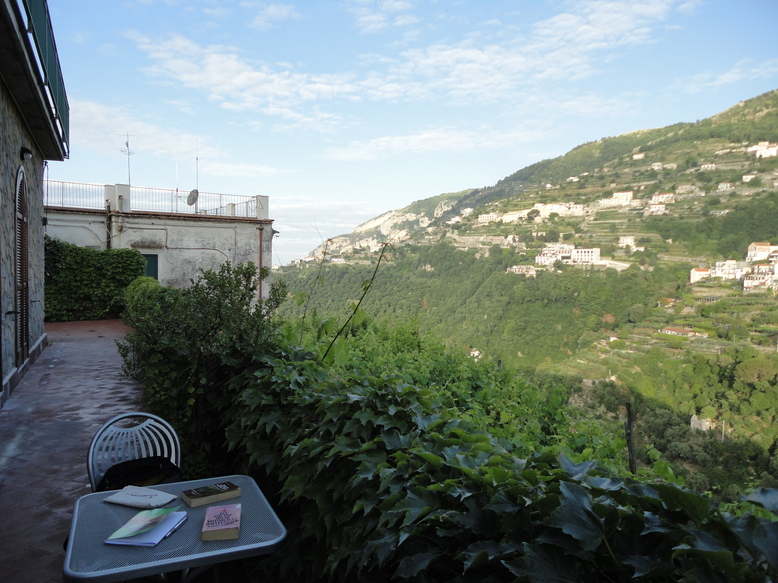
Recently I increased by one the unknown number of my readings of ZAMM. Earlier in this month of June, 2013, above the Tyrrhenian Sea, in the gorgeous hilltop setting of Ravello, where I was attending a mathematics conference, in the early mornings I would rise, sit outside, and either work on mathematics or read ZAMM.

photo of terrace in Ravello
ZAMM in the morning in Ravello

Continue reading

May Day One Month Late

I am not able, and do not attempt, to tell the full story of recent events in Istanbul. My impression is that mainstream foreign media (in English) do a reasonable job at this. It might be emphasized that the first protesters were yoga practitioners and tree huggers. It was police brutalization of them that drew out more violent protesters—as well as people who had never demonstrated in their lives. If the government had allowed May Day demonstrations this year, as last year, then radicals might have blown off some steam then, and the rest might not have happened. But this is just speculation, not meant to belittle the serious grievances that people have with the government. What follows is just a personal account of a walking tour in the vicinity of Taksim Square, June 1, 2013. I made a Google map of the route. The most interesting experience was seeing plain-clothes police officers retreating from Taksim. The second-most interesting was encountering a wedding of friends of the ruling party, taking place in the gardens of an Ottoman pleasure palace, while police battled protesters about 600 meters away.

We were awakened in the night by a strange persistant sound. Was it the creaking of our building in the Next Big Earthquake? No, it was our neighbors beating on pots and pans.
Continue reading

Police against all

I returned again this afternoon (Friday, May 31, 2013) to Gezi Park, or rather to its vicinity. Since yesterday the police had fenced it off.

Northern end of Gezi Park

Northern end of Gezi Park

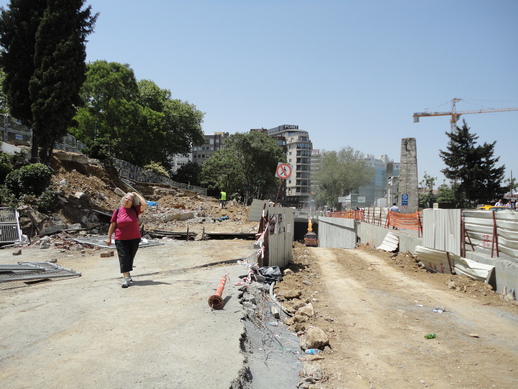
The police fences can be seen on the left above. I think the woman here was just trying to make her way to Taksim. Presently I noticed that my eyes were stinging. It was the same with other people nearby, even in front of the ritzy Hotel Intercontinental adjacent to the park. Some young men I consulted with there confirmed that the police were using tear gas.
Continue reading

Occupy Istanbul Taksim Gezi Parkı

When the last tree has been cut down, the last fish caught, the last river poisoned, only then will we realize that one cannot eat money.

They took all the trees and put ’em in a tree museum
And they charged all the people a dollar and a half just to see ’em

Don’t it always seem to go
That you don’t know what you’ve got til it’s gone
They paved paradise and put up a parking lot

Taksim Square is the cultural heart of Istanbul.  Most of it is paved, but nearby is Gezi Parkı, shaded by many trees.  It is somewhat out of the way and hidden from view: from the Taksim side, one must climb steps to reach it, and between it and the main road north, Cumhuriyet Caddesi, there are restaurants and a Turkish Airlines office.  As a tourist in Istanbul, I was only vaguely aware of the park.  Now, as a resident, whenever I walk from home to Taksim, I pass through the park.

The Turkish Prime Minister Recep Tayyip Erdoğan intends to replace the park with buildings of some kind.  His words are translated by Hürriyet Daily News:

If you have respect for history, first you need to learn the history of Gezi Park.

He is supposedly referring to the Topçu Kışlası or Artillery Barracks that used to stand on the land of the park.

It is a bad joke. Continue reading

Learning mathematics

This is mostly reminiscences about high school. I also give some opinions about how mathematics ought to be learned. The post originally formed one piece with my last article, “Limits.”

I learned calculus, and the epsilon-delta definition of limit, in Washington D.C., in my last two years at St Albans School, in a course taught by a peculiar fellow named Donald J. Brown. The first of these two years was officially called Precalculus Honors, but some time in that year, we started in on calculus proper.

Continue reading

Limits

This is about limits in mathematics: both the technical notion that arises in calculus, and the barriers to comprehension that one might reach in one’s own studies. I am going to say a few technical things about the technical notion, but there is no reason why this should be a barrier to your reading: you can just skip the paragraphs that have special symbols in them.

Looking up something else in the online magazine called Slate, I noted a reprint of an article called “What It Feels Like to Be Bad at Math” from a blog called Math With Bad Drawings by Ben Orlin. Now teaching high-school mathematics, Mr Orlin recalls his difficulties in an undergraduate topology course. His memories help him understand the difficulties of his own students. When students do not study, why is this? It is because studying makes them conscious of how much they do not understand. They feel stupid, and they do not like this feeling. Continue reading

Self-similarity

Animation: circles within circles

From the poster depicting a few von Neumann natural numbers, I created this animation. The moving image no longer depicts natural numbers in the sense of the poster, since there is no infinite descending chain of natural numbers. There is an infinite ascending chain of them; but the poster does not actually depict such a chain as nested circles. So running the animation in reverse would not give a correct suggestion of the original poster, even if it were of infinite size. Continue reading

The von Neumann natural numbers: a fractal-like image

See the next article, “Self-similarity,” for an animation of the image here.

I have long been fascinated by von Neumann’s definition of the natural numbers (and more generally the ordinals). In developing axioms for set theory, Zermelo used the sets 0, {0}, {{0}}, {{{0}}}, {{{{0}}}}, and so on as the natural numbers. Here 0 is the empty set. Zermelo’s method works, but is not so elegant as von Neumann’s later proposal to consider each natural number as the set of all natural numbers that are less than it is, so that (again) 0 is the empty set, but also n + 1 = {0, 1, …, n}.

Continue reading

Similar images of different saints

I have been impressed by the similar depiction of the two saints here; first, St John Chrysostom, from the Byzantine collection of Dumbarton Oaks:

Image

and then St Cyril of Alexandria, in an image taken from Wikipedia, though apparently the original image is in Chora, here in Istanbul.  (I visited Chora once, maybe 14 years ago, but hope to visit again soon.)

Image

I was originally impressed by how the blue and red crosses of the vestments of Chrysostom were repeated in his halo; then I happened upon the image of Cyril, with crosses similar in form, though not color, again repeated about the head.

The Point of Teaching Mathematics

This essay was provoked in part by a New York Times opinion piece by Andew Hacker (July 28, 2012) called “Is Algebra Necessary?” (the suggested answer being No):

Continue reading