Tag Archives: 2019

On Being Given to Know

  1. What if we could upload books to our brains?
  2. What if a machine could tell us what was true?

We may speculate, and it is interesting that we do speculate, because I think the questions do not ultimately make sense – not the sense that seems to be intended anyway, whereby something can be got for nothing.

Trees, clearings, and houses in the foreground; mountains receding into the background; clouds above
View from Şavşat

Continue reading

On Causation

Causation seems commonly to be understood as a physical concept, like being a fossil. The paleontologist seeks the one right answer to the question of when a particular dinosaur bone became part of the fossil record; likewise readers of international news seem to think there is one right answer to the question of whether Donald Trump or Ali Khamenei caused the shooting down of Ukraine International Airlines Flight 752 on January 8, 2020.

There is not one right answer. If you are Trump, you caused 176 civilian deaths by attacking the Iranians and provoking their response. If you are Mitch McConnell, you caused the deaths by inhibiting the removal of Trump from office. If you are Khamenei, you did it by meeting Trump’s fire with fire.

Being a cause does not mean you deserve condemnation or praise: that is another matter.

Continue reading

NL I: “Body and Mind” Again

Index to this series

“We are beginning an inquiry into civilization,” writes Collingwood, “and the revolt against it which is the most conspicuous thing going on at the present time.” The time is the early 1940s.

Human tourists photographing sculptured supine blue ape with chrome testicles outside the Intercontinental Hotel, Prague Continue reading

Elliptical Affinity

After Descartes gave geometry the power of algebra in 1637, a purely geometrical theorem of Apollonius that is both useful and beautiful was forgotten. This is what I conclude from looking at texts from the seventeenth century on.

In ellipse, colored triangles move to illustrate theorem Continue reading

We the Pears of the Wild Coyote Tree

This is a preliminary report on two recent films:

  • The Wild Pear Tree, by Nuri Bilge Ceylan;
  • We the Coyotes, by Marco La Via and Hanna Ladoul.

The report is preliminary, not because there is going to be another, but because I have seen each film only once, and I may see one of them again.

I remember that François Truffaut liked to see films at least twice. I believe I read this in The Washington Post, and I might have guessed it was in an appreciation published when Truffaut died; however, he died on October 21, 1984, during the first semester of my sophomore year at St John’s College in Santa Fe, and I would not have been reading the Post then.

While in college, I did enjoy seeing some films twice, or a second time; Truffaut’s own 400 Coups was an example, a French teacher having shown it to us in high school.

The two films that I am reviewing now concern young adults trying to find their own way in the world, in defiance of their elders. We all have to do this. In every generation, some will do it more defiantly than others. Heraclitus can be defiant, he of Ephesus and thus one of the Ionian philosophers, whose spirit I imagine to haunt the Nesin Mathematics Village. A further reason to bring up Heraclitus will be a theme that is explicit in Pear Tree, implicit (or metaphorical) in Coyotes: gold.

A book, whose cover shows a bonfire, sits on a rock dampened by waves of the sea, which laps on the sand beyond
A copy of The Logos of Heraclitus,
by Eva Brann,
on Marmara Island, July, 2012

Continue reading

Piety

The post below is a way to record a passage in the Euthyphro where Socrates says something true and important about mathematics.

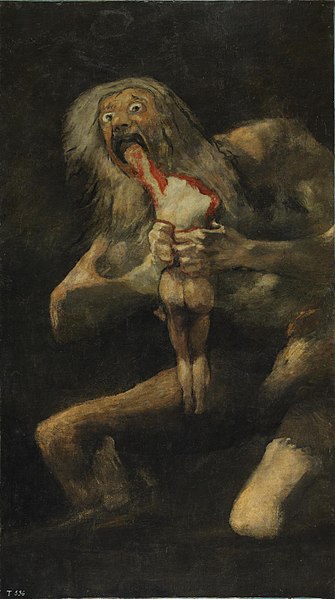
Crude depiction of bug-eyed figure grasping the torso of, and putting into his mouth the arm of, a smaller figure
Goya, [Cronus] Devouring His Son
(see below)

The passage is on a list of Platonic passages that I recently found, having written it in a notebook on May 23, 2018. The other passages are in the Republic; here they are, for the record, with some indication of why they are worth noting (translations are Shorey’s, originally from 1930 and 1935 in the old Loeb edition):

Continue reading

NL XLV: The Germans

Index to this series

At the end of Collingwood’s New Leviathan (1942), we reach a chapter whose theme is that of my more recent articles on grammar.

By August Macke – The Yorck Project (2002) 10.000 Meisterwerke der Malerei (DVD-ROM), distributed by DIRECTMEDIA Publishing GmbH. ISBN: 3936122202., Public Domain, Link

As history, Collingwood’s last chapter is difficult, for the reasons that trouble Herbert Read at the beginning of his Concise History of Modern Painting (revised 1968, augmented 1974). Read opens his first chapter with a passage from Collingwood’s Speculum Mentis (1924):

Continue reading

NL XLIV: The Turks

Index to this series

The last part of Collingwood’s New Leviathan (Oxford, 1942) is “Barbarism.” The first chapter of the part is “What Barbarism Is”; the remaining chapters describe examples of barbarism in turn. The fourth and last example is the one that Britain is fighting as Collingwood writes.

Sun behind mosque on cover of The Ottoman Centuries (Lord Kinross, a.k.a. Patrick Balfour) Continue reading

A Defense

Here is the defense (savunma) of Ayşe Berkman before the 36th Heavy Penalty Court (Ağır Ceza Mahkemesi) of Istanbul, January 10, 2019, against the charge of making propaganda for a terrorist organization (terör örgütü propagandası yapmak).

Crowd of mostly smiling people outside a courtroom

The crowd from the courtroom when the session was over.
From a tweet of the Peace Academics

Continue reading

Logic of Elliptic Curves

In my 1997 doctoral dissertation, the main idea came as I was lying in bed one Sunday morning. Continue reading