Tag Archives: Agnes Callard

Family

In the Nicomachean Ethics, this third of eight readings on friendship (φιλία) is the first of three on the connection with the just (τὸ δίκαιον). A lot of the reading might be summarized in a table:

Polity | Analogue | Perversion | Analogues
kingdom | fatherhood | tyranny |
|
Persian fatherhood
slave-owning
aristocracy | marriage | oligarchy |
|
man does all
woman rules
timocracy | brotherhood | democracy |
|
no master
weak master

We are reading chapters ix–xi of Book VIII. The table is based on chapter x and is elaborated on in chapter xi. Chapter ix introduces the idea that friendship and justice go together in communities, and all communities are formed within political communities, or polities, which they somehow reflect.

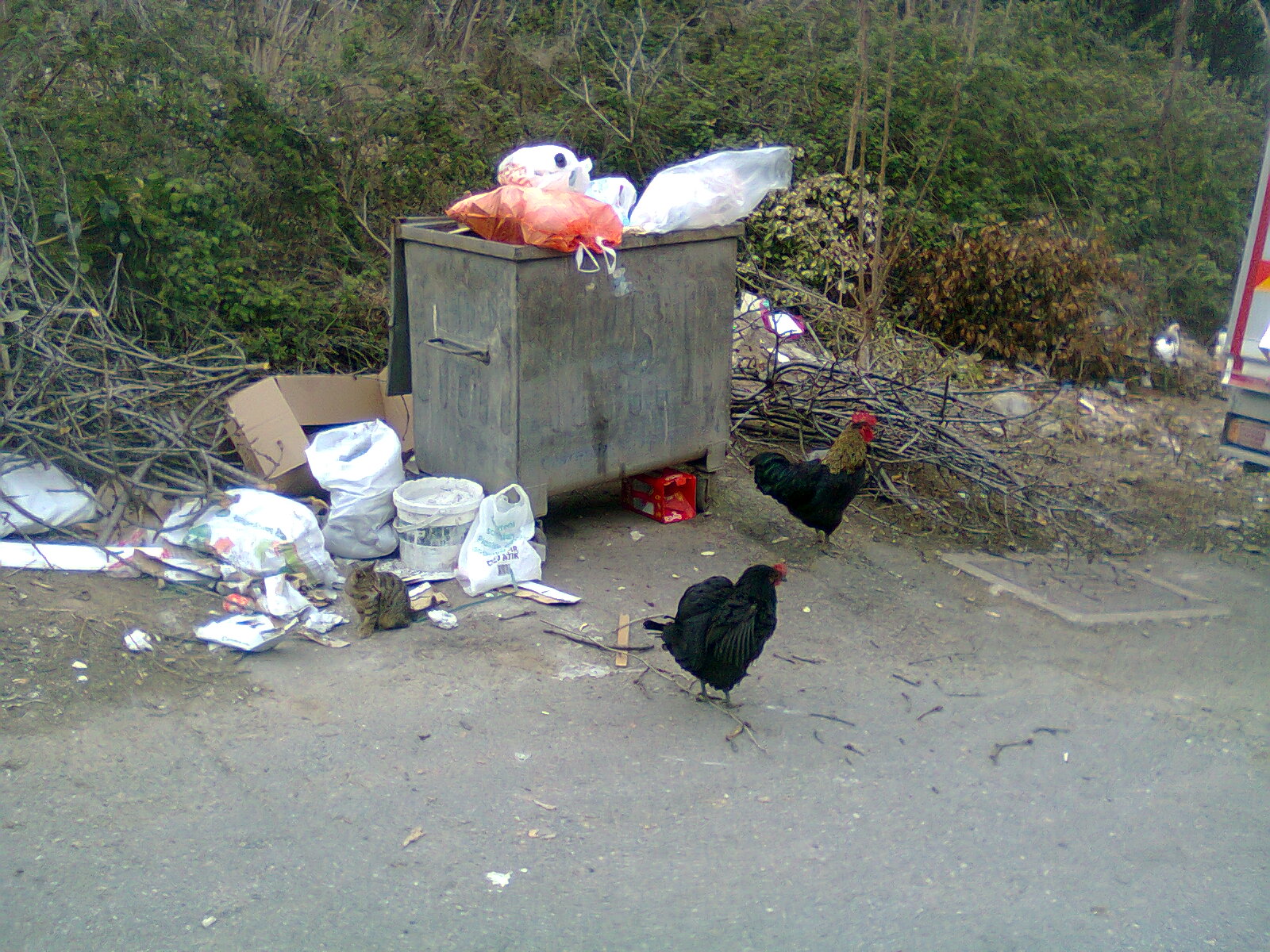
Animals around an overflowing dumpster
Animal friends in the neighborhood
Cat, hen, and rooster, all attracted to a trash bin by the road
Tarabya, Sunday, March 24, 2024

Continue reading

Symmetry

In the account of justice – the dicaeology – that I looked at last time, equality was a nominal concern. I said it might not be what we mean today by equality before the law. We may come closer to that in the present reading, but I’m not sure.

We have reached the part of the Nicomachean Ethics that I dipped into more than six years ago, when writing what ultimately became a long mathematical and historical paper, “On Commensurability and Symmetry” (Journal of Humanistic Mathematics, Volume 7 Issue 2 [July 2017], pages 90–148, DOI). Back then, I made only a precision raid, as if by helicopter, using coordinates supplied by the LSJ lexicon for the words of interest (σύμμετρος and συμμετρία). Now, in a party, we have been working our way in on foot.

Two loaves, split lengthwise along the top, rest on two rectangular pans; behind them, a teapot
Bread: money
Two loaves: equality
The flour is siyez (einkorn)
The leaven is sourdough
Both are from İstiklal Yolu in Kastamonu

Continue reading

Excuses

This post features the first five chapters of Book III of the Nicomachean Ethics of Aristotle. Those chapters take up the following subjects.

  • Chapter I. The voluntary and involuntary (ἑκούσιος and ἀκούσιος).
  • Chapter II. Choice (also called intention, preference, and rational or deliberate choice: προαίρεσις).
  • Chapter III. The deliberated (βουλευτός).
  • Chapter IV. The wished-for (βουλητός).
  • Chapter V. Vice (κακία) as being voluntary.

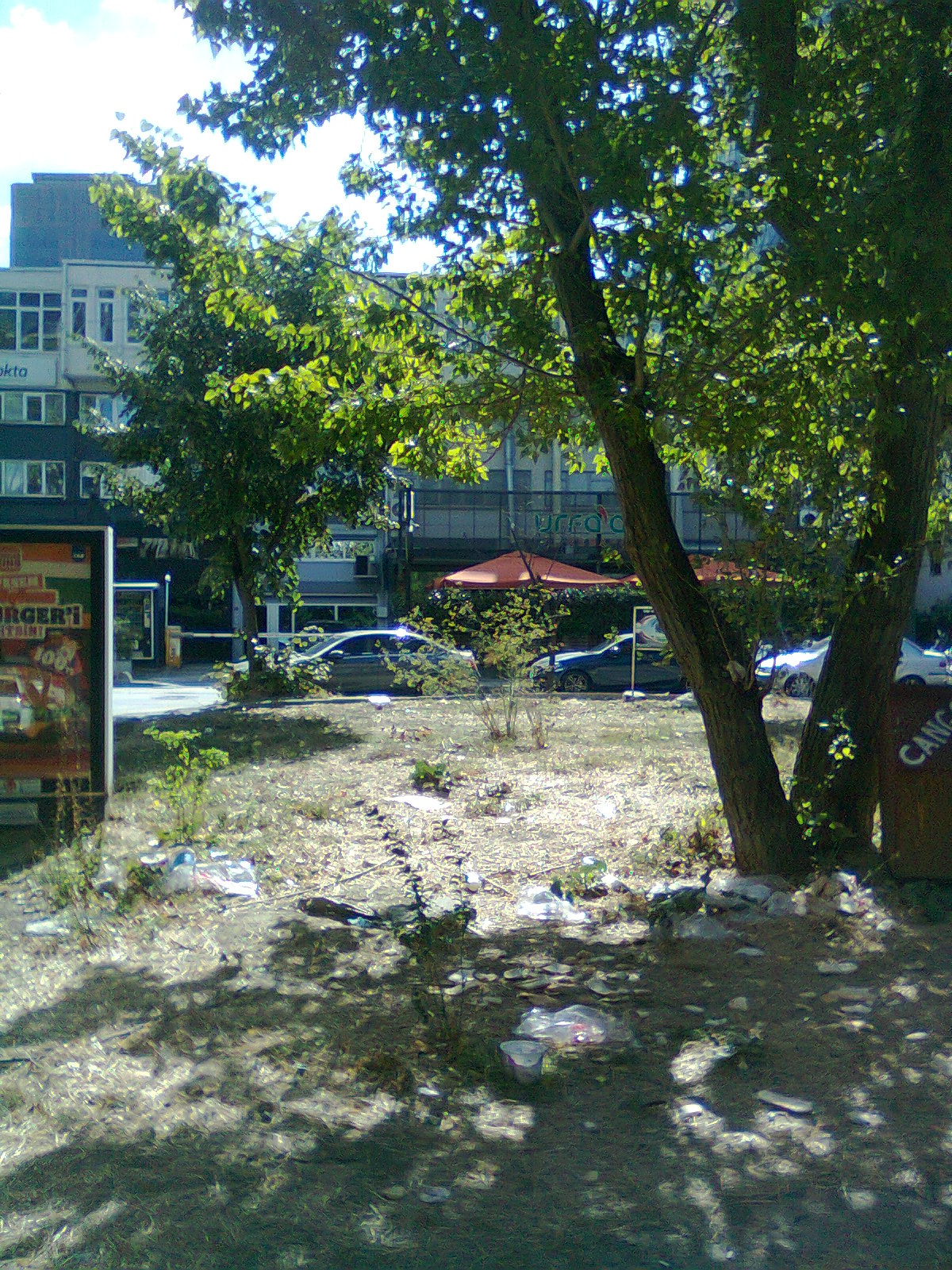
Mostly bare earth with a few weeds, some trash, a tree with two trunks, and a billboard; cars and low-rise buildings behind, on a sunny day
Public space in Maslak, Sarıyer
“One of the main business districts of Istanbul”
September 19, 2023

Continue reading

Badiou, Bloom, Ryle, Shorey

Index to this series

The discussion having been postponed for our fifth reading in the Republic, I give here some remarks that started out as part of my commentary on Book IV. The remarks concern

  • the translations of the Republic that I have been reading, mainly those of
    • Alain Badiou (b. 1937), translated in turn from the French by Susan Spitzer;
    • Allan Bloom (1930–92);
    • Paul Shorey (1857–1934);
  • the “Interpretive Essay” that accompanies Bloom’s translation;
  • a 1969 review of Bloom’s translation and essay by Gilbert Ryle (1900–76), who embarrasses the profession of philosophy (if it be a profession).

I quote also Christopher Hitchens; A Guide to Plato’s Rupublic, by Daryl H. Rice; Agnes Callard; Martha Nussbaum; and Henry David Thoreau.


Palm trimmed
Profesörler Sitesi, Altınova, Balıkesir, Turkey
September 13, 2021

Continue reading

On Plato’s Republic, 4

Index to this series

Our fourth scheduled reading in the Republic is Book III, Stephanus pages 386–417. Socrates continues to direct the construction of the fantastic city. Plato’s brothers, faithful as dogs, agree to two infamous proposals:

  1. The deportation from the city of any poet “who is able by wisdom to become every sort of thing and to imitate all things” (δυνάμενον ὑπὸ σοφίας παντοδαπὸν γίγνεσθαι καὶ μιμεῖσθαι πάντα χρήματα, 398a).

  2. The teaching of the Noble Lie, that the citizens were formed under ground and distinguished, according to class, with admixture of

    • gold for the rulers,
    • silver for the auxiliaries,
    • iron and bronze for the “farmers and other craftsmen” (414b–5c).

Later in this post, I shall try to analyze the reading into sections; but a serial summary of these seems tedious, and I shall focus on a few remarkable points, such as the ones above.


Two dogs with my copy of
Allan Bloom (translator), The Republic of Plato, 2016 edition,
on the beach at
Profesörler Sitesi, Altınova, Balıkesir, Turkey
September 8, 2021

I shall be quoting

  • Homer, whom Socrates loves to hate;
  • Adam Kirsch, from the 2016 introduction to Allan Bloom’s Republic translation, on the danger of summarizing Plato;
  • Pascal on the will of God as the rule for justice;
  • Bruno Bettelheim on fairy tales such as the Three Little Pigs, and perhaps our City in Speech, as opposed to fables;
  • Somerset Maugham on the fable of the Ant and the Grasshopper;
  • Plato, in the Symposium, on the identity of comedy and tragedy, and Socrates as a seductive flute-player;
  • Anne Applebaum on “The New Puritans”: the same as the old ones, called Glaucon, Adeimantus, and Socrates?

Continue reading

On Plato’s Republic, 3

Index to this series

We are reading now Book II of Plato’s Republic, Stephanus pages 357–83, covering:

  1. The conventional arguments in favor of injustice and justice, reviewed by Plato’s brothers Glaucon and Adeimantus respectively.
  2. The beginning of the construction of the city in speech, wherein the advent of justice is to be discerned; the guardians of the city are to be like dogs and to be given a traditional education, although with none of the traditional stories, since they talk about things like parricide and bad luck.

A book next to a dog lying on the beach

Dog with copy of Alain Badiou, Plato’s Republic:
A Dialogue in Sixteen Chapters, with a Prologue and an Epilogue, 2012
Profesörler Sitesi, Altınova, Balıkesir, Turkey, September 2, 2021

Continue reading

Words

This post is based on recent readings, often on or through Twitter, of the following writers.

  1. Lilith Saintcrow on “Domestic abusers, white supremacists, and religious bigots.”
  2. C. S. Lewis on gulling the educated, and objectivity as a dubious value.
  3. Marilynne Robinson on consensus as concealing the objectively true.
  4. Neil deGrasse Tyson on objectivity as a good value.
  5. Plato on seeming wise, without being so.
  6. Mark Vernon on imagination in William Blake.
  7. whoever wrote an “Open Letter Concerning Transphobia in Philosophy,” signed by many professional philosophers.
  8. Agnes Callard on how philosophers shouldn’t be signing petitions.
  9. Rebecca Reilly-Cooper, on the incoherence of the notion of gender identity.
  10. Christopher Bertram, a signer of the “Open Letter.”
  11. Nathan Oseroff-Spicer, who noticed who had not signed the letter.
  12. Aaden Friday, on what’s wrong with Reilly-Cooper and other such women.
  13. Brian Earp, on why declaring pronouns is not obviously a good thing.
  14. Liam Kofi Bright, another signer of the “Open Letter.”
  15. Masha Gessen, on wishing he could have transitioned as a teen.
  16. John Steinbeck, on being a man.
  17. Christa Peterson, on what gender identity might be.
  18. Holly Lawford-Smith, on third bathrooms and being banned from social media.
  19. Jason Stanley, who signed the “Open Letter,” but also calls for left unity.
  20. Isaac Asimov, on behaviorism.
  21. Dominic Berry, who will block anybody who follows the editor who published Reilly-Cooper’s essay.
  22. Kathleen Stock, the subject of the “Open Letter.”
  23. Caitlin Green, on what people such as Stock should do if they are going to change their research focus.

Having originally posted this essay on January 9, 2021, I edited and augmented it, on January 19 and December 19 of that year. I return to it now, on June 22, 2023, having posted “On Dialectic,” two days ago; this one is another post that quotes lots of people, and I want to check how it reads. It reads fine, to me, although I did have to correct occurrences of “behavior” spelled as “behavor.” Moreover, although I had forgotten what was here, I recognized it instantly as I read; another reader would not experience this recognition.

What stands out most to me now is Christa Peterson’s suggestion,

A representation of our own gender … could … be a means of picking out people as who we are co-gendered with …

As the essay already suggests, if you replaced “gender” with “race,” then the resulting speculation could get you called a racist, and that is supposed to be something bad. However, if we replace “gender” with “sex,” we obtain a proposition that is fundamental to contemporary biology, as I understand it, because evolution is

  • not only by natural selection, or “survival of the fittest” – selection by the rigors of the natural environment,
  • but also by sexual selection, or selection for mating by members of the opposite sex of one’s (sexually reproducing) species.

I think this is why Nina Paley can say, in a blog post called “Why I Don’t Use ‘Preferred Pronouns’,” which I referred to also in “Imagination,”

Like most mammals, I can’t help but identify someone’s sex with +99% accuracy. (… Women, I think, are better at identifying sex than men, either due to instinct or conditioning for survival …)

We know that there are two sexes, and we know who is of which sex, the way we know that some foods are good to eat. However, Peterson seems to think of this knowledge a bit differently:

Trans people’s dignity and legitimacy does not depend on the success of any one attempt to conceptualize their experience. But the most common way, in terms of “gender identity,” is perfectly functional. The commitments of the popular notion are minimal: people have an internal sense of their own gender that can come apart from their knowledge of their assigned sex, and is generally fixed, and certainly not revisable in the way ordinary beliefs are.

What is the word “assigned” doing here? Does whether you are trans depend on whether somebody made a mistake when checking one of the boxes marked “male” and “female” at your birth?
A lot of old PSA’s about drugs are on YouTube and the Web Archive, and sometimes they are linked to by articles that ridicule them. There is one that I have not been able to find, perhaps from around 1970, in which parents confront their teenager with the drug paraphernalia that they have found in his room. The boy storms out of the house, saying, “You don’t understand!”

There’s a lot that I don’t understand. I must not, since it seems childish, but is coming from adults. Some of these adults stormed the US Capitol the other day; others encourage them; still others are professors of philosophy.

Figure in book showing egg and sperm. The circular egg has a fiery corona, and little sperm with wavy flagella come at it from one side. There are also two sperm with parallel straight flagella whose length is the diameter of the egg
“Human egg and sperm cells.”
Asimov’s New Guide to Science (1984), page 600

Continue reading

Map of Art

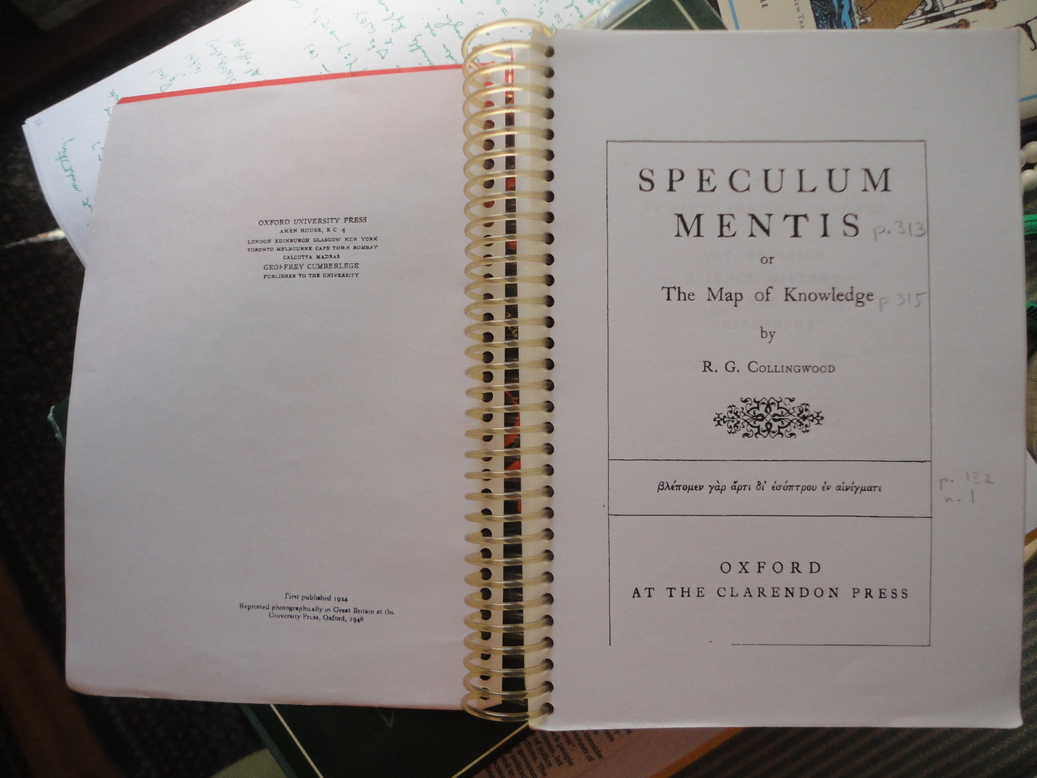
The bulk of this post is a summary of the chapter on art in Collingwood’s Speculum Mentis: or The Map of Knowledge (1924). The motto of the book is the first clause of I Corinthians 13:12:

Βλέπομεν γὰρ ἄρτι δι’ ἐσόπτρου ἐν αἰνίγματι

For now we see through a glass, darkly

The chapter “Art” has eight sections:

Continue reading