Tag Archives: David Bolotin

Reading and Talking

Reading a book as if it had “no introduction, no notes, no aids or guides, no nothing but the naked text” (as William Deresiewicz puts it): such a reading seemed to need a defense. Here is my elaborate one, which seemed in the end to fall into nine sections as summarized below.

Let me note first that searching on “ahistorical reading” led me to a textbook chapter called “What Is Ahistorical Reading?” (in Intro to Poetry, by Alan Lindsay and Candace Bergstrom). The chapter seems to say well what every high-school graduate ought to know, though unfortunately they may not in fact. If you don’t want to slog through what I wrote, read that.

1. Some Novels and Novelists.
These may be read in school or for pleasure – mine, or that of writer and blogger Hai Di Nguyen. There can be epics such as War and Peace, Moby-Dick, and Zen and the Art of Motorcycle Maintenance. George Steiner finds the last two comparable. There can be an unreliable narrator.
2. Reading Comprehension.
This may be challenged by some poetry, such as Wordsworth’s, and annotations may not help.
3. Reading Without Preconceptions.
St John’s College accustomed me to this.
4. Reading Groups.
There are many that (thanks to the Catherine Project) I have been able to join and enjoy, all pursued in the St-John’s way as I understand it.
5. Story.
Mythos or logos. We inevitably tell it in our own words (unless perhaps somebody else has fed us the words).
6. Giving What Is Wanted.
“Ask me no questions, and I’ll tell you no fibs.” (To Goldsmith’s comedy She Stoops to Conquer, the saying is traced by Grammarist, which however has “lies” for “fibs”; Wikipedia currently repeats this apparent misquotation, citing Grammarist.) People are trained now to give most of their attention to their mobiles; in school we may be trained to supply what teachers want to hear.
7. Historicism.
I continue not to understand the objection of Leo Strauss to the “historicism” of R. G. Collingwood, but I agree with such ahistorical reading as is practiced at St John’s and was defended in my day (as I recall) by Strauss’s student and my teacher, David Bolotin.
8. The Classics.
There is something to be said for being assigned to read what one might not otherwise. My example is John Donne.
9. Re-Enactment.
Collingwood came to understand history as the re-enactment of thought, but this can be misunderstood, either when reading a poet such as John Donne, or when thinking of a certain major general who happened to read poetry while getting ready for battle.
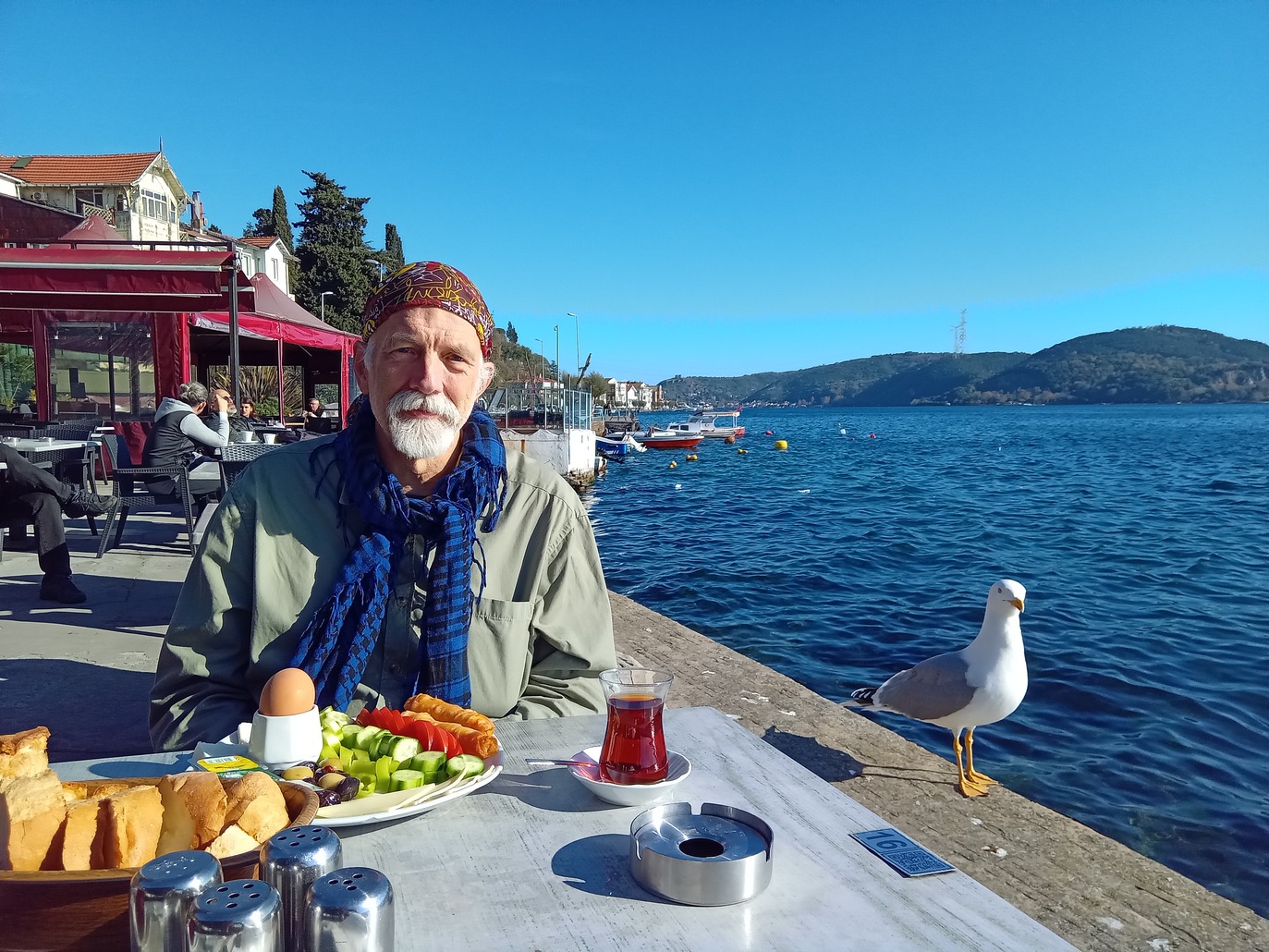
Seaside on a sunny day. Seagull, and human with tea and breakfast plate in front of him

Beyazpark Liseliler Kafe
Sarıyer, Istanbul
November 25, 2025

Continue reading

Perception Deception


John Donne, Holy Sonnet XIX
(on the last line, “make” should be “ſhake”)

This post involves:

  • “the” philosopher –
    • Aristotle;
  • two mathematicians –
    • Euclid,
    • David Hilbert;
  • three persons associated with Black Mountain College –
    • Josef Albers,
    • Dorothea Rockburne,
    • Max Dehn;
  • one person (in addition to myself and Dehn) associated with St John’s College –
    • David Bolotin.

Continue reading

Tests

This post concerns different kinds of knowledge, as for example of Achilles, or Cyrus the Great, or even oneself.

According to the last sentence of the “Findings” column in Harper’s for June, 2023,

Researchers developed a blood test for anxiety, which was found to underlie the joy of missing out.

Those researchers need a weatherman to tell which way the wind blows.

Similar research is reported in the Guardian Weekly for 9 September, 2022. The article is called “‘I’m glowing’: How an app is helping us measure the joy of trees.” The app in question does not detect your joy in the woods; it gives you a way to record your own self-assessment for later study. However, writes Patrick Barkham,

several studies suggest that more biodiversity has a bigger boost on people’s mental health, while the recording of brain activity in response to forest density found a more relaxed state and reduced tension and fatigue in forests with a lower density of trees.

Are you going to need a brain scan to tell if you are chilling out? Other people may relax among a few trees; does that mean you will?

My grandfather Kenneth Crawford described his own grandparents’ house in Wisconsin as being

innocent of plumbing, central heat or telephone. But the proportions were good and it was set in a grove of assorted trees.

I wish he had named some of the trees in the assortment. Right now I’ve got doves cooing in the umbrella pines overhead. Beneath these are oleanders and laurels and pomegranate trees.

Pine trunk next to leaves and needles of other trees; white wall below

Continue reading

Affiliation

Friendship is natural to most animals, especially human beings, and that’s why we praise the philanthropist. You will see, if you travel, that all of us are family and even friends.

Something like that is what Aristotle says, in this first of eight readings on friendship. I have trouble imagining where the Philosopher is going to go with his subject; or perhaps I am troubled to imagine what may be in store.

Blurry white disk in a gray sky above black, bird-shaped dots in the highest branches of the foremost of a line of bare trees; several human silouettes below
Crows in a tree
in the morning mist by the Bosphorus
Kireçburnu, Sarıyer, İstanbul
Sunday, March 10, 2024

Continue reading

On Reading Plato’s Republic

Index to this series

In adolescence, when I started visiting art museums in Washington for my own pleasure, I would visit also the museum shops, hoping to be able to take home a souvenir. Eventually, my own memories were enough to take home.

That is what I remember observing about myself, perhaps around the time when my body stopped growing taller. That time may be used to demarcate adulthood, although in kindergarten, it had made no sense to me that our bodies could ever stop growing.

Cycad with seeds
Cycads outside Selenium Twins
in the valley above Ihlamur Kasırları
on the way to Beşiktaş
December 27, 2021

I have not been to a museum since the advent of Covid-19, but I often want a souvenir when I am reading now. The souvenir may be in the form of pencil marks in a book, or pen marks in a magazine, or various interventions in an electronic file. To be able to make such interventions, I save webpages, usually with a browser’s print function or with Print Friendly.

I may also respond to what I read by writing blog posts. This is why I now have eighteen of those on Plato’s Republic: one for each of the fourteen parts in which the dialogue was divided for an online discussion, and four more for when I had an abundance of ideas.

Where has all of that left me?

Continue reading

On Plato’s Republic, 14

Index to this series

In the tenth and final book of Plato’s Republic (Stephanus 595–621), with the help of Glaucon, Socrates does three things:

  1. Confirm and strengthen the ban on imitative poetry carried out in Book III.
  2. Prove the immortality of the soul.
  3. Tell the Myth of Er about how best to make use of that immortality.


Bernard Picart
Glaucus Turned into a Sea-God, 1731
“Just as those who catch sight of the sea Glaucus would no longer easily see his original nature because some of the old parts of his body have been broken off and the others have been ground down and thoroughly maimed by the waves at the same time as other things have grown on him – shells, seaweed, and rocks – so that he resembles any beast rather than what he was by nature, so, too, we see the soul in such a condition because of countless evils” – Republic 611d

Here is a finer analysis, as part of a general table of contents for this post.

  • Prologue
    • A Translation Issue. How you translate Book X depends on whether you believe Socrates has a theory that all art is imitation. I have gathered sixteen translations of a diagnostic passage that Collingwood highlights in The Principles of Art (1938).
    • Imitation Elsewhere – that is, in Books II, III, V, and VI, as well as in the Phaedrus.
  • Book X
    • Imitation
      • What It Is. It is at a third remove from reality.
      • Homer and the Tragic Poets – did you ever hear that they had
        • given a city its constitution,
        • led a successsful military campaign,
        • invented something useful,
        • been revered as private teachers, as Pythagoras was and sophists want to be?
      • The Three Arts involving a thing:
        1. Using it.
        2. Making it.
        3. Imitating it.
      • Parts of the Soul – the best part is the calculating part, which can avoid the confusions that imitations subject the worse parts to.
      • Imitation Is of the Worse – our worse aspects, not the good and decent ones.
      • Imitation Makes Us Worse by bringing out shameful feelings for others that we suppress for ourselves.
      • Philosophy and Poetry – they have an old quarrel, but philosophy is willing to listen to an argument on behalf of poetry.
    • Immortality – the soul must have this, because only its specific evils could kill it, and these are the opposites – injustice, license, cowardice, and ignorance – of the virtues identified in Book IV. They do not in fact kill the soul, at least not directly.
    • Myth of Er – a Pamphylian, son of Armenius, he died in battle, but rose again on the twelfth day, having learned that, unless condemned to hell, we are going to choose our next life, after a spell in heaven or purgatory, depending on how we have lived our current life; thus we had better be ready to choose wisely.

Continue reading

Nature

Index to this series

Can Socrates really “find a natural support for justice,” as Allan Bloom says he must? It is strictly impossible, as I say in “Bloom, Badiou, Ryle, Shorey.” Inevitably there is more that can be said, and I shall try to say some of it here.

Sand, sea, mountains, sky
Anatolian sand, Aegean sea, Lesbian mountains
Uranus over all
Profesörler Sitesi, Altınova, Balıkesir, Turkey
September 24, 2021

Continue reading

Politics

Index to this series

This is mostly about avoiding things. An early theme of Plato’s Republic is avoiding the deprivations of solitary life through politics. Some of us would rather just avoid politics. Such persons include Henry David Thoreau, Gilbert Ryle, and the inventor of the h-index (he is a physicist called Jorge E. Hirsch, but I know nothing else about him). I mentioned these persons in my last Plato post, “Badiou, Bloom, Ryle, Shorey.” I have some more to say about them here. In “Civil Disobedience” (1848), for example, Thoreau writes, “it is, after all, with men and not with parchment that I quarrel”; but measures like the h-index are used to hide the human factor in the equations used to judge us.

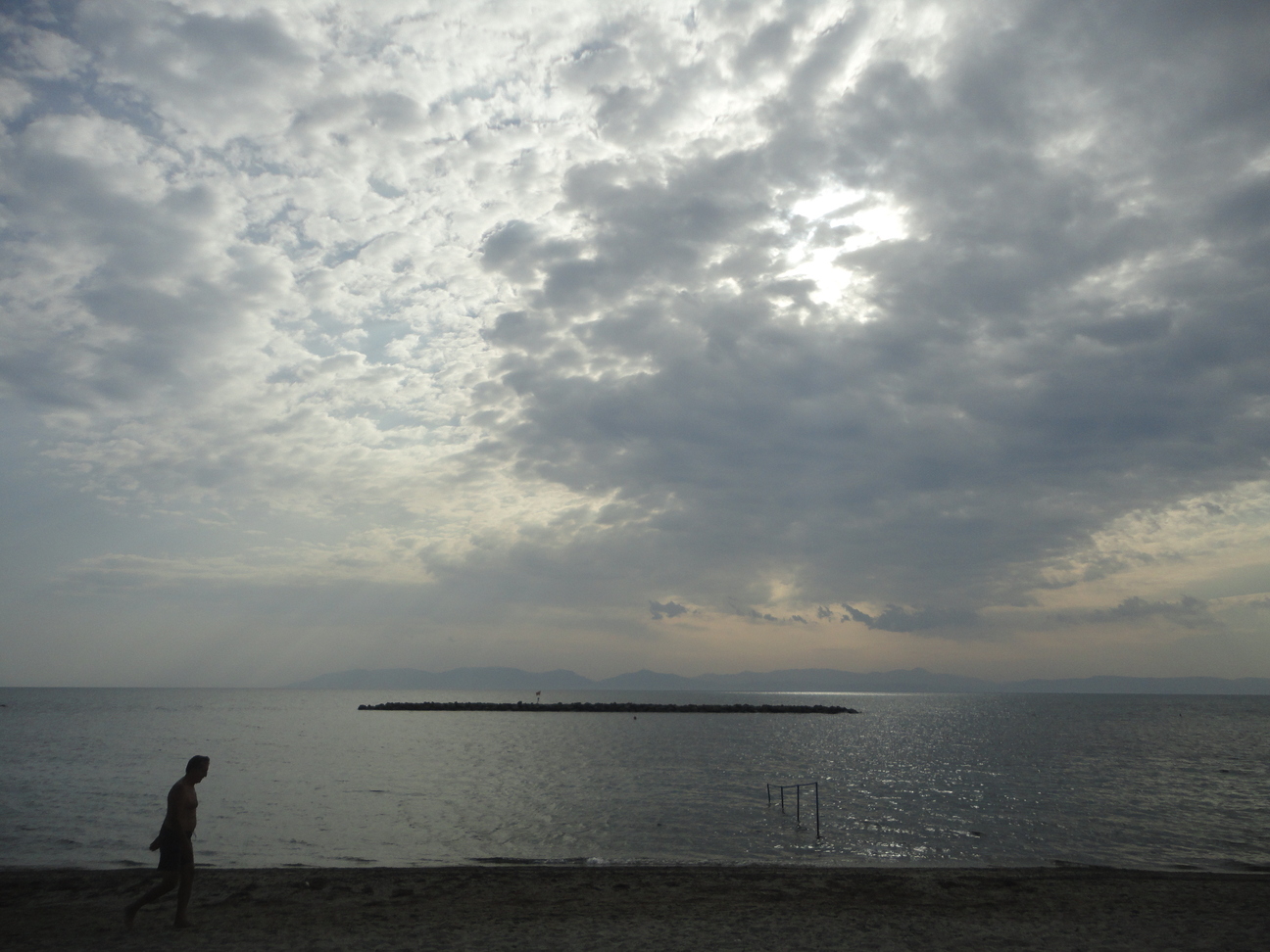
Lone man walks by sea with mountains beyond and under a cloudy sky
All photos are from Profesörler Sitesi, Altınova, Balıkesir, Turkey
September 21–3, 2021

Continue reading

Donne’s Undertaking

To ease the strain of pandemic restrictions, I was recently called on to recommend a poem. I chose “The Undertaking” of John Donne. I want to say here why. Briefly:

  1. The poem (which I transcribe below) has a sound that impressed me when I first read it, more than thirty years ago.
  2. The poem alludes to ideals:
    • of recognizing what is good for its own sake, and
    • of climbing a rung or two on Diotima’s ladder of love.
  3. The sound of Donne’s poem may seduce one into thinking the ideals worthy.

          ⯅          

I also indulge myself here in reminiscences not obviously relevant to “The Undertaking.” They do conclude with my sitting down to read Donne for myself. (Note added November 3, 2025.)

          ⯆          

Diotima’s ladder, or stairway, is recounted by Socrates in Plato’s Symposium (211c, here in the translation of Jowett, which is the one I read at school, though it may not be the most faithful; the bullets and insertions from the Greek text are mine):

And the true order of going, or being led by another, to the things of love (τὰ ἐρωτικά), is to begin from the beauties of earth and mount upwards for the sake of that other beauty, using these as steps (οἳ ἐπαναβαθμοί) only, and from

  • one going on to
  • two, and from two to
  • all fair forms (τὰ καλὰ σώματα), and from fair forms to
  • fair practices (τὰ καλὰ ἐπιτηδεύματα), and from fair practices to
  • fair notions (τὰ καλὰ μαθήματα), until from fair notions he arrives at
  • the notion of absolute beauty, and at last knows what the essence of beauty is (ὃ ἔστι καλόν).

Analytic Geometry and Donne’s complete poetry
Two books that were my mother’s

Continue reading

NL XL: Peace and Plenty

Index to this series

With “Peace and Plenty,” we reach the end of the account of civilization in Collingwood’s New Leviathan. What remains is the account of barbarism. Strictly speaking, we little need it. Civilization quâ ideal of civility is the positive end of civilization quâ process, and as was pointed out on Chapter XXXII, “Society and Nature in the Classical Politics,” the positive end is the primary thing to know in conducting a process (32. 35–6).

“May Day, 1929,” V. V. Kuptsov

Continue reading