Tag Archives: Tom Holland

Righteousness

Words of Martin Luther King are on my mind:

No, no, we are not satisfied, and we will not be satisfied until justice rolls down like waters and righteousness like a mighty stream.

My mother was there, at the March on Washington. She must then have heard a particular singer, whom my wife and I heard in concert, fifty-two years later. I wrote about this in “Joan Baez in Istanbul.”
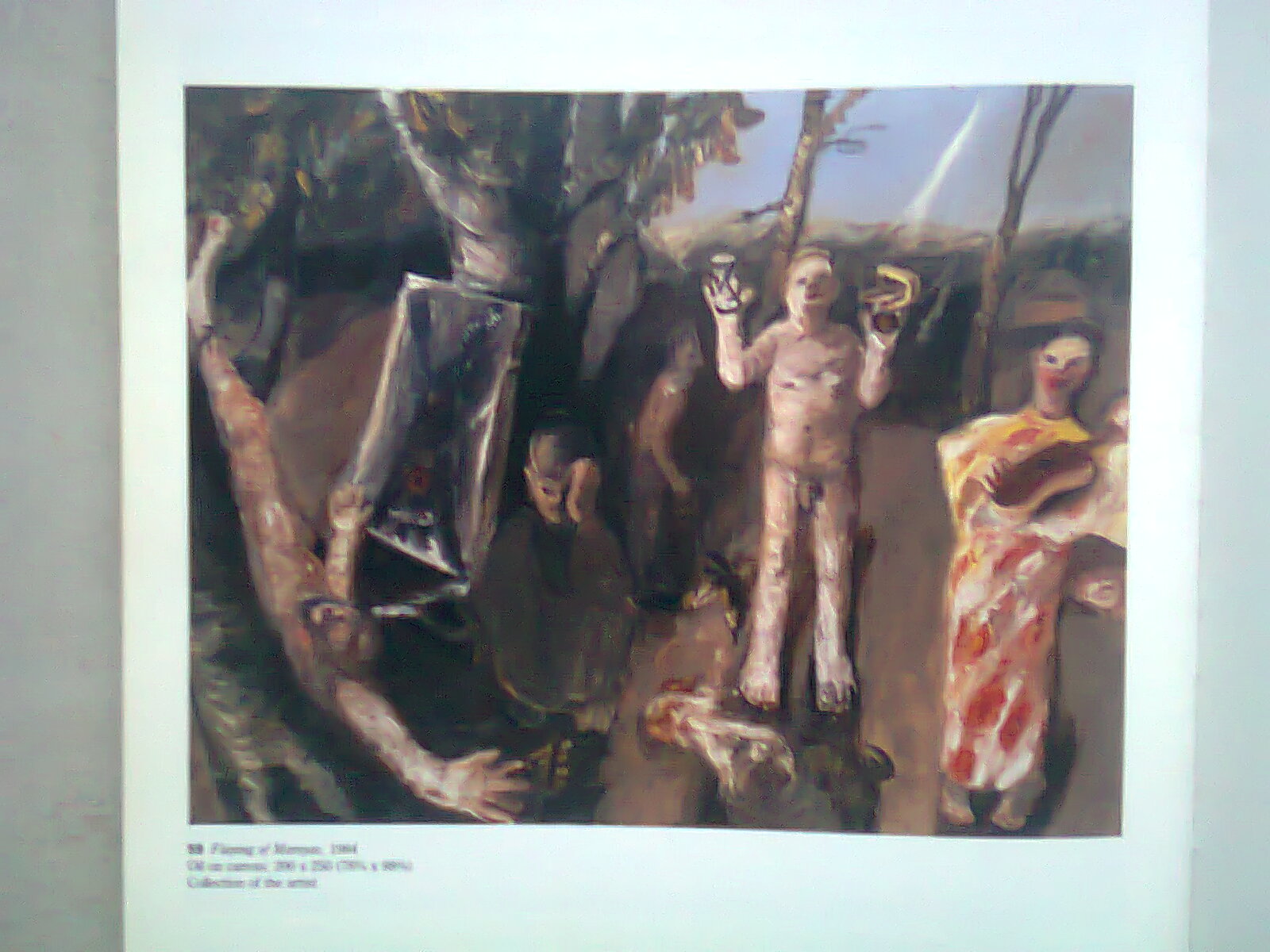
Several crudely painted figures
Klaus Fussmann, “Flaying of Marsyas,” 1984
as reproduced in
Joe Shannon, Representation Abroad
(Hirshhorn Museum, Smithsonian Institution, 1985)
catalogue of an exhibit I visited several times
in the summer after my sophomore year of college

Continue reading

Plato and Christianity

Index to this series

This post uses work of Hannah Arendt, Augustine, R. G. Collingwood, Tom Holland, Somerset Maugham, and Ved Mehta.

Elevated highway, way above city streets

Ortaköy, December 27, 2021

In the first post of this series, I gave some reasons to read the Republic, and one of them was the problem of how our political leaders were not always the best. Plato had not solved that problem, since we still had it; but that meant nobody else had solved it either. Plato had at least taught us that people with great worldly power could nonetheless be more miserable than their subjects. In the Republic, Plato has Socrates teach that lesson

  • to Thrasymachus, in the latter part of Book I;
  • to Glaucon, who concludes at the end of Book IV that if having an unhealthy body is bad, having a vicious soul is worse;
  • in Book IX, with the account of the tyrant;
  • with the Myth of Er in Book X.

Continue reading

Hostility and Hospitality

After seventeen weekly posts of readings with my annotations, the Pensées of Pascal join two other works that I have blogged about systematically, chapter by chapter or book by book:

  • R. G. Collingwood, The New Leviathan, or Man, Society, Civilization, and Barbarism (1942);

  • Homer, the Iliad, in George Chapman’s translation.

Do three authors belong together, for any other reason than that I have spent time with each of them?

  • For Pascal, the Torah is history, but the Iliad was written too late to be that, and is just a novel (S 688 / L 436 / B 628). It has no concept of law, he says (S 691 / L 451 / B 620), but later Greeks took this and other things from the Jews. I discussed this in “Judaism for Pascal.” For example, Philo Judaeus thinks that when Heraclitus says, “We live their death and we die their life,” this is the death wrought by eating of the tree of the knowledge of good and evil in Genesis.

  • Pascal and Collingwood both come to terms with a world of contrariety. Collingwood calls it “a Heraclitean world,” alluding to how Plato has Socrates tell Hermogenes in the Cratylus (402a, Loeb translation by Harold North Fowler),

    Heracleitus says, you know, that all things move and nothing remains still, and he likens the universe to the current of a river, saying that you cannot step twice into the same stream.

    Continue reading

Doing and Suffering

To do injustice is worse than to suffer it. Socrates proves this to Polus and Callicles in the dialogue of Plato called the Gorgias.

I wish to review the proofs, because I think they are correct, and their result is worth knowing.

Loeb Plato III cover

Or is the result already clear to everybody?

Whom would you rather be: a Muslim in India, under attack by a Hindu mob, or a member of that mob?

You would rather not be involved; but if you had to choose, which option would be less bad: to be driven to an insane murderous fury, or to be the object of that fury?

Continue reading

Re-enactment

Two whiteboards, one above the other, with geometrical diagrams and equations
My whiteboards from Tuesday, November 3, 2015,
concerning Pappus of Alexandria,
in the course “Geometriler


Executive summary (added October 6, 2018). Historian Niall Ferguson praises Collingwood as a philosopher of history, while showing no sign of understanding Collingwood’s actual philosophy. This provokes me. My comments are in the following sections.

Continue reading