The use of a distinction between the subjective and the objective has sometimes made me suspicious. The suggestion is made here that Gödel’s Incompleteness Theorem relies on the distinction. I shall look at this more in “Gödel and AI.” Meanwhile, the major sources for the present post are the following.
- William James, Psychology: Briefer Course (1892), on “the stream of thought, of consciousness, or of subjective life” – also on
- nerves as telephone lines;
- emotions as resulting from “a physical effect on the nerves.”
- C. F. von Weizsäcker, The Relevance of Science (1964), on how “Cosmogony … is, objectively speaking, the way in which the world came into being, or it is, subjectively speaking, the teaching about this way.”
- Robert Pirsig, Zen and the Art of Motorcycle Maintenance (1974), on whether quality is objective or subjective (the answer is no) – also on the distinction between the classical and the romantic.
- R. G. Collingwood, Speculum Mentis (1924), on
- his usage whereby
- what pertains to a consciousness is called subjective;
- what the consciousness is of is called objective;
- atoning for the Fall, that is, the separation of subject from object
– also (in response to James) on how emotions don’t need a physical source.
- his usage whereby
- James Mumford, “Therapy Beyond Good and Evil: A nonjudgmental psychology is failing patients who need to hear hard truths” (perhaps the hard truths of the title are objective truths, and what the patients need to hear is that their own subjective evaluations of themselves may be wrong).
- William Egginton, “Why Kant Wouldn’t Fear ChatGPT-4” (for a computer, there is nothing beyond what it “knows” – all is subjective).
- Kurt Gödel, “On formally undecidable propositions of Principia mathematica and related systems I” (the Incompleteness Theorem relies on a distinction between a [subjective] statement and its [objective] meaning).
- Shannon Vallor, “The Thoughts The Civilized Keep” (they require labor, with a history).
Minor sources include the following.
- James Joyce, Ulysses, as presenting streams of consciousness.
- Sigrid Undset, Kristin Lavransdatter, as being more readable.
- Aristotle, Nicomachean Ethics and Physics, on how there is not deliberation about the cosmos, or the irrationality of √2, or how to build a ship.
- Jared Henderson, “How to read Aristotle’s Nicomachean Ethics.”
- C. S. Lewis, The Magician’s Nephew, where an iron bar grows into a lamp-post the way Aristotle imagines a log’s growing into a ship.
- a letter to Analog magazine on how religion is false science.
- Robert Pirsig, Lila, on the distinction between the static and the dynamic.
- Elle Hunt, “Octopus farming turns my stomach – but are some species really more worthy than others?”
- the Hebrew Bible (Psalms and Ezekiel) on eating words.
- Alexander Bevilacqua, “Saints for Supper” (a review of Jérémie Koering, Iconophages: A History of Ingesting Images).
- Jack A. Goldstone and Peter Turchin, “Welcome To The ‘Turbulent Twenties’.”
- David Allen Green, “‘Twelfth Night Till Candlemas’ – the story of a forty-year book-quest and of its remarkable ending.”
Having started last spring, my wife and I recently completed a project to read Ulysses together. I was glad to be able to put the book back on the shelf. It sits there, next to another of comparable length, Kristin Lavransdatter; this is because I order my books according to the birth of the writer (or subject), and James Joyce was born February 2, 1882; Sigrid Undset, May 5.
I read her book on my own, for and with pleasure, and it entered into my thoughts on the Nicomachean Ethics of Aristotle, expressed for example in “Impermanence” (on Book IX, chapters i–iii; the common theme was how children might forget their mothers, but not conversely; Maya Angelou recalled how many black women had nursed white children in America).

Karanlık Kilise (Dark Church), Göreme Open Air Museum
Cappadocia, January 11, 2009
I might not have finished Ulysses without Ayşe’s companionship, along with the awareness that so many other people had found the novel worth reading. The stream-of-consciousness parts were – interesting.
This post tries to channel my own consciousness.
That term, “stream of consciousness” – Wikipedia traces it to 1855, while noting it is “commonly credited to William James,” who writes,
Consciousness, then, does not appear to itself chopped up in bits. Such words as ‘chain’ or ‘train’ do not describe it fitly as it presents itself in the first instance. It is nothing jointed; it flows. A ‘river’ or ‘stream’ are the metaphors by which it is most naturally described. In talking of it hereafter, let us call it the stream of thought, of consciousness, or of subjective life.
That’s from the copy of James’s Psychology: Briefer Course (Harvard, 1984; original publication, 1892) that I have kept from college. The italics are in the source, but the bolding is mine (as it is below).
I don’t know what it means to call something subjective or objective – I have said this, then been told I must know something. Well, it seems to me that if consciousness “appears” or “presents itself,” as James says, then it is something objective; but James calls it subjective.
Mathematics may be both subjective and objective, because of what I have told students: our subject is
- personal – each of us gets to decide what is true;
- universal – disagreement must be peaceably resolved, without any “agreeing to disagree,” not to mention fisticuffs, but neither by majority vote or even consensus.
Aristotle suggests that last point in the Nicomachean Ethics, Book III, chapter iii, § 3:
περὶ δὴ τῶν ἀιδίων | Concerning the eternal, then, οὐδεὶς βουλεύεται, | nobody deliberates – οἷον περὶ | for example, concerning τοῦ κόσμου ἢ | the order [of the universe], or τῆς διαμέτρου καὶ | the diagonal and τῆς πλευρᾶς, | the side [of a square], ὅτι ἀσύμμετροι. | that they are incommensurable.
Non-deliberation comes up also in the Physics – I note the point now, because somebody in a recent discussion of that work thought Aristotle was mistaken. This is from Book II, chapter 8, 199b27–32, here in Joe Sachs’s 1995 translation (with my italics for the phrases whose Greek I insert):
It is absurd to think that a thing does not happen for the sake of something if we do not see what sets it in motion deliberating. Surely even art does not deliberate (ἡ τέχνη οὐ βουλεύεται). If shipbuilding were present in wood, it would act in the same way as nature does, so if being for the sake of something is present in art, it is also present in nature. This is most clear when someone practices medicine himself on himself; for nature is like that (τούτῳ γὰρ ἔοικεν ἡ φύσις).
It’s a nice image: nature as doctor caring for herself. The examples being medicine and shipbuilding, evidently “art” means skill or practical science. Do not then practitioners deliberate on how to apply what they know? Perhaps they do; still, that knowledge itself is not achieved through deliberation.
It seems like a good idea to apply here what I recently noticed in a guide to a reading of the Ethics last summer. The writer is Jared Henderson, who, like Sabine Hossenfelder and perhaps others, has found it more worthwhile to make YouTube videos than pursue an academic career.
When I was first learning my Aristotle, I took a seminar on the Nicomachean Ethics. The professor told us something which at the time I found scandalous: for the purposes of this class, Aristotle is never wrong.
The point here is not Aristotle cannot be wrong. My professor was laying down a rule for the kind of reading that we were going to do. Instead of being overly critical, negative readers, doing our best to find the holes in the arguments so that we could prove our intellectual superiority, we were going to do our best to understand how the Aristotelian mind worked.
As I understand Aristotle’s mind in the Physics, the ability to grow into a branch or a new tree is present in wood. We can imagine wood growing into a wooden ship, as an iron bar grows into a new lamp-post in The Magician’s Nephew of C. S. Lewis. In that case, we would recognize the growing as occurring for the sake of the ship; therefore, as it is, wood grows for the sake of the tree. Something like that.
An issue with all of this is the presupposition that we have always made ships, as “naturally,” so to speak, as acorns have always grown into oaks. On the contrary, I think, we create new things all the time, but Aristotle does not seem to recognize it. In any case, perhaps the creation too is not through deliberation as such.

Ihlara Valley, Cappadocia, January 10, 2009

The winter visit to Cappadocia happened during an attempt to collaborate on creating some new mathematics. At least I created the notes being read here, during the hike through Ihlara Valley, but nothing seems to have come from them
In a 2024 mathematics article that I recently reviewed, the authors corrected their own earlier article. Every new result in the main theorem of their 2019 paper had turned out to be wrong. I don’t know exactly how they discovered the problem, but it had to be by thinking. If feelings are subjective, and things “out in the world” are objective, where does that leave thought?
This post is a chance to investigate questions like that, with the help of various sources. It gives me an excuse to note some of the interesting things that I happen to read.
Two of my four posts in December included annotated versions of chapters of The Relevance of Science (1964) by C. F. von Weizsäcker. The posts were
- “Biblical Creation,” including Chapter 3, “Creation in the Old Testament,” and
- “Religious Science,” including Chapter 1, “Science and the Modern World.”
I read Chapter 3 to see what the author said, if anything, about how the God of Genesis checks his work as he goes along. I noted how creation was paradoxical, like learning in Plato’s Meno. Later will come
- “Order from Chaos,” including Chapter 2, “Cosmogonical Myths,” of Weizsäcker’s book; I shall make use of this chapter below.

Myself in Berlin, September 14, 2007. We were attending a mathematics conference, but our stay included a visit to the Berggruen Museum, which features modern art. Collector Heinz Berggruen had been born in Berlin in 1914; “in 1936 the Nazis forced him out, and he emigrated to the United States,” according to the museum guidebook, purchased and kept as a souvenir. Published in 2005, the book lacks the information that Berggruen died in February, 2007. Berggruen’s son Nicolas founded the Berggruen Institute in 2010. From Institute publication Noêma, articles that I have read are
- Jack A. Goldstone and Peter Turchin, “Welcome To The ‘Turbulent Twenties’” (September 10, 2020), discussed in a footnote;
- Shannon Vallor, “The Thoughts The Civilized Keep” (February 2, 2021), discussed below, in the body of this post, as being relevant to the main theme.
In his Chapter 1, Weizsäcker suggests ways that science is a religion. He also points out how science is not a religion – not a true religion, not true as a religion. Since making the original post with the chapter, I remembered recovering relevant words (since added to the post) that I had read at the age of twelve in Analog magazine. These give a contrasting or complementary view, that religion is false science, because it doesn’t “work.”
I found an online Analog archive in May (2024). Now I have made another recovery, of my own notes on objectivity. I put these together in 2022, then forgot them, until reading Weizsäcker moved me to remember them.
This blog may aid my memory – or my forgetting, as Socrates suggests in the Phaedrus. I need not remember what I have written, as long as I can look it up again.
I have to remember enough to be able to look it up. Socrates’s doctrine of recollection does not really resolve the Meno Paradox. How can I recollect what I have forgotten? If I don’t remember something, how can I even try to remember?
The second chapter of The Relevance of Science is called “Cosmogonical Myths,” and Weizsäcker begins it by referring to my title subjects as follows.
MODERN SCIENCE seems to expose the concept of creation as a myth. In this second lecture I want to study what cosmogonical myths really are. Let me begin by considering the meaning of the words “cosmogonical myth”.
The Greek word kosmos means order, ornament, and beauty. The Pythagorean philosophers made it mean the world which is of perfect beauty because it is ordered. In the Christian tradition it comes to mean the world as distinct from God. The final syllables – gonical – are derived from the Greek root – gen – which indicates birth and more generally every way of coming into being, every becoming. Cosmogony then is, objectively speaking, the way in which the world came into being, or it is, subjectively speaking, the teaching about this way.
Let us recall that Aristotle gave kosmos as an example of something not deliberated about, in the passage from the Ethics quoted earlier.
Why does Weizsäcker not say simply that cosmogony is the way that either
- the world happened or
- we say it did?
Why bring in the technical-sounding terminology of the objective and subjective?
Perhaps I have been infected by the skepticism of one of my teachers, Chaninah Maschler, from whom I first learned Greek in 1983/4. She also had us read Orwell’s “Politics and the English Language,” and she expressed her particular suspicion of the terms “static” and “dynamic.” It is curious that these should be the key terms of the second novel, Lila (1991), of the writer, Robert Pirsig, whose first novel had helped induce me to attend St John’s College in the first place. I do know another Johnnie who attended the College in spite of that novel. Key terms in Zen and the Art of Motorcycle Maintenance (1974) are “classic” and “romantic,” and these made sense to me, as Pirsig used them. (I am going to look at those terms again in “The System,” where I note how they occur also in Norman Mailer, “The Hip and the Square.”)
Weizsäcker’s distinction between the objective and the subjective may be Collingwood’s, here in the Preface (page 11) of Speculum Mentis (1924):
When I call a thing subjective I mean that it is or pertains to a subject or conscious mind. When I call it objective, I mean that it is or pertains to an object of which such a mind is conscious. I do not call a real rose objective and an imaginary one subjective, or the rose objective and its colour subjective, or the molecules in it objective and the beauty of it subjective. A real rose I call real, and an imaginary rose I call imaginary; and I call them both objective because they are the objects of a perceiving and an imagining mind respectively. Similarly, the molecules are objective to a scientist and the beauty to an artist.
Unfortunately there is no example of something subjective; Collingwood just goes on to explain his use of other words:
Again, where formal logic uses the words judge, judgement, I have permitted myself, out of respect for English use, to substitute assert and assertion, or state and statement, where no confusion could result.
I shall return below to statements, as being what Gödel’s Incompleteness Theorem is about. Meanwhile, in a statement such as “I think this” or “I perceive that,” there is a subject and an object, and we can distinguish them, without needing a theory of what the distinction is.
As a senior in college, I read the suggestion of such a theory in William James; now I find it ridiculous. This is from Chapter II, “Sensation in General,” of Psychology: Briefer Course:
Just as we arm ourselves with a spoon to pick up soup, and with a fork to pick up meat, so our nerve-fibres arm themselves with one sort of end-apparatus to pick up air-waves, with another to pick up ether-waves. The terminal apparatus always consists of modified epithelial cells with which the fibre is continuous. The fibre itself is not directly excitable by the outer agent which impresses the terminal organ. The optic fibres are unmoved by the direct rays of the sun; a cutaneous nerve-trunk may be touched with ice without feeling cold.* The fibres are mere transmitters; the terminal organs are so many imperfect telephones into which the material world speaks, and each of which takes up but a portion of what it says; the brain-cells at the fibres’ central end are as many others at which the mind listens to the far-off call.
* The subject may feel pain, however, in this experiment; and it must be admitted that nerve-fibres of every description, terminal organs as well, are to some degree excitable by mechanical violence and by the electric current.
Nerve fibers are transmitters, like old-fashioned telephone lines, or internet cables: they don’t know what they are transmitting. That’s fine, but who does know: the homunculus inside our heads?
It is not clear, first of all, why we should not think of the nerve-fibers as part of our brains, or the other way around. The neurosurgeon who operated on my ruptured spinal disk on February 19, 2019 (as I shall discuss in “Organ Recital”) – he operates also on brains. A writer called Elle Hunt wrote in the Guardian Weekly (7 April 2023),
I myself don’t eat octopus, and have made a lot of noise about why: they’re as smart as parrots, their brain is spread over their arms, they are many millions of years older than we are – don’t you know that, of all the species on Earth, only they and we share a high-resolution camera eye?
If we “arm” ourselves with spoon or fork, as James says, so do we arm ourselves with our bodies themselves, including our brains, it seems to me. We do not sit in our brains, directing our limbs, unless we direct our brains too. Nonetheless, we do not inhabit our bodies, unless our thoughts can be said to inhabit our words.
Thoughts do inhabit words, giving them a flavor – in a manner of speaking:
7 The law of the Lord is an undefiled law, converting the soul: the teſtimony of the Lord is ſure, and giveth wiſdom unto the ſimple.
8 The ſtatutes of the Lord are right, and rejoice the heart: the commandment of the Lord is pure, and giveth light unto the eyes.
9 The fear of the Lord is clean, and endureth for ever: the judgments of the Lord are true, and righteous altogether.
10 More to be deſired are they than gold, yea, than much fine gold: ſweeter alſo than honey, and the honey-comb.
Thus Psalm 19, in the Psalter of the 1662 Book of Common Prayer, as printed by John Baskerville in 1762, transcribed electronically by Charles Wohlers. (I use the Baskerville typeface for my blog – at least I do now, though I could change the typeface for some reason, without remembering to come back and modify the present parenthesis.)
The flavor of words is mentioned also in Ezekiel 2 and 3:
8 But thou, son of man, hear what I say unto thee; Be not thou rebellious like that rebellious house: open thy mouth, and eat that I give thee.
9 And when I looked, behold, an hand was sent unto me; and, lo, a roll of a book was therein;
10 And he spread it before me; and it was written within and without: and there was written therein lamentations, and mourning, and woe.
1 Moreover he said unto me, Son of man, eat that thou findest; eat this roll, and go speak unto the house of Israel.
2 So I opened my mouth, and he caused me to eat that roll.
3 And he said unto me, Son of man, cause thy belly to eat, and fill thy bowels with this roll that I give thee. Then did I eat it; and it was in my mouth as honey for sweetness.
Apparently there is a book called Iconophages: A History of Ingesting Images, by Jérémie Koering, and according to the review by Alexander Bevilacqua (“Saints for Supper,” LRB, Vol. 46 No. 24 · 26 December 2024),
The premodern cosmos was structured by mysterious correspondences which modern scholars have called sympathies, interconnections between things that shared particular characteristics … According to this account of the universe, it was plausible that a depiction might be vested with the properties of the thing depicted … Christianity inherited the sympathetic view of the cosmos … Yet in spite of Koering’s emphasis on the power of images, premodern thinkers did not mistake them for the things they represented, nor were they thought to have powers in their own right.
Thus when a woman here in Constantinople around the year 600 cured her abdominal pain by consuming bits of an image of martyrs, “the woman was not made whole by the frescoed wall, but by the saints whom the painting represented.”
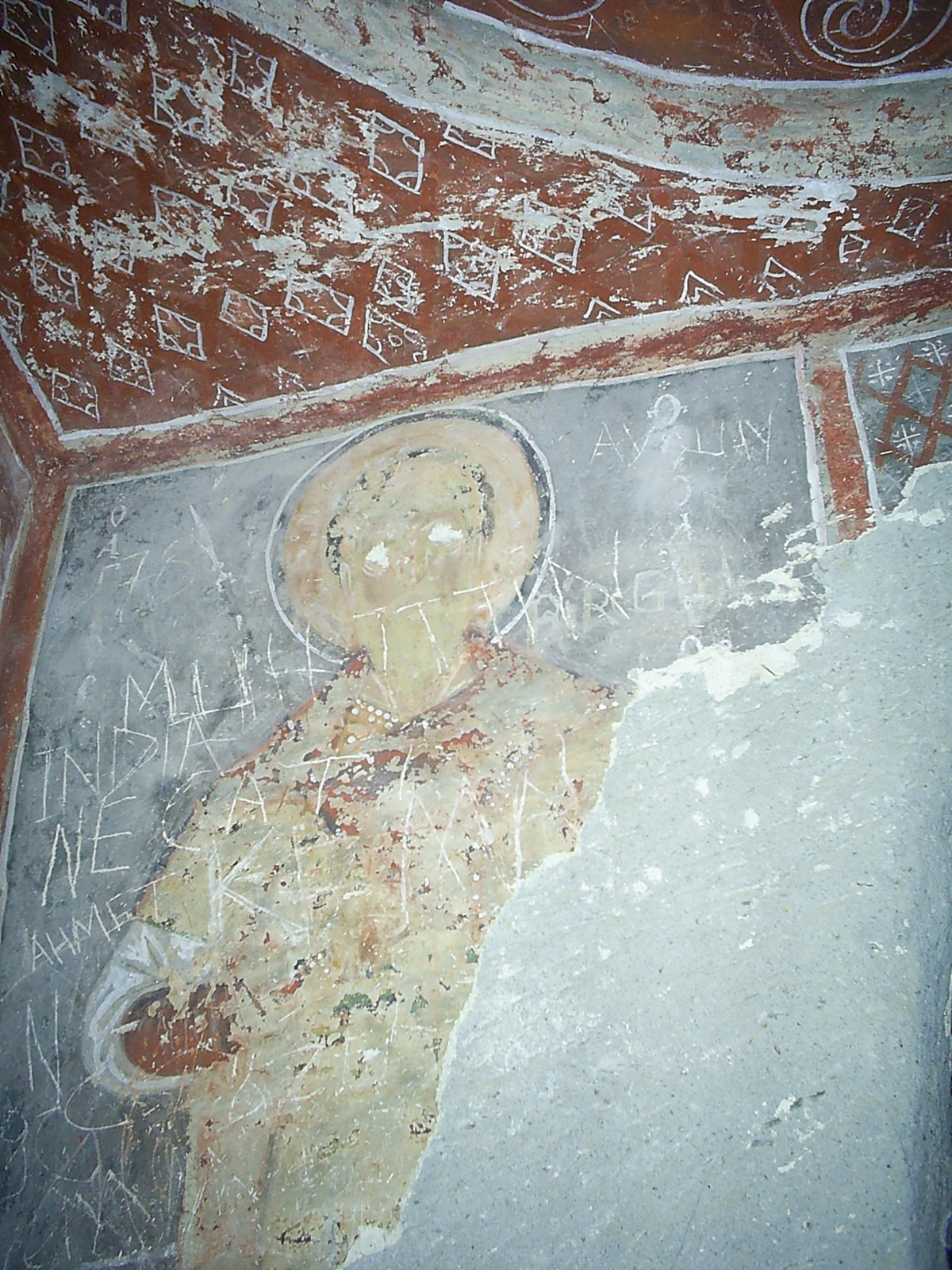
Sümbüllü Kilise (“Church with Hyacinth”), Ihlara Valley, Cappadocia, January 10, 2009. Bevilacqua’s review corroborates what tour guides say, that people scraped off the eyes of saints in order to treat ophthalmia. I tweeted the photo in response to the tweet that linked to Bevilacqua’s article in the first place
In the post I called “Emotional Contagion,” where I took up Book VIII of the Iliad, I found a reason or an excuse to dwell on Collingwood’s disagreement with William James over where emotions come from. James thinks it is a “physical effect on the nerves,” since in “pathological cases” at least, one can have an “objectless emotion,” such as fear in the absence of anything frightening.
As I think Collingwood suggests, the absence here is only of anything that the attending psychiatrist can detect. The patient can still be frightened of his, her, or their own thoughts. Physical manifestations of fear might be created by coffee, but they are not fear itself, any more than aspartame is sugar.
What it all means may not be clear, but if I taste the sweetness of a persimmon, the subject is “I,” and “sweetness” is the object: I think we can say at least that much.
Still, overcoming presumptions about subject and object is a theme of the already-mentioned Zen and the Art of Motorcycle Maintenance. Teaching rhetoric in Montana, Robert Pirsig discovered that he could not say what quality was, even as he could recognize it, and so could everybody else. Years later, visiting his old haunts, hiking up into the mountains, Pirsig recalls what happened to his former self, whom he calls Phaedrus (chapter 19):
Time to get on with the Chautauqua and the second wave of crystallization, the metaphysical one.
This was brought about in response to Phaedrus’ wild meanderings about Quality when the English faculty at Bozeman, informed of their squareness, presented him with a reasonable question: “Does this undefined ‘quality’ of yours exist in the things we observe?” they asked. “Or is it subjective, existing only in the observer?” …
Because if Quality exists in the object, then you must explain just why scientific instruments are unable to detect it …
On the other hand, if Quality is subjective, existing only in the observer, then this Quality that you make so much of is just a fancy name for whatever you like.
Writing about Pirsig and Collingwood in “Anthropology of Mathematics,” I observed what I would say also now, that scientific instruments cannot detect mathematical truth, even though it is universal in the sense above: common to all of us, at least potentially, and not subject to deliberation. This example would seem to belie the dichotomy that Phaedrus’s colleagues propose.
The Index of Speculum Mentis has a number of entries beginning with “object” or “subject”; however, I do not find there the exemplification of the distinction on pages 223–4:
Historical ethics thus fails to give a clear answer to the question ‘What is duty?’ and in practice vacillates between two contradictory answers.
First, the subjective answer: the will is its own world and its own law. It has nothing outside it to determine it, but is absolutely autonomous, and duty is simply its pure self-determination.
Secondly, the objective answer: the moral order of the objective world as a given whole is the law which must determine the subjective will.
Both these solutions are doomed to failure precisely because of their distinctness. They are a pair of opposites, as yet unreconciled …
I can only recall a tune that I remember to be popular in the recent holiday season, in places that observe it:
HARK! the Herald Angels sing
Glory to the new-born King!
Peace on Earth, and Mercy mild,
God and Sinners reconcil’d.
I have a memory of a parody that goes something like,
Glory to the store display,
Credit today, don’t pay till May!
I have not been able to find the song, probably played by Weasel on WHFS, some Christmas eve in the 1980s.
Back to the index of Speculum Mentis. The first referent under “Subject-object relation” is a nice one from page 141. This is in Chapter IV, “Religion,” which begins on page 108 and succeeds the “Art” chapter. Religion throws an apple of discord into the art world – the following is from page 140:
The griefs and joys of the lyrical poet are not necessarily historical facts, any more than the griefs and joys of other dramatis personae. If therefore the artist feels dissatisfied with himself – and the greatest of all artists looked upon himself and cursed his fate:
Desiring this man’s art and that man’s scope,
With what I most enjoy contented least – –it is no more than a passing mood; it is overcome even in the act of giving it aesthetic utterance, and is thus only asserted to be denied. But in religion this self is asserted as real, and at the same time as other than the true reality God. Hence the self is by the very presuppositions of the religious consciousness alienated from God and in a state of sin. This is the so-called Fall of Man, or original sin. Here again, there is no question for philosophy as to whether there was an historical fall, and Darwinism has no quarrel with Genesis …
A resolution of the problem – an atonement – is easier said than done. Now we are on page 141:
The short and easy way of dealing with these conceptions is simply to deny them, to point out, what is perfectly true, that the severance of subject from object is no philosophical truth but an error incidental to ‘picture-thinking’, to the imaginative form of knowledge. To one who really conceives, instead of imagining, the subject-object relation, it is evident without more ado that this is a relation of correlatives in which each requires the other for its own existence. But to make this point is to pass at a leap beyond the sphere of imaginative knowledge and to short-circuit the whole train of development from the beginning of religion to the end of philosophy.
Again, I have got on the subject of subject and object because of the chapter of The Relevance of Science called “Cosmogonal Myths.” Weizsäcker summarizes three examples of what the title names:
- the Babylonian Enūma Eliš,
- Hesiod’s Theogony,
- the Icelandic Edda.
Then he asks:
Such are the tales. What is their meaning?
He who asks such a question is no longer a child of the mythical age; else the myths would tell him what they want to tell, without an explanation. Think of their little brothers, the fairy-tales. The youngster who asks what the fairy-tales mean has outgrown the age of fairy-tales. If, then, he should still wish to understand them, he must outgrow that age, too, in which he is proud of not believing in fairy-tales. Our situation with respect to the myths is very similar.
Speculum Mentis too is concerned with such growth, as we have just seen, and as in the following grand paragraph from Chapter VII, “Philosophy,” on pages 293–4, the sole referent in the Index under “Subjectivity of the world”:
Art has turned out to be philosophy; and concrete philosophy is therefore art. That beauty which is the fleeting quarry of the artist is no stranger to the philosopher. His thought must clothe itself in speech, and to him all the quire of heaven and the furniture of earth becomes a divine language, symbolizing in sensuous imagery the eternal truths of thought. Nor is this imagery to him mere art; for art in his mind is enriched and deepened into religion in the knowledge that what he was taught in his youth, and in his haste perhaps rejected as fable, is true: that God really lives and is his father, that the voice that speaks in nature is truly the voice of her creator, and that this very God became man to die for him and to atone by a full, perfect and sufficient sacrifice for the sins of the whole world. And this knowledge is not, for him, in any conflict with the regularity and uniformity of nature, with the fact that he can and does abstract, generalize, conceive everything as matter and motion or in modern language as space-time: for this abstract conception of the world is to him only the schematic order which, without doing it violence, he detects in that infinite whole which is at once spirit and nature, the whole of which the starry heavens above him and the moral law within him are parts. And in learning to know this whole, a whole of truly objective fact in which art and religion and science all play their parts – so, and only so, he comes to know himself. Its true objectivity is not the abstract objectivity of a world in which the knower himself has no place, but the concrete objectivity which is only the correlative of his own subjectivity. It is his world that he knows in this way: if he were not, this world of reality as he sees it would not be. Other worlds would no doubt exist, and in their very difference these would be in a sense identical with his, versions of it: but they could never replace it.
Thinking about the bolded words, I wanted to put my hands on a writer’s recollection of a spell in a psychiatric hospital:
Next, the psychologist, with a flourish, ventures an observation. Each of us, he says, has different values. What’s more, we often disagree about our values. “So,” he concludes, “values are subjective.” And our recovery, our restoration to sanity, hinges upon our willingness to choose our own values.
The article is in The New Atlantis (Number 68, Spring 2022, pp. 28–38), and the title is, “Therapy Beyond Good and Evil: A nonjudgmental psychology is failing patients who need to hear hard truths”; but I had trouble recovering all of this, along with the name of the author.
James Mumford reports that, “making space as it does for patients to make inquiries about which values are worth pursuing,” the hospital “grasps” the doctrine of “Psychiatrist and Holocaust survivor Viktor Frankl,” who
insisted that we’ll never be able to treat mental illness properly until we acknowledge the existential dimension of depression … But in another way the hospital’s therapeutic regime forecloses that search for meaning by denying the reality or importance of objective, transcendent truths by which men and women have historically navigated their lives.
I had kept a copy of the article in a directory with 276 other files, mostly in pdf format. I did not know how to find there what I wanted, if it even was there, rather than in another directory with 739 files. It occurred to me that I might have notes about the article in a third directory, and it turned out I did.
Collected in a file called objectivity-all, the notes are from August, 2019; January, February, and July 2021; and February, March, June, and July, 2022. Apparently some of the notes made their way, somehow or other, into the following posts (in chronological order; the dates are in the URLs):
- “Law and History” (concerning the attempt by Peter Turchin to turn history into mathematics; again, see the footnote),
- “Words,”
- “Feminist Epistemology,”
- “Pascal, Pensées, S 183–254,”
- “Imagination,”
- “On Reading Plato’s Republic,”
- “Sacrifice and Simulation.”
Perhaps there have been other posts to add to the list.
Meanwhile, in order to recover Mumford’s article, another option would have been to learn about, install, and use pdfgrep; but then what string should I have searched for? Now I have installed the program, but searching on “subjective” leads to more results than I feel like waiting to see the end of.
I bring in somebody else’s blog post now, to have a better chance of remembering it later. The title explains it: “‘Twelfth Night Till Candlemas’ – the story of a forty-year book-quest and of its remarkable ending” (20 December 2024). David Allen Green spent decades trying to recover a story read in childhood. He was ultimately successful, thanks to “a trained and experienced librarian.”
She sensibly assumed some of the things I could recall would have more weight – be more reliable – than others …
She then used various permutations of my memory points until she found a match, and she then found a book which someone had scanned onto internet archive …
The story had been found – because of a librarian using critical skills (and thereby not giving equal weight to each factor), an archive, and a catalogue/index.
Verily: librarians, archivists, cataloguers, and indexers are the Noble Professions.
For they organise information in a manner in which humans actually think – unlike ChatGPT and Artificial Intelligence.
What makes AI either empty calories or empty of calories is that it cannot distinguish between the “subjective” – itself – and the “objective” – everything else:
A being whose cognition consisted entirely of a set of instructions could, by definition, make no distinction between the instructions and an experience of the world outside those instructions. For such a being, its knowledge would always equate to its world, with no difference between the two.
Thus William Egginton in “Why Kant Wouldn’t Fear ChatGPT-4” (Time, August 29, 2023). Kant might not have feared AI, but I think one may fear what people will do with it. Egginton continues:
And yet, Kant saw, such a model of knowledge emphatically contradicts everything we know about our experience.
I do not know Egginton’s source, but it may be clear in his book, The Rigor of Angels: Borges, Kant, Heisenberg, and the Ultimate Nature of Reality, which is apparently all about
the powerful, haunting fact that there is an irreconcilable difference between reality “out there” and reality as we experience it.
I’ll suggest that if any difference were simply irreconcilable, then we could not be aware of it. We make small reconciliations, but the work is never over. We remember some things, but if we could remember everything, then it would not be memory anymore. The same is true, I suppose, with re-enacting somebody else’s thought, or simply learning something, wherever it comes from. We have to be able to know that we have learned: that’s what I said in “Rethinking,” having been studying Collingwood’s “History as Re-enactment of Past Experience” (1936; included posthumously in The Idea of History, 1946). Egginton says in the Time essay,
This paradox of a perfect memory haunts every attempt we can make to imagine cognition arising solely from information. Just as remembering the past requires a modicum of a self suspended at a distance from that past to relate to it as past, perceiving the present requires a modicum of a self that is not utterly immersed in that present, without which there would be nothing to synthesize disparate moments into a coherent experience.
This all seems connected to what I was doing on New Year’s Day, 2025, keen to respond to the request made by an editor on New Year’s Eve. (Apparently mathematicians do not take holidays in the normal way.) I was revising an article of which an earlier draft was posted here as “Gödel, Grammar, and Mathematics” (and which itself is going to appear as “On Gödel’s Incompleteness Theorem,” Journal of Humanistic Mathematics, July, 2025). I wrote,
Gödel’s theorem is a logical theorem about proving mathematical theorems. Again, the theorem is that there are mathematical systems so strong as to contain a statement σ whose meaning is precisely that of the statement, “σ is not a theorem.” In short then, σ is the statement, “I am not a theorem.”
Mathematical statements are not normally in the first person; they do not feature anything like the pronoun I. For the effect of such a pronoun, Gödel makes use of an ambiguity. A statement can be either of the following:
- something stated – call it a meaning;
- something spoken, or written down, and thus a string of symbols, be they sounds, words, or letters …
As the object of an act of meaning, a meaning would seem to be objective. The expression doing the meaning would then be subjective. For its being somehow “about” the difference, I call Gödel’s theorem logical, rather than mathematical.
When it first occurred to me that the terminology of subjective and objective applied here, I used it the other way around. Now I recall being told by a friend in college that Plato was a realist, not an idealist, even though our notion of an idea comes from him; for him, “those ideas are real.”
A friend who has sometimes slogged through my posts suggested recently that he might understand better the things I share, (not only if I stuck to the point, but) if philosophy had been taught in American schools the way it is in France. I am dubious, because I don’t think I was “taught” philosophy either, unless you count reading about the Divided Line and the Allegory of the Cave in Cornford’s translation of the Republic. I don’t remember whether we were quizzed on these things, but the point of reading Plato is not to learn to talk about him in an approved fashion.
Meanwhile, in the strong mathematical systems that we were talking about, there is a proof that a certain hypothesis τ entails the conclusion σ. I recall now Weizsäcker’s usage:
Cosmogony then is, objectively speaking, the way in which the world came into being, or it is, subjectively speaking, the teaching about this way.
“Subjectively” speaking then,
- τ is that a number exists with certain arithmetical properties;
- σ is that another number does not exist.
I talk about τ in an earlier post, “On Gödel’s Incompleteness Theorem.” “Objectively” speaking,
- the number that doesn’t exist, according to σ, is the Gödel number of a proof of σ;
- the number that does exist, according to τ, is the Gödel number of some sentence that has no proof.
We conclude that σ is true, but has no proof in our system, if indeed the system is consistent, as we believe it to be. Thus we have a distinction as follows.
- The proof of an ordinary mathematical theorem, as that τ entails σ, is entirely subjective, being something that can be formalized so as to be checked by a program.
- Gödel’s proof cannot be so formalized, because it is about the objective meaning of a formal proof that τ entails σ.
The distinction here seems like what Shannon Vallor is getting at in “The Thoughts The Civilized Keep” (Noêma, February 2, 2021):
The hype around GPT-3 as a path to general artificial intelligence … reveals the sterility of our current thinking about thinking … the purpose of thought — what thought is good for — is a question widely neglected today, or else taken to have trivial, self-evident answers … What is missing from GPT-3? It’s more than just sentience … than conscious self-awareness … than free will, too … there is a further capacity it lacks, one that may hold the answer to the question we are asking. GPT-3 lacks understanding … Understanding is not an act but a labor. Labor is entirely irrelevant to a computational model that has no history or trajectory in the world.
There’s that key idea of history, now connected with struggling. I have been suspicious of a so-called “intelligence” that could pass easily from infancy to maturity without a period of adolescence; I talked about this in a post “On Being Given to Know,” though the concern there was “uploading books to one’s brain.”
According to Vallor,
GPT-3 doesn’t even know that to successfully answer the question “Can AI be conscious?,” as the philosopher Raphaël Millière prompted it to do in an essay, it can’t randomly reverse its position every few sentences.
GPT-3 effortlessly completed the essay assigned by Millière. This is a sign not of GPT-3’s understanding, but the absence of it. To write it, it did not need to think; it did not need to struggle to weld together, piece by piece, a singular position that would hold steady under the pressure of its other ideas and experiences, or questions from other members of its lived world.
I have struggled to weld together a lot of things in this post, though I may not have reached a “singular position.”
Having related the gruesome story of a boy raised like a dog in a kennel, James Mumford says,
In moments of despair, I cling to my unshakeable belief that a child is not supposed to be treated that way, ever, in any world. It’s the only thing I know to be true …
I turn now to the truth of the Hexagon Theorem, as entailed by Book I of Euclid’s Elements, although this entailment seems to have taken till the twentieth century to work out.
-
The article by Goldstone and Turchin of September 10, 2020, was recommended by Stephen Greenleaf in his comment on my post “Law and History.” According to the authors, referring to the US Presidential election of 2020, won by Joe Biden,
given the accumulated grievances, anger and distrust fanned for the last two decades, almost any election scenario this fall is likely to lead to popular protests on a scale we have not seen this century.
I guess they were right, if the storming of the US Capitol on January 6, 2021, was a “popular protest.” They say also,
American politics has fallen into a pattern that is characteristic of many developing countries, where one portion of the elite seeks to win support from the working classes not by sharing the wealth or by expanding public services and making sacrifices to increase the common good, but by persuading the working classes that they are beset by enemies who hate them (liberal elites, minorities, illegal immigrants) and want to take away what little they have.
That makes sense too. Nonetheless, disputing Turchin at least, Yascha Mounk wrote “There Is No Surplus Elite in America” (December 5, 2024), including the observation,
A lot of the reason why some writers and academics have found the idea of a “surplus elite” intuitively appealing is that they are disproportionately likely to know people who fit this description. In Brooklyn alone, thousands of people aspire to make their name as the voice of their generation … virtually all of the people who fail to attain their dream jobs can secure perfectly decent employment in some other line of work.
Edited, especially to add the lists of sources, February 7, 2025.
Edited again on April 25,
- to change “It occurred to me that I had notes” to “… might have notes”;
- to add the missing letter tee to what is now “but the work”;
- to reverse the order of σ and τ in what is now “an ordinary mathematical theorem, as that τ entails σ …”
Edited yet again, November 23, 2025,
- to make the lists of sources numbered rather than unnumbered (so that I could more easily say there were twenty of those sources in all);
- to make the forward references to
- “Gödel and AI,”
- “The System”;
- to observe that my use of Baskerville could change;
- to change
- “his or her or their” to “his, her, or their”;
- “even as [Pirsig] could recognize [quality], as could everybody else” to “even as he could recognize it, and so could everybody else”;
- to add a link to my ultimately published “On Gödel’s Incompleteness Theorem.”
On April 4, 2026, I added the forward links to “Organ Recital” and “Order from Chaos.”
 Polytropy
2 Comments
Very interesting. I’m currently working on a project to republish the fictional and philosophical works of May Sinclair, who was the first to apply the term “stream of consciousness” to literary works. By the way, she knew Collingwood, who reviewed one of her books and advised her on another. I hope all is well with you and Ayşe. James
Thanks James. I just sent you an email, but it was returned: “Address not found.”
6 Trackbacks
[…] « Subjective and Objective […]
[…] “Subjective and Objective” and […]
[…] Fear ChatGPT-4” (Time, August 29, 2023). I’ve brought up this essay twice before, in “Subjective and Objective” and “On Kant’s Groundwork.” Egginton […]
[…] Gödel relies on the distinction between the subjective and the objective. I suggested this in “Subjective and Objective,” while noting also that, for a computer, all is […]
[…] the truth to win. The truth wins only by being found, and it is not found by deliberation. (In “Subjective and Objective,” I trace this idea to the Nicomachean Ethics of […]
[…] Thus we are not computers: for these, all is subjective. I am helped to see this by William Egginton and Shannon Vallor, as in “Subjective and Objective.” […]