The extant works of Hippocrates take up ten volumes of the Loeb Classical Library. I’ve got the fourth of those volumes, because it contains also the extant fragments of Heraclitus, collected under the title ΠΕΡΙ ΤΟΥ ΠΑΝΤΟΣ, On the Universe. [See the footnote on this title.]
I am going to look here at some aphorisms of Heraclitus, Parmenides, Turkish folklore, Zen, and Erich Segal – also of Hippocrates, who seems to be the source of our word “aphorism.” He wrote ΑΦΟΡΙΣΜΟΙ, and they turn out be in the same Loeb volume with Heraclitus.
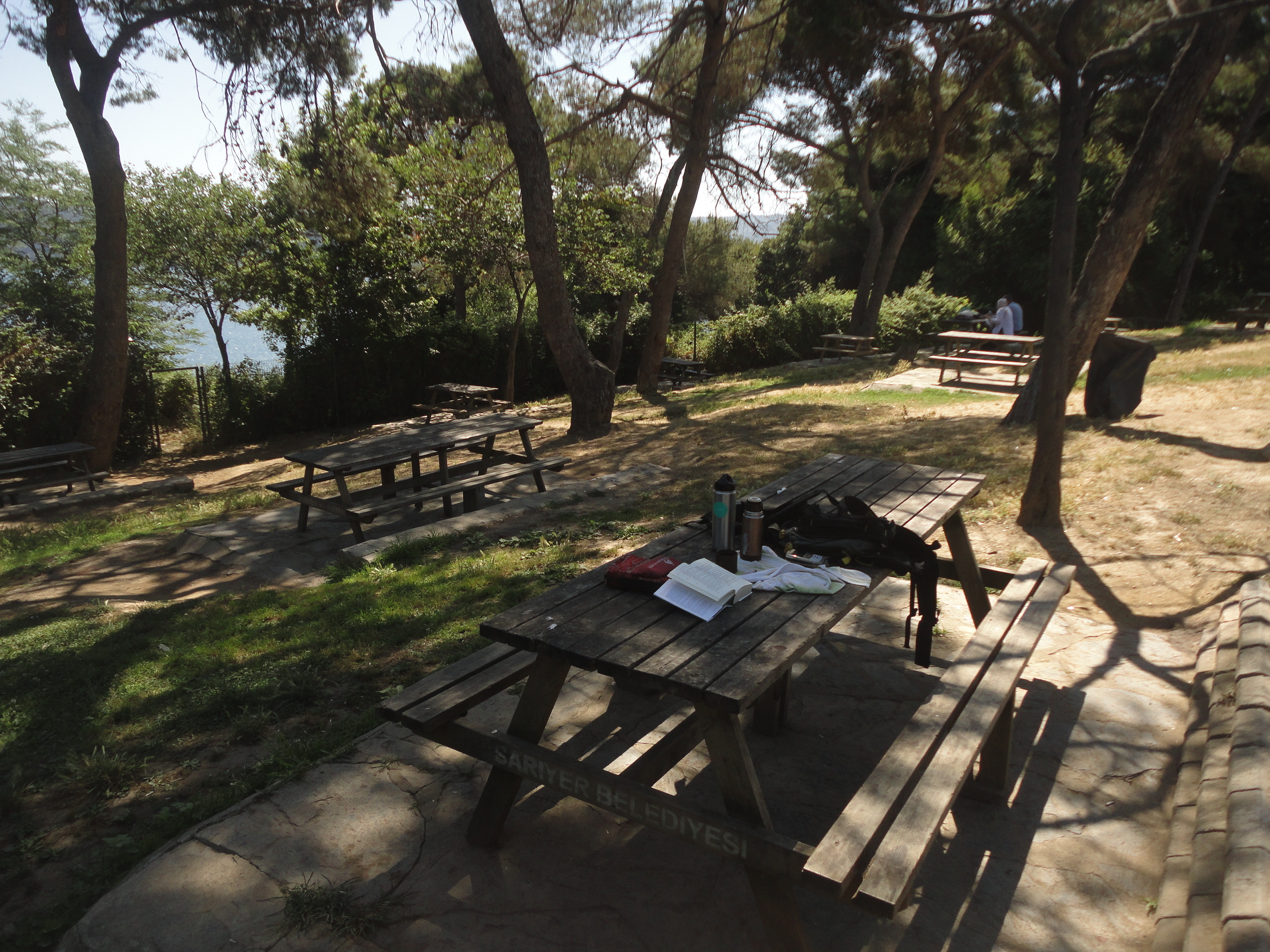
I was reading Parmenides
in Kireçburnu Çamlık Parkı
Erguvantepe, Sarıyer, Istanbul
July 6, 2025
The first of the Aphorisms of Hippocrates starts out with Ars longa, vita brevis. Here’s the whole thing:
| Ὁ βίος βραχύς, | | | Life is short, |
| ἡ δὲ τέχνη μακρή, | | | art is long; |
| ὁ δὲ καιρὸς ὀξύς, | | | time is sharp, |
| ἡ δὲ πεῖρα σφαλερή, | | | experiment is risky, |
| ἡ δὲ κρίσις χαλεπή. | | | decision is hard. |
| δεῖ δὲ | | | It is a must, |
| οὐ μόνον ἑωυτὸν | | | not only for oneself alone |
| παρέχειν | | | to be ready, |
| τὰ δέοντα ποιέοντα, | | | doing what is needed, |
| ἀλλὰ καὶ τὸν νοσέοντα | | | but also for the sick person |
| καὶ τοὺς παρεόντας | | | and the attendants |
| καὶ τὰ ἔξωθεν. | | | and the externals. |
I tried to give a literal translation there; the Loeb translation by W. H. S. Jones is,
Life is short, the Art long, opportunity fleeting, experiment treacherous, judgment difficult. The physician must be ready, not only to do his duty himself, but also to secure the co-operation of the patient, of the attendants and of the externals.
I don’t see cooperation literally in the Greek, but Francis Adams refers to it too, in his 1849 translation, available at WikiSource:
Life is short, and Art long; the crisis fleeting; experience perilous, and decision difficult. The physician must not only be prepared to do what is right himself, but also to make the patient, the attendants, and externals cooperate.
In the original, δεῖ and δέοντα can be understood as a third-person singular, used impersonally, and a neuter plural participle, both of δέω “to bind.” Collingwood has a warning about the chance for misunderstanding here. James Connelly alluded to the warning recently, in a great talk called “The Sense of the Past: Williams and Collingwood on Humanistic and Scientific Knowledge,” given in the philosophy department of Boğaziçi University (Friday, April 3, 2026).
From a decade ago, in “Pictures” (October, 2015) I have some photos from the Boğaziçi campus and from Aşiyan just below it. As for Bernard Williams, my second-hand understanding of his notion of toleration appears in “Courage” (August, 2025).
From James Connelley’s talk, My wife and I recall the example of the word “impressive,” which John Stuart Mill had used, not to express approbation, but only to describe weight or impact. As for Collingwood’s warning, here it is:
in ethics, a Greek word like δεῖ cannot be legitimately translated by using the word ‘ought’, if that word carries with it the notion of what is sometimes called ‘moral obligation’. Was there any Greek word or phrase to express that notion? The ‘realists’ said there was; but they stultified themselves by adding that the ‘theories of moral obligation’ expounded by Greek writers differed from modern theories such as Kant’s about the same thing. How did they know that the Greek and the Kantian theories were about the same thing? Oh, because δεῖ (or whatever word it was) is the Greek for ‘ought’.
That is from An Autobiography (1939; page 63), where Collingwood elaborates on the absurdity of the “realists.”
Liddell, Scott, and Jones only partially confirm Collingwood’s assertion – or partially contradict it, if you want to see it that way. Looking up δεῖ in the big lexicon, you find the original meaning as,
there is need (the sense of moral obligation, prop. belonging to χρή, is later, S. Ph. 583, etc.).
I wrote about the Philoctetes of Sophocles in “Craftiness.” The speech that the LSJ cites is given to a sailor disguised as a trader; Neoptolemus is being addressed:
ὦ σπὲρμ’ Ἀχιλλέως, μή με διαβάλῃς στρατῷ
λέγονθ’ ἃ μὴ δεῖ.Son of Achilles, do not slander me,
speaking of me to the army as a tattler.
The translation is by David Grene. As far as I can tell, the “speaking” would be by the speaker (“me”), not the listener (“son of Achilles”), since the Greek participle is
- not λέγων, which would agree in case with σπὲρμ’, that is, σπέρμα “seed” (or “sperm”!),
- but λέγονθ’ presumably for λέγοντα, to agree with με “me.”
I think a more literal translation would be, “Do not slander me to the army [as] saying what one ought not”; but I am not an expert.
In his first aphorism, I want to think Hippocrates has the idea that I tried to express in “Machinations.” We can measure the temperature, weight, and height of a sleeping person. If we can at all measure such properties as “intelligence” or “loneliness,” the subject at least needs to be conscious and cooperative.
I think we can use this idea to differentiate physical health from mental health. The difference corresponds roughly to that between the nonmoral and moral interpretations of δεῖ – and between an engineer and a lawyer. Here I’m thinking of a review of Breakneck (2025), by Dan Wang. The review itself, dated October 22, 2025, is by Hollis Robbins, who says,
Dan Wang “gets” China, all the reviews say … his central framing that China is run by engineers and the US by lawyers has been taken up by all the best podcasts and reviews …
“All the best podcasts and reviews” sounds like parody, but I guess Robbins is serious. I’ve been taken aback by her assertions before. As I suggested in “Reading and Talking,” mainly by means of her own words, she seems to think “teaching the Odyssey” means delivering information of the kind that can be asked for on exams. Meanwhile, in reviewing Breakneck, she explains:
The problem with engineers doing social engineering is that things can go very, very wrong. Ideally a country would have lawyers and engineers. As Dan said in one early interview, “the issue with lawyers is that they’re really good at saying no. They’re really good at blocking things … and so in the lawyerly society you don’t have stupid ideas like the one child policy; you also don’t have very functional infrastructure almost anywhere throughout the country.”
That one-child policy meant forced abortions. Horrifying. The sister of Robbins’s son-in-law was adopted from China; now she is
a robotics engineer and a talented musician. Dan’s one-child policy chapter details the brutal conditions that led to her being here, to the benefit of everyone who knows her and to our nation’s economic growth.
I’m afraid that sounds like the worst kind of engineering mentality right there.
All of that comes to me out of the first aphorism of Hippocrates.
For What Is Not to Be
In the Parmenides of Plato, a man called Cephalus recalls having come to Athens with friends. The party are all from Clazomenae, and I assume this is the city of Ionia whose ruins are near Izmir. Perhaps then this Cephalus is not the one who lives with his son Polemarchus in Piraeus, as in the Republic; according to scholars, that Cephalus is from Syracuse.
The Republic is strictly a monologue, in which Socrates recounts a dialogue he had with Cephalus, Polemarchus, Adeimantus, and others.
The Parmenides is the monologue of Cephalus of Clazomenae. Cephalus reports that his party were taken to see the half-brother of Adeimantus. Antiphon was prevailed on to repeat a dialogue once held by Parmenides, Zeno, and Socrates.
What Antiphon knew of the conversation, he knew from Zeno’s friend Pythodorus, who reported Parmenides to have been about sixty-five; Zeno, forty; and Socrates, “very young” (σφόδρα νέον). Today we call Zeno the student of Parmenides. According to the story passed on by Pythodorus, Zeno had been, to Parmenides, the παιδικά. That word is formally the neuter plural of the adjective meaning “childish.” The Greek root appears in “paedogogy,” but also in “paedophilia.”
I read the Parmenides on my own last year, after I had joined a group who were reading, in Greek, the words that have come down to us from the “real” Parmenides. Sextus Empiricus quotes some of those words in Book I of Against the Logicians. Before getting to Parmenides, Sextus talks about Gorgias of Leontini – apparently the same Gorgias who features in the Platonic dialogue of that name. The arguments of Gorgias that Sextus recounts are, to my mind, reminiscent of those of the Platonic Parmenides. I am not going to look at them further here.
The “real” Parmenides wrote poetry. At least, he wrote verses. Some of them might be taken as aphorisms. Plato and Aristotle take one of them that way. It can be looked up as B7.1 in Diels, Fragmente der Vorsokratiker:
οὐ γὰρ μήποτε τοῦτο δαμῇ εἶναι μὴ ἐόντα.
In my memory, this verse is uttered by a friend at St John’s College: “Never let it be said that not-being is.”
I probably would have read the verse in the two forms that occur in Jowett’s translations of Plato’s Sophist. These are at 237a and 258d:
For never will you show that not-being is.
Not-being never is.
In the Loeb edition of the Sophist, where the Greek is the same at either place, the translations by Fowler are,
Never let this thought prevail, that not-being is.
Never shall this thought prevail, that not-being is.
Plato includes the next verse from Parmenides: “But keep your mind from this way of investigation,” as Fowler puts it, at 237a. Aristotle quotes only the first verse at Metaphysics XIV.ii.4, 1089a4, where the Loeb translation by Tredennick reads,
’Twill ne’er be proved that things which are not, are.
Does this mean that a lie, such as “The election was stolen,” does not come true, no matter how many times you say it?
I think another possibility is suggested by Laks and Most in Early Greek Philosophy, Volume V: Western Greek Thinkers, Part 2 (Loeb Classical Library, 2016), where the verse in question is D8.1. I’m adding a line break:
οὐ γὰρ μήποτε τοῦτο δαμῇ
εἶναι μὴ ἐόντα.For never at all could you master this:
that things that are not are.
The word whose form δαμῇ is rendered now as “master”: it would seem to be the verb that you can look up as δαμάζω in Cunliffe’s Lexicon of the Homeric Dialect. Eight meanings are given, all about the bringing under control of something such as
- horses;
- people, as political subjects;
- women, as wives or slaves;
- feelings;
- spirit (θυμός);
- foes;
- life (by killing).
The Indo-European root of δαμάζω is supposed to be demə-, from which the English “tame” descends – as do “daunt” and “indomitable,” according to the Linguistics Research Center of the University of Texas at Austin; however, “dominate, domicile,” and “timber” are from a different IE root, which can nonetheless be spelled the same.
Can we master the unknown by making it known? At δαμάζω, the big LSJ lexicon translates the first part of Parmenides’s verse as “it shall never be proved that …” (ellipsis in origional), but gives no other example of such an abstract use of the verb.
“Proving” is ambiguous anyway.
- A proof in mathematics establishes a truth.
- A proving ground is where things are tested and may fail.
If you say that something does not exist, then you are still talking about something, which therefore does exist.
Parmenides seems to allow such an interpretation of his words, while also suggesting that you will not understand it.
If people believe a lie, still, they do believe it, and this affects what they do.
People are currently turning to ChatGPT and Grok as authorities. My calling this foolish or wrong-headed does not change the fact.
Thinking and Thought
We have now seen an aphorism of Parmenides that struck Plato and Aristotle. I have interpreted it to apply to contemporary life.
An aphorism of Parmenides that strikes me independently is Diels B8.34, Laks and Most D8.39:
ταὐτὸν δ’ ἐστὶ νοεῖν τε καὶ οὕνεκεν ἔστι νόημα.
I’ve got here the translations of Burnet; Davidson; McKirahan and Curd; and Laks and Most:
- The thing that can be thought and that for the sake of which the thought exists is the same.
- One and the same are thought and that whereby there is thinking.
- What is for thinking is the same as that on account of which there is thought.
- This is the same: to think and the thought that “is.”
My translation:
The same is:
- Thinking.
- That for which there is thought.
I am thinking here of Heraclitus (Diels B50, Bywater I, Laks and Most D46):
οὐκ ἐμοῦ ἀλλὰ τοῦ λόγου ἀκούσαντας ὁμολογεῖν σοφόν ἐστιν ἓν πάντα 〈εἶναι〉.
Eva Brann looks at this fragment in The Logos of Heraclitus (Philadelphia: Paul Dry, 2011; page 17). At St John’s College, I knew the author (not very well) as Miss Brann. I consulted her book for “We the Pears of the Wild Coyote Tree,” which reviews two movies about young people who are rebellious, as Heraclitus was, according to some of the reports collected by Laks and Most in Early Greek Philosophy, Volume III: Early Ionian Thinkers, Part 2 (Loeb Classical Library, 2016):
For certain people are not less convinced about their opinions than others are about their knowledge – [scil. the case of] Heraclitus shows this.
They say that when he was asked why he kept silent, he said, “So that you can chatter.”
Those are P10a and P14, by Aristotle (in the Nicomachean Ethics, VII.iii.4) and Diogenes Laertius.
As for the words of Heraclitus himself, Miss Brann gives a translation headed by a dangling participial phrase:
Listening not to me but to The Speaker, there is a Wise Thing to agree with – One : Everything.
As I understand, the εἶναι (“to be”) at the end of the fragment is what a scholar called Miller has substituted for the manuscripts’ εἰδέναι (“to know”). However, not all is one, simply. If you disagree with me here, then you prove the point, since you are saying there are two thoughts on the matter, yours and mine. My wrong thought would still be a thought, and a thought is a thing – as Parmenides would seem to have pointed out.
Still, any two things have a connection, a ratio. Miss Brann suggests this, visually, by writing “One : Everything.”
Who’s First
Of Heraclitus and Parmenides, it is not clear which came first. Miss Brann thinks it was the one of them called dark and obscure (page 5):
Did Heraclitus from eastern Ephesus incite Parmenides from western Elea to propose his seamless sphere of Being in opposition to the former’s river of becoming (as I think) … ? … My priority implies that our philosophical West began in Asia Minor. Well, so did our poetical West – Homer.
I too may mention the epic poet that way, when I am called on to explain what I like about living in Turkey.
Here in Istanbul, a student in my wife’s geometric group theory class was discovered to be reading the Iliad for pleasure. Ayşe had brought up the Achilles Paradox, attributed to Parmenides’s student Zeno.
Applause
I don’t think the politics of this country are something to be emulated, even thought the current American regime takes them that way. Myself, I do not think it is good to make cabinet appointments based on fealty, or to lock up the people you don’t like. I’m pretty content with Plato’s demonstration of this, as in the Gorgias or the Republic; see my post “Doing and Suffering.”
There are still some Turkish aphorisms worth thinking about:
Bakmakla öğrenilse, köpekler kasap olurdu.
If one learned by watching, then dogs would be butchers.Bal tutan parmağını yalar.
The handler of honey licks their finger.Görünen köy kılavuz istemez.
The seen village wants no guidebook.
I occasionally remind students of the first one.
The second one may explain corruption, either to justify it or condemn it.
I read the last aphorism as, “You don’t need a weatherman to know which way the wind blows.”
If there are various ways to understand existence in Parmenides, likewise in Turkish.
In this language, “I’m there” is varım. That’s the first-person singular suffix, attached to var. This might be classed as a predicative adjective, meaning “existing.” Thus kitabım vardır means “my book is extant,” that is, I have a book.
By itself, kitabım can also be read as an assertion: “I am a book.” The suffix here is different though, and the difference is audible and visible in some contexts:
-
Şeftalim vardır “I’ve got a peach”;
-
Şeftaliyim “I am a peach.”
The negation of the latter is Şeftali değilim, “I am not a peach.” However, “I have no peach” is Şeftalim yoktur.
One more Turkish aphorism is
Bir elin nesi var? İki elin sesi var.
One hand, what has it got? Two hands have a sound.
Thus, some jobs needs more than one worker, at least according to the interpretation given in the three books of Turkish sayings and proverbs that I have.
One of those books is Konuşan Deyimler ve Atasözleri (Istanbul: Remzi, 1978). Here, Aysan Ediskun Türkhan specifies the job in question as a lawsuit (dava); alternatively, the “job” is a disagreement, which always takes two.
I have not seen any suggestion that the Turkish aphorism has the same purpose as the Zen kōan about the sound of one hand clapping. I brought up the kōan in “Impermanence,” which discusses and includes chapters i–iii of Book IX of the Nicomachean Ethics of Aristotle. I thought Bart Simpson’s naive or literal response to the kōan echoed Aristotle’s response to what Socrates observes in the Republic: that we must not always give people what is supposed to be theirs.
Baggage
For its inclusion of the fragments of Heraclitus, the Loeb volume already mentioned, Early Greek Philosophy, Volume III, is one of the five best books on aphorisms, according to Andrew Hui.
Hui is an associate professor at the National University of Singapore. He is also a fellow alumnus of St John’s College, as I have learned from the College’s page of books by Johnnies.
Hui’s book is A Theory of the Aphorism: From Confucius to Twitter. I have not obtained it, but I have the interview of Hui by Nigel Warburton for Five Books (October 3, 2019; updated December 1, 2023).
In the Cratylus (402a), Plato has Socrates recall the saying of Heraclitus that you cannot step into the same river twice. Hui talks about this (which is Laks and Most D65, Bywater XLI, Diels A6, B12, B49). He brings in the fragment that I quoted earlier:
Even without knowledge of Heraclitus, you and I could spend two hours talking about and unpacking this statement. Who is ‘you’? What counts as the river? What does twice mean in this context? What is the act of stepping? Is this a notion of the flux of all things? There are other Heraclitus fragments that say “all things are one” – so does he believe that everything is one, or does he believe in flux?
Hui and Warburton could spend two hours unpacking; but would they get the job done?
Speaking and Writing
Is there a job to get done? This is a problem with aphorisms. Brevity can be mistaken for profundity. Maybe there’s really nothing there.
Alternatively, a saying may have been taken from a context that would give it a meaning different from or even opposite to the one it seems to have.
One example indeed might be
Bir elin nesi var, iki elin sesi var.
Another example is
Verba volant, scripta manent.
I discussed this first in “Interconnectedness” (June, 2014). The saying can be found in Hans Walther (1884–1971), Proverbia Sententiaeque Latinitatis Medii Aevi, volume 5 (Göttingen, 1967), page 658. In this source, the aphorism is assigned the number 33093a: yes, that number is in excess of thirty thousand. I’m not sure, but the references for the entry seem not to be ancient. This would corroborate what Wikipedia says:
The authorship of this proverb is, as with many others, unknown, but it was well known by the seventeenth century …
Walther’s “impressive” or massive work is the source cited by Çiğdem Dürüşken in Latince Deyişler ya da Yaşamın Renkleri (“Latin sayings or the colors of life”). That little book features two sayings, or sometimes only one, on each of pages 19–296, and it was published in 2004 in Istanbul by Homer Kitabevi. That press is also a bookshop that stocks Loebs, and its slogan is Verba volant, scripta manent.
Probably the slogan is supposed to mean that speech is evanescent, but written things stick around.
Thus, if you want a deal to be kept, get it in writing.
If you want to remember something, write it down: that’s a reason for this blog.
Nonetheless, for Socrates, in the Phaedrus, speech can meet you where you are, while the written word just sits there, dumb.
Dürüşken’s reference line is
Walther, 33093a; krş.: Cicero, Brutus, 96.328
Here krş. is presumably karşılaştırınız: “compare,” that is, cf. In the Cicero, I’m not sure that § 96 is relevant, but § 328 (of 333 in all) includes
Sic ferunt, inquam, idque declarat totidem quot dixit, ut aiunt, scripta verbis oratio.
In the translation of E. Jones (1776), this becomes:
“I have often heard of it,” replied I, “and his oration, which was afterwards published, they say, in the very same words in which he delivered it, is no way inferior to the character you give it …”
The Loeb translation is terser:
“That seems to be the general verdict,” I answered, “and the written speech, reproduced I am told exactly as spoken, confirms your judgement …”
That’s my scholarship on some words. It says nothing on how to take them, except that Cicero seems not to have shared Socrates’s horror of writing. Like Plato, perhaps, he seems to have thought that writing could preserve speech.
What Is Love
“Aphoristic Intelligence Beats Artificial Intelligence,” according to the title of an article in The Atlantic (December 26, 2025). The article is an excerpt from The World in a Phrase: A Brief History of the Aphorism, by James Geary. It was the latest “Article of Note” at Arts & Letters Daily, Friday, January 2, 2026.
The difference between a rut and a grave is the depth
– so read Geary, age eight, in his parents’ Reader’s Digest. “I’ve been obsessing,” he says,
about the respective depths of ruts and graves for more than 50 years now, wondering every morning whether I’m simply walking to work or slowly burying myself.
I suppose then Geary walks to the Harvard Kennedy School, where he works as “an adjunct lecturer in public policy,” according to The Atlantic. He makes a distinction:
A platitude is a placebo for the mind; an aphorism is a wake-up call. Aphorisms provoke debate; they don’t promote dogma. Though they’re short, aphorisms spur considered reflection, not Pavlovian partisanship.
How does one tell the difference – can one write a program to do it?
Unfortunately, Geary’s own style recalls a computer, at least by the account of Hollis Robbins in “How to Tell if Something is AI-Written” (August 13, 2025; I looked at this also in “Prairie Life” and then “Artificial Language”). Robbins proposes some rules, and one of them comes under the heading “Telltale Contrasting Structures”:
… look for formulations like “it’s not just X, but also Y” or “rather than A, we should focus on B.” This structure is a form of computational hedging …
An LLM navigates what researchers call “conceptual space,” the network of relationships between ideas as they appeared in training text. This is different than the network of relationships between ideas and reality we struggle with. LLMs live entirely within the realm of signifiers, tracking statistical relationships between word-forms without access to the signifieds that anchor language to human experience.
As for Geary, he continues making his distinction:
Where artificial intelligence makes things that are supposed to be hard seem like they’re easy, aphoristic intelligence accepts that things that are supposed to be hard are, in fact, really hard. Aphorisms gleefully increase our cognitive loads by immersing us even further in the difficulty and reminding us of what’s at stake.
When burdened with a lot of work, does anybody actually say, “My cognitive load is heavy today”?
Geary gives the example of the platitude, “Love means never having to say you’re sorry.”
Apart from the inaccuracy – in my experience, love means having to say you’re sorry on a regular basis – this is not an aphorism, because it’s too easy. It induces complacency. It doesn’t make you think.
Nothing makes us think, as I pointed out in my last post, “Contradiction in Terms,” the terms in question being the components of the noun phrase, “artificial intelligence.” Geary seems to have chosen not to think too much about the line that comes from Love Story (1970). Myself, I’ve been thinking about it since first hearing it. Perhaps this was in a Mad magazine parody, presumably around when young Geary was reading Reader’s Digest. The saying didn’t make much sense, but somebody must have thought it did; at least, that’s what I thought.
I haven’t read the novel or seen the movie.
On the subject of love, I am told that Iain McGilchrist has uttered a kind of aphorism:
Love is a pure intention to the existence of the other.
McGilchrist is admired by at least two internet friends of mine. Unfortunately the words attributed to him are written in a code that I don’t know.
As for Erich Segal’s aphorism, a possible interpretation is that you need never apologize out loud to your beloved, because they can already feel your contrition, just by reading your face.
Collingwood asserts in The Principles of Art (1938; page 246),
the dance is the mother of all languages … every kind or order of language (speech, gesture, and so forth) was an offshoot from an original language of total bodily gesture. This would have to be a language in which every movement and every stationary poise of every part of the body had the same kind of significance which movements of the vocal organs possess in a spoken language.
As James Connelly pointed out in the talk already mentioned, when people want to understand what Collingwood means in An Autobiography when he calls history a re-enactment of past thought, they should read The Principles of Art. They should not dismiss this book as concerning a subject separate from history.
I would consider language in the broader sense when considering a sort of complement of Segal’s saying, written by Collingwood in Religion and Philosophy (1916; page 178):
The most perfect punishments involve no “incidental” pains at all. The condemnation is expressed simply and quietly in words, and goes straight home.
The “words” here could be a look of disappointment. I can remember being the recipient of such looks. I once tried to explain this to somebody, but he didn’t get it. He had a teenage daughter, so maybe he knew what parenting techniques worked with her; but maybe not. Since we were participating in an online seminar on The Human Condition of Hannah Arendt (2018, 1958), I was not at leisure to pursue the matter.
Collingwood goes on to acknowledge that mere words may not do the job:
If a criminal is extremely coarsened and brutalised, we have to express our feelings in a crude way by cutting him off from the privileges of a society to whose moral aims he has shown himself hostile; but if we are punishing a child, the tongue is a much more efficient weapon than the stick.
The important point is that punishment is properly not something bad. Some professional philosophers would seem to disagree, and I took this up in “Antitheses.” Parents may disagree as well. They may also agree, implicitly, but only in the sense of thinking that administering punishment is good for them, because they are sadists: that is what I understand from J. Daniel Sawyer in “Kinky Families, Under God: The Context and Legacy of James Dobson” (September 2, 2025), which I looked at in “Reading and Writing.”
That’s what I get from the aphorism that didn’t make somebody else think.
Note
That fourth Loeb volume of Hippocrates contains also the remarks of editor W. H. S. Jones on “Intentional Obscurity in Ancient Writings,” which I quoted in “We the Pears of the Wild Coyote Tree.”
As for the title that Jones assigns to the collected works of Heraclitus, I think one could translate ΠΕΡΙ ΤΟΥ ΠΑΝΤΟΣ also as On the Whole. I do not know why the title was chosen in the first place, since Jones reports in his own Introduction,
We are told by Diogenes Laertius that the book of Heracleitus was divided into three parts,
- one dealing with the universe,
- one with politics and
- one with theology.
The particular passage about Heraclitus from Diogenes is R3a for Laks and Most in Early Greek Philosophy, Volume III: Early Ionian Thinkers, Part 2 (Loeb Classical Library, 2016; the volume covers Xenophanes and Heraclitus):
τὸ δὲ φερόμενον αὐτοῦ βιβλίον ἐστὶ μὲν ἀπὸ τοῦ συνέχοντος Περὶ φύσεως, διῄρηται δ’ εἰς τρεῖς λόγους, εἴς τε τὸν
- περὶ τοῦ παντὸς καὶ
- πολιτικὸν καὶ
- θεολογικόν.
The book of his that is in circulation is entitled On Nature [or: is about nature] as a whole, but it is divided into three accounts (logoi),
- about the universe,
- on politics, and
- on theology.
 Polytropy