A text for this post is from Wendell Berry:
Justice is a rational procedure. Mercy is not a procedure and it is not rational. It is a kind of freedom that comes from sympathy, which is to say imagination – the felt knowledge of what it is to be another person or another creature. It is free because it does not have to be just. Justice is desirable, of course, but it is virtually the opposite of mercy. Mercy, says the Epistle of James, “rejoiceth against judgment.”
That is from an essay published originally in Citizenship Papers (2003); I am reading it in Essays 1993–2017 (Library of America, 2019). The quoted essay is called “Two Minds”: those minds are rational and sympathetic respectively. Although Berry does not use the term here, I would say that those two minds are in antithesis.

I often read Berry at a beach that is in antithesis to Lesbos. The breakwaters were laid down some time after we started coming here about 25 years ago. I am not aware that they solve any problem, beyond some functionary’s problem with untrammelled nature. The breakwaters may be a boondoggle
Berry’s pairing of justice and mercy is itself an antithesis. It corresponds to the pairing of punishment and forgiveness taken up in “Antitheses,” where my idea is that
- “an eye for an eye” sets an upper limit on retribution;
- “resist not evil” means there is no lower limit.
That is how I read what Jesus says in Matthew 5:
| 38 | Ἠκούσατε ὅτι ἐρρέθη, ὀφθαλμὸν ἀντὶ ὀφθαλμοῦ καὶ ὀδόντα ἀντὶ ὀδόντος. | Ye have heard that it hath been said, An eye for an eye, and a tooth for a tooth: |
| 39 | ἐγὼ δὲ λέγω ὑμῖν μὴ ἀντιστῆναι τῷ πονηρῷ· ἀλλ’ ὅστις σε ῥαπίζει εἰς τὴν δεξιὰν σιαγόνα, σου στρέψον αὐτῷ καὶ τὴν ἄλλην. | But I say unto you, That ye resist not evil: but whosoever shall smite thee on thy right cheek, turn to him the other also. |
Concerning Matthew 5:21–48 generally, Wikipedia currently quotes Robert H. Gundry, Commentary on Matthew (Grand Rapids: Baker Academic, 2010):
This passage contains six sayings starting with “You have heard that it was said” and, after a quotation of the Law, continuing with Jesus’ interpretation, starting with “But I tell you.” The sayings are traditionally called “the Antitheses.” But this designation seems to imply that after stoutly affirming the Law in 5:17–20, Jesus contradicts it.
Myself, I don’t take the term “antithesis” to imply contradiction. Gundry continues:
We’ll see on the contrary that he escalates it. He takes the Law up to the goal toward which it was already headed, so that we should stop calling these sayings “the Antitheses” and perhaps start calling them “the Culminations.”
Alternatively, understand antithesis as the placing of two concepts against one another, that they may provide mutual support, like bums leaning on one another, back to back, in an old drawing by Ernie Bushmiller.
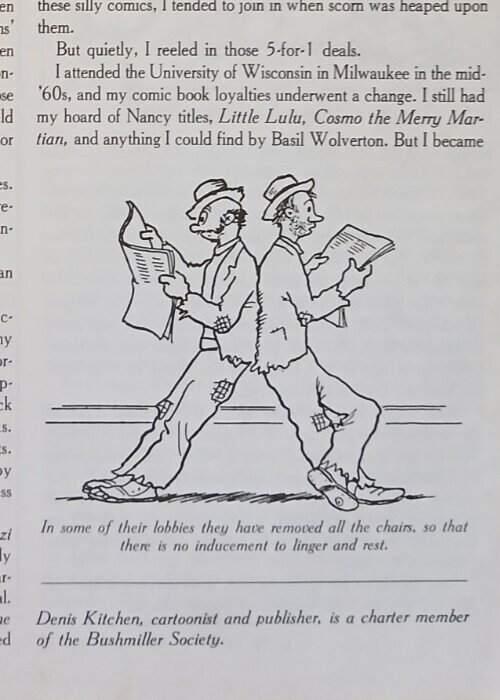
From the introduction by Denis Kitchen to Bums, Beatniks and Hippies, a compilation of Nancy cartoons by Ernie Bushmiller paired with – in antithesis to – Artists and Con Artists. Not being at home where my copy is, I found the book on Ebay
In the 1970s, I heard a schoolmate talk about a debate between liberals and conservatives. I don’t recall the topic, but apparently one of the debaters quoted the Bible. He was obviously a conservative, according to the boy telling the story, who was himself a liberal.
I don’t think it should have been obvious.
One might quote scripture, just to be able to say of it, as a friend once did,
I think “turn the other cheek” and “love your enemy” are not truths, are positively immoral, and make a hypocrite of every Christian I have ever met.
Berry may describe such hypocrites in another essay, “The Burden of the Gospels,” which appeared first in The Christian Century (September 20, 2005), then in The Way of Ignorance (October 21, 2005) – and now in Essays 1993–2017:
Anybody half awake these days will be aware that there are many Christians who are exceedingly confident in their understanding of the Gospels, and who are exceedingly self-confident in their understanding of themselves in their faith. They appear to know precisely the purposes of God, and they appear to be perfectly assured that they are now doing, and in every circumstance will continue to do, precisely God’s will as it applies specifically to themselves. They are confident, moreover, that God hates people whose faith differs from their own, and they are happy to concur in that hatred.
Berry tries to distinguishes himself from those people, but may fail:
We know we don’t have to look far to find people who equate more abundant life with a bigger car, a bigger house, a bigger bank account, and a bigger church. They are wrong, of course.
He seems pretty sure he knows the meaning of John 10:
| 9 | ἐγώ εἰμι ἡ θύρα: δι’ ἐμοῦ ἐάν τις εἰσέλθῃ, σωθήσεται καὶ εἰσελεύσεται καὶ ἐξελεύσεται καὶ νομὴν εὑρήσει. | I am the door: by me if any man enter in, he shall be saved, and shall go in and out, and find pasture. |
| 10 | ὁ κλέπτης οὐκ ἔρχεται εἰ μὴ ἵνα κλέψῃ καὶ θύσῃ καὶ ἀπολέσῃ: ἐγὼ ἦλθον ἵνα ζωὴν ἔχωσιν καὶ περισσὸν ἔχωσιν. | The thief cometh not, but for to steal, and to kill, and to destroy: I am come that they might have life, and that they might have it more abundantly. |
Another friend recently mentioned “a problem with Wendell Berry.” I think the problem was really this friend’s. Nonetheless, he passed along a relevant observation: losing is not failing. As I understand Wendell Berry then, regarding another antithesis, agrarianism may lose, but industrialism is failing.
Molly Crabapple is emphatic: the Jewish Labor Bund did not fail; they lost. Apparently she said that in Los Angeles, in the hearing of my friend, when she was talking about her new book, Here Where We Live Is Our Country. I share the sentiment of that title, as I understand it. In the memoir on my college published in the De Morgan Gazette (volume 2, issue 2), I said Istanbul was mine because I lived there, and even because I had read Xenophon about how he had passed through the city when it was Byzantium.
I don’t know how such remarks fit with Wendell Berry’s notion of land. He describes agrarianism and industrialism in a piece now in Essays 1993–2017 called “The Whole Horse,” “Originally published in a shorter version [which does not seem to be online] in The Amicus Journal, Winter 1998,” then collected in the 2003 book Citizenship Papers, already mentioned:
The fundamental difference between industrialism and agrarianism is this: Whereas industrialism is a way of thought based on monetary capital and technology, agrarianism is a way of thought based on land.
Agrarianism, furthermore, is a culture at the same time that it is an economy. Industrialism is an economy before it is a culture. Industrial culture is an accidental by-product of the ubiquitous effort to sell unnecessary products for more than they are worth.
The bolding is mine, as usual. I’m wondering about the closing prepositional phrase, “for more than they are worth.” Would it be acceptable to sell unnecessary products for exactly what they were worth? How would that worth be arrived at?
As I have suggested, the present post is a companion or follow-up to one called “Antitheses.” You don’t have to read that one to read this one, but I have reread it.
Each of Berry’s essays is self-contained; at least, it is presented as if self-contained. Nonetheless, there are recurring themes, and I for one might appreciate pointers to where those themes are developed further or perhaps treated differently.
For example, Berry says in “The Agrarian Standard,” another essay in Citizenship Papers:
The industrial contempt for anything small, rural, or natural translates into contempt for uncentralized economic systems, any sort of local self-sufficiency in food or other necessities. The industrial “solution” for such systems is to increase the scale of work and trade … There is never any question of propriety, of adapting the thought or the purpose or the technology to the place.
What exactly does Berry mean by propriety? He could mean appropriateness, suitability, or even fittingness. However, those terms may lack such moralistic connotations as are suggested by Merriam-Webster:
In an earlier era, when social manners were far more elaborate than they are today, propriety and impropriety were words in constant use. Today we’re more likely to use them in other contexts … Wherever rules, principles, and standard procedures have been clearly stated, propriety can become an issue. Something improper usually isn’t actually illegal, but it makes people uncomfortable by giving the impression that something isn’t quite right.
Does Berry mean to bring in all of that baggage? He does say, in “The Burden of the Gospels,”
I think Jesus recommended the Samaritan’s loving-kindness, what certain older writers called “holy living,” simply as a matter of propriety, for the Samaritan was living in what Jesus understood to be a holy world.
“Propriety” is the name of the second of the eight chapters of Berry’s book Life Is a Miracle: An Essay Against Modern Superstition (2000). As I reported in “Astronomy Anomaly” (which took up the Timaeus of Plato), I obtained Essays 1993–2017 because it included Life Is a Miracle. The “Propriety” chapter begins thus:
My general concern is with what I take to be the increasing inability of the scientific, artistic, and religious disciplines to help us address the issue of propriety in our thoughts and acts. “Propriety” is an old term, even an old-fashioned one, and is not much in favor. Its value is in its reference to the fact that we are not alone …
In the ensuing paragraph, Berry uses my term “antithesis”:
Propriety is the antithesis of individualism. To raise the issue of propriety is to deny that any individual’s wish is the ultimate measure of the world. The issue presents itself as a set of questions: Where are we? … What appropriately may we do in our own interest here? These questions … do not call for specialized answers …
We might understand propriety precisely in an individualistic sense. Propriety is literally the condition of being property, to be disposed of according to the owner’s mind.
We do not always know our mind. For example, people who set suicide in motion may regret it – as I see for example in a recent article by Leyland Cecco in The Guardian, “Canadian man admits sending ‘suicide packets’ to hundreds of people around world (May 29, 2026):
In a particularly harrowing case, a young man was heard vomiting by his family and pleaded for help from his parents after telling them he had consumed a toxic substance.
In another, a 29-year-old man called 911 himself, asking for medical help. He said he had ingested a toxic substance, repeating: “Please, and I am going to die soon”, and then began crying …
A victim in the UK called emergency services and told the operator he had taken a substance to kill himself but did not want to die and began panicking …
I’m not sure about the first case, but in the last two, the call for help was too late.
“What are people for?” asks Josh Rosenberg, nom de plume “Josh of Arc,” in “Techno Hubris Cometh Before the Fall” (May 29, 2026):
the answer that’s reigned supreme for thousands of years, at least since Cain’s famous conversation with God, has been “other people.”
One of the more enigmatic qualities of many techno-optimists is that they embrace the notion of revolutionary technological change while at the same time arguing to their detractors that in the realm of human affairs, there’s nothing really new under the sun … Yet I think there’s ample reason to believe that as far as the current iteration of rapid technological innovation is concerned, there is something new under the sun.
While our society has evolved various mechanisms for assimilating labor-replacing technology, it’s developed no such immunities to the downstream effects of technology that makes people increasingly obsolete as social companions.
No companions, bad decisions – maybe. Josh of Arc observes
an emerging and widespread contemporary trend among Americans to reject the abstract, the conceptual, and the universal in favor of the tangible, the concrete, and the particular.
He assesses the trend as a response to the latest technology. In sharing the essay, “Cosmopolitan Globalist” Claire Berlinski sees herself as having represented the trend in “Under the Roman Goddess” (May 29, 2026), her own offering to supporters (who include myself) about a few days without internet (and thus new posts) in her Paris walkup:
The solitariness was exquisite. I don’t think I had many days like this even before the Internet, because my yearning for solitude developed later in life. As young people do, I wanted to spend my time with friends and boyfriends. I didn’t crave total aloneness the way I do now. That desire has grown more acute year by year, especially since the arrival of the Internet. Now it’s the only way my soul can be at peace.
How does Claire’s solitude relate to what Josh observed “about twenty years ago,” describing it as follows?
Over the course of about five years, the cultural touchstone of the ecstasy-soaked rave was supplanted by the image of a young person binge-watching reality TV in their underwear while doing bong hits and instant-messaging with friends.
Today, he figures,
As the alternatives to human contact continue to become more accessible, more addictive, and more ubiquitous, the incentives to make ourselves fit company for other human beings plummet.
Perhaps we lose all sense of propriety.
Unfortunately, when we are with others, they may try to tell us what we should do. Robert Pirsig talks about that, in a passage from chapter 19 of Zen and the Art of Motorcycle Maintenance that I could have included in “The System” last summer, but apparently didn’t:
Little children were trained not to do “just what they liked” but – but what? – Of course! What others liked. And which others? Parents, teachers, supervisors, policemen, judges, officials, kings, dictators. All authorities. When you are trained to despise “just what you like” then, of course, you become a much more obedient servant of others … a good slave. When you learn not to do “just what you like” then the System loves you.
When I was growing up in Alexandria, Virginia, there was a proposal for a halfway house in our neighborhood. Such a siting was opposed, because it would be “inappropriate” for residential area.
My mother was not very demonstrative – except that she did attend one big demonstration, the March on Washington, as I mentioned in “Joan Baez in Istanbul.” Regarding the halfway house, my mother made clear, at least at home, that she was disgusted by the opposition.
The woman who didn’t want the halfway house said she wasn’t against helping the disadvantaged, but she thought it should be done in an “industrial” area. She was also the mother of a boy on the fringe of our neighborhood gang. The family were from the South – further south than Northern Virginia – and the boy showed some pride in this. He also fancied himself the reincarnation of Jim Morrison.
There was a rumor that Morrison had lived in our neighborhood. I have found some confirmation of this. The Morrison house on Woodland Terrace was at the corner with Fontaine Street, where we lived. Around 1970, I would go to the corner house, to play with the daughter of the military family then in residence. I was so young then, I don’t remember the name of the girl or her family.
A good essayist like Wendell Berry may leave out such extraneous details; but then you already know who the author is, or at least you have some reason to believe that he or she has given you something worth reading. Me, I’m just trying to make sense of things, and these are my notes on the process.
In “The Whole Horse,” Berry would seem to elaborate on propriety, though without using that term. There is also the theme of justice that we started with above:
In the written record of agrarianism, there is a continually recurring affirmation of nature as the final judge, lawgiver, and pattern-maker of and for the human use of the earth. We can trace the lineage of this thought in the West through the writings of Virgil, Spenser, Shakespeare, Pope, Jefferson, and on into the work of the twentieth-century agriculturists and scientists … The idea is variously stated: We should not work until we have looked and seen where we are; we should honor Nature not only as our mother or grandmother, but as our teacher and judge; we should “let the forest judge”; we should “consult the Genius of the Place”; we should make the farming fit the farm; we should carry over into the cultivated field the diversity and coherence of the native forest or prairie. And this way of thinking is surely allied to that of the medieval scholars and architects who saw the building of a cathedral as a symbol or analogue of the creation of the world. The agrarian mind is, at bottom, a religious mind …
I don’t know whether Berry expects us to recognize the quotations. I do not recognize them, but according to a note at the end of the Library of America edition of Essays 1993–2017,
- “Let the forest judge” is from Shakespeare, As You Like It, III.ii;
- “consult the Genius of the Place” is from Alexander Pope.
Still in “The Whole Horse,” Berry makes the distinction that we have taken from Molly Crabapple:
Having, so to speak, laid industrialism and agrarianism side by side, implying a preference for the latter, I will be confronted by two questions that I had better go ahead and answer.
The first is whether or not agrarianism is simply a “phase” that we humans had to go through and then leave behind in order to get onto the track of technological progress toward ever greater happiness. The answer is that although industrialism has certainly conquered agrarianism, and has very nearly destroyed it altogether, it is also true that in every one of its uses of the natural world industrialism is in the process of catastrophic failure. Industry is now desperately shifting – by means of genetic engineering, global colonialism, and other contrivances – to prolong its control of our farms and forests, but the failure nonetheless continues. It is not possible to argue sanely in favor of soil erosion, water pollution, genetic impoverishment, and the destruction of rural communities and local economies. Industrialism, unchecked by the affections and concerns of agrarianism, becomes monstrous. And this is because of a weakness identified by the Twelve Southerners of I’ll Take My Stand in their “Statement of Principles”: Under the rule of industrialism “the remedies proposed … are always homeopathic.” That is to say that industrialism always proposes to correct its errors and excesses by more industrialization.
Throwing away fertile land does seem insane. Of course, somebody will get defensive: “Where are we supposed to live then?” The difficulty of responding to such questions may be a reason for Berry to remark in “Conservationist and Agrarian,” yet another essay in Citizenship Papers (apparently first published as “For Love of the Land” in Sierra, May-June 2002, but nothing from that issue seems to be in the magazine’s archives):
… I have spent my life on two losing sides. As long as I have been conscious, the great causes of agrarianism and conservation, despite local victories, have suffered an accumulation of losses, some of them probably irreparable – while the third side, that of the land-exploiting corporations, has appeared to grow ever richer. I say “appeared” because I think their wealth is illusory.
Such wealth is illusory, as is any advantage of doing injustice over suffering it – the theme of “Doing and Suffering,” taken from Plato.
Still, I wonder whether the failure of industrialism is to be considered worse than the Lost Cause of the Confederacy. Is Berry supporting that cause? Concerning the work of Berry’s Twelve Southerners, Wikipedia says currently,
I’ll Take My Stand was criticized at the time, and since, as a reactionary and romanticized defense of the Old South and the Lost Cause of the Confederacy. It ignored slavery and denounced “progress”, for example, and some critics considered it to be moved by nostalgia.
Berry does not ignore slavery. However, as far as I can tell so far (mainly by using the Index of Essays 1993–2017), Berry does not talk about whether resorting to slave labor represented a failure of agrarianism.
As for the Twelve Southerners themselves, one of them was Allen Tate, whom I happened to name in “Reading and Talking,” because he had taught Robert Pirsig about the unreliable narrator given to us by Henry James in The Turn of the Screw.
In Either/Or, Elif Batuman gives us a narrator who reports near the end,
Thinking of the people who populated my life, who acted, spoke, and viewed the world so differently … I recognized how important it was for me that I could understand them all, at least a little bit, and better than they could understand each other. Was that what a novel was: a plane where you could finally juxtapose all the different people, mediating between them and weighing their views?
That’s on pages 347–8 of the 2023 Vintage paperback edition that I picked up at Pandora Kitabevi in Istanbul (and the narrator’s word for what a novel may be is indeed “plane,” not “place”). In the novel, as a rising junior at Harvard University, and now as a writer for Let’s Go, Selin has been touring Turkey, which is her parents’ native land, and she has been reading (page 345)
The Portrait of a Lady, chosen somewhat perfunctorily from the one shelf of English-language books – all discount paperback “classics” – at the bookstore in Antalya.
I’m not sure just why, two decades ago, I chose that Henry James novel from a shelf in Homer Kitabevi in Istanbul, when we were visiting from Ankara. Maybe I appreciated the physical quality of the Everyman edition. In Either/Or, visiting Konya, Selin chooses a book of Rumi’s work by following more or less physical clues (pages 329–30):
I tried the Turkish translations first, feeling they would be somehow closer to the original … But the only Turkish editions in the store, aside from an expensive shrink-wrapped multivolume set that would never have fit in my backpack, were flimsy booklets full of typos, where the cover art was a rainbow-colored whirling dervish, or a photograph of a dew-covered rose.
I picked up an English translation: one that seemed correctly book-sized, with a professionally designed cover, an introduction, and hundreds of pages of couplets organized into different categories …
I bought the English edition.
I imagine Selin recognizes that a well-made book need not be a good book. Some of what she tells us about the Rumi book is,
The translator, Coleman Barks, was apparently from Chattanooga, Tennessee, and didn’t speak Persian … Sometimes, as I was reading, I felt worried that Coleman Barks had made everything up. How could a thirteenth-century person have written such things?
What Barks writes is at least good poetry. As for Henry James, apparently he is credited with distinguishing between the writer of a novel and its first person:
McGurl appears to believe that ‘point of view’ was somehow invented by Henry James. ‘Jamesian’ point of view, he implies, was later refined by the creative writing programme into new techniques such as ‘the “surprising point of view” trick’ in The Sound and the Fury …
That’s Batuman again, in “Get a Real Degree” (London Review of Books, Vol. 32, No. 18, 23 September 2010). She is reviewing Mark McGurl, The Programme Era: Postwar Fiction and the Rise of Creative Writing (2009). To credit James is to ignore earlier writers, she says, as follows (the brackets are hers):
In the early 19th century, Jane Austen, who did not use the phrase ‘point of view’, or read an anthology called Points of View, nonetheless began writing novels whose sophisticated and innovative use of limited narration is founded on a firm grasp of the fact that ‘everything said is said by [i.e. from the limited perspective of] an observer’: an insight described by McGurl as the ‘foundational constructivist claim [of] contemporary systems theory’, and the cornerstone of ‘the paradoxes of narrative “point of view” in the Jamesian tradition’ …
I suppose Points of View is the book that I too was assigned stories from in school. In sum:
- Allen Tate
- influenced Wendell Berry – indeed, the epigraph of “The Whole Horse” is by Tate: “This modern mind sees only half of the horse – that half which may become a dynamo, or an automobile, or any other horsepowered machine … The religious mind … wants the whole horse …”;
- taught Robert Pirsig about point of view, using Henry James as an example.
- Elif Batuman
- informs us that Henry James was not actually the first writer to make use of point of view;
- is herself moved by a James novel to contemplate the bringing of different voices together – as for example in this post.
To return to the voice of Wendell Berry: taking an eye for an eye would seem to be what he calls a “rational procedure” in the first quotation above. Not resisting evil could be a procedure, like releasing inmates when the prisons are too crowded, or on the monarch’s birthday; however, it is not mercy or forgiveness unless coming from sympathy, literally “feeling together”: a recognition that the person who deserves punishment is nonetheless a fellow human being, guilty of no more than we are capable of.
Although Berry cites chapter 2 of the Epistle of James, I’m not sure how much insight it provides:
| 8 | εἰ μέντοι νόμον τελεῖτε βασιλικὸν κατὰ τὴν γραφήν, ἀγαπήσεις τὸν πλησίον σου ὡς σεαυτόν, καλῶς ποιεῖτε: | If ye fulfil the royal law according to the scripture, Thou shalt love thy neighbour as thyself, ye do well: |
| 9 | εἰ δὲ προσωπολημπτεῖτε, ἁμαρτίαν ἐργάζεσθε, ἐλεγχόμενοι ὑπὸ τοῦ νόμου ὡς παραβάται. | But if ye have respect to persons, ye commit sin, and are convinced of the law as transgressors. |
| 10 | ὅστις γὰρ ὅλον τὸν νόμον τηρήσῃ, πταίσῃ δὲ ἐν ἑνί, γέγονεν πάντων ἔνοχος. | For whosoever shall keep the whole law, and yet offend in one point, he is guilty of all. |
| 11 | ὁ γὰρ εἰπών, μὴ μοιχεύσῃς, εἶπεν καί, μὴ φονεύσῃς: εἰ δὲ οὐ μοιχεύεις, φονεύεις δέ, γέγονας παραβάτης νόμου. | For he that said, Do not commit adultery, said also, Do not kill. Now if thou commit no adultery, yet if thou kill, thou art become a transgressor of the law. |
| 12 | οὕτως λαλεῖτε καὶ οὕτως ποιεῖτε ὡς διὰ νόμου ἐλευθερίας μέλλοντες κρίνεσθαι. | So speak ye, and so do, as they that shall be judged by the law of liberty. |
| 13 | ἡ γὰρ κρίσις ἀνέλεος τῷ μὴ ποιήσαντι ἔλεος: κατακαυχᾶται ἔλεος κρίσεως. | For he shall have judgment without mercy, that hath shewed no mercy; and mercy rejoiceth against judgment. |
Verse 9 is the sole citation of the big Liddell–Scott–Jones lexicon for the verb προσωποληπτέω “to be a respecter of persons.” Here “respect” would seem to be a word like “propriety”: capable of taking opposite connotations. In context, the respecter of persons is not respectful, but partial, as the earlier verses in the chapter make plain:
| 2 | ἐὰν γὰρ εἰσέλθῃ εἰς συναγωγὴν ὑμῶν ἀνὴρ χρυσοδακτύλιος ἐν ἐσθῆτι λαμπρᾷ, εἰσέλθῃ δὲ καὶ πτωχὸς ἐν ῥυπαρᾷ ἐσθῆτι, | For if there come unto your assembly a man with a gold ring, in goodly apparel, and there come in also a poor man in vile raiment; |
| 3 | ἐπιβλέψητε δὲ ἐπὶ τὸν φοροῦντα τὴν ἐσθῆτα τὴν λαμπρὰν καὶ εἴπητε, σὺ κάθου ὧδε καλῶς, καὶ τῷ πτωχῷ εἴπητε, σὺ στῆθι ἢ κάθου ἐκεῖ ὑπὸ τὸ ὑποπόδιόν μου, | And ye have respect to him that weareth the gay clothing, and say unto him, Sit thou here in a good place; and say to the poor, Stand thou there, or sit here under my footstool: |
| 4 | οὐ διεκρίθητε ἐν ἑαυτοῖς καὶ ἐγένεσθε κριταὶ διαλογισμῶν πονηρῶν; | Are ye not then partial in yourselves, and are become judges of evil thoughts? |
| 5 | ἀκούσατε, ἀδελφοί μου ἀγαπητοί. οὐχ ὁ θεὸς ἐξελέξατο τοὺς πτωχοὺς τῷ κόσμῳ πλουσίους ἐν πίστει καὶ κληρονόμους τῆς βασιλείας ἧς ἐπηγγείλατο τοῖς ἀγαπῶσιν αὐτόν; | Hearken, my beloved brethren, Hath not God chosen the poor of this world rich in faith, and heirs of the kingdom which he hath promised to them that love him? |
| 6 | ὑμεῖς δὲ ἠτιμάσατε τὸν πτωχόν. οὐχ οἱ πλούσιοι καταδυναστεύουσιν ὑμῶν, καὶ αὐτοὶ ἕλκουσιν ὑμᾶς εἰς κριτήρια; | But ye have despised the poor. Do not rich men oppress you, and draw you before the judgment seats? |
| 7 | οὐκ αὐτοὶ βλασφημοῦσιν τὸ καλὸν ὄνομα τὸ ἐπικληθὲν ἐφ’ ὑμᾶς; | Do not they blaspheme that worthy name by the which ye are called? |
Trying to follow Berry, I suggested that mercy was not properly procedural. I find the idea illustrated in a book that was for some reason was in that house on Fontaine Street, during what would turn out to be one of our last visits with my mother before her death in 2013. The book was The Sheen on the Silk, by Anne Perry. I read it. The novel was set in Constantinople, after the Venetians had been driven out, before the Turkish conquest. Thanks to Anna’s Archive, I am able to recover the passage whose theme has stayed in mind:
“I came to apologize to you,” Anna said. “I presumed to think that you could not have been absolved for taking Joanna’s husband from her when she was dying. That was arrogant of me to the point of absurdity. It is none of my business, and I have no right even to think it.”
Theodosia shrugged slightly. “Yes, it is arrogant, but I accept your apology. I have the Church’s absolution, and that is really all that counts.” She half turned away.
Anna contradicted her. “Your face, your eyes, say that it doesn’t count at all, because you don’t believe it.”
“It isn’t a matter of belief, it’s fact. Bishop Constantine said so,” Theodosia replied tartly. “And, as you say, it is not your concern.”
“The Church’s absolution, or God’s?” Anna refused to be dismissed.
Apparently the bishop forgave the sins of Theodosia, but it could only be in a perfunctory way, as she was not actually contrite.
In own her “Personal Biography,” the late Anne Perry says little about adolescence:
However at thirteen I became ill again and was off school from then on. So that may be of some encouragement to those who had missed much formal education. In many areas it is possible to catch up, even to do well, especially if you have parents who encourage you, which I certainly did have.
Although I had various jobs there was never anything I seriously wished to do except write. It was my father who was responsible for encouraging me to write my ideas down. However, I was in my twenties before I started putting together the first semblance of a book …
As one can learn from and through Wikipedia, Perry spent five of those missing adolescent years in prison for the murder, committed with a friend, of the friend’s mother. The experience must have given her some ideas about justice and mercy.
 Polytropy