Here are my slides on the construction of the heptakaidecagon. I have referred to them before, as detailed below, but I have edited them (slightly) since, and I wanted to have a fixed home for them. That will be this post.
I call them slides, because the page size is A6, in landscape orientation, and most pages are self-contained, except for the six pages of the Introduction. There are 80 pages, all told, last edited June 13 of this year (2026). A circle is divided into seventeen equal arcs, with ruler and compass alone, and then a proof that the circle has been so divided is given in Euclidean terms.
One purpose then is to contemplate why the Ancients did not discover the construction.
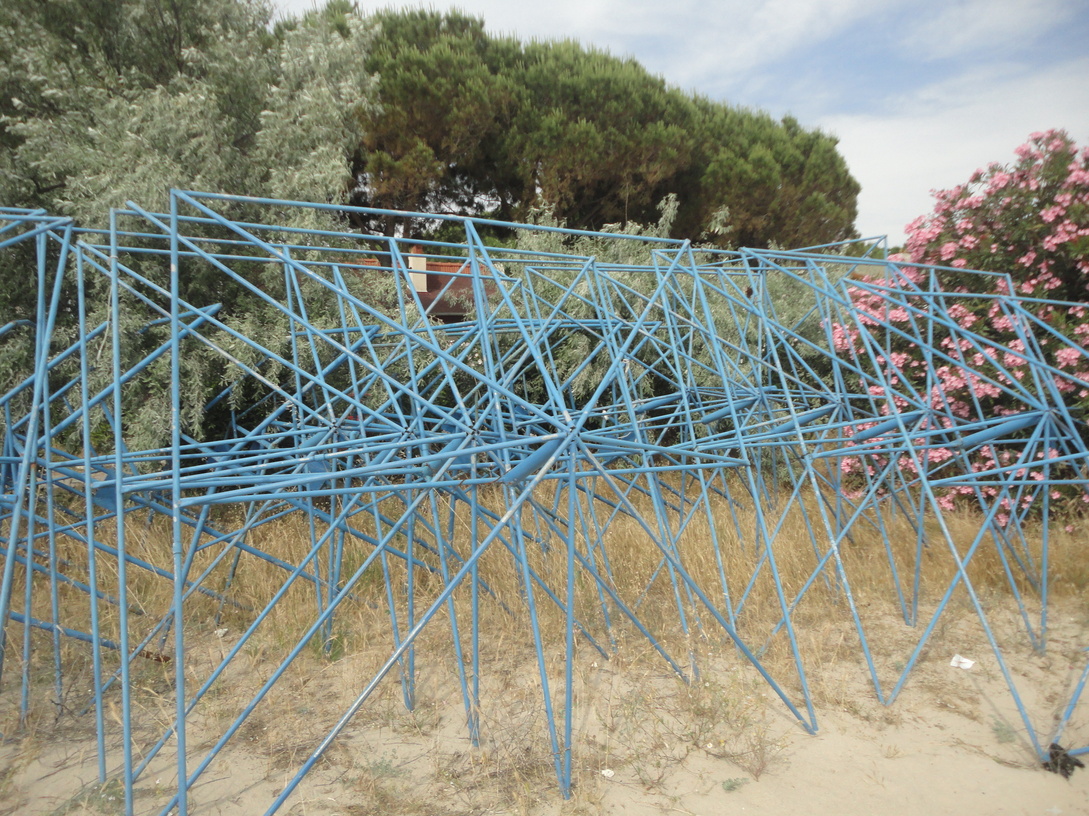
Some polygons in three dimensions
Unused supports for beach umbrellas
Thursday, June 4, 2026
All photos on this page from Altınova, Ayvalık, Balıkesir, Turkey
It is always possible that the construction was discovered, by Euclid, Archimedes, Apollonius, or some more obscure geometer, and then the manuscript was lost. We know about Euclid’s three books of Porisms only from the work of Pappus, seven centuries later, discussed in two posts from earlier this year (2026):
- “Organ Recital” (February 14, concerning an operation I had had; also the death of a friend; and Pappus, because I had been working on him); and
- “Geometry and Algebra” (April 30, concerning what Descartes has done to geometry).

We now have a beer in Turkey named for Perge, the hometown of Apollonius:
in Latin Perga, but Pergê (Πέργη) in Greek.
Monday, June 1, 2026
The people who could ensure that writings survived were not always (if they ever were) the best judges of their value. Lucio Russo talks about the problem in The Forgotten Revolution: How Science Was Born in 300 BC and Why It Had to Be Reborn (translated from the 1996 Italian original, La rivoluzione dimenticata, by Silvio Levy, 2003; page 8; bolding mine):
The seriousness of the destruction of Hellenistic works has usually been underestimated in the past, due to an assumption that it was the best material that survived. Unfortunately, the optimistic view that “classical civilization” handed down certain fundamental works that managed to include the knowledge contained in the lost writings has proved groundless. In fact, in the face of a general regression in the level of civilization, it’s never the best works that will be saved through an automatic process of natural selection. That the same tradition that preserved in their totality the 37 books of Pliny’s Natural history overlooked the few pages of Archimedes’ seminal treatise The method is in itself a proof that the tendency is exactly the opposite. Late Antiquity and the Middle Ages favored compilations, or at least books written in a language still understandable to a civilization that had returned to the prescientific stage. Thus we have Varro’s work on agriculture and Vitruvius’ on architecture, but not their Hellenistic sources; we have Lucretius’ splendid poem on nature, but not the works of Strato of Lampsacus, who according to some indications may have originated natural science in the true sense. Even among real scientific works, some of which were preserved by the Byzantines and Arabs, two selection criteria seem to have been at work. The first was to give preference to authors of the imperial period, whose writings are in general methodologically inferior but easier to use: we have, for example, Heron’s work on mirrors, but not the treatise that, according to some testimonies, Archimedes wrote on the same subject. Next, among the works of an author the ones selected are generally the more accessible, and of these often only the initial portions. We have the Greek text of the first four, more elementary, books of Apollonius’ Conics, but not the next four (of which three survived in Arabic); we have Latin and Arabic translations of the work of Philo of Byzantium on experiments in pneumatics, but none of his works on theoretical principles. We will see further examples of these selection criteria.
Pliny’s Natural History takes up ten volumes of the Loeb Classical Library. I remember looking it up, because it seemed to be the source for a work of fantasy called Inventorum Natura: The Wonderful Voyage of Pliny, by Una Woodruff. This book was full of illustrations of what was supposedly found on the titular “wonderful voyage,” including, as I recall, the amphisbaena. I once had a copy of that book, probably purchased cheaply, but it was not among the books that I brought back from the New World during voyages across the Atlantic.
As for my write-up on the regular heptakaidecagon, I have already referred to it in two posts of 2024:
- In “Necessity” (February 18, 2024), on chapters iv–vi of Book VII of the Nicomachean Ethics of Aristotle, I talk about what might be worth doing in life: it could be writing, or reading Aristotle, or discovering, as Gauss did by the age of 24, a construction of the regular polygon with seventeen sides. Making such a discovery would seem to need desire. By a naïve reading of Buddhism, desire is something to stamp out. Aristotle recognizes necessary desires, such as eating: desires whose fulfilment keeps us alive.
- “Rethinking” (July 4, 2024) concerns the title activity, which is
- what history is, by the account of Collingwood;
- what must be made possible for the reader by the writer of mathematics.
The writer of mathematics may be a student solving a problem on an examination. I had recently given a final examination in an upper-level undergraduate course of number theory. I tried to ensure that when students solved a problem, they could check the correctness of their solution by a method other than just reviewing their work.
Writing the slides on the heptakaidecagon may have been an absurd kind of effort, like that of Thoreau in surveying Walden Pond – I talked about that effort briefly in “Thoreau and Anacreon,” using the account of Laura Dassow Walls in Henry David Thoreau: A Life (University of Chicago Press, 2017).

On one side of the wall is our garden; on the other, the neighbors’
Which is which?
Hint: one side requires what I think is an absurd kind of effort!
I admire the “do-nothing” farming of Masanobu Fukuoka
Thursday, June 4, 2026
Making another connection is more of a stretch, but it concerns what I have read more recently. In Dostoevsky’s Notes from Underground (II.I), the narrator gets tired of making way for a certain military officer who strolls on Nevsky Prospect. The narrator resolves to bump into this officer, and he makes an absurd effort to achieve this goal. He asks for an advance on his salary, in order to buy himself some better clothes, including a collar of beaver fur to replace the one of raccoon.

The beach dogs tend to come guard the human as he reads Dostoyevsky.
Sunday, June 7, 2026
I note by the way that that narrator seems to excuse his behavior as being an expression of freedom from mechanical laws. The following is from the end of § VIII of part I, in Constance Garnett’s translation.
You will scream at me (that is, if you condescend to do so) that no one is touching my free will, that all they are concerned with is that my will should of itself, of its own free will, coincide with my own normal interests, with the laws of nature and arithmetic.
Good heavens, gentlemen, what sort of free will is left when we come to tabulation and arithmetic, when it will all be a case of twice two make four? Twice two makes four without my will. As if free will meant that!
The next section begins:
Gentlemen, I am joking, and I know myself that my jokes are not brilliant, but you know one can take everything as a joke. I am, perhaps, jesting against the grain. Gentlemen, I am tormented by questions; answer them for me. You, for instance, want to cure men of their old habits and reform their will in accordance with science and good sense. But how do you know, not only that it is possible, but also that it is desirable to reform man in that way? And what leads you to the conclusion that man’s inclinations need reforming? In short, how do you know that such a reformation will be a benefit to man? And to go to the root of the matter, why are you so positively convinced that not to act against his real normal interests guaranteed by the conclusions of reason and arithmetic is certainly always advantageous for man and must always be a law for mankind? So far, you know, this is only your supposition. It may be the law of logic, but not the law of humanity.
Not the law of humanity indeed! We are foolish when we assume we know what other people’s interests are – particularly when they prove us wrong.
I read Notes in high school, but pretty much all I could remember was that the book would be worth revisiting. Probably that it why I had a copy in a Dover thrift edition (in school we used a big anthology, which I have not kept). I was pleased then to be able to join a Catherine Project group to read that book (along with Nietzsche’s three essays On the Genealogy of Morals).
Another option would have been the group reading Iris Murdoch, The Sea, The Sea. I bought that book anyway, in an Everyman edition that included also A Severed Head. Ayşe and I read that together, and so I am in a position to observe that Murdoch has a psychiatrist excuse his behavior precisely as the working out of mechanical laws:
The psyche is a strange thing, and it has its own mysterious methods of restoring a balance. It automatically seeks its advantage, its consolation. It is almost entirely a matter of mechanics, and mechanical models are the best to understand it with.
The doctor has seduced a woman who is both his patient and the wife of his friend.

This girl on her mobile did not seem to be enjoying the sunset
Maybe she was being stood up
She went away after the sun went down
Saturday, June 6, 2026
A Severed Head was a fascinating read, and we shall read The Sea, the Sea next, after having read the ultimate source of the title, which is apparently the Anabasis of Xenophon. A blog post may come out of that, but no guarantee. Meanwhile, I’ve posted my notes on the construction of a regular seventeen-sided polygon!
Edited July 31, 2026

