Category Archives: Homer

Anthropology of Mathematics

This essay was long when originally published; now, on November 30, 2019, I have made it longer, in an attempt to clarify some points.

The essay begins with two brief quotations, from Collingwood and Pirsig respectively, about what it takes to know people.

  • The Pirsig quote is from Lila, which is somewhat interesting as a novel, but naive about metaphysics; it might have benefited from an understanding of Collingwood’s Essay on Metaphysics.

  • A recent article by Ray Monk in Prospect seems to justify my interest in Collingwood; eventually I have a look at the article.

Ideas that come up along the way include the following.

  1. For C. S. Lewis, the reality of moral truth shows there is something beyond the scope of natural science.

  2. I say the same for mathematical truth.

  3. Truths we learn as children are open to question. In their educational childhoods, mathematicians have often learned wrongly the techniques of induction and recursion.

  4. The philosophical thesis of physicalism is of doubtful value.

  5. Mathematicians and philosophers who ape them (as in a particular definition of physicalism) use “iff” needlessly.

  6. A pair of mathematicians who use “iff” needlessly seem also to misunderstand induction and recursion.

  7. Their work is nonetheless admirable, like the famous expression of universal equality by the slave-driving Thomas Jefferson.

  8. Mathematical truth is discovered and confirmed by thought.

  9. Truth is a product of every kind of science; it is not an object of natural science.

  10. The distinction between thinking and feeling is a theme of Collingwood.

  11. In particular, thought is self-critical: it judges whether itself is going well.

  12. Students of mathematics must learn their right to judge what is correct, along with their responsibility to reach agreement with others about what is correct. I say this.

  13. Students of English must learn not only to judge their own work, but even that they can judge it. Pirsig says this.

  14. For Monk, Collingwood’s demise has meant Ryle’s rise: unfortunately so since, for one thing, Ryle has no interest in the past.

  15. In a metaphor developed by Matthew Arnold, Collingwood and Pirsig are two of my touchstones.

  16. Thoreau is another. He affects indifference to the past, but his real views are more subtle.

  17. According to Monk, Collingwood could have been a professional violinist; Ryle had “no ear for tunes.”

  18. For Collingwood, Victoria’s memorial to Albert was hideous; for Pirsig, Victorian America was the same.

  19. Again according to Monk, some persons might mistake Collingwood for Wittgenstein.

  20. My method of gathering together ideas, as outlined above, resembles Pirsig’s method, described in Lila, of collecting ideas on index cards.

  21. Our problems are not vague, but precise.


When Donald Trump won the 2016 U.S. Presidential election, which opinion polls had said he would lose, I wrote a post here called “How To Learn about People.” I thought for example that just calling people up and asking whom they would vote for was not a great way to learn about them, even if all you wanted to know was whom they would vote for. Why should people tell you the truth?

Saturn eclipse mosaic from Cassini

Continue reading

On Translation

Achilles is found singing to a lyre, in a passage of Book IX of the Iliad. Homer sets the scene in five dactylic hexameters; George Chapman translates them into four couplets of fourteeners.

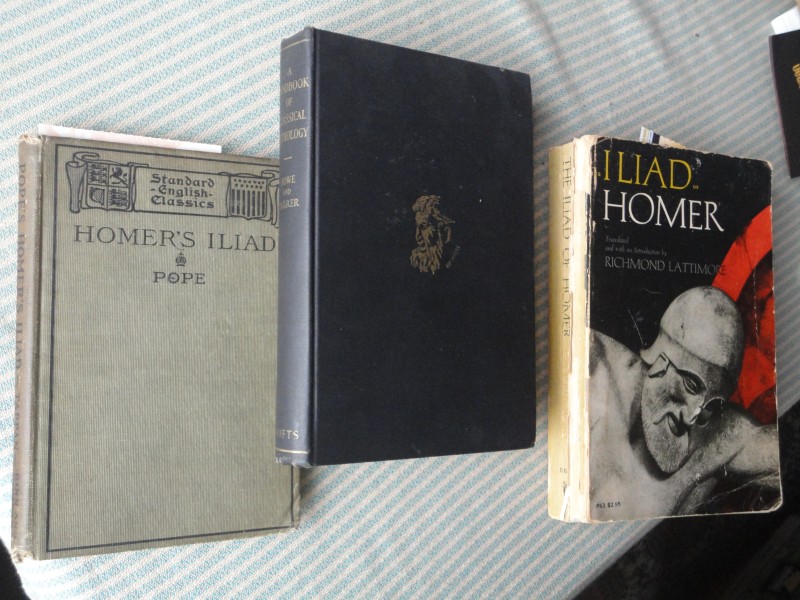
I wrote a post about each book of the Iliad, in Chapman’s version of 1611. As I said at the end, I look forward to reading Emily Wilson’s version. Meanwhile, here I examine the vignette of the lyre in several existing English translations, as well as in the original.

Three books mentioned in the text Continue reading

On Chapman’s Homer’s Iliad, Book XXIV

One man kills another, legally, according to the laws of war, such as they are. The two sides fight over the body, which might be ransomed, if taken by the killer’s side; however, the body is not so taken. The friend of the slain man kills the killer and takes his body to mutilate, though this be sacrilege.

The father of the newly slain man crosses enemy lines to ransom his son’s body. He puts his lips to the hand of the killer, who agrees to give up the body, even coming to admire the father, who in turn admires him.

Woman with arms outstretched, left hand with palm up, right hand grasping a dagger pointed towards her breast

Rembrandt van Rijn (Dutch, 1606-69)
Lucretia, 1664, oil on canvas
Andrew W. Mellon Collection
National Gallery of Art, Washington

Continue reading

On Chapman’s Homer’s Iliad, Book XXIII

Book XXII of the Iliad is rich in human emotion; Book XXIII, in anthropological detail. The books form a natural sequence:

  1. Defiance, flight, fight, and death of a man.
  2. Funeral and memorial games for a man.

That the man is different in either case creates tension, to be resolved in the next and final book (whose emotions I once took up in “Homer for the Civilian”).

Continue reading

On Chapman’s Homer’s Iliad, Book XXII

Note added September 9, 2024: In “Potential (Iliad Book XIII)” and “Femininity (Iliad Book XIV),” I wondered whether an editor would remove Books XII and XIII (or at least the latter) for featuring neither Agamemnon (wounded in Book XI) nor Achilles (still on strike, despite the pleas in Book IX). An editor might remove or trim Books XX and XXI too, for being “only” about a warrior gone berserk. After Achilles has

  • recognized his foolishness in Book XVIII,
  • patched things up with Agamemnon in Book XIX,

that could be enough, even for an epic. I continue to wonder about the function of the ensuing two books. Do they show how words of contrition may not represent a real change of heart? As well as Aeneas and his genealogy, the books give us Polydorus and Lycaon, sons of Laothoë, daughter of Altes; killed by Achilles, the boys will be missed by their father, Priam, in Book XXII. This book is a relief, not because Achilles gives anybody any relief; that will come in Book XIV.

Andromache draws a hot bath, for Hector to slip into when he comes home from the war. Actually she has her maids heat the water, while she herself weaves flowers into a tapestry.

Rocks in foreground, houses in background, and in front of them, a spit of sand; rippling sea on the left, still water on the right, with a narrow passage between
Mouth of stream forming border between Balıkesir and İzmir

Continue reading

On Chapman’s Homer’s Iliad, Book XXI

Jove allowed the gods to aid whom they would, in the previous book of the Iliad; now, in Book XXI, they fight with one another. The god of fire attacks a river god; the god of war, the goddess of wisdom. This calls into question the notion of gods as personifications of abstract concepts.

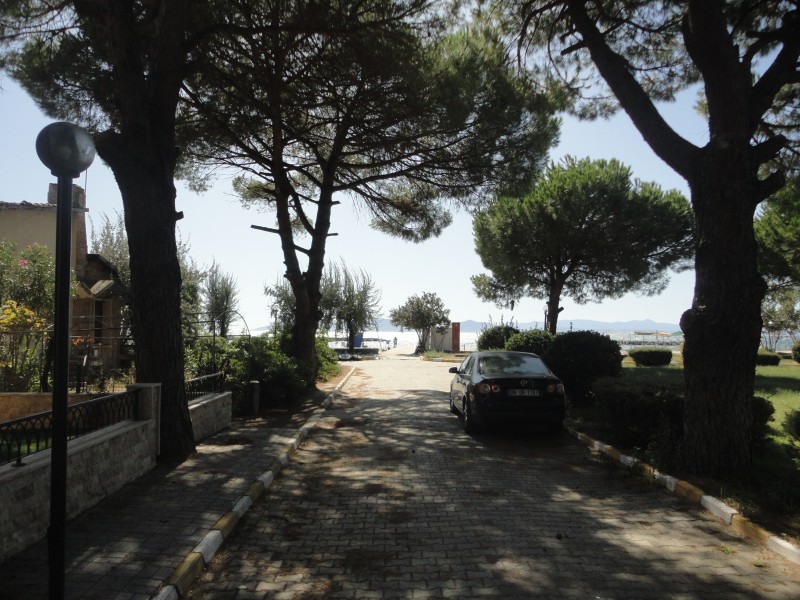
Road to beach, shaded by pines

Continue reading

On Chapman’s Homer’s Iliad, Book XX

The Wikipedia article “Superhero” traces the word itself to “at least 1917,” giving “such folkloric heroes as Robin Hood” as “Antecedents of the archetype.” I don’t know why Achilles should not be considered as an antecedent. According to the opening description,

A superhero is a type of heroic stock character, usually possessing supernatural or superhuman powers, who is dedicated to fighting the evil of their universe, protecting the public, and usually battling super-villains.

Achilles has superhuman powers; he has supernatural powers, when aided by the gods; and now in Book XX of the Iliad, as far as the Greeks are concerned, he is fighting the evil of their universe. However, the Trojans are not evil in Homer’s universe. There is no Manichaean principle of evil, and much less is Achilles personally devoted to fighting it.

Nonetheless, Book XX would seem to be a battle of the superheroes.

Spreading pine branches
The scene from where I read as the sun went down

Continue reading

On Chapman’s Homer’s Iliad, Book XIX

Book XIX of the Iliad consists mostly of speeches.

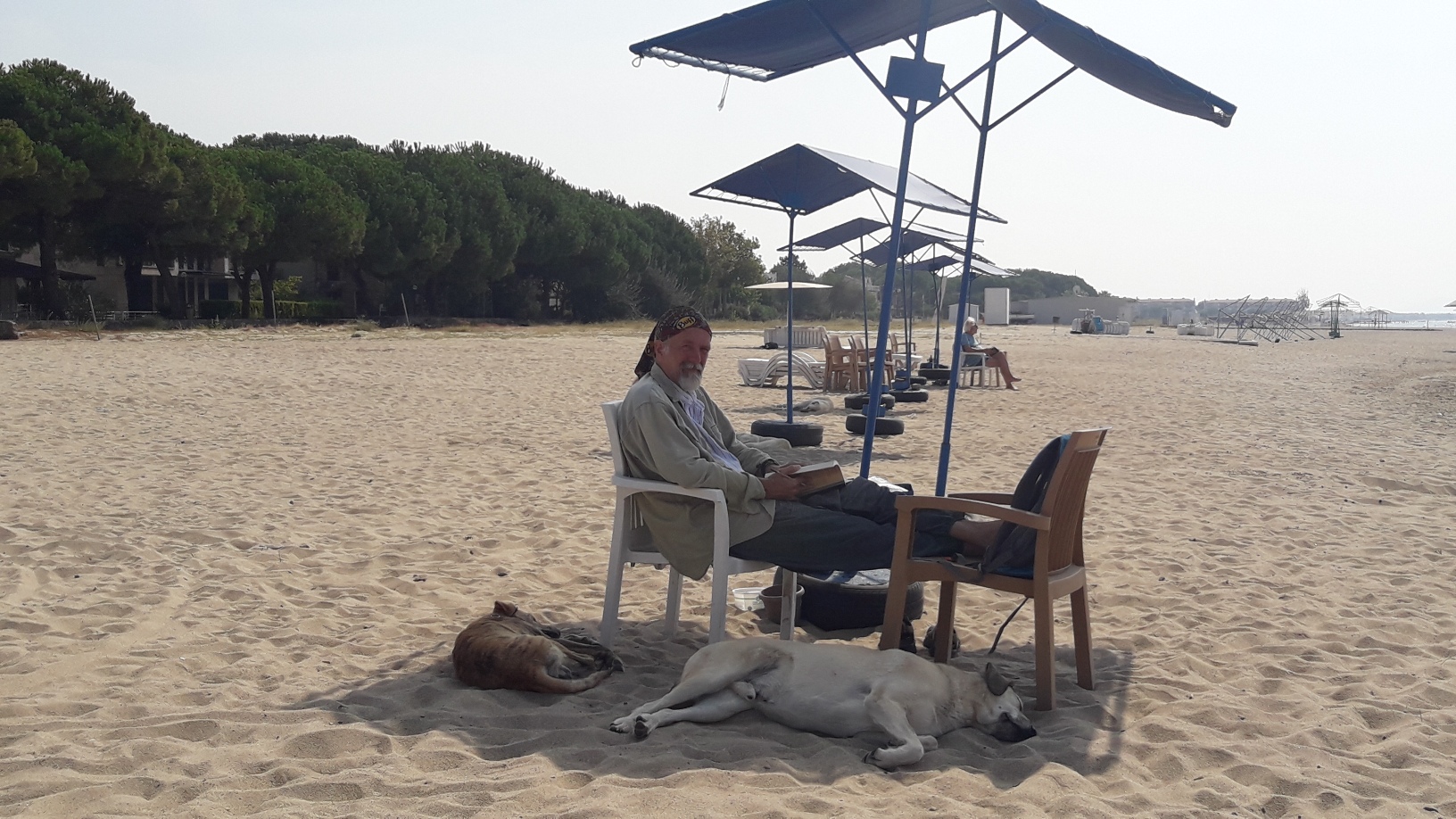
Myself on the beach with dogs, pines behind

Continue reading

On Chapman’s Homer’s Iliad, Book XVIII

I analyze Book XVIII of the Iliad into seven scenes.

Branches against sky

Continue reading

On Chapman’s Homer’s Iliad, Book XVII

Book XVI of the Iliad ended with the death of Patroclus; Book XVIII will begin with Achilles’s learning of the death. Book XVII gives us the fight over the body.

Dogs in the shade on the beach in the waning summer

Continue reading