Category Archives: Poetry

On Chapman’s Homer’s Iliad, Book V

Index to this series | Text of Chapman’s Homer’s Iliad

Book V of the Iliad is long and rich, with lots of characters like War and Peace, and stories within stories. The main story is of Tydeus’s son Diomedes, who with Pallas’s help is able to wound both Venus and Mars – I follow Chapman in using the Roman names.

  • Mars agrees with Minerva not to interfere with the war, but she immediately breaks the agreement.
  • A skilled hunter is successfully hunted down.
  • An oracle is mentioned that the Trojans should not go to sea; the master builder of Paris’s ships is slain.
  • A man who can read the future in dreams is bereft of the sons he let go to war.
  • An old man loses his only sons, the offspring of his old age.
  • Having broken the truce and shot Menelaus, Pandarus turns out to have left his horses in Lycia, because he didn’t think they would eat well in Troy.
  • The story is mentioned twice of the horses of Aeneas, offspring of the horses of Jove.
  • Pandarus thinks he cannot command the horses of Aeneas better than Aeneas.
  • Venus is not the first deity to have been injured by a mortal, and her mother Dione advises patience.
  • “He that fights with heaven hath never long to live,” or perhaps to have a faithful wife, she says.
  • She can cure a wound without balm.
  • “The race of gods is far above men creeping here below,” says Apollo to Diomedes.
  • Sarpedon discusses justice and sets an example of it.
  • “Strength is but strength of will,” says Agamemnon.
  • To have self-confidence may be good, but not to tempt fate.
  • Pallas has a theory of just war.

Continue reading

On Chapman’s Homer’s Iliad, Book IV

Index | Text

The gods confer. The humans can make war or peace; which shall it be? Juno insists on war, so that Troy can be punished. When Jove objects, Juno offers up her most beloved Greek cities in return.

  • Mycenae,
  • Argos,
  • Sparta

– let Jove destroy them at will, if only Pallas be sent to induce one of the Trojans to break the truce.

Dog in the square shadow of an umbrella on a beach where there are other umbrellas, but no humans
Altınova (Golden Plain), Balıkesir (Paleocastron), 2017.08.31

Continue reading

On Chapman’s Homer’s Iliad, Book III

Index | Text

The Iliad is about the feud between Achilles and Agamemnon, a feud that occurs during the Trojan War. Book III of the Iliad has nothing to do with Achilles, a little to do with Agamemnon, and everything to do with why the whole war is happening at all.

Note added August 19, 2024: The war is happening because Paris is God’s gift to women. By his own account, he is excellent in the “gifts of peace,” and these are “as little to be scorn’d, / As to be wonne with strength, wealth, state …” It is good to recognize that some things cannot be obtained by “strength” or force. Achilles recognizes this in Book I when he refrains from killing Agamemnon. However, Paris scorns not only strength, but also wealth and state. I suppose it is “state” that lets Hector and Agamemnon come to an agreement about a duel between Paris and Menelaus that will end the war. Paris breaks the agreement by running away to visit the prize of his excellence, namely Helen. Homer has Venus spirit Paris away, but I take this to be a poetic embellishment, agreeing with Eva Brann in Homeric Moments: Clues to Delight in Reading the Odyssey and the Iliad (Paul Dry Books, 2002; pages 41–3):

But the gods’ face-off effects nothing; at least nothing happens that could not happen without them. And so it is always; Zeus himself disclaims responsibility for human fate right at the beginning of the Odyssey


To be sure, as I said above, nothing is ever done that could not have been done by the humans themselves …

Photo of the tower of books used for this article

Continue reading

On Chapman’s Homer’s Iliad, Book II

Index | Text

Even gods must sleep; but under the weight of his responsibility to Thetis, Zeus cannot. As Achilles pointed out in Book I, “dreams are often sent from Jove”; now we shall have a case in point (Chapman’s lines 4–7).

… Al waies cast; this coūsel seru’d his mind
With most allowance: to dispatch, a harmefull dreame to greet
The king of men; and gaue this charge: Go, to the Achiue fleet,
(Pernicious dreame) …

Continue reading

On Chapman’s Homer’s Iliad, Book I

This post, originally of April 14, 2017, is the first of twenty-four, one on each book of Homer’s Iliad in Chapman’s translation.

A later series began on November 29, 2022. Again there was a post on each book of the Iliad, but now I was reading Murray’s translation in the Loeb Classical Library.

Achilles banefull wrath” is to be resounded by the Goddess, whom the poet invokes.

Strife between Achilles and Agamemnon is the story of the Iliad. It begins with Apollo, who has plagued the Greek army.

Homer denies no human responsibility. Apollo has plagued the army, because Agamemnon insists on keeping a man’s daughter as his slave. The woman’s father is a priest of Apollo called Chryses; we shall come to know the daughter’s name only as Chryseis. She has been taken in a Greek raid on her home town, which will be called Chrysa. We shall hear more about the raid later in Book I, when Achilles tells the story to his mother.

Thus Homer’s narrative is not sequential. In a technique that will become standard in literature, we start in medias res.

Continue reading

Homer for the Civilian

The sources of this essay (originally posted April 8, 2017) are an earlier one, written as an email in 2009, and a conversation that ensued it, on the theme of what Homer may mean in one’s life, and whether an application to one’s life involves an abuse of the original text. I wrote on this blog, in July 2016, on analogies in Homer and elsewhere, in “Thinking & Feeling.” My last post considered an apparent instance of abuse of the Hebrew Bible.

At the end of the Iliad, to retrieve the body of Hector from its killer, King Priam of Troy visits Achilles in his tent in the evening, in the camp of the hostile Greeks. The scene may recall two political enemies from the 1980s, President Ronald Reagan and Congressman Thomas O’Neill, Speaker of the House: these two were able to be on friendly terms “after 6 PM.”

Homer, Iliad, Wordworth edition
Aleksandr Andreevich Ivanov
“King Priam begging Achilles for the Return of Hector’s Body,” 1824
Tretyakov Gallery, Moscow

Continue reading

Confessions

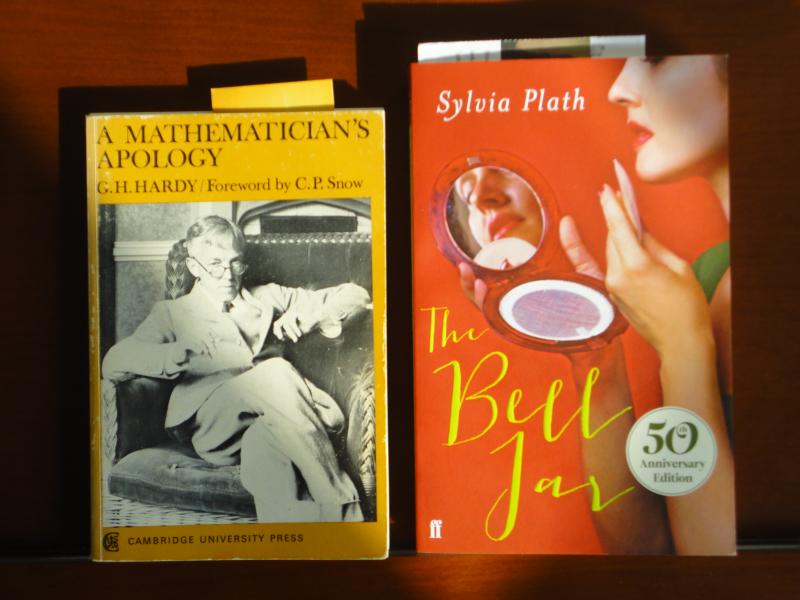
This is about G. H. Hardy and Sylvia Plath: Hardy quâ author of A Mathematician’s Apology (1940); Plath, The Bell Jar (1963).

Photo: the Hardy and Plath books

I first read Plath only recently, after encountering The Bell Jar by chance in the Istanbul bookshop called Pandora. After I finished reading it next day in Espresso Lab on İstiklâl, a woman who had earlier been speaking Turkish asked in English to look at the book. She pondered the front and the back before handing the book back to me. When I asked whether she knew of it, she simply said yes. She may not have understood my meaning; but I did not put her English (or my Turkish) to the test. Had she been made curious by the cover, showing a woman applying powder with the aid of a compact mirror? Did that cover accurately reflect the novel?

On an airplane once I was reading a paperback whose cover displayed a painting of ruins beneath the Acropolis of Athens. “I love historical fiction!” gushed a flight attendant. The term might be stretched to cover what I was reading; but it was the Oxford World’s Classics edition of Plato’s Republic.

Plato’s Republic

I had first read Hardy’s Apology in high school, thanks to the suggested reading at the end of Spivak’s Calculus. A couple of weeks ago, I somehow found a blog that took its title from the end of Hardy’s opening paragraph. That paragraph reads:

It is a melancholy experience for a professional mathematician to find himself writing about mathematics. The function of a mathematician is to do something, to prove new theorems, to add to mathematics, and not to talk about what he or other mathematicians have done. Statesmen despise publicists, painters despise art-critics, and physiologists, physicists, or mathematicians have usually similar feelings: there is no scorn more profound, or on the whole more justifiable, than that of the men who make for the men who explain. Exposition, criticism, appreciation, is work for second-rate minds.

The blog was called just that: Second Rate Minds. “We quote Hardy with irony,” says one of the two creators,

because we do not agree with him.

I believe there is great importance in communicating mathematics as widely as possible. I think it is important that children are encouraged to enjoy mathematics so that they might take further interest in the subject. Equally important is the view of mathematics held by the general public. Despite Hardy’s disdain for applications, mathematics nevertheless pervades the modern world and benefits from society valuing its role.

This is all fine; except I wonder if the writer has been corrupted by the same culture that made Hardy into somebody he found himself in disagreement with. This is the culture of judging people against one another, in order to rank them. Hardy gives a hint of this culture in the closing section of his essay:

I cannot remember ever having wanted to be anything but a mathematician. I suppose that it was always clear that my specific abilities lay that way, and it never occurred to me to question the verdict of my elders. I do not remember having felt, as a boy, any passion for mathematics, and such notions as I may have had of the career of a mathematician were far from noble. I thought of mathematics in terms of examinations and scholarships: I wanted to beat other boys, and this seemed to be the way in which I could do so most decisively.

I do not remember just what I thought of Hardy’s Apology in high school. I was at a school for boys, where I won prizes for mathematics and other subjects. I did not wish to emulate Hardy, either in pursuing just one thing, or in trying to beat others at it. Nonetheless, at the end of my freshman year at St John’s College in Annapolis, I bought my own copy of Hardy’s Apology in the College bookshop. The manager remarked that the book had decided her against pursuing mathematics. She had had dreams of doing good for the world; by Hardy’s account, mathematics was about personal glory.

I did want to do mathematics, as I ultimately understood. But this final understanding came after four more years: three in college, and one at large. I was working at a farm when I understood in a dream that I must learn modern mathematics. I cannot say that Hardy had any role in this, one way or other. Still, I would suggest now that, if Hardy does discourage you from pursuing mathematics, this may be just as well. You will have to focus like a laser if you want to do mathematics; you will be judged mercilessly, as mathematical truth is merciless; and you will suffer self-doubt, when it seems that the hardest you can work is still not good enough.

I am sorry that Hardy continued to be preoccupied with comparing himself to others:

I still say to myself when I am depressed, and find myself forced to listen to pompous and tiresome people, ‘Well, I have done one the thing you could never have done, and that is to have collaborated with both Littlewood and Ramanujan on something like equal terms.’

At least Hardy can accept that he was not quite at the level of his two collaborators. The mathematician must guard against all illusions.

In the end, I say, think what you like about Hardy; but give him credit for giving us a window into his life. Reading his essay yet again, I am impressed by the clarity and rhythm of the language, and by the frankness of the writer.

Sylvia Plath reminds me of Hardy. This is not because she ultimately gives up her virginity to a mathematician, at least in her novel. Like Hardy, she appears early on as an unpleasant person.

Plath’s character Esther proposes to Doreen that they ditch a party and have drinks with a man who wears cowboy boots and a lumber shirt. Doreen agrees to go up to Lenny’s apartment, as long as Esther will go. In the apartment, Doreen asks Esther to stick around. Still, Esther slips out; and back at the hotel, when a drunken Doreen pounds on her door, Esther won’t let her in. She allows Doreen to pass out in the corridor, since she won’t remember the incident anyway.

Maybe this was all part of the Girls’ Code, though it would seem to be a violation. Esther did not seem very nice to me. But then, trying to kill yourself is not very nice either, and Esther will do this repeatedly. There is a lot to investigate and contemplate here, including an academic system that squeezed both Plath and Hardy. It is odd that a bell jar is a place where the pressure is taken off. Now I want just to appreciate both Plath and Hardy, for laying themselves bare.

Written January, 2017. Revisited August 27, 2022. Later in 2017, I wrote more about Plath (and a little more about Hardy) in “Women and Men.”

Thinking & Feeling

This essay is written as a distraction from current events, though I make some reference to them. I am prompted by questions of analogy provoked by

  1. the similes of Homer and
  2. a recent theater review in Harper’s that mentions the parables of Jesus.

With sea in the background, on the sand of a beach sits Chapman’s Homer: The Iliad, the cover featuring a 16th-century Flemish tapestry (framed by a circle), Scene from Roman History, showing a number of men, the one in the middle armored; a horse is in the foreground

Continue reading

35th Istanbul Film Festival, 2016

After a preamble on freedom, this is an account of nine movies in three parts.

This part:

  • Thirst

  • Rain the Color of Blue With a Little Red in It

  • Fire at Sea

Part 2:

  • The Demons

  • The Music of Strangers: Yo-Yo Ma and the Silk Road Ensemble

  • Florida

Part 3:

  • Interruption

  • Under the Sun

  • News from Planet Mars

Photo of books referred to in this article

In the summer of 1994, I was a graduate student at the University of Maryland, and I had lived in the state since 1989. My roommate in a suburban apartment complex was finishing her own degree and moving away. I decided to move across the border into the city of Washington, where I had already become involved in some bicycle activism. I found a congenial vegetarian group house. I would bicycle the nine miles to the College Park campus. But moving to the city raised a moral question: should I really give up my political right to a meaningful vote?

Continue reading

Turks of 1071 and Today

Skip to Michael Attaleiates on Alparslan after the Battle of Manzikert

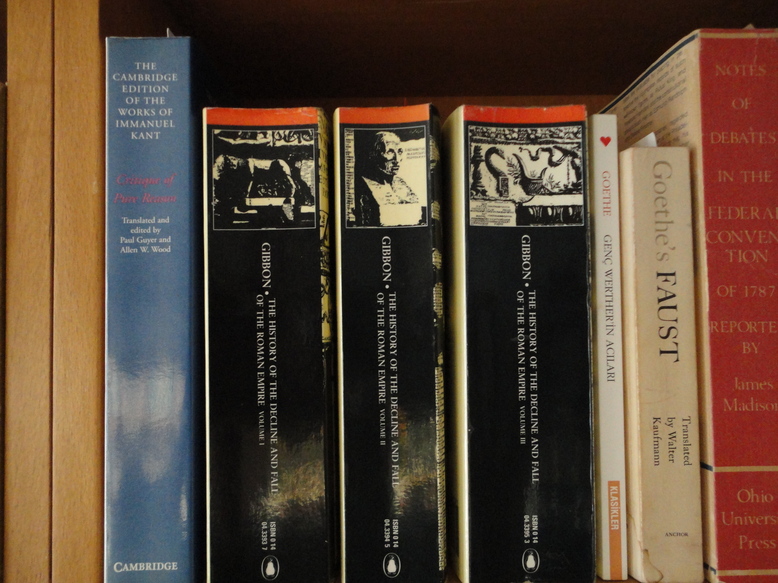
Published in six volumes between 1776 and 1788, Edward Gibbon’s History of the Decline and Fall of the Roman Empire tells the story of a thousand years and more, from before the founding of Constantinople in 330 till after its loss in 1453. Gibbon can be ridiculed for his title: a millenium is a long time to be in decline. The three thick volumes of the Penguin edition took me a long time to read, if not quite as long as Gibbon took to write. I was living in Ankara at the time, but I enjoyed being able to read Gibbon’s work also while visiting the three old imperial capitals: Istanbul, Rome, and Milan.

Gibbon’s Decline and Fall on my shelves (which are arranged according to date of birth of author)
Gibbon’s Decline and Fall on my shelves
(which are arranged according to date of birth of author)

Continue reading