Category Archives: Euclid

Victor Vasarely

Tophane-i Amire
Tophane-i Amire, 2017.03.25

Last week I wrote about the Turkish Impressionist Feyhaman Duran, born in 1886. Now my subject is the Hungarian-French Op Artist born twenty years later as Győző Vásárhelyi. His “Rétrospective en Turquie” is at the Tophane-i Amire Culture and Art Center in an Ottoman cannon foundry.

Vasarely show Continue reading

The geometry of numbers in Euclid

This is about how the Elements of Euclid shed light, even on the most basic mathematical activity, which is counting. I have tried to assume no more in the reader than elementary-school knowledge of how whole numbers are added and multiplied.

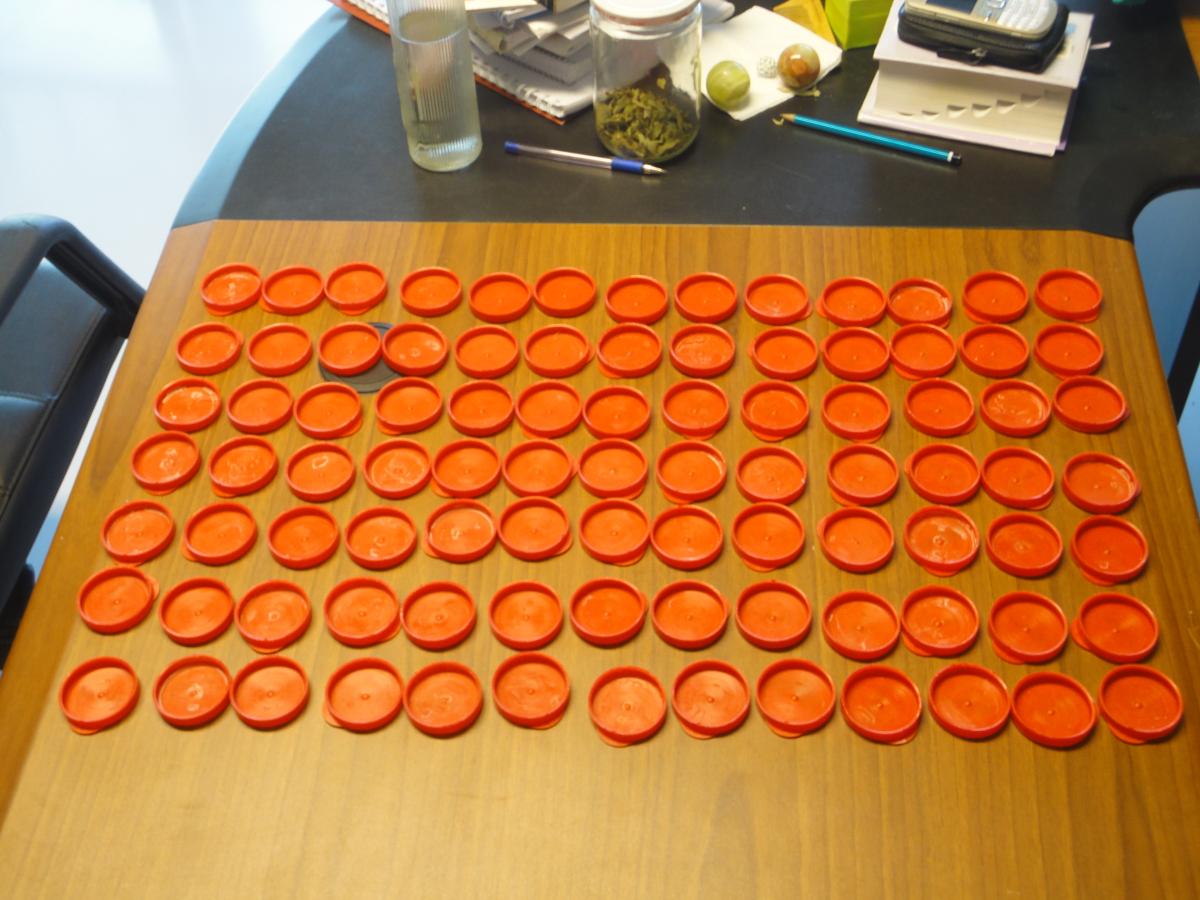
How come 7 ⋅ 13 = 13 ⋅ 7? We can understand the product 7 ⋅ 13 as the number of objects that can be arranged into seven rows of thirteen each.

Bottlecaps arranged on a desk in seven rows, thirteen columns
Seven times thirteen

If we turn the rows into columns, then we end up with thirteen rows of seven each; now the number of objects is 13 ⋅ 7.

The same bottlecaps, now seen from another side as thirteen rows, seven columns
Thirteen times seven

Continue reading

Thales of Miletus

This is about Thales of Miletus and what it means to study him. I am moved to ask what history is in the first place. It is a study of the freedom in which we face our conditions. Thales had his way of understanding the world, and we may benefit from trying to learn it.

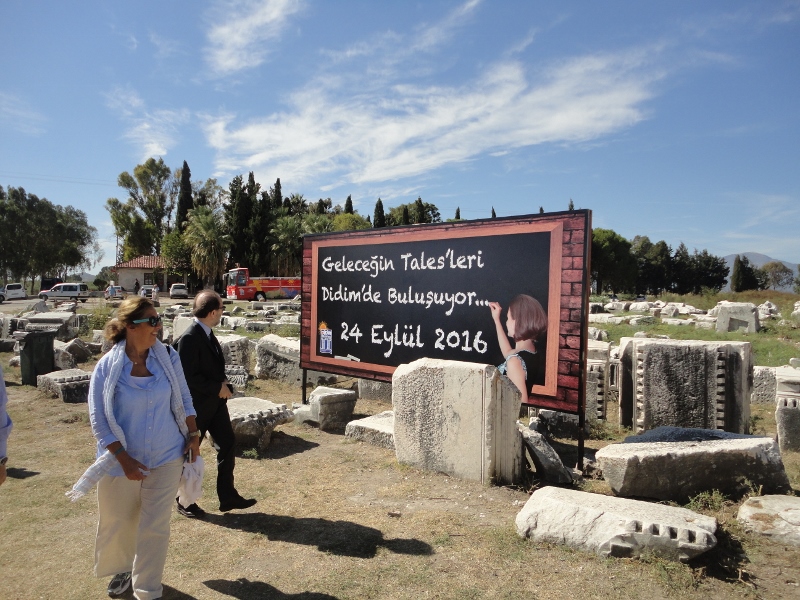
“The Thaleses of the future are meeting in Didim, September 24, 2016”

“The Thaleses of the future are meeting in Didim,
September 24, 2016”

Continue reading

Equality Is Not Identity

I want to record here an account by Collingwood of Aristotle’s theory of knowledge. The passages quoted below are relevant, both to something I have learned from reading Euclid with students, and to the considerations of consciousness that led to my recent article “Body and Mind.”

Continue reading

The Peace of Liberal Education

The wall of Dolmabahçe Sarayı, January 11, 2015

The wall of Dolmabahçe Sarayı, January 11, 2015

The occasion of this article is my discovery of a published Turkish translation of Collingwood’s Speculum Mentis or The Map of Knowledge (Oxford, 1924). Published as Speculum Mentis ya da Bilginin Haritası (Ankara: Doğu Batı, 2014), the translation is by Kubilay Aysevenler and Zerrin Eren. Near the end of the book, Collingwood writes the following paragraph about education, or what I would call more precisely liberal education. The main purpose of this article then is to offer the paragraph to any reader who happens to stop by.

Continue reading

NL III: “Body As Mind”

Index to this series

In Chapter I of The New Leviathan, we stipulated that natural science, the “science of body,” must be free to pursue its own aims. But we ourselves are doing science of mind, and:

1. 85. The sciences of mind, unless they preach error or confuse the issue by dishonest or involuntary obscurity, can tell us nothing but what each can verify for himself by reflecting on his own mind.

All of us can be scientists of mind, if only we are capable of reflection: Continue reading

NL I: “Body and Mind”

Index to this series. See also a later, shorter article on this chapter

The Chapter in Isolation

“Body and Mind” is the opening chapter of Collingwood’s New Leviathan. The chapter is a fine work of rhetoric that could stand on its own, though it invites further reading. In these respects it resembles the first of the ten traditional books of Plato’s Republic, or even the first of the thirteen books of Euclid’s Elements. The analogy with Euclid becomes a bit tighter when we consider that each chapter of The New Leviathan is divided into short paragraphs, which are numbered sequentially for ease of reference.

Continue reading

The Tradition of Western Philosophy

Note added October 16, 2018: Here I compare two projects of re-examining the philosophical tradition named in my title. The projects are those of

  • R. G. Collingwood in An Essay on Philosophical Method (Oxford, 1933);

  • Stringfellow Barr and Scott Buchanan at St John’s College in Annapolis, Maryland, beginning in 1937.

I review

  • how I ended up as a student at St John’s;

  • how Collingwood has been read (or not read) by myself and others, notably Simon Blackburn;

  • how Collingwood’s Essay is based on the hypothesis of the “overlap of classes.”

Continue reading

Psychology

Preface (January 17–18, 2019). This essay is built around two extended quotations from Collingwood:

  1. From the posthumous Idea of History (1946) with the core idea, “people do not know what they are doing until they have done it.”
  2. From An Essay on Philosophical Method (1933), about how logic is neither a purely descriptive nor a purely normative science.

The quotations pertain to the title subject of psychology for the following reasons.

  1. Psychological experiments show that we may not know what we are doing until we have done it.
  2. Psychology is a descriptive science.

Psychological experiments can tell us about what we do, only when we presuppose the general applicability of their findings. This is true for any descriptive science. Philosophy demands more. A philosophical science like logic is categorical, in the sense of the second listed quotation, because it is what Collingwood will later call criteriological. I go on to discuss criteriological sciences as such in “A New Kind of Science,” but not here.

Continue reading

Learning mathematics

This is mostly reminiscences about high school. I also give some opinions about how mathematics ought to be learned. The post originally formed one piece with my last article, “Limits.”

I learned calculus, and the epsilon-delta definition of limit, in Washington D.C., in my last two years at St Albans School, in a course taught by a peculiar fellow named Donald J. Brown. The first of these two years was officially called Precalculus Honors, but some time in that year, we started in on calculus proper.

Continue reading