Category Archives: Collingwood

Concerning the philosopher R. G. Collingwood (1889–1943). Many if not most of my posts concern Collingwood somehow, so this category may not be of much use. See Articles on Collingwood for some articles by other persons

Reading and Talking

Reading a book as if it had “no introduction, no notes, no aids or guides, no nothing but the naked text” (as William Deresiewicz puts it): such a reading seemed to need a defense. Here is my elaborate one, which seemed in the end to fall into nine sections as summarized below.

Let me note first that searching on “ahistorical reading” led me to a textbook chapter called “What Is Ahistorical Reading?” (in Intro to Poetry, by Alan Lindsay and Candace Bergstrom). The chapter seems to say well what every high-school graduate ought to know, though unfortunately they may not in fact. If you don’t want to slog through what I wrote, read that.

1. Some Novels and Novelists.
These may be read in school or for pleasure – mine, or that of writer and blogger Hai Di Nguyen. There can be epics such as War and Peace, Moby-Dick, and Zen and the Art of Motorcycle Maintenance. George Steiner finds the last two comparable. There can be an unreliable narrator.
2. Reading Comprehension.
This may be challenged by some poetry, such as Wordsworth’s, and annotations may not help.
3. Reading Without Preconceptions.
St John’s College accustomed me to this.
4. Reading Groups.
There are many that (thanks to the Catherine Project) I have been able to join and enjoy, all pursued in the St-John’s way as I understand it.
5. Story.
Mythos or logos. We inevitably tell it in our own words (unless perhaps somebody else has fed us the words).
6. Giving What Is Wanted.
“Ask me no questions, and I’ll tell you no fibs.” (To Goldsmith’s comedy She Stoops to Conquer, the saying is traced by Grammarist, which however has “lies” for “fibs”; Wikipedia currently repeats this apparent misquotation, citing Grammarist.) People are trained now to give most of their attention to their mobiles; in school we may be trained to supply what teachers want to hear.
7. Historicism.
I continue not to understand the objection of Leo Strauss to the “historicism” of R. G. Collingwood, but I agree with such ahistorical reading as is practiced at St John’s and was defended in my day (as I recall) by Strauss’s student and my teacher, David Bolotin.
8. The Classics.
There is something to be said for being assigned to read what one might not otherwise. My example is John Donne.
9. Re-Enactment.
Collingwood came to understand history as the re-enactment of thought, but this can be misunderstood, either when reading a poet such as John Donne, or when thinking of a certain major general who happened to read poetry while getting ready for battle.

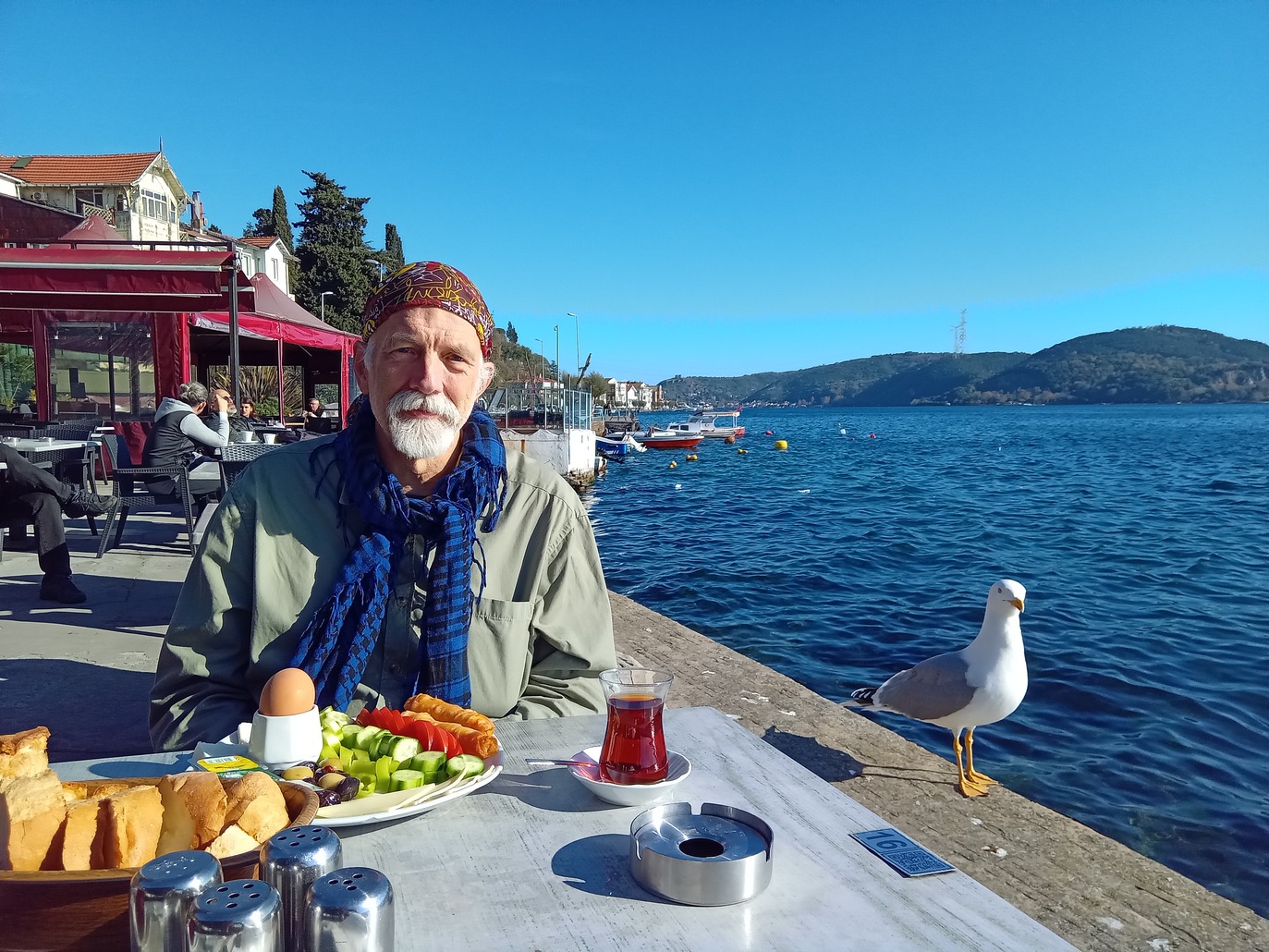
Seaside on a sunny day. Seagull, and human with tea and breakfast plate in front of him

Beyazpark Liseliler Kafe
Sarıyer, Istanbul
November 25, 2025

Continue reading

The System

After sitting behind his father on a motorcycle for a day, and riding through a thunderstorm, Chris Pirsig wants to tell and hear ghost stories. He asks whether his father believes in ghosts.

Clear blue sky above; below, a sand beach, with a strip of sea visible; on the left, a brick road parallel to the shore passes in the distance through trees

Altınova, September 10, 2025

Continue reading

Prairie Life

I’m going to make some comparisons here, even some likenings, mainly between

  • Robert Pirsig, Zen and the Art of Motorcycle Maintenance (1974), especially chapter 2, and
  • Wendell Berry, “Conservation is Good Work” (Sex, Economy, Freedom & Community, 1993; reprinted in Essays 1993–2017, Library of America, 2019).

Pirsig recounts a motorcycle trip west from Minnesota across the prairie. The riders pass through Yellowstone National Park, but Pirsig does not like it. At least his former self did not like it. This is in chapter 12 of ZAMM:

The guided-tour attitude of the rangers angered him. The Bronx Zoo attitudes of the tourists disgusted him even more … It seemed an enormous museum with exhibits carefully manicured to give the illusion of reality, but nicely chained off so that children would not injure them.

For Berry, such parks set the wrong standard for what should be conserved:

Right at the heart of American conservation, from the beginning, has been the preservation of spectacular places. The typical American park is in a place that is “breathtakingly” beautiful or wonderful and of little apparent economic value. Mountains, canyons, deserts, spectacular landforms, geysers, waterfalls – these are the stuff of parks. There is, significantly, no prairie national park.

I do see that Tallgrass Prairie National Preserve was created in Kansas in 1996.

A number of roses in three groups on canes sharing a root, against ground covered with pine needles; the shadow of a tree trunk divides the scene diagonally

Roses in the garden
Altınova, Ayvalik, Balıkesir
September 2, 2025

Continue reading

Removal

This is about metaphor.


Handwritten sign in shop window: ΜΕΤΑΦΕΡΘΗΚΑΜΕ …
Shop window in Athens, Monday, July 10, 2017:
ΜΕΤΑΦΕΡΘΗΚΑΜΕ
ΔΙΠΛΑ ΣΤΟ 46Α

ΤΑΚΗΣ
Μεταφερθήκαμε is the first-person plural passive aorist of μεταφέρω. I guess the meaning of the sign is, “We moved next door to 46A – Takis.” I took the photo, just so I could use it at a time like this. I didn’t try to talk with Takis.

Continue reading

Subjective and Objective

The use of a distinction between the subjective and the objective has sometimes made me suspicious. The suggestion is made here that Gödel’s Incompleteness Theorem relies on the distinction. I shall look at this more in “Gödel and AI.” Meanwhile, the major sources for the present post are the following.

  1. William James, Psychology: Briefer Course (1892), on “the stream of thought, of consciousness, or of subjective life” – also on
    • nerves as telephone lines;
    • emotions as resulting from “a physical effect on the nerves.”
  2. C. F. von Weizsäcker, The Relevance of Science (1964), on how “Cosmogony … is, objectively speaking, the way in which the world came into being, or it is, subjectively speaking, the teaching about this way.”
  3. Robert Pirsig, Zen and the Art of Motorcycle Maintenance (1974), on whether quality is objective or subjective (the answer is no) – also on the distinction between the classical and the romantic.
  4. R. G. Collingwood, Speculum Mentis (1924), on
    • his usage whereby
      • what pertains to a consciousness is called subjective;
      • what the consciousness is of is called objective;
    • atoning for the Fall, that is, the separation of subject from object

    – also (in response to James) on how emotions don’t need a physical source.

  5. James Mumford, “Therapy Beyond Good and Evil: A nonjudgmental psychology is failing patients who need to hear hard truths” (perhaps the hard truths of the title are objective truths, and what the patients need to hear is that their own subjective evaluations of themselves may be wrong).
  6. William Egginton, “Why Kant Wouldn’t Fear ChatGPT-4” (for a computer, there is nothing beyond what it “knows” – all is subjective).
  7. Kurt Gödel, “On formally undecidable propositions of Principia mathematica and related systems I” (the Incompleteness Theorem relies on a distinction between a [subjective] statement and its [objective] meaning).
  8. Shannon Vallor, “The Thoughts The Civilized Keep” (they require labor, with a history).

Minor sources include the following.

  1. James Joyce, Ulysses, as presenting streams of consciousness.
  2. Sigrid Undset, Kristin Lavransdatter, as being more readable.
  3. Aristotle, Nicomachean Ethics and Physics, on how there is not deliberation about the cosmos, or the irrationality of √2, or how to build a ship.
  4. Jared Henderson, “How to read Aristotle’s Nicomachean Ethics.”
  5. C. S. Lewis, The Magician’s Nephew, where an iron bar grows into a lamp-post the way Aristotle imagines a log’s growing into a ship.
  6. a letter to Analog magazine on how religion is false science.
  7. Robert Pirsig, Lila, on the distinction between the static and the dynamic.
  8. Elle Hunt, “Octopus farming turns my stomach – but are some species really more worthy than others?”
  9. the Hebrew Bible (Psalms and Ezekiel) on eating words.
  10. Alexander Bevilacqua, “Saints for Supper” (a review of Jérémie Koering, Iconophages: A History of Ingesting Images).
  11. Jack A. Goldstone and Peter Turchin, “Welcome To The ‘Turbulent Twenties’.”
  12. David Allen Green, “‘Twelfth Night Till Candlemas’ – the story of a forty-year book-quest and of its remarkable ending.”

Having started last spring, my wife and I recently completed a project to read Ulysses together. I was glad to be able to put the book back on the shelf. It sits there, next to another of comparable length, Kristin Lavransdatter; this is because I order my books according to the birth of the writer (or subject), and James Joyce was born February 2, 1882; Sigrid Undset, May 5.

I read her book on my own, for and with pleasure, and it entered into my thoughts on the Nicomachean Ethics of Aristotle, expressed for example in “Impermanence” (on Book IX, chapters i–iii; the common theme was how children might forget their mothers, but not conversely; Maya Angelou recalled how many black women had nursed white children in America).


Three haloed figures in front of a fourth with spread arms and wings; faces are mostly scratched out
Karanlık Kilise (Dark Church), Göreme Open Air Museum
Cappadocia, January 11, 2009


Continue reading

Free Groups and Topology

My title alludes to some notes for the layperson that I rediscovered recently. I have reviewed and edited them, and they are below, in the following sections (linked to by the titles after the three main bullets; other links are to Wikipedia).

  • Quasicrystals,” based on an email of mine sent to a group of alumni of St John’s College on October 8, 2011. This was my contribution to a thread in which somebody said that
    • Dan Schechtman (whom she called Danny) was a worthy recipient of that year’s Nobel Prize in Chemistry for the discovery of quasicrystals, but
    • John Cahn deserved credit, even the prize itself, as the real discoverer.

    My wife and I had recently moved to Istanbul, and the Istanbul Model Theory Seminar had just got going. The Nobel Prize and quasicrystals had been mentioned there too.

  • Free Groups,” based on an email of October 10, 2011. I tried to describe free groups to somebody who expressed interest, but who also called himself the world’s worst mathematician.
  • Topology” – a draft of an attempt to describe that subject. In graduate school, I got excited about the definition of a topological space when I first encountered it. Here I try to motivate the definition by abstracting from the properties of the Cartesian plane as a metric space. I give the example of the Zariski topology on the same plane. I start to talk about the topology derived from the Gromov–Hausdorff metric on the space of groups with n generators, but then I stop.

A green landscape
Vegetable plot in Yeniköy (where Cavafy lived a while), Istanbul, Saturday, September 28, 2024

Continue reading

Tests

This post concerns different kinds of knowledge, as for example of Achilles, or Cyrus the Great, or even oneself.

According to the last sentence of the “Findings” column in Harper’s for June, 2023,

Researchers developed a blood test for anxiety, which was found to underlie the joy of missing out.

Those researchers need a weatherman to tell which way the wind blows.

Similar research is reported in the Guardian Weekly for 9 September, 2022. The article is called “‘I’m glowing’: How an app is helping us measure the joy of trees.” The app in question does not detect your joy in the woods; it gives you a way to record your own self-assessment for later study. However, writes Patrick Barkham,

several studies suggest that more biodiversity has a bigger boost on people’s mental health, while the recording of brain activity in response to forest density found a more relaxed state and reduced tension and fatigue in forests with a lower density of trees.

Are you going to need a brain scan to tell if you are chilling out? Other people may relax among a few trees; does that mean you will?

My grandfather Kenneth Crawford described his own grandparents’ house in Wisconsin as being

innocent of plumbing, central heat or telephone. But the proportions were good and it was set in a grove of assorted trees.

I wish he had named some of the trees in the assortment. Right now I’ve got doves cooing in the umbrella pines overhead. Beneath these are oleanders and laurels and pomegranate trees.

Pine trunk next to leaves and needles of other trees; white wall below

Continue reading

Rethinking

Last week, a student wrote me, “Is there going to be a proof question on the number theory exam?”

I answered,

As far as I’m concerned, the answer to every mathematical question is a proof, because everybody can check whether the answer is right.

I meant that the answer should provide the means for the reader to re-enact the answerer’s thought.

A bay seen from a hill across trees and houses, with green hills beyond (and heavier development at the top)
View from Büyükdere, Sarıyer, Istanbul
We live near the big building at Hacıosman
just over the horizon on the right
Sunday, June 30, 2024

Continue reading

Solipsism

Aristotle sets the example that Thomas Aquinas follows in the Summa. We are reading chapters viii and ix of Book IX of the Nicomachean Ethics. The Philosopher makes the best case against two positions that he ultimately argues for:

  1. One should be selfish.
  2. One needs friends anyway.

Highrise under construction above a green playing field
In “Sanity” I used a photo of the same skeletal building from the other side

Continue reading

Benefaction

Does this sound like Aristotle?

It might seem like it’s easier to love others than to love yourself, but it’s tough to build healthy relationships if you don’t love yourself first.

The sentence is from a WikiHow page, “How to Love Yourself: Treat Yourself Like Your Own Best Friend.” Back in in the 1970s, I thought something like it was an excuse for self-indulgence.

A cat on a path of fine gravel investigates the ornamental grass beside it
Atatürk City Forest
Wednesday, April 10, 2024

Continue reading