Does consciousness have a “physical basis” or “material basis”? I am provoked by the suggestion that it does; for the question itself is misleading, if not simply meaningless.
In the September, 2014, issue of Harper’s magazine, Edward O. Wilson begins an essay called “On Free Will” with the following paragraph.
Neuroscientists who work on the human brain seldom mention free will. Most consider it a subject better left, at least for the time being, to philosophers. Meanwhile, their sights are set on discovering the physical basis of consciousness, of which free will is a part. No scientific quest is more important to humanity. Everyone – scientists, philosophers, and religious believers alike – can agree with the neurobiologist Gerald Edelman that “[c]onsciousness is the guarantor of all we hold human and precious. Its permanent loss is considered equivalent to death, even if the body persists in its vital signs.”
When somebody tells me that nothing is more important than what is being talked about, or that everybody will agree to something, I become skeptical. If everybody will agree, then there is no need to point this out. There may indeed be universal agreement on the proposition that permanent loss of consciousness is death; but then this agreement has little practical value, since there is no universal agreement on whether permanent loss of consciousness is recognizable or even possible at all. Physicians can debate whether a particular comatose or vegetative patient will ever regain consciousness. There is the further question of whether a noncommunicative patient is truly unconscious. Finally, there are those people who believe they have eternal life, granted them by a deity who, as Genesis 2:7 says,
formed man of the dust of the ground, and breathed into his nostrils the breath of life; and man became a living soul.
For such believers, permanent loss of consciousness would seem to be impossible: we can all be restored to consciousness, if only on Judgment Day. We may wish to discount such beliefs; but then Wilson himself seems to retain a vestige of them. It is not clear what Wilson means by a “basis” of consciousness; but I think it must be different from consciousness itself, as the dust of the ground is different from the breath of life that God breathes into it.
Wilson quotes with approval the description of consciousness as a guarantor of something. What can this even mean? Is consciousness like Jesus, who is said to guarantee us eternal life? It is unfair to be critical of a person’s precise choice of words, without first trying to understand the overall point. But Wilson tempts me do it. According to Turkish politicians (among others), Muslims are provoked by the recent Charlie Hebdo cartoon of a sad bearded fellow in a turban. (See my previous article.) Likewise, I am provoked by Wilson’s fourth paragraph:
Philosophers have labored for more than two thousand years to explain consciousness. Innocent of biology, however, they have for the most part gotten nowhere. I don’t believe it too harsh to say that the history of philosophy when boiled down consists mainly of failed models of the brain.
Only an ignorant or willfully annoying person can say such a thing. The editors of Charlie Hebdo are willfully annoying. They may be ignorant too: I do not know. With his apologetic words, “I don’t believe it too harsh to say,” Edward O. Wilson may be trying to mitigate his acerbity. But then it is hard to believe that such a learned accomplished person as Wilson can be ignorant of philosophy.
Philosophical problems are not biological problems. The dialogue of Plato known as the Republic is a great work of philosophy, even today, despite its author’s ignorance of modern biology. The dialogue takes up the philosophical problem of δικαιοσύνη – what we translate as justice or morality. The dialogue starts out by showing the inadequacy of conventional beliefs, such as the belief voiced by Polemarchus, according to which justice – δικαιοσύνη – is doing good to friends and evil to enemies. What more the dialogue goes on to do is controversial. It may recommend fascism; or it may recommend the way of life that Jesus enjoined in the Sermon on the Mount (in Matthew 5:38–9):
Ye have heard that it hath been said, An eye for an eye, and a tooth for a tooth;
But I say unto you, That ye resist not evil; but whosoever shall smite thee on thy right cheek, turn to him the other also.
Of course Jesus did not actually speak the English of the King James Bible. He did not speak Greek either, at least not as a first language; but we have his words only from a Greek version as follows (transcribed from Barbara Aland & al., The Greek New Testament, Fourth Revised Edition, 2001):
Ἠκούσατε ὅτι ἐρρέθη, Ὀφθαλμὸν ἀντὶ ὀφθαλμοῦ καὶ ὀδόντα ἀντὶ ὀδόντος.
ἐγω δὲ λέγω ὑμῖν μὴ ἀντιστῆναι τῷ πονηρῷ· ἀλλ’ ὅστις σε ῥαπίζει εἰς τὴν δεξιὰν σιαγόνα [σου], στρέψον αὐτῷ καὶ τὴν ἄλλην·
Is the Nazarene’s advice good? This is not a biological question. One may try to make it into a biological question. One might assert for example that a correct answer requires a study of the evolution of our species. However, the advent of a biological theory of evolution means that we live in a different world from that of Plato and Jesus. Using their Greek words as I did above is a reminder of this. We see things differently now. Plato’s δικαιοσύνη is not our justice or morality, although there are similarities. But neither can our justice be described by the words, “survival of the fittest,” or some other formula derived from biological writings. At least, justice is not automatically or by definition this. In fact, though he is “innocent of biology,” Thrasymachus in the Republic asserts that justice is something like this, namely the interest of the stronger; but then Socrates causes his confusion to be revealed, and he blushes.
A biological question might be, Were Neanderthals of the same species as modern humans? Such questions might be thought to have great importance for understanding justice. According to a book review (David Quammen, “The Replacements: New evidence on the old mystery of the Neanderthals”) in the same September, 2014, issue of Harper’s that I have quoted Wilson from, it has been found by Svante Pääbo and his team that
between 1 and 4 percent of the DNA in modern Europeans and Asians has come down from ancestral interbreeding with Neanderthals. (Africans don’t show this hybridization, probably because Neanderthals never got to Africa.)
Racists might make use of this finding to argue the superiority of Europeans and Asians over Africans. But they could just as well argue the reverse. Or they could say that neither group of people is superior, but the two groups are different and should be kept distinct, as under apartheid. In any case, what the racists are talking about is not biology. Biological superiority or difference is not established by argument; it just happens. The species that survives is biologically superior to that which does not, by definition (if one actually wants a definition). Two populations of organisms are of the same species if they can interbreed and produce fertile offspring. None of this provides any guidance on whether two persons should be allowed to marry, or whether species ought to be saved from extinction.
New philosophical questions may be raised, because of our knowledge of biology. We understand now that species are not permanent, but can be extinguished. Species can be and have been extinguished by human action: the dodo and the passenger pigeon are classical examples. This causes us to face a question not contemplated by Plato: should we refrain from killing off other species? Biology gives us the question, but does not tell us how to answer it.
I return to the question of what a “physical basis” of consciousness can be. Wilson describes the “Brain Activity Map (BAM) Project, led by the National Institutes of Health,” which “has the goal of generating a map of the activity of every neuron in real time.” He goes on to say,
The basic goal of activity mapping is to connect all of the processes of thought – rational and emotional; conscious, preconscious, and unconscious; held still and moving through time – to a physical base. It won’t come easy. Bite into a lemon, fall into bed, recall a departed friend, watch the sun sink beyond the western sea. Each episode comprises mass neuronal activity so elaborate we cannot even conceive of it, much less write it down as a repertory of firing cells.
Obviously we do conceive of the action of biting a lemon. We might even flinch or salivate in doing so. These attendent responses can be conceived by others. What is impossibly difficult to conceive of is the brain, quâ physical object, of a person biting a lemon, as distinct from the brain of a person biting a peach, or solving an equation. I suppose it is just as hard to conceive of what distinguishes a living body from a dead one.
To solve the former problem, the Brain Activity Map is proposed. Most maps are smaller than the terrain that they are maps of: the map is needed because the terrain itself is too large. But one difficulty in understanding the brain is that neurons are too small. So it sounds as if the Brain Activity Map should be understood as a brain magnification, with neurons and their connections rendered large enough to see (or rendered in symbolic form that allows them to be seen with the mind’s eye).
Socrates proposes such a magnification in the Republic, leading his interlocutors to seek δικαιοσύνη in the city, rather than the person, since the city is larger. But if a person is like a city, then the citizens themselves will be like little cities, and so forth. What then can be explained by the analogy? The same problem of infinite regress occurs in Wilson’s essay. Wilson proposes that the brain (or the entire nervous system) is like a queen ant or termite, together with her swarm of workers. The subtitle of his essay is, “And how the brain is like a colony of ants.” An ant is not a person; but it is like a person, at least an unintelligent person:
Each worker on its own is relatively stupid. It follows a program of blind, untutored instinct, which is subject to only a small amount of flexibility in its expression.
We have seen Wilson describe free will as a “part” of consciousness. This part is provided by a “self”:
And what would that be? Where is it? The self does not exist as a paranormal being living on its own within the brain. It is, instead, the central dramatic character of the confabulated scenarios. In these stories, it is always on center stage – if not as participant, then as observer and commentator – because that is where all of the sensory information arrives and is integrated.
It is odd that Wilson denies that the self is a “paranormal being.” As far as science is concerned, there are no paranormal beings at all; nor can there be. Science does not prove this; for the paranormal is just what science can say nothing about. In any case, Wilson here describes the self as if it were a conscious mind; but it is supposed to be only part (albeit a central part) of a conscious mind.
The analogy to an ant colony is indeed potentially useful, but only in a way that Wilson does not make explicit. Regardless of our knowledge of science, we humans have a way of recognizing consciousness. If we can have a conversation with a person, then that person is conscious. Has Wilson had a conversation with an ant colony? Being an entomologist, perhaps he has. In that case, it would seem that consciousness does not have a physical basis, or at least not a particular basis. The brain in a skull may be conscious; but things with completely different physical properties may be conscious too. (You can distil an ant colony to obtain formic acid, but I am not aware that you can do the same with a brain.)
Now I have used Wilson’s word “basis.” I do not think it is the right word. A basis is a base: a support, a foundation. It holds something up. We can look at a coin from two sides; is one of these the basis of the other? We can perceive the coin in many ways: not only can we look at it, but we can feel it, we can heft it, we can hear it ring when we flip it in the air. We can even taste it: children are especially likely to do the last, or at least I can remember doing it as a child. Is the felt coin a “basis” for the tasted coin?
We might say rather that there is some physical object that is the basis for both the feeling and the taste of the coin. What can this mean? Perhaps the physical coin is just what can be analyzed scientifically. But there can be a chemical analysis (into gold and silver perhaps), a spatial analysis (describing the coin as roughly cylindrical, with certain deviations), a numismatical analysis (stating where the coin was minted and whose head is on it), and perhaps other analyses. Which analysis gives us the “real” coin? They all do.
By one analysis, a human being is a consciousness. By another, the human being is a body with a certain description, and in particular certain “vital signs.” Which is the real human? Either one is real.
If we want to know what a coin tastes like, without relying on childhood memory, we can put a coin in our mouth. If we have no coin at hand, we might use the known scientific analysis of coins to produce an object that should taste like a coin. But then the real proof will be in the tasting.
It may be a moral obligation to recognize consciousness where it exists. Since some seemingly unconscious persons turn out to be conscious, we want to treat them properly. The neurological research described by Wilson may help us do this, and this may justify Wilson’s assertion that “no scientific quest is more important to humanity.” The quest may give us the ears of Horton the Elephant, as put to use in Horton Hears a Who!
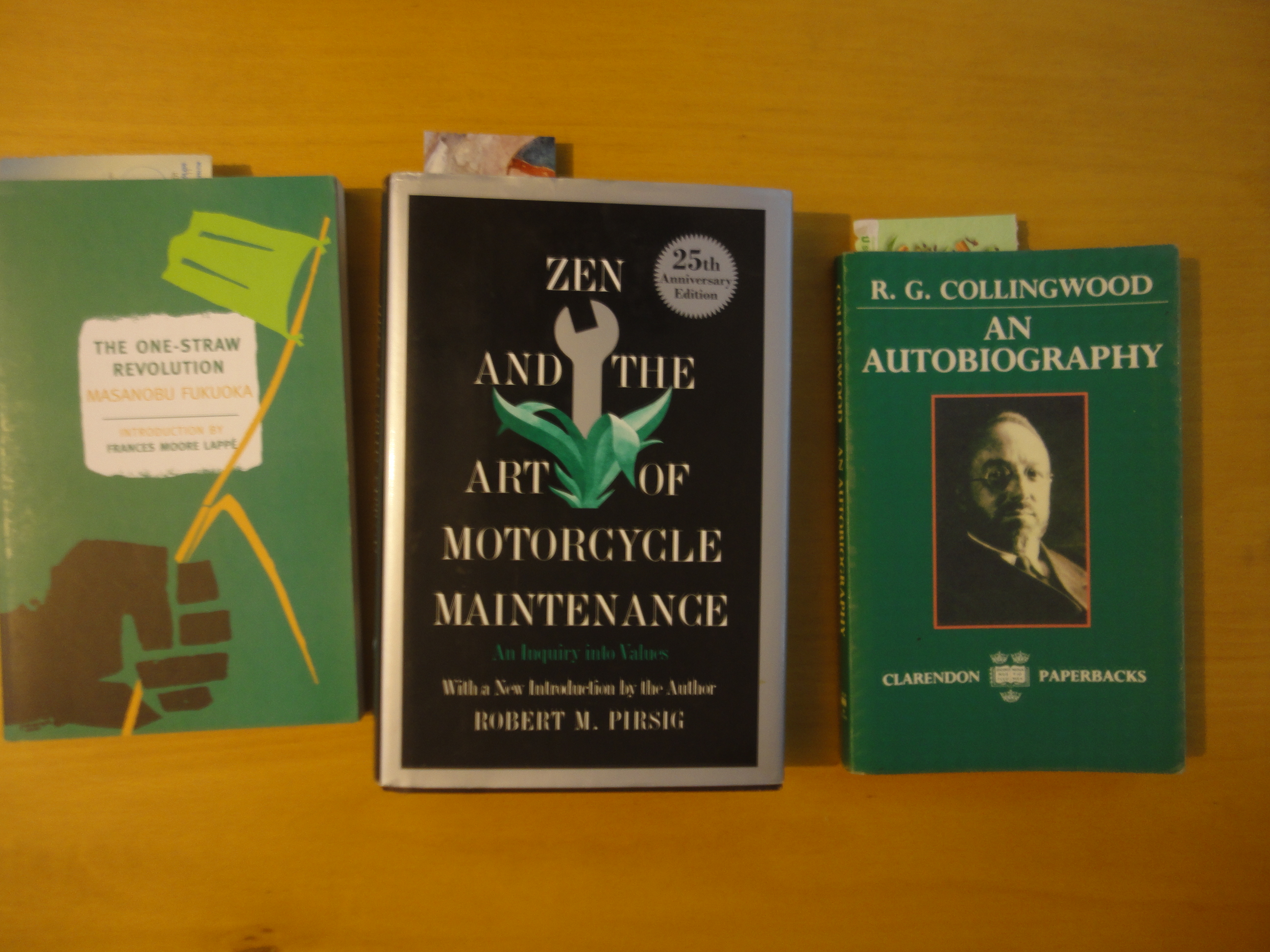
Perhaps the most important quest of all is simply to be conscious, or to be as conscious as possible. These are grand words, but perhaps ridiculous. In high school I liked a passage from Robert Pirsig’s Zen and the Art of Motorcycle Maintenance (ch. 25):
Other people can talk about how to expand the destiny of mankind. I just want to talk about how to fix a motorcycle. I think that what I have to say has more lasting value.
The point is to talk about something you can actually do. Part of being conscious is talking to other consciousnesses. It may be the only part of consciousness, in the sense that consciousness always involves talking at least to oneself, recalling memories and imagining possibilities. Such talking may not be done out loud. The invention of writing allows talking to be done across centuries. Talking to Plato may be as valuable as talking to ants.
Edited December 27, 2021 – and again on May 22, 2026, when I am returning to this post because of its discussion of the “Fifth Antithesis,” mentioned in “Antitheses”; today I am only converting unspaced em-dashes to spaced en-dashes, since the latter read better in a fixed-width font, and in any font they allow line breaks